Official source note
psm i anti patterns is the main focus of this page, and the safest way to study it is to keep the exam hub open while you work through the official facts and the service selection patterns. Scrum.org describes Professional Scrum Master™ I as a certification that validates practical cloud literacy, service selection, and scenario thinking. The main Cert Pass hub remains /exams/scrumorg-professional-scrum-master-i.
Exam facts
- Exam name: Professional Scrum Master™ I
- Exam slug: scrumorg-professional-scrum-master-i
- Vendor: Scrum.org
- Cert Pass landing page: /exams/scrumorg-professional-scrum-master-i
- Study hub: /exams/scrumorg-professional-scrum-master-i
- Official vendor page: Professional Scrum Master I
Why this article exists
The goal here is not to collect trivia. The goal is to build the habit of reading a scenario, identifying the category, and choosing the simplest service that directly fits the requirement.
Fast study map
Use the exam hub twice during review: /exams/scrumorg-professional-scrum-master-i and /exams/scrumorg-professional-scrum-master-i. Those internal links should act as the stable anchor for practice, revision, and final review.
Exam facts
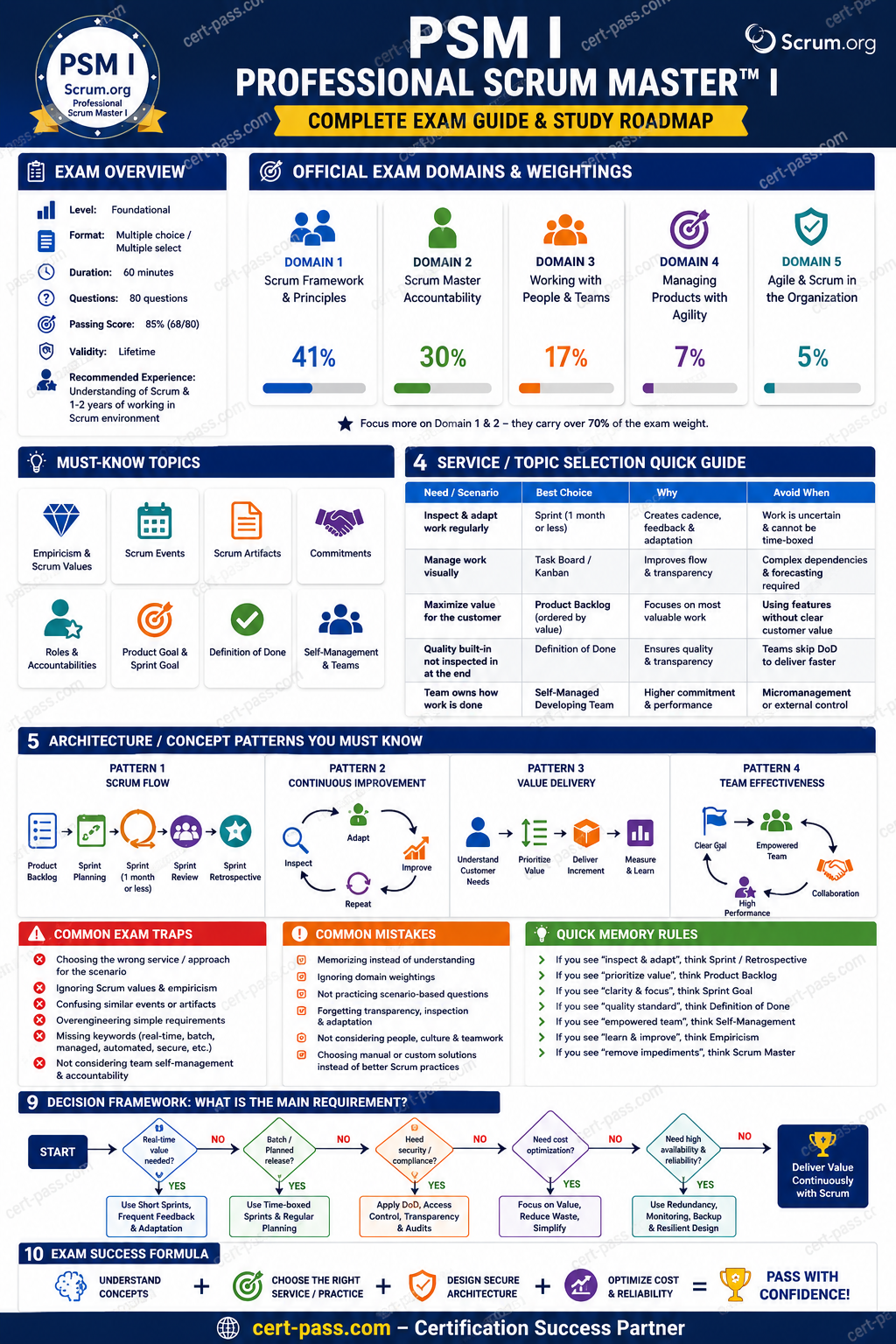
Exam code: PSM I Certification name: Professional Scrum Master I Vendor: Scrum.org Questions: 80 Time limit: 90 minutes Passing score: 70 percent Cert Pass access: Practice options start at 29.00 and complete access starts at 39.00 Landing page: Professional Scrum Master I
Domain breakdown
Understanding and Applying the Scrum Framework: 64 percent Developing People and Teams: 22 percent Managing Products with Agility: 14 percent
Overview
This anti pattern guide should help candidates understand how the Scrum Guide is tested in scenario form. The exam rewards careful reading, clear role awareness, and a strong sense of what Scrum allows, what it requires, and what it leaves open to the Scrum Team. The best preparation focuses on how the framework behaves in real situations rather than on memorizing isolated definitions.
What counts as an anti pattern
An anti pattern is a behavior that sounds professional but breaks Scrum in practice. The exam uses these patterns to test whether candidates can tell the difference between genuine Scrum behavior and familiar management habits that have been relabeled. The most common pattern is a role that starts managing instead of coaching.
Common anti patterns
- The Scrum Master assigns work or tracks individual performance
- The Product Owner writes detailed requirements for Developers
- The Daily Scrum becomes a status meeting for management
- The Sprint Review becomes a sign off gate
- The team separates testing into a later phase or later Sprint
- Stakeholders decide the Sprint Goal
- The Definition of Done is lowered to fit scope
- Velocity becomes a target for evaluation
- The team waits for permission instead of self managing
- Events are skipped when the team feels busy
Why these patterns fail
Each of these habits weakens transparency, inspection, or adaptation. Some of them make work invisible. Some of them slow feedback. Some of them hand control to the wrong role. In every case, the result is less empirical control and more process theater.
How to spot them quickly
Look for words like approval, assignment, management, sign off, gate, report, and compliance with a fixed plan. Those words often signal a wrong answer because Scrum prefers collaboration, inspection, and adaptation. Also look for answers that create sub teams inside the Scrum Team or treat the Sprint as a phase rather than a container for learning and delivery.
Corrective behavior
The correction is usually to restore role clarity, keep work transparent, and let the Scrum Team inspect and adapt. If the issue is quality, strengthen the Definition of Done. If the issue is priorities, review the Product Backlog. If the issue is progress, use the Daily Scrum for Developers. If the issue is a changing market, inspect at the Sprint Review and adapt the backlog.
Study note
Most wrong answers are not random. They are familiar habits that do not belong in Scrum. Once that is understood, the exam becomes less about trick detection and more about framework recognition.
Next step
Start with the landing page here: Professional Scrum Master I. It is the single best entry point for practice, topic review, and readiness checks.
Extended official revision notes
Scrum.org Professional Scrum Master™ I (PSM I) Compressed Exam Course
Source used: the provided PSM I practice question bank containing 1050 questions.
Vendor: Scrum.org
Certification: Professional Scrum Master™ I (PSM I)
Official exam style: time-boxed online assessment focused on Scrum Guide knowledge and practical Scrum application. Scrum.org lists the PSM I focus areas under Professional Scrum Competencies: Understanding and Applying the Scrum Framework, Developing People and Teams, and Managing Products with Agility.
1. Exam Overview
What the exam is testing
PSM I tests whether you understand Scrum as defined in the Scrum Guide and whether you can apply it in realistic team, stakeholder, product, and organizational situations. It is not mainly a memorization test. It checks whether you can identify what Scrum requires, what is optional, and what is an anti-pattern.
The exam expects you to understand:
- Scrum theory: empiricism, lean thinking, transparency, inspection, adaptation.
- Scrum accountabilities: Scrum Master, Product Owner, Developers.
- Scrum events: Sprint, Sprint Planning, Daily Scrum, Sprint Review, Sprint Retrospective.
- Scrum artifacts and commitments: Product Backlog / Product Goal, Sprint Backlog / Sprint Goal, Increment / Definition of Done.
- How Scrum works with stakeholders, governance, compliance, forecasting, product value, and complex adaptive work.
How to think like the exam
The exam rewards answers that are:
- Empirical, not predictive command-and-control.
- Scrum Guide aligned, not based on generic project management habits.
- Team-empowering, not manager-driven task assignment.
- Value-focused, not output-focused.
- Transparent, not hiding problems until later.
- Adaptive, not freezing plans against evidence.
When choosing an answer, ask:
- Does this preserve transparency?
- Does this support inspection and adaptation?
- Does this respect accountabilities?
- Does this avoid adding non-Scrum roles, approvals, phases, or gates?
- Does this help the Scrum Team deliver a Done Increment?
How to use this course
Read this course in three passes:
- Foundation pass: learn the framework, roles, events, artifacts, commitments, and time-boxes.
- Reasoning pass: study traps, scenarios, and elimination rules.
- Final pass: use the memory rules, rapid review, and exam-day checklist.
Do not study by memorizing answer letters. Study the reasoning behind why one answer protects Scrum and another answer weakens it.
2. Exam Domains
Scrum.org does not publish AWS-style numeric domain weights for PSM I. It publishes focus areas under Professional Scrum Competencies. The source question bank is organized around these official competency areas.
| Official Scrum.org Competency Area | Questions in Source Bank | Approx. Source Priority | What Matters Most |
|---|---|---|---|
| Understanding and Applying the Scrum Framework | 672 | 64% | Scrum theory, events, artifacts, commitments, Done, Sprint Goal, accountabilities |
| Developing People and Teams | 231 | 22% | Scrum Master service, coaching, facilitation, self-management, impediments |
| Managing Products with Agility | 147 | 14% | Product value, Product Owner accountability, Product Backlog, stakeholders, forecasting |
Priority notes
The highest-value exam areas are:
- Sprint Goal, Sprint Backlog, and Developers' adaptation during the Sprint.
- Definition of Done and Increment quality.
- Product Owner accountability for Product Backlog ordering and value.
- Scrum Master accountability for coaching the team and organization.
- Sprint Review vs status meeting confusion.
- Daily Scrum purpose and who uses it.
- Self-management vs external assignment of work.
- Transparency, inspection, and adaptation as the basis of decisions.
What matters most
PSM I often tests whether you can reject plausible but wrong answers that sound professional, such as:
- “Project manager assigns tasks.”
- “Stakeholders approve the Increment at Sprint Review.”
- “The Scrum Master enforces velocity targets.”
- “The Product Owner changes the Sprint Goal mid-Sprint.”
- “Testing is done in a later hardening Sprint.”
- “The Daily Scrum is a status report to the Scrum Master.”
3. Start-to-Finish Study Path
Phase 1 - Foundation
Learn the exact Scrum structure:
- Scrum is a lightweight framework for complex work.
- Scrum is founded on empiricism and lean thinking.
- The Scrum Team has three accountabilities: Product Owner, Scrum Master, Developers.
- Scrum has five events inside the Sprint.
- Scrum has three artifacts and each artifact has one commitment.
Foundation goal: you should be able to explain every event, artifact, commitment, and accountability without looking.
Phase 2 - Intermediate
Move from definitions to application:
- Decide who owns each decision.
- Identify whether a scenario requires transparency, inspection, or adaptation.
- Recognize anti-patterns around approvals, handoffs, late testing, separate QA phases, and external task assignment.
- Understand how Scrum handles governance without replacing empiricism.
Intermediate goal: you should be able to eliminate two wrong answers quickly in most questions.
Phase 3 - Advanced
Practice scenario reasoning:
- When stakeholders disagree, increase transparency and inspect value.
- When quality is low, improve Definition of Done and engineering practices.
- When the organization blocks agility, Scrum Master coaches and removes impediments.
- When scope changes, Product Owner manages Product Backlog; Sprint Goal remains stable unless the Sprint becomes obsolete.
- When forecasts are requested, use empirical evidence, not fixed promises.
Advanced goal: you should know why the “professional-sounding” answer is often wrong.
Phase 4 - Final Review
Review these repeatedly:
- Events and purposes.
- Artifact commitments.
- Accountabilities.
- Time-boxes.
- Definition of Done.
- Increment rules.
- Scrum Master service to Developers, Product Owner, and organization.
- Product Owner value decisions.
- Common traps.
4. Core Concepts by Domain
Domain 1: Understanding and Applying the Scrum Framework
Concepts
Scrum theory
Scrum is based on:
- Empiricism: knowledge comes from experience and decisions are based on observation.
- Lean thinking: reduce waste and focus on essentials.
- Transparency: important information is visible and understood.
- Inspection: frequently inspect artifacts and progress.
- Adaptation: adjust when results deviate from goals.
Scrum Team
A Scrum Team is:
- One Product Owner.
- One Scrum Master.
- Developers.
- Small enough to remain nimble and large enough to complete significant work.
- Self-managing and cross-functional.
- Accountable for creating a valuable, useful Increment every Sprint.
There are no sub-teams or hierarchies inside the Scrum Team.
Accountabilities
| Accountability | Owns / Is accountable for | Does not do |
|---|---|---|
| Product Owner | Maximizing product value, Product Goal, Product Backlog ordering and transparency | Does not assign Sprint tasks to Developers |
| Scrum Master | Establishing Scrum, coaching, facilitation, removing impediments, serving team/PO/organization | Does not manage Developers as a project manager |
| Developers | Sprint Backlog, quality, creating Done Increment, adapting plan toward Sprint Goal | Do not wait for external task assignment |
Events
| Event | Purpose | Key exam point |
|---|---|---|
| Sprint | Container for all Scrum events and work toward Product Goal | No changes that endanger Sprint Goal |
| Sprint Planning | Decide why, what, and how for the Sprint | Sprint Goal is created during planning |
| Daily Scrum | Developers inspect progress toward Sprint Goal and adapt plan | Not a status meeting for Scrum Master |
| Sprint Review | Inspect Increment and adapt Product Backlog | Not a formal approval gate |
| Sprint Retrospective | Inspect how the team worked and plan improvements | Focuses on process, quality, collaboration |
Artifacts and commitments
| Artifact | Commitment | Purpose |
|---|---|---|
| Product Backlog | Product Goal | Transparent ordered list of what is needed to improve product |
| Sprint Backlog | Sprint Goal | Plan by and for Developers for the Sprint |
| Increment | Definition of Done | Concrete stepping stone toward Product Goal |
Definition of Done
The Definition of Done is a formal description of the state of the Increment when it meets required quality measures.
Exam rules:
- Work not meeting the Definition of Done is not part of the Increment.
- The Increment must be usable.
- Multiple Scrum Teams on one product must share the same Definition of Done or a standard that ensures integrated quality.
- Do not choose answers that defer testing, integration, security, or compliance to a later phase if these are needed for Done.
Sprint Goal
The Sprint Goal is the commitment for the Sprint Backlog. It provides focus and flexibility.
Important rules:
- Developers adapt the Sprint Backlog during the Sprint as more is learned.
- The Sprint Goal should not be changed casually.
- If the Sprint Goal becomes obsolete, only the Product Owner can cancel the Sprint.
- Stakeholders do not directly change the Sprint Goal during the Sprint.
Patterns
Common scenario pattern: new requirement appears mid-Sprint
Best answer usually:
- Product Owner considers it for Product Backlog ordering.
- Developers inspect whether it affects the Sprint Goal.
- Sprint Backlog may be adapted by Developers if the Sprint Goal remains valid.
- Do not automatically add it or force overtime.
Common scenario pattern: work is not Done by Sprint end
Best answer usually:
- It is not part of the Increment.
- It returns to the Product Backlog if still valuable.
- The team inspects why in the Sprint Retrospective.
- Do not extend the Sprint.
Common scenario pattern: stakeholder wants approval gate
Best answer usually:
- Use Sprint Review for inspection and adaptation.
- Maintain transparency about Increment and Product Backlog.
- Avoid turning Sprint Review into sign-off bureaucracy.
Traps
- “Scrum Master assigns tasks” → wrong; Developers self-manage.
- “Daily Scrum is for reporting to Scrum Master” → wrong; it is for Developers.
- “Sprint Review approves the Increment” → wrong; it inspects Increment and adapts Product Backlog.
- “Undone work can be demonstrated as part of the Increment” → wrong.
- “A hardening Sprint is required” → wrong; quality belongs inside each Sprint.
- “Velocity is a commitment” → wrong; it may inform forecasting but is not a Scrum commitment.
Domain 2: Developing People and Teams
Concepts
This domain focuses on the Scrum Master as a true leader who serves the Scrum Team and the organization.
Scrum Master service to the Scrum Team
The Scrum Master helps by:
- Coaching team members in self-management and cross-functionality.
- Helping the team focus on creating high-value Increments.
- Removing impediments to progress.
- Ensuring Scrum events happen and are positive, productive, and within the time-box.
Scrum Master service to the Product Owner
The Scrum Master helps the Product Owner by:
- Finding techniques for effective Product Goal definition and Product Backlog management.
- Helping the Scrum Team understand the need for clear and concise Product Backlog items.
- Facilitating stakeholder collaboration when requested or needed.
Scrum Master service to the organization
The Scrum Master helps the organization by:
- Leading, training, and coaching Scrum adoption.
- Planning and advising Scrum implementations.
- Helping employees and stakeholders understand empirical work.
- Removing barriers between stakeholders and Scrum Teams.
Self-management
Self-management means the Scrum Team decides internally:
- Who does what.
- When work is done.
- How to perform the work.
- How to adapt the Sprint Backlog toward the Sprint Goal.
Self-management does not mean ignoring the Product Owner, stakeholders, governance, or quality requirements. It means the team manages its own work within Scrum boundaries.
Facilitation and coaching
The Scrum Master should not solve every problem directly. The best exam answer often involves coaching, facilitating, helping others inspect, or enabling the right people to decide.
Patterns
Scenario: team is dependent on a manager for task assignments
Best answer:
- Scrum Master coaches Developers and organization on self-management.
- Developers decide how to turn Product Backlog items into Done Increment.
Wrong answer:
- Scrum Master becomes the new task manager.
Scenario: organization says Scrum is failing because old governance is not followed
Best answer:
- Scrum Master helps the organization understand Scrum and empiricism.
- Inspect whether the governance step is useful or wasteful.
- Keep necessary compliance but integrate it transparently into Done and Product Backlog.
Wrong answer:
- Remove all governance because “Scrum has no rules.”
Scenario: conflict between Developers and Product Owner
Best answer:
- Scrum Master facilitates conversation and improves understanding of accountabilities.
- The Product Owner remains accountable for Product Backlog ordering.
- Developers remain accountable for Sprint Backlog and quality.
Wrong answer:
- Scrum Master decides product priority or technical assignments.
Traps
- “Servant leader” does not mean administrative assistant.
- “Remove impediments” does not mean doing everyone’s work.
- “Coaching” does not mean forcing Scrum mechanically.
- “Self-management” does not mean no accountability.
- “Facilitation” does not mean taking over decisions.
Domain 3: Managing Products with Agility
Concepts
This domain focuses on maximizing value through Product Ownership and empirical product management.
Product Owner accountability
The Product Owner is accountable for maximizing value. This includes:
- Developing and communicating the Product Goal.
- Creating and clearly communicating Product Backlog items.
- Ordering Product Backlog items.
- Ensuring the Product Backlog is transparent, visible, and understood.
The Product Owner may delegate work, but remains accountable.
Product Goal
The Product Goal is the commitment for the Product Backlog. It provides a long-term objective for the Scrum Team.
Exam rules:
- Product Backlog items should align with the Product Goal.
- The Scrum Team fulfills or abandons one Product Goal before taking on the next.
- The Product Goal gives direction; it is not a fixed scope contract.
Product Backlog management
The Product Backlog is:
- Ordered.
- Emergent.
- Transparent.
- The single source of work undertaken by the Scrum Team.
Ordering can consider value, risk, dependencies, learning, cost, and stakeholder needs.
Stakeholders and customers
Stakeholders should collaborate regularly with the Scrum Team, especially at Sprint Review. They provide feedback that helps adapt the Product Backlog.
They do not:
- Assign tasks to Developers.
- Override Product Owner accountability.
- Approve Done as a substitute for Definition of Done.
- Change the Sprint Goal directly.
Forecasting and release planning
Scrum allows forecasting, but forecasts are empirical. The best answer uses evidence such as:
- Past delivery data.
- Current Product Backlog ordering.
- Product Goal progress.
- Inspection at Sprint Review.
Avoid answers that promise fixed scope, fixed date, and fixed cost without empirical uncertainty.
Patterns
Scenario: stakeholder requests a feature urgently
Best answer:
- Product Owner discusses value and ordering.
- Item may be added to the Product Backlog.
- It does not automatically interrupt the Sprint.
Scenario: many stakeholders disagree on priority
Best answer:
- Product Owner makes ordering decisions to maximize value.
- Scrum Master may facilitate stakeholder collaboration.
- Evidence from Sprint Review helps inspect and adapt.
Scenario: management wants a detailed annual plan
Best answer:
- Provide transparent empirical forecasts and communicate uncertainty.
- Use Product Goal and Product Backlog ordering.
- Do not pretend complex work is fully predictable.
Traps
- Product Owner is not a committee.
- Stakeholders influence, but Product Owner orders the Product Backlog.
- Product Backlog is not a fixed requirements document.
- Sprint Review is not a sign-off meeting.
- Forecasts are not commitments.
5. Service Selection Guide
PSM I is not a cloud/vendor service-selection exam. Instead, it tests Scrum decision selection: choosing the correct accountability, event, artifact, or empirical response.
Accountability selection table
| If the question asks who should... | Choose | Avoid |
|---|---|---|
| Maximize product value | Product Owner | Committee, Scrum Master, project manager |
| Order the Product Backlog | Product Owner | Stakeholders voting as final authority |
| Create Sprint plan and manage Sprint Backlog | Developers | Scrum Master assigning tasks |
| Ensure Scrum is understood and enacted | Scrum Master | PMO command-and-control |
| Remove organizational impediments | Scrum Master helps/serves/coaches | Developers ignoring the problem |
| Decide how technical work is performed | Developers | Product Owner prescribing technical tasks |
| Cancel Sprint when Sprint Goal is obsolete | Product Owner | Scrum Master or stakeholders |
Event selection table
| If you need to... | Scrum event | Why |
|---|---|---|
| Decide Sprint Goal, selected work, and initial plan | Sprint Planning | It answers why, what, and how |
| Inspect progress toward Sprint Goal and adapt plan | Daily Scrum | Developers use it to coordinate daily |
| Inspect Increment with stakeholders and adapt Product Backlog | Sprint Review | It is product/value-focused |
| Inspect team process and plan improvements | Sprint Retrospective | It is team/process/quality-focused |
| Do all Scrum work inside a fixed container | Sprint | It creates regular cadence for inspection/adaptation |
Artifact and commitment selection table
| If the question mentions... | Think | Commitment |
|---|---|---|
| Long-term objective | Product Goal | Commitment for Product Backlog |
| Work selected for the Sprint and plan | Sprint Backlog | Sprint Goal |
| Usable product step | Increment | Definition of Done |
| Quality standard | Definition of Done | Commitment for Increment |
| Ordered future work | Product Backlog | Product Goal |
When not to choose common wrong answers
| Wrong answer pattern | Why it is wrong |
|---|---|
| Add a project manager to assign work | Scrum Team self-manages; Developers manage Sprint work |
| Extend the Sprint to finish scope | Sprint time-box is fixed |
| Accept partially tested work | Not Done; cannot be part of Increment |
| Make Sprint Review a sign-off gate | Sprint Review is inspection/adaptation, not approval bureaucracy |
| Freeze Product Backlog for the whole project | Product Backlog is emergent |
| Use velocity as a promise | Velocity is not a Scrum commitment |
| Let stakeholders reorder directly | Product Owner is accountable for ordering |
6. Architecture Patterns
In PSM I, “architecture patterns” means Scrum operating patterns: how the framework should be applied in realistic organizational contexts.
Pattern 1: Empirical product delivery
Scenario: The organization wants certainty in a complex product.
Recommended solution:
- Use short Sprints.
- Create Done Increments.
- Inspect with stakeholders at Sprint Review.
- Adapt Product Backlog based on evidence.
Why alternatives are wrong:
- Big upfront plans assume predictability that may not exist.
- Delayed integration hides risk.
- Approval gates reduce transparency if they replace inspection.
Pattern 2: One product, multiple teams
Scenario: Several Scrum Teams work on the same product.
Recommended solution:
- One Product Backlog.
- One Product Goal.
- Integrated Increment each Sprint.
- Shared Definition of Done.
Why alternatives are wrong:
- Separate Product Backlogs can fragment value.
- Separate Definitions of Done can create integration and quality gaps.
- Component teams can create handoffs unless carefully managed.
Pattern 3: Compliance-heavy environment
Scenario: A regulated product requires audit, security, or compliance.
Recommended solution:
- Make compliance work transparent in Product Backlog and Definition of Done.
- Build compliance into each Increment.
- Inspect compliance evidence regularly.
Why alternatives are wrong:
- A final compliance Sprint creates hidden risk.
- Ignoring compliance is not professional Scrum.
- Turning every Sprint Review into a bureaucratic approval board weakens empiricism.
Pattern 4: Stakeholder conflict
Scenario: Stakeholders disagree about priorities.
Recommended solution:
- Product Owner orders Product Backlog to maximize value.
- Scrum Master may facilitate collaboration.
- Sprint Review provides transparency and feedback.
Why alternatives are wrong:
- Stakeholder voting does not replace Product Owner accountability.
- Scrum Master should not become product decision maker.
- Developers should not be forced to satisfy conflicting stakeholder demands directly.
Pattern 5: Low quality and repeated carryover
Scenario: Many items are unfinished or defects appear after Sprint.
Recommended solution:
- Strengthen Definition of Done.
- Improve engineering practices.
- Use Sprint Retrospective to inspect causes.
- Keep undone work out of the Increment.
Why alternatives are wrong:
- Extending Sprints hides forecasting problems.
- Carrying partially Done work as Done destroys transparency.
- Creating a separate test team can increase handoffs unless the Scrum Team remains accountable for Done.
7. Exam Traps
Misleading wording
Watch for words like:
- Must - is this actually required by Scrum?
- Always - Scrum rarely says always outside framework rules.
- Best - choose the answer most consistent with Scrum values and empiricism.
- Approve - often a trap around Sprint Review.
- Assign - often a trap around self-management.
- Commit to scope - often a trap; Sprint Goal is the commitment, not every item.
- Report to Scrum Master - often a Daily Scrum trap.
Wrong-but-plausible answers
| Wrong answer | Why it sounds plausible | Why it fails |
|---|---|---|
| Scrum Master assigns tasks | Sounds efficient | Violates self-management |
| Product Owner controls Developers' daily work | Product Owner owns value | Developers own Sprint Backlog and how work is done |
| Sprint Review is for approval | Many organizations use gates | Scrum uses inspection/adaptation, not sign-off as the purpose |
| Extend Sprint to finish work | Sounds customer-friendly | Breaks the Sprint time-box |
| Include undone work in Increment | Shows progress | Destroys transparency |
| Hardening Sprint | Common in traditional delivery | Quality must be built into every Increment |
| Freeze Product Backlog | Makes planning easier | Product Backlog is emergent |
Common distractors
- Add a new role not in Scrum.
- Use a project manager to coordinate Developers.
- Make Scrum Master enforce estimates or velocity.
- Ask stakeholders to directly order the Product Backlog.
- Delay testing to later.
- Protect the team by hiding stakeholder feedback.
- Choose process compliance over empirical learning.
Elimination strategy
Use this four-step filter:
- Scrum legality: Is the answer allowed by Scrum?
- Accountability: Is the right accountability making the decision?
- Empiricism: Does it improve transparency, inspection, and adaptation?
- Value and Done: Does it help create a valuable Done Increment?
If an option adds control, secrecy, approval bureaucracy, late quality, or external task assignment, it is probably wrong.
8. Quick Memory Rules
Rules of thumb
- Product Owner owns value and Product Backlog ordering.
- Developers own Sprint Backlog, quality, and how to build.
- Scrum Master owns Scrum effectiveness through coaching and service.
- Sprint Goal is the commitment for the Sprint Backlog.
- Product Goal is the commitment for the Product Backlog.
- Definition of Done is the commitment for the Increment.
- Daily Scrum is for Developers, not a report to management.
- Sprint Review is about product inspection and adaptation.
- Sprint Retrospective is about team process improvement.
- Undone work is not part of the Increment.
- Sprint is fixed; do not extend it.
- Forecasts are empirical; they are not guarantees.
Fast mapping
| If you see... | Think... |
|---|---|
| Task assignment | Developers self-manage |
| Priority conflict | Product Owner orders Product Backlog |
| Stakeholder feedback | Sprint Review and Product Backlog adaptation |
| Team process problem | Sprint Retrospective |
| Daily coordination | Daily Scrum |
| Quality confusion | Definition of Done |
| Unfinished work | Not part of Increment; return to Product Backlog if valuable |
| Sprint Goal obsolete | Product Owner may cancel Sprint |
| Organization resisting Scrum | Scrum Master coaches organization |
| Many teams, one product | One Product Backlog, integrated Increment, shared quality standard |
“If you see X, think Y” patterns
- If you see approval board, think: Sprint Review is not a gate.
- If you see status report, think: Daily Scrum is for Developers to adapt plan.
- If you see manager assigns, think: self-management violation.
- If you see done later, think: not Done now.
- If you see scope commitment, think: Sprint Goal commitment.
- If you see urgent stakeholder request, think: Product Owner evaluates value and ordering.
- If you see uncertain release date, think: empirical forecast.
- If you see low trust, think: transparency and frequent inspection.
- If you see compliance, think: integrate into Definition of Done and Product Backlog.
9. Final Revision Notes
Highest-yield review points
- Scrum Team has no hierarchy and no sub-teams.
- Developers are accountable for creating a Done Increment each Sprint.
- Product Owner is accountable for Product Backlog and value.
- Scrum Master coaches the team and organization; does not command the team.
- Sprint Review is not a demo-only meeting and not an approval gate.
- Daily Scrum is not required to use the three classic questions.
- Sprint Retrospective should produce actionable improvement.
- Definition of Done determines whether work can be part of the Increment.
- The Sprint Goal gives focus and flexibility.
- Only the Product Owner can cancel a Sprint when the Sprint Goal becomes obsolete.
- Product Backlog is emergent and ordered, not frozen.
- Multiple teams on one product need integrated work and coherent quality.
- Do not add roles like project manager, test manager, business analyst as Scrum accountabilities.
- Scrum does not forbid governance, but governance must not destroy empiricism.
- Empirical decisions beat detailed speculative plans in complex work.
Last-day revision list
Review these until instant:
- Scrum values: commitment, focus, openness, respect, courage.
- Pillars: transparency, inspection, adaptation.
- Accountabilities: Product Owner, Scrum Master, Developers.
- Events and time-boxes.
- Artifacts and commitments.
- Done vs undone work.
- Sprint Goal vs Sprint Backlog items.
- Product Goal vs Product Backlog.
- Stakeholder role in Sprint Review.
- Scrum Master service to organization.
Mini decision framework
When stuck between two answers:
- Prefer coaching over commanding.
- Prefer transparency over hiding.
- Prefer inspection/adaptation over fixed prediction.
- Prefer Done Increment over partial progress.
- Prefer right accountability over committee decision.
- Prefer Scrum Guide language over generic agile jargon.
10. Exam-Day Checklist
Must-know topics
- Scrum theory: empiricism and lean thinking.
- Scrum pillars: transparency, inspection, adaptation.
- Scrum values and how they affect behavior.
- Product Owner accountability.
- Scrum Master accountability.
- Developers accountability.
- Sprint purpose and rules.
- Sprint Planning: why, what, how.
- Daily Scrum purpose.
- Sprint Review purpose.
- Sprint Retrospective purpose.
- Product Backlog and Product Goal.
- Sprint Backlog and Sprint Goal.
- Increment and Definition of Done.
- What happens to undone work.
- Who can cancel a Sprint.
- How Product Backlog ordering works.
- How stakeholders give feedback.
- How Scrum handles compliance.
- How multiple teams work on one product.
Final confidence checklist
Before exam day, you should be able to answer these without hesitation:
- Who orders the Product Backlog?
- Who owns the Sprint Backlog?
- Who creates the Increment?
- What is the purpose of the Sprint Goal?
- What makes work part of the Increment?
- What is the purpose of the Sprint Review?
- What is the purpose of the Sprint Retrospective?
- What should happen when work is not Done?
- What should happen when stakeholders request urgent changes?
- What should the Scrum Master do when the organization resists Scrum?
Final warning
PSM I questions are often short but precise. Read every word. The wrong answer is often only wrong because of one phrase such as assign, approve, guarantee, extend, report, must, or later.
If an answer weakens empiricism, hides reality, delays quality, adds a non-Scrum authority, or violates accountabilities, eliminate it.
Ultra-Rapid One-Page Review
| Area | Must remember |
|---|---|
| Scrum purpose | Deliver value in complex work through empiricism |
| Scrum Team | Product Owner + Scrum Master + Developers |
| Product Owner | Value, Product Goal, Product Backlog ordering |
| Scrum Master | Scrum effectiveness, coaching, facilitation, impediment removal |
| Developers | Sprint Backlog, quality, Done Increment |
| Sprint | Container, fixed time-box, no changes endangering Sprint Goal |
| Sprint Planning | Why, what, how |
| Daily Scrum | Developers inspect progress and adapt plan |
| Sprint Review | Inspect Increment and adapt Product Backlog |
| Retrospective | Improve process, quality, collaboration |
| Product Backlog | Ordered, emergent, transparent |
| Product Goal | Commitment for Product Backlog |
| Sprint Backlog | Sprint Goal + selected PBIs + plan |
| Sprint Goal | Commitment for Sprint Backlog |
| Increment | Usable Done product step |
| Definition of Done | Commitment for Increment |
| Biggest traps | PM assigns, Review approval, Daily status, hardening Sprint, undone Increment |
FAQ
What should be learned first?
Start with the official facts, the service families, and the service selection pairs that are easiest to confuse. Use /exams/scrumorg-professional-scrum-master-i as the home base for practice and revision.
Is the official vendor page useful?
Yes. It provides the vendor baseline for what the certification covers and helps anchor the study plan to official wording.
Final CTA
Return to /exams/scrumorg-professional-scrum-master-i whenever you need a clean reset before practice or final revision.