

Cert-Pass
Log in Sign up
AWS AWS Certified auto_stories Free Compressed Course : 20% preview

AWS Certified Machine Learning Engineer – Associate MLA-C01 Certification Course

bolt Everything you need to pass : in one free course.

30 expert modules derived from 65+ exam-style questions. Covers every domain and scenario : organized by blueprint weight so you study what matters most.

Full access from $ 29 One-time · No subscription
check_circle 5 of 30 modules free · No account needed
30
Modules
65+
Questions
AWS Certified Machine Learning Engineer – Associate MLA-C01
200+ AWS Certified 93% First-Attempt Pass Rate 4.9/5 Rating
AWS

About This Course

AWS Certified Machine Learning Engineer – Associate MLA-C01 · 30 modules

This course covers every domain tested on the AWS Certified Machine Learning Engineer – Associate MLA-C01 exam. Based on our 65+ real practice questions and prepared by certification experts.

info What you'll learn:

  • Every exam domain with detailed explanations
  • Common exam traps that catch unprepared candidates
  • Key concepts, syntax, and configurations
  • Real-world scenarios aligned with exam objectives
  • Quick-reference cheat sheets for last-minute review

Your AWS Certified Machine Learning Engineer – Associate MLA-C01 Roadmap

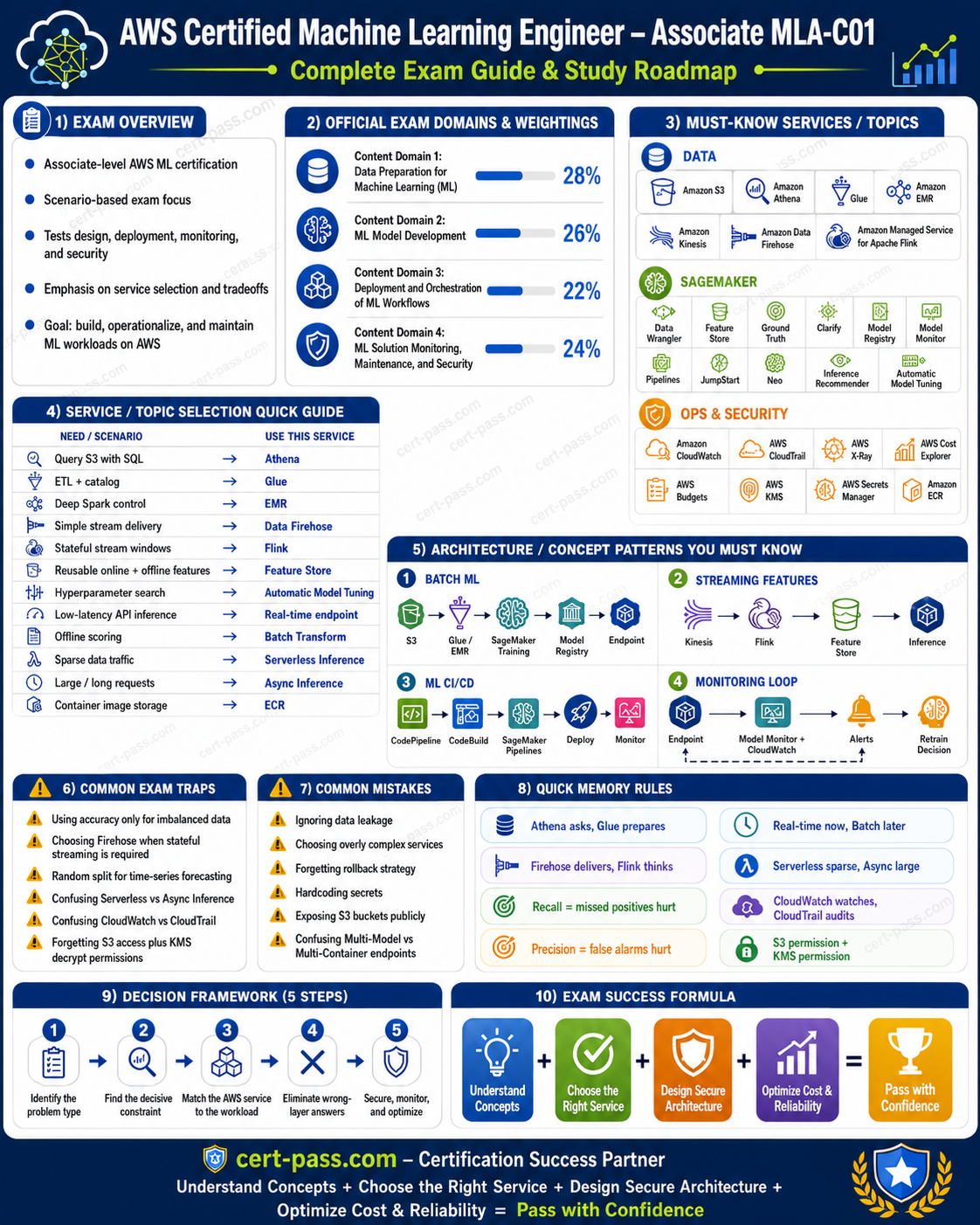
AWS Certified Machine Learning Engineer – Associate MLA-C01 certification preparation infographic

You're viewing 5 of 30 free modules

The remaining 25 modules cover advanced topics, exam traps, and scenarios that appear on the certification exam.

Unlock All : $ 29

1. Exam Overview

What the exam is really testing

MLA-C01 is not a pure machine-learning theory exam and it is not a broad cloud-architecture exam. It tests whether you can take an ML workload from data preparation to production operations using the correct AWS services, with attention to cost, reliability, security, and maintainability.

Most questions are scenario-based. The exam rarely asks, “What does this service do?” Instead, it asks you to choose the best service or architecture for a specific constraint:

  • Low latency or offline inference?
  • Stateful streaming or simple delivery?
  • Shared features for training and inference?
  • Accuracy, recall, or precision?
  • Canary deployment or immediate replacement?
  • Reactive scaling or scheduled scaling?
  • IAM role or long-lived access key?
  • Data drift or infrastructure latency?
  • Athena, Glue, EMR, Flink, Lambda, or Data Firehose?

Your task is to identify the requirement that matters most, eliminate services that solve a different problem, and choose the least complex managed option that fully satisfies the scenario.

Official exam format

Item Current MLA-C01 exam detail
Total questions 65
Scored questions 50
Unscored questions 15
Passing scaled score 720 out of 1,000
Question styles Multiple choice, multiple response, ordering, matching
Scoring principle No penalty for guessing; unanswered questions are incorrect
Passing method Compensatory scoring across the full exam

Core exam mindset

Use this sequence for almost every question:

  1. Classify the problem: data, model, deployment, monitoring, cost, or security.
  2. Underline the decisive constraint: latency, scale, stateful processing, delayed labels, public exposure, cost threshold, auditability, or operational simplicity.
  3. Choose the AWS service designed for that job.
  4. Reject answers that solve a neighboring problem.
  5. Prefer managed and maintainable solutions unless the scenario explicitly requires custom control.


2. Exam Domains

The official blueprint contains four content domains.

Domain Weight Main exam focus
Content Domain 1: Data Preparation for Machine Learning (ML) 28% Ingest, store, transform, label, validate, secure, and prepare data
Content Domain 2: ML Model Development 26% Select approaches, train, tune, refine, evaluate, explain, and version models
Content Domain 3: Deployment and Orchestration of ML Workflows 22% Choose inference targets, provision infrastructure, scale endpoints, automate CI/CD
Content Domain 4: ML Solution Monitoring, Maintenance, and Security 24% Detect drift, monitor quality, troubleshoot performance, control cost, secure resources

Domain task statements

Content Domain 1: Data Preparation for Machine Learning (ML)

Task What you must know
1.1 Ingest and store data Formats, storage choices, batch and streaming ingestion, scaling, merging sources
1.2 Transform data and perform feature engineering Cleaning, encoding, scaling, transformations, Feature Store, labeling
1.3 Ensure data integrity and prepare data for modeling Bias, leakage, splitting, augmentation, encryption, masking, quality validation

Content Domain 2: ML Model Development

Task What you must know
2.1 Choose a modeling approach Algorithms, managed AI services, interpretability, pretrained models, cost
2.2 Train and refine models Training behavior, tuning, early stopping, regularization, fine-tuning, versioning
2.3 Analyze model performance Metrics, baselines, bias, explainability, convergence, shadow comparisons

Content Domain 3: Deployment and Orchestration of ML Workflows

Task What you must know
3.1 Select deployment infrastructure Real-time, batch, serverless, asynchronous, multi-model, multi-container, edge
3.2 Create and script infrastructure IaC, containers, VPC endpoints, scaling metrics, scheduled and reactive scaling
3.3 Automate orchestration and CI/CD CodePipeline, CodeBuild, CodeDeploy, EventBridge, Step Functions, SageMaker Pipelines, MWAA

Content Domain 4: ML Solution Monitoring, Maintenance, and Security

Task What you must know
4.1 Monitor model inference Data drift, model quality, delayed ground truth, A/B tests, anomaly detection
4.2 Monitor and optimize infrastructure and costs CloudWatch, CloudTrail, X-Ray, scaling, quotas, right-sizing, Budgets, Spot
4.3 Secure AWS resources IAM, KMS, Secrets Manager, S3 protections, VPC controls, CI/CD security

3. Start-to-Finish Study Path

Use this sequence so that each topic builds on the previous one.

Phase 1: Data foundation

Master these first:

  1. S3 formats and partitioning.
  2. Athena versus Glue versus EMR.
  3. Kinesis, Data Firehose, Flink, and Lambda.
  4. Data Wrangler, DataBrew, and Glue Data Quality.
  5. Feature Store online and offline access.
  6. Bias, leakage, splitting, PII masking, KMS encryption.

Checkpoint: You should be able to design a clean, governed path from raw data to training-ready features.

Phase 2: Model development

Study:

  1. Business problem to algorithm or managed AI service.
  2. Metrics: accuracy, precision, recall, F1, RMSE, ROC, AUC.
  3. Overfitting, underfitting, convergence, and catastrophic forgetting.
  4. Early stopping, regularization, distributed training, fine-tuning.
  5. SageMaker automatic model tuning.
  6. SageMaker Clarify, Model Debugger, JumpStart, and Model Registry.

Checkpoint: You should be able to justify a model-development decision using business cost, performance, explainability, and operational requirements.

Phase 3: Production deployment

Study:

  1. Real-time endpoint.
  2. Batch transform.
  3. Serverless inference.
  4. Asynchronous inference.
  5. Multi-model and multi-container endpoint patterns.
  6. Lambda, ECS, EKS, and edge optimization.
  7. Endpoint auto scaling and infrastructure as code.
  8. ECR and custom containers.

Checkpoint: You should be able to choose a deployment pattern from latency, traffic shape, payload size, processing time, cost, and model count.

Phase 4: Automation, monitoring, and security

Study:

  1. SageMaker Pipelines, EventBridge, Step Functions, and MWAA.
  2. CodeBuild, CodePipeline, CodeDeploy, and rollback strategies.
  3. Model Monitor, Clarify, CloudWatch, CloudTrail, X-Ray.
  4. Inference Recommender, Cost Explorer, Budgets, tagging.
  5. IAM roles, KMS permissions, Secrets Manager, S3 Block Public Access, and VPC endpoints.

Checkpoint: You should be able to operate the workload safely after deployment and troubleshoot the first production failure.


4. Core Concepts by Domain

Content Domain 1: Data Preparation for Machine Learning (ML)

4.1 Ingest and store data

Choose the data format from the access pattern

Format Best use Key benefit Common trap
Parquet Analytical datasets, Athena queries, feature engineering Columnar reads, compression, column pruning Choosing CSV because it is simple
ORC Columnar analytics Efficient scans and compression Treating it as a universal replacement without checking ecosystem fit
CSV Basic exchange, small files, human-readable exports Simple and portable Using it for large analytical scans
JSON Semi-structured records, event payloads Flexible schema Storing millions of tiny row-level objects
Avro Row-oriented serialization and schema evolution Efficient serialization Choosing it when Athena-style column pruning is the main requirement

Decision rule: If the scenario says Athena, analytical scans, small subset of columns, or reduce scan cost, choose Parquet and a sensible partition scheme.

S3 partitioning

Partition on columns that frequently appear in filters, such as:

  • Event date
  • Region
  • Tenant
  • Business unit
  • Data source

Avoid:

  • Random-only partition keys
  • Extremely high-cardinality partitions
  • One object per row
  • Millions of tiny objects

Small-files trap: Increasing prefixes does not fix the root problem if distributed jobs still open millions of tiny files. Compact files into appropriately sized objects while retaining useful partitions.

Storage selection

Requirement Best-fit service
Durable object storage and data lake Amazon S3
Block storage attached to compute Amazon EBS
Shared POSIX-style file system Amazon EFS
High-performance shared file workloads Amazon FSx
Archive, not active training Amazon S3 Glacier
Relational source data Amazon RDS
Key-value access pattern Amazon DynamoDB

Exam trap: Glacier is for archive and retrieval use cases. It is not the default active training-data tier.

Athena, Glue, and EMR

Requirement Choose
Serverless SQL query directly over S3 Amazon Athena
Catalog metadata and run managed ETL AWS Glue
Run Spark with deeper cluster-level control or customization Amazon EMR
Govern lake access centrally AWS Lake Formation

Elimination rule:
If the scenario says query S3 with SQL without provisioning servers, choose Athena.
If it says catalog, ETL, Spark transformation, or curated output, choose Glue.
If it says deep Spark customization, cluster control, or specialized big-data environment, consider EMR.

Batch versus streaming ingestion

Requirement Best-fit choice
Managed stream delivery to S3 with simple transformations Amazon Data Firehose
Stateful stream processing, windows, late events, rolling aggregates Amazon Managed Service for Apache Flink
Event ingestion stream Amazon Kinesis
Lightweight stateless per-event transformation AWS Lambda
Large historical distributed transformation AWS Glue or Amazon EMR

Key contrast: Data Firehose versus Flink

  • Data Firehose: Deliver streaming records to destinations such as S3 with minimal administration.
  • Flink: Stateful processing, windows, aggregations, event-time logic, and late arrivals.

If the question mentions rolling windows, out-of-order events, or stateful processing, Firehose alone is usually too limited.

Transfer and I/O optimization

Problem Solution
Long-distance S3 uploads from distributed locations S3 Transfer Acceleration
EBS-bound workload requiring predictable high IOPS EBS Provisioned IOPS
Small-file overhead in Spark jobs Compact files
Shared concurrent file access EFS or FSx

Do not confuse:

  • S3 Transfer Acceleration with EBS IOPS.
  • EBS IOPS with S3 scan optimization.
  • File compaction with network acceleration.

lock

4.2 Transform data and engineer features

This module is part of the full course. Unlock all 30 modules + 65+ practice questions.

lock_open Unlock for $ 29

One-time payment · 48h money-back guarantee

lock

4.3 Ensure data integrity and prepare for modeling

This module is part of the full course. Unlock all 30 modules + 65+ practice questions.

lock_open Unlock for $ 29

One-time payment · 48h money-back guarantee

lock

4.4 Choose a modeling approach

This module is part of the full course. Unlock all 30 modules + 65+ practice questions.

lock_open Unlock for $ 29

One-time payment · 48h money-back guarantee

lock

4.5 Train and refine models

This module is part of the full course. Unlock all 30 modules + 65+ practice questions.

lock_open Unlock for $ 29

One-time payment · 48h money-back guarantee

lock

4.6 Analyze model performance

This module is part of the full course. Unlock all 30 modules + 65+ practice questions.

lock_open Unlock for $ 29

One-time payment · 48h money-back guarantee

lock

4.7 Select deployment infrastructure

This module is part of the full course. Unlock all 30 modules + 65+ practice questions.

lock_open Unlock for $ 29

One-time payment · 48h money-back guarantee

lock

4.8 Create and script infrastructure

This module is part of the full course. Unlock all 30 modules + 65+ practice questions.

lock_open Unlock for $ 29

One-time payment · 48h money-back guarantee

lock

4.9 Automate orchestration and CI/CD

This module is part of the full course. Unlock all 30 modules + 65+ practice questions.

lock_open Unlock for $ 29

One-time payment · 48h money-back guarantee

lock

4.10 Monitor model inference

This module is part of the full course. Unlock all 30 modules + 65+ practice questions.

lock_open Unlock for $ 29

One-time payment · 48h money-back guarantee

lock

4.11 Monitor and optimize infrastructure and costs

This module is part of the full course. Unlock all 30 modules + 65+ practice questions.

lock_open Unlock for $ 29

One-time payment · 48h money-back guarantee

lock

4.12 Secure AWS resources

This module is part of the full course. Unlock all 30 modules + 65+ practice questions.

lock_open Unlock for $ 29

One-time payment · 48h money-back guarantee

lock

5. Service Selection Guide

This module is part of the full course. Unlock all 30 modules + 65+ practice questions.

lock_open Unlock for $ 29

One-time payment · 48h money-back guarantee

lock

6. Architecture Patterns

This module is part of the full course. Unlock all 30 modules + 65+ practice questions.

lock_open Unlock for $ 29

One-time payment · 48h money-back guarantee

lock

Pattern 1: Batch training from an S3 lake

This module is part of the full course. Unlock all 30 modules + 65+ practice questions.

lock_open Unlock for $ 29

One-time payment · 48h money-back guarantee

lock

Pattern 2: Streaming features

This module is part of the full course. Unlock all 30 modules + 65+ practice questions.

lock_open Unlock for $ 29

One-time payment · 48h money-back guarantee

lock

Pattern 3: Consistent online and offline features

This module is part of the full course. Unlock all 30 modules + 65+ practice questions.

lock_open Unlock for $ 29

One-time payment · 48h money-back guarantee

lock

Pattern 4: Governed training pipeline

This module is part of the full course. Unlock all 30 modules + 65+ practice questions.

lock_open Unlock for $ 29

One-time payment · 48h money-back guarantee

lock

Pattern 5: Low-latency real-time deployment

This module is part of the full course. Unlock all 30 modules + 65+ practice questions.

lock_open Unlock for $ 29

One-time payment · 48h money-back guarantee

lock

Pattern 6: Controlled model release

This module is part of the full course. Unlock all 30 modules + 65+ practice questions.

lock_open Unlock for $ 29

One-time payment · 48h money-back guarantee

lock

Pattern 7: Delayed-ground-truth monitoring

This module is part of the full course. Unlock all 30 modules + 65+ practice questions.

lock_open Unlock for $ 29

One-time payment · 48h money-back guarantee

lock

Pattern 8: Private encrypted ML workload

This module is part of the full course. Unlock all 30 modules + 65+ practice questions.

lock_open Unlock for $ 29

One-time payment · 48h money-back guarantee

lock

7. Exam Traps

This module is part of the full course. Unlock all 30 modules + 65+ practice questions.

lock_open Unlock for $ 29

One-time payment · 48h money-back guarantee

lock

8. Quick Memory Rules

This module is part of the full course. Unlock all 30 modules + 65+ practice questions.

lock_open Unlock for $ 29

One-time payment · 48h money-back guarantee

lock

9. Final Revision Notes

This module is part of the full course. Unlock all 30 modules + 65+ practice questions.

lock_open Unlock for $ 29

One-time payment · 48h money-back guarantee

lock

10. Exam-Day Checklist

This module is part of the full course. Unlock all 30 modules + 65+ practice questions.

lock_open Unlock for $ 29

One-time payment · 48h money-back guarantee

What others say

star star star star star

"The compressed course cut my study time in half. The VPC and IAM sections were exactly what appeared on the real AWS Certified Machine Learning Engineer – Associate MLA-C01 exam."

Sarah M.

Solutions Architect

Scored 94%
star star star star star

"Every AWS domain explained clearly. The exam traps section saved me from at least 3 tricky questions on AWS Certified Machine Learning Engineer – Associate MLA-C01."

James K.

Cloud Engineer

Scored 91%

Unlock the full course

Stop guessing. Start passing.

5 of 30 modules free. The remaining 25 modules contain the exam traps, edge cases, and domain deep-dives that make the difference.

48h money-back guarantee Secure PayPal checkout

Unlock all 30 modules

From $ 29 · One-time payment

Unlock

Course Modules

30 modules

Unlock All Modules

Get full access to all 30 modules

auto_stories More Guides