
Cert-Pass
Log in Sign up
AWS AWS Certified auto_stories Free Compressed Course

AWS Solutions Architect โ€“ Associate (SAA-C03) Certification Course

bolt Everything you need to pass : in one free course.

16 expert modules derived from 1008+ real exam questions. Covers every domain, exam trap, and scenario : organized by blueprint weight so you study what matters most.

check_circle 100% free ยท No account needed ยท 16 modules
16
Modules
1008+
Questions
64
Domains
AWS Solutions Architect โ€“ Associate (SAA-C03)
AWS

About This Course

AWS Solutions Architect โ€“ Associate (SAA-C03) ยท 16 modules

This course covers every domain tested on the AWS Solutions Architect โ€“ Associate (SAA-C03) exam. Based on our 1008+ real practice questions and prepared by certification experts.

info What you'll learn:

  • Every exam domain with detailed explanations
  • Common exam traps that catch unprepared candidates
  • Key concepts, syntax, and configurations
  • Real-world scenarios from actual exam questions
  • Quick-reference cheat sheets for last-minute review

1. Exam Overview

What the exam is testing

The AWS Certified Solutions Architect โ€“ Associate (SAA-C03) exam tests whether you can design secure, resilient, high-performing, and cost-optimized architectures on AWS. It is not mainly a memorization exam. Most questions describe a business scenario, constraints, and several plausible AWS services. Your job is to choose the design that best satisfies the requirement with the least operational burden and the most appropriate tradeoff.

The exam commonly tests your ability to:

  • Translate business requirements into AWS architecture choices.
  • Select the right managed service instead of overengineering.
  • Apply security controls without breaking application access.
  • Design for Availability Zone or Regional failure where required.
  • Improve performance with caching, scaling, partitioning, and service selection.
  • Reduce cost without sacrificing stated requirements.
  • Eliminate distractors that are technically possible but not the best architecture.

How to think like the exam

Read every scenario in this order:

  1. Requirement: What must the architecture achieve? Security, resiliency, performance, cost, migration, or operations?
  2. Constraint: Least operational effort, no code change, low latency, private connectivity, multi-account governance, compliance, or cost reduction?
  3. Data pattern: Object, block, file, relational, key-value, streaming, queue, analytics, or archive?
  4. Traffic pattern: Steady, unpredictable, spiky, global, read-heavy, write-heavy, or batch?
  5. Failure scope: Instance, Availability Zone, Region, account, or user mistake?
  6. Best AWS-native answer: Prefer managed, scalable, secure-by-default services unless the question explicitly requires custom control.

How to use this course

Use this file as a compressed revision guide. First read the domain sections to understand the exam logic. Then use the service-selection tables to learn how to choose between confusing AWS services. Finally, use the exam traps, memory rules, and exam-day checklist to revise quickly before the test.

This course is synthesized from the SAA-C03 blueprint and from repeated patterns in the generated practice question bank. It does not reproduce raw questions or dumps.


2. Exam Domains

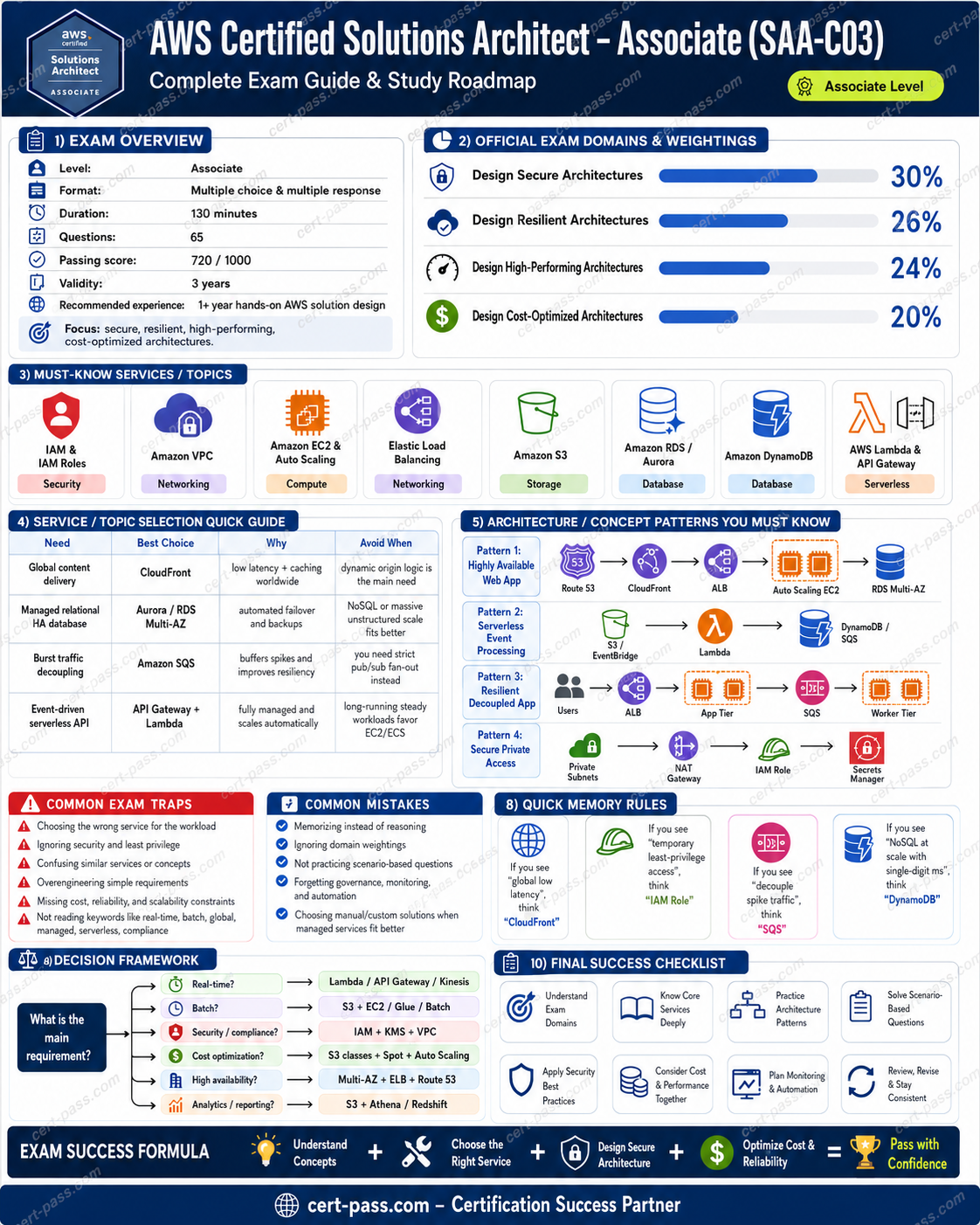
Domain Official Weight Priority What matters most
Design Secure Architectures 30% Highest IAM, VPC security, private access, encryption, logging, multi-account guardrails, data protection
Design Resilient Architectures 26% Very high Multi-AZ, backup, disaster recovery, decoupling, failover, stateless design, durable storage
Design High-Performing Architectures 24% High Scalable compute, caching, databases, storage performance, network acceleration, global delivery
Design Cost-Optimized Architectures 20% High Pricing models, right sizing, storage classes, managed services, serverless, cost-aware data transfer

Priority notes

Security has the largest weighting, so expect many questions where the obvious service is not enough unless access control, encryption, logging, or network isolation is handled correctly. Resiliency and performance questions often look similar, but resiliency focuses on surviving failures while performance focuses on latency, throughput, and scalability. Cost questions often contain traps where the cheapest option violates availability, durability, or performance requirements.

What matters most

The most repeated high-value services and concepts are:

  • Amazon S3: storage classes, lifecycle policies, encryption, bucket policies, access points, versioning, replication, Object Lock, VPC endpoints.
  • Amazon EC2: Auto Scaling, purchase options, placement groups, AMIs, EBS, instance families, load balancing.
  • VPC networking: public/private subnets, NAT gateway, internet gateway, route tables, security groups, NACLs, VPC endpoints, peering, Transit Gateway, VPN, Direct Connect.
  • IAM and Organizations: least privilege, roles, resource policies, SCPs, identity federation, permission boundaries.
  • Databases: RDS/Aurora, DynamoDB, ElastiCache, Redshift, OpenSearch, read replicas, Multi-AZ, global tables.
  • Resiliency services: ELB, Auto Scaling, Route 53 failover, AWS Backup, SQS, SNS, EventBridge, multi-AZ databases.
  • Monitoring and governance: CloudWatch, CloudTrail, AWS Config, GuardDuty, Security Hub, WAF, Shield, Systems Manager.

3. Start-to-Finish Study Path

Foundation

Learn the core AWS building blocks before memorizing edge cases:

  • AWS global infrastructure: Regions, Availability Zones, edge locations.
  • Shared responsibility model.
  • IAM users, groups, roles, policies, and resource-based policies.
  • VPC basics: CIDR, subnets, route tables, gateways, security groups, NACLs.
  • Storage basics: S3, EBS, EFS, FSx.
  • Compute basics: EC2, Auto Scaling, ELB, Lambda, ECS/Fargate.
  • Database basics: RDS, Aurora, DynamoDB, ElastiCache, Redshift.

Intermediate

Build service-selection instincts:

  • Choose S3 vs EBS vs EFS vs FSx.
  • Choose RDS/Aurora vs DynamoDB vs Redshift vs OpenSearch.
  • Choose ALB vs NLB vs Gateway Load Balancer.
  • Choose CloudFront vs Global Accelerator vs Route 53 latency routing.
  • Choose SQS vs SNS vs EventBridge vs Step Functions.
  • Choose VPN vs Direct Connect vs Transit Gateway vs VPC peering.
  • Choose KMS key policy vs IAM policy vs bucket policy vs SCP.

Advanced

Practice tradeoff questions:

  • Multi-AZ vs multi-Region.
  • Read replica vs Multi-AZ standby.
  • NAT gateway vs VPC endpoint.
  • S3 Standard-IA vs One Zone-IA vs Glacier Instant Retrieval vs Flexible Retrieval vs Deep Archive.
  • Reserved Instances vs Savings Plans vs Spot Instances.
  • CloudFront caching vs ElastiCache vs DynamoDB DAX.
  • S3 replication vs AWS Backup vs versioning.
  • RTO/RPO-driven disaster recovery patterns.

Final review

Use the last stage to improve elimination speed:

  • Mark the keyword that decides the answer: private, managed, least operational overhead, global low latency, compliance, multi-account, unpredictable traffic, archive, read-heavy, asynchronous, event-driven.
  • Remove any answer that violates the explicit requirement.
  • Prefer fully managed services when the question asks for reduced operational overhead.
  • Prefer serverless when traffic is unpredictable and the workload fits the service limits.
  • Prefer multi-AZ for high availability inside a Region; prefer multi-Region only when the question requires Regional disaster recovery or global users.

4. Core Concepts by Domain

Domain 1: Design Secure Architectures

Concepts

Security questions test whether you can design access control, network isolation, encryption, auditability, and governance together. The exam often gives a design that works functionally but misses a security control.

Key concepts:

  • Least privilege: Grant only required actions on required resources.
  • IAM roles over long-term keys: Use roles for EC2, Lambda, ECS tasks, and cross-account access.
  • Resource policies: Use S3 bucket policies, KMS key policies, SQS queue policies, SNS topic policies, and Lambda resource policies when access is controlled from the resource side.
  • SCPs: Use AWS Organizations service control policies to set account-level guardrails. SCPs do not grant permissions; they only limit maximum permissions.
  • Encryption at rest: Use KMS-managed keys when audit, rotation, key policy control, or cross-account access matters.
  • Encryption in transit: Use TLS/HTTPS, ACM certificates, ALB listeners, CloudFront viewer policies.
  • Private access: Use VPC endpoints for private access to AWS services without internet or NAT.
  • Secrets: Use AWS Secrets Manager for automatic rotation and AWS Systems Manager Parameter Store for configuration/secrets with simpler requirements.
  • Monitoring and audit: Use CloudTrail for API activity, CloudWatch for metrics/logs/alarms, AWS Config for configuration history/compliance.
  • Threat detection: GuardDuty detects suspicious activity; Inspector scans vulnerabilities; Macie discovers sensitive data in S3; Security Hub aggregates findings.

Services

  • IAM, IAM Identity Center, STS, AWS Organizations, SCPs.
  • Amazon VPC, security groups, NACLs, VPC endpoints, PrivateLink.
  • AWS KMS, CloudHSM, ACM, Secrets Manager, Parameter Store.
  • S3 bucket policies, S3 Block Public Access, Object Lock, versioning, access points.
  • CloudTrail, CloudWatch Logs, AWS Config, GuardDuty, Security Hub, Inspector, Macie.
  • AWS WAF and AWS Shield for application and DDoS protection.

Patterns

Scenario Recommended pattern Why
EC2 needs to read S3 privately Gateway VPC endpoint for S3 plus least-privilege bucket policy Avoids NAT, internet gateway, and public IPs
Lambda needs database credentials Secrets Manager with rotation Avoids hardcoded credentials and supports rotation
Multi-account organization needs to prevent disabling logging SCP denying CloudTrail disabling actions Central governance control across accounts
Public web app needs protection from SQL injection AWS WAF attached to CloudFront or ALB Layer 7 filtering for common web attacks
Sensitive S3 data must not become public S3 Block Public Access, bucket policy, IAM least privilege, encryption Prevents accidental exposure
Cross-account access to S3 IAM role assumption plus bucket policy/KMS key policy if encrypted Both identity and resource permissions may be needed

Traps

  • Using IAM users/access keys for applications when an IAM role is available.
  • Confusing SCPs with IAM policies: SCPs restrict; they do not grant.
  • Forgetting KMS permissions: Access to an encrypted S3 object requires S3 permission and KMS key permission.
  • Choosing NAT gateway for private S3 access when a gateway VPC endpoint is more secure and cheaper.
  • Using security groups as deny rules: Security groups allow only; NACLs can allow and deny.
  • Assuming CloudTrail prevents attacks: CloudTrail records API events; it does not block by itself.

lock

Module 6 is locked

Unlock all 16 modules, exam traps, cheat sheets, and 1008+ practice questions.

lock

Module 7 is locked

Unlock all 16 modules, exam traps, cheat sheets, and 1008+ practice questions.

lock

Module 8 is locked

Unlock all 16 modules, exam traps, cheat sheets, and 1008+ practice questions.

lock

Module 9 is locked

Unlock all 16 modules, exam traps, cheat sheets, and 1008+ practice questions.

lock

Module 10 is locked

Unlock all 16 modules, exam traps, cheat sheets, and 1008+ practice questions.

lock

Module 11 is locked

Unlock all 16 modules, exam traps, cheat sheets, and 1008+ practice questions.

lock

Module 12 is locked

Unlock all 16 modules, exam traps, cheat sheets, and 1008+ practice questions.

lock

Module 13 is locked

Unlock all 16 modules, exam traps, cheat sheets, and 1008+ practice questions.

lock

Module 14 is locked

Unlock all 16 modules, exam traps, cheat sheets, and 1008+ practice questions.

lock

Module 15 is locked

Unlock all 16 modules, exam traps, cheat sheets, and 1008+ practice questions.

lock

Module 16 is locked

Unlock all 16 modules, exam traps, cheat sheets, and 1008+ practice questions.

Ready to Test Your Knowledge?

Take a practice exam with 1008+ real questions and detailed explanations.

Course Modules

16 modules

Unlock All Modules

Get full access to all 16 modules

auto_stories More Guides