
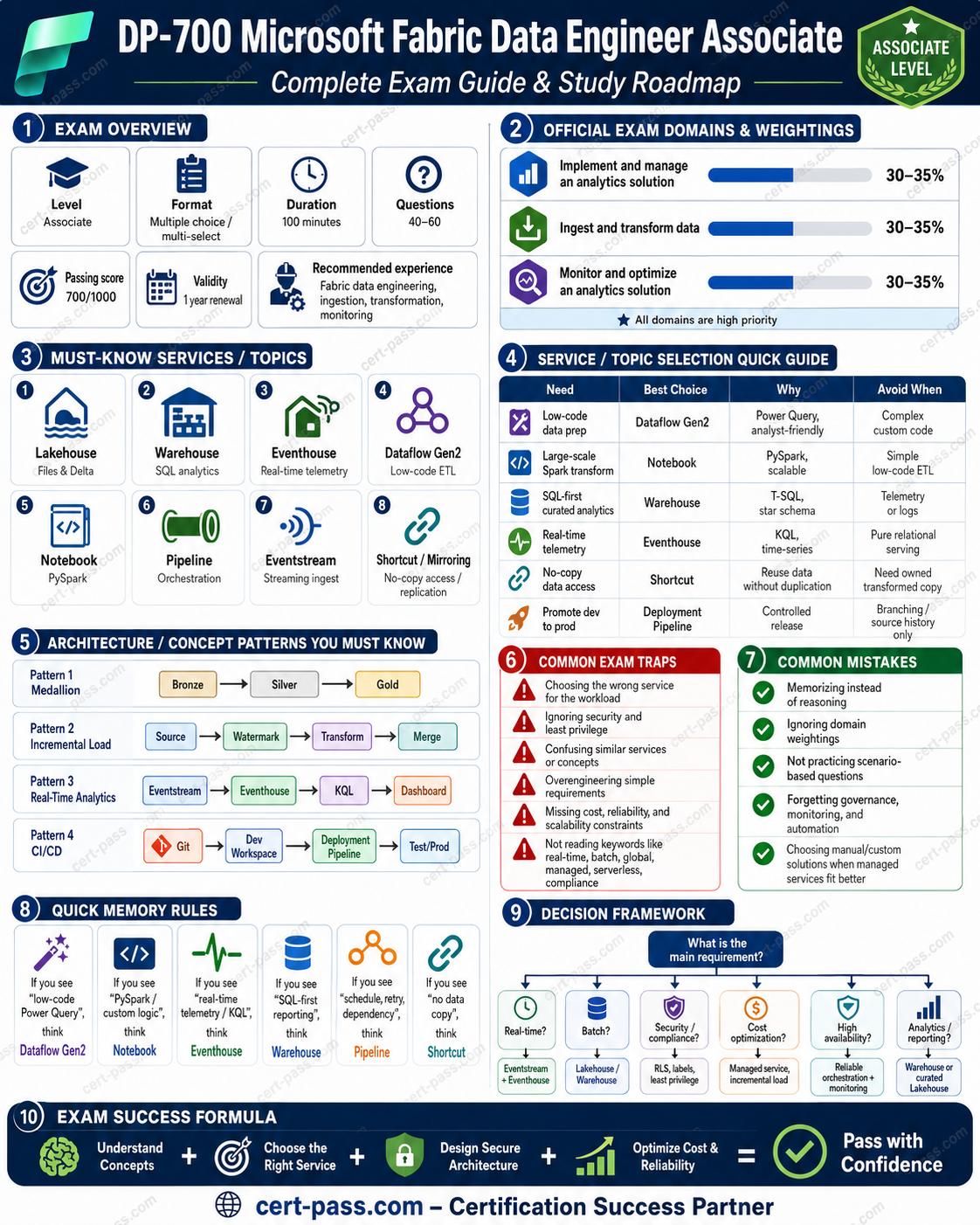
1. Exam Overview
What the exam is testing
DP-700 validates whether you can implement data engineering solutions in Microsoft Fabric. The exam is not just about knowing product names. It tests whether you can choose the right Fabric item, loading pattern, transformation engine, security model, monitoring approach, and optimization technique for a realistic enterprise analytics scenario.
You are expected to reason across:
- Workspaces and lifecycle: Git integration, deployment pipelines, environments, item promotion, workspace settings, domains, capacity, and governance.
- Data engineering implementation: lakehouses, warehouses, Eventhouses, Eventstreams, Dataflows Gen2, notebooks, pipelines, KQL, T-SQL, PySpark, shortcuts, mirroring, batch and streaming ingestion.
- Operations and performance: troubleshooting pipelines, notebooks, Dataflows Gen2, Eventstreams, Eventhouses, OneLake shortcuts, semantic model refresh, Spark jobs, warehouse queries, and capacity issues.
How to think like the exam
The exam usually gives you a business or technical constraint and asks for the best Fabric-native choice. Do not choose the tool you personally prefer. Choose the tool that best matches the scenario constraints.
Typical exam logic:
- Identify the data shape: batch, streaming, relational, files, telemetry, dimensional model, or operational replication.
- Identify the user persona: data engineer, low-code analyst, SQL developer, real-time analyst, BI consumer, administrator.
- Identify operational constraints: CI/CD, governance, security, monitoring, cost, performance, incremental load, late-arriving data, or schema evolution.
- Eliminate attractive but wrong options: wrong engine, wrong security layer, wrong optimization level, or manual approach when Fabric has a managed feature.
- Prefer the simplest Fabric-native solution that satisfies all requirements.
How to use this course
Read sections 1–3 first, then study sections 4–8 by scenario. For final review, use sections 9–10. When practicing questions, map every question to one of these decisions:
- Which Fabric item should be used?
- Which transformation engine is best?
- Which security boundary applies?
- Which monitoring signal identifies the problem?
- Which optimization action fixes the bottleneck?