
Cert-Pass
Log in Sign up
CompTIA CompTIA Certified auto_stories Free Compressed Course : 20% preview

Security+ SY0-701 Certification Course

bolt Everything you need to pass : in one free course.

66 expert modules derived from 90+ exam-style questions. Covers every domain and scenario : organized by blueprint weight so you study what matters most.

Full access from $ 29 One-time · No subscription
check_circle 14 of 66 modules free · No account needed
66
Modules
90+
Questions
Security+ SY0-701
200+ CompTIA Certified 93% First-Attempt Pass Rate 4.9/5 Rating
CompTIA

About This Course

Security+ SY0-701 · 66 modules

This course covers every domain tested on the Security+ SY0-701 exam. Based on our 90+ real practice questions and prepared by certification experts.

info What you'll learn:

  • Every exam domain with detailed explanations
  • Common exam traps that catch unprepared candidates
  • Key concepts, syntax, and configurations
  • Real-world scenarios aligned with exam objectives
  • Quick-reference cheat sheets for last-minute review

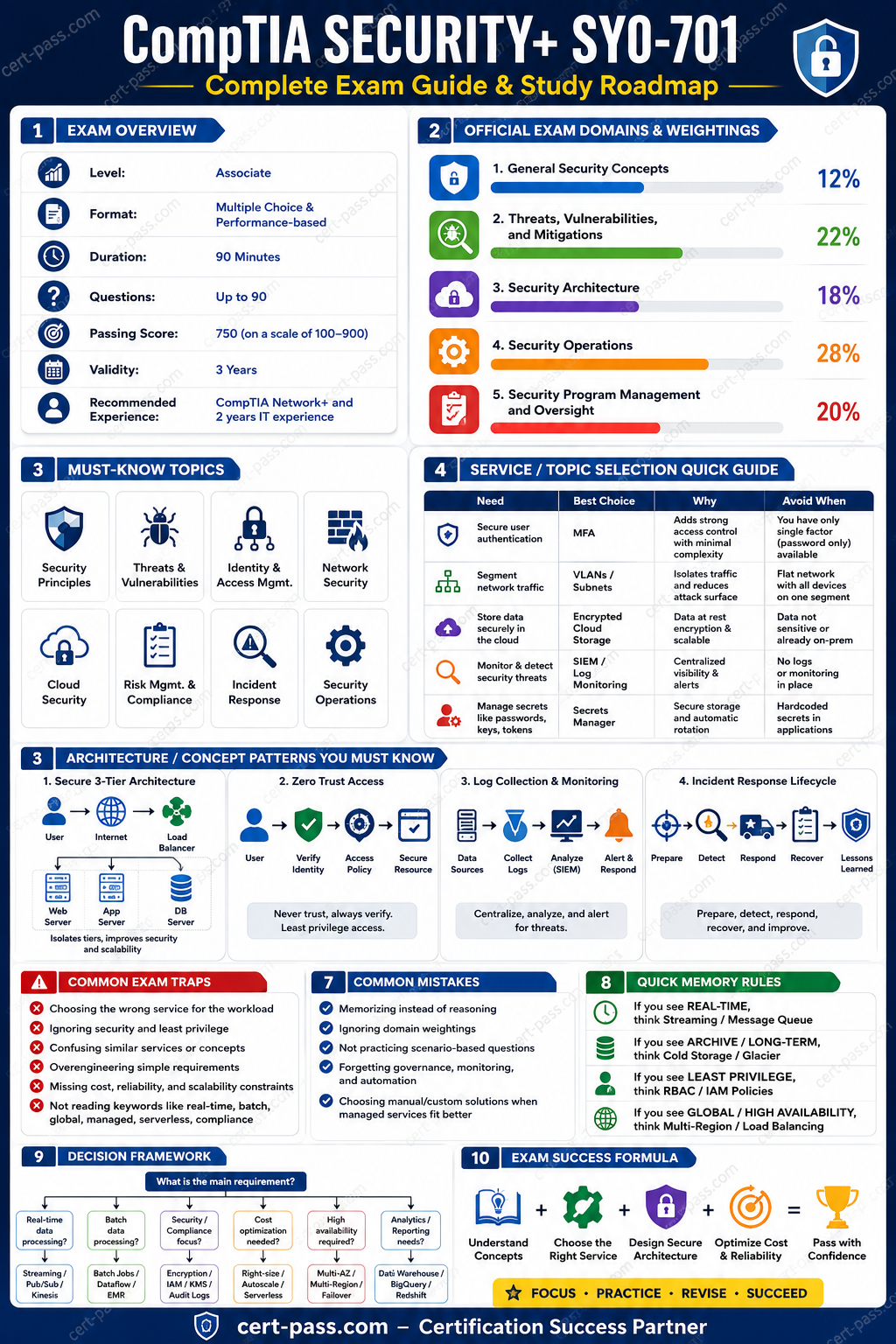
Your Security+ SY0-701 Roadmap

Security+ SY0-701 certification preparation infographic

You're viewing 14 of 66 free modules

The remaining 52 modules cover advanced topics, exam traps, and scenarios that appear on the certification exam.

Unlock All : $ 29

What the exam is testing

CompTIA Security+ SY0-701 validates whether you can make sound security decisions in realistic business and technical situations. It is not primarily a vocabulary test. Expect questions that ask for the best, most appropriate, or first action when several answers appear plausible.

The exam is vendor-neutral. You must recognize the purpose of controls and tools without relying on a specific product name.

The official exam focus is to verify that you can:

  • assess an enterprise security posture and recommend appropriate controls;
  • secure hybrid environments, including cloud, mobile, operational technology, and Internet of Things devices;
  • operate with an awareness of governance, risk, compliance, and privacy requirements;
  • identify, analyze, contain, eradicate, and recover from security events and incidents.

Exam format snapshot

Item SY0-701 exam detail
Exam version Security+ V7
Exam code SY0-701
Maximum number of questions 90
Time limit 90 minutes
Passing score 750 on a scale of 100–900
Question styles Multiple-choice and performance-based questions

How to think like the exam

Use this decision sequence:

  1. Identify the exact requirement. Is the question asking about confidentiality, integrity, availability, authentication, authorization, evidence, containment, resilience, compliance, or cost?
  2. Respect the timing word. “First” usually means stabilize, preserve evidence, or identify scope before making a permanent change. “Best” usually means the option that most directly satisfies the requirement with the least unnecessary risk.
  3. Prefer least privilege and reduced blast radius. Narrow access, segment networks, isolate suspicious systems, and remove unnecessary exposure.
  4. Choose the control closest to the problem. A web application attack suggests a web-focused defense. A compromised endpoint suggests endpoint isolation and EDR. A privileged-account risk suggests PAM and just-in-time access.
  5. Do not solve a governance problem with only a technical tool. A contract, policy, audit, exception, or risk register may be the correct answer.
  6. Do not overreact. Avoid options that disable logging, destroy evidence, grant broad access, apply untested production changes, or rely on one control only.
  7. Prefer repeatable and measurable controls. Centralized logging, documented procedures, version control, baselines, automation with guardrails, and validation are stronger than informal manual steps.

How to use this course

Read sections 1–4 in order for a complete foundation. Use sections 5–8 for targeted scenario practice. Use sections 9–10 in the final days before the exam.

A productive revision loop is:

  • review one domain;
  • answer a focused group of practice questions;
  • write down why your best wrong answer was wrong;
  • revisit the relevant comparison table;
  • repeat until you can explain the decision rule without memorizing the wording.

2. Exam Domains

Official domain priorities

Domain Weight Study priority Why it matters
1.0 General Security Concepts 12% Foundation Establishes the language used in every other domain: controls, CIA, AAA, zero trust, change management, and cryptography.
2.0 Threats, Vulnerabilities, and Mitigations 22% High Tests whether you can recognize attack patterns, distinguish vulnerabilities from threats, and choose practical mitigations.
3.0 Security Architecture 18% High Tests design choices for cloud, networks, data protection, resilience, and secure communications.
4.0 Security Operations 28% Highest The largest domain. Focus on hardening, monitoring, IAM, vulnerability management, incident response, automation, and investigation data sources.
5.0 Security Program Management and Oversight 20% High Tests governance, risk, third-party management, compliance, audits, privacy, and awareness.

What matters most

The source bank and official blueprint point to the following high-value areas:

  1. Security operations: incident response ordering, log selection, hardening, EDR, SIEM, IAM, PAM, vulnerability remediation, automation, and validation.
  2. Threat recognition and mitigation: phishing, credential attacks, application attacks, network attacks, malware, social engineering, and supply-chain risk.
  3. Architecture decisions: segmentation, zero trust, secure protocols, data states, cloud shared responsibility, backups, recovery sites, and availability design.
  4. Risk and governance: risk treatments, BIA metrics, policy hierarchy, vendor due diligence, contracts, audits, exceptions, awareness, and privacy.
  5. Foundational reasoning: CIA, AAA, control categories, encryption versus hashing versus signatures, PKI, and change management.

3. Start-to-Finish Study Path

Phase 1: Foundation

Build the vocabulary required to eliminate obviously wrong answers.

Study in this order:

  1. CIA triad, AAA, non-repudiation, least privilege, separation of duties.
  2. Control types and categories.
  3. Hashing, encryption, digital signatures, certificates, PKI, and key management.
  4. Threat actors, social engineering, malware, password attacks, and common web attacks.
  5. Network basics: segmentation, DMZ, VPN, TLS, IPSec, firewalls, IDS, IPS, WAF, and NAC.

Checkpoint: You should be able to explain why a hash does not provide confidentiality, why an IDS is not an IPS, and why a broad VPN group conflicts with least privilege.

Phase 2: Intermediate application

Move from definitions to selecting the best control.

Study:

  1. Endpoint hardening and secure baselines.
  2. IAM lifecycle, MFA, SSO, federation, PAM, access reviews, and service accounts.
  3. Vulnerability management: scan, prioritize, remediate, rescan, and verify.
  4. Monitoring: SIEM, EDR, XDR, logs, packet captures, dashboards, and alerts.
  5. Data protection: classification, encryption, tokenization, masking, DLP, retention, and disposal.
  6. Cloud architecture and shared responsibility.
  7. Risk register, risk treatment, RTO, RPO, MTTR, MTBF, and third-party agreements.

Checkpoint: Given a scenario, you should be able to choose the most relevant control and explain why a generic control is weaker.

Phase 3: Advanced scenario reasoning

Focus on priority, tradeoffs, and sequence.

Study:

  1. Incident response order: preparation, detection, analysis, containment, eradication, recovery, lessons learned.
  2. Forensic evidence: preserve before changing, maintain chain of custody, use legal hold when required.
  3. Architecture tradeoffs: availability versus cost, convenience versus least privilege, rapid automation versus guardrails, temporary exceptions versus permanent bypasses.
  4. Governance-document selection: policy, standard, procedure, guideline, SLA, NDA, MOU, rules of engagement.
  5. Recovery design: backup type, immutable or offline copies, replication, journaling, snapshots, warm versus hot versus cold sites.
  6. Zero trust and segmentation: evaluate identity, device posture, and resource-level authorization continuously.

Checkpoint: You should be able to identify why a technically useful answer may still be wrong because it occurs too early, grants too much access, destroys evidence, or fails to address the underlying cause.

Phase 4: Final review

Use sections 8–10 as a condensed review sheet. Practice mixed scenarios under time pressure. Flag questions containing BEST, FIRST, MOST likely, MOST appropriate, and Select TWO because wording determines the required reasoning style.


4. Core Concepts by Domain

Domain 1: General Security Concepts : 12%

1.1 Security control categories and functions

A control can be categorized by how it is implemented and what it does.

Implementation categories

Category Meaning Examples
Technical Implemented with technology Firewall, MFA, EDR, encryption, access control list
Managerial Administrative oversight and governance Risk assessment, security policy, vendor review
Operational People-driven process Awareness training, incident handling procedure, change review
Physical Protects physical access or environment Locks, bollards, guards, cameras, fencing

Functional types

Type Purpose Example Common trap
Preventive Stops an event before it occurs MFA, firewall allowlist, locked door Do not confuse with a control that only alerts afterward.
Detective Identifies an event IDS alert, log review, motion sensor Detection does not block the attack.
Corrective Fixes or restores after an event Patch deployment, restore from backup Restoration is not the same as prevention.
Deterrent Discourages attempts Warning sign, visible camera A deterrent changes behavior but may not stop an attacker.
Directive Tells people what to do Policy, standard, security procedure A document does not enforce a technical restriction by itself.
Compensating Alternative when the preferred control is not feasible Jump host and allowlisting for a legacy system lacking MFA Use only when the preferred control cannot reasonably be implemented.

Decision rule

When the question says a preferred control is impossible because of a legacy constraint, choose a compensating control that reduces exposure and is monitored. Never choose “ignore the risk” or “publish the service directly.”

1.2 Fundamental concepts

CIA triad

Property Question to ask Typical failure
Confidentiality Was information exposed to an unauthorized party? Data leak, excessive permissions, unencrypted sensitive data
Integrity Was data changed without authorization? Tampering, unauthorized database edit, malicious software update
Availability Can authorized users access the system when needed? Denial of service, outage, ransomware disruption

AAA

Element Purpose Example
Authentication Prove identity Password, passkey, smart card, biometric
Authorization Determine allowed actions Role-based permissions, ACL, least privilege
Accounting Record actions Audit log showing commands used by an administrator

Non-repudiation

Non-repudiation provides evidence that a specific party performed an action and cannot credibly deny it later. A common mechanism is a digital signature created with the signer’s private key.

Zero trust

Zero trust assumes that network location alone is not proof of trust. Evaluate:

  • user identity;
  • device health and posture;
  • resource sensitivity;
  • context such as location and risk;
  • least-privilege access;
  • continuous verification.

Trap: “The user is on the internal network” is not enough to justify broad access.

Deception and disruption technology

Technology Purpose
Honeypot Decoy system intended to attract suspicious activity
Honeynet Network of decoy systems
Honeyfile Decoy file that should not be accessed legitimately
Honeytoken Decoy credential or data element that triggers an alert if used

1.3 Change management

Security controls can create outages when implemented without review. A sound change process includes:

  1. request and business justification;
  2. impact analysis and dependency review;
  3. approval;
  4. testing;
  5. communication;
  6. implementation during an appropriate window;
  7. monitoring;
  8. rollback plan;
  9. documentation updates;
  10. version control and audit history.

Exam trap: The fastest technical fix is not always the best answer. If the question emphasizes avoiding an undocumented outage, choose assessment, approval, testing, and rollback.

1.4 Cryptographic solutions

Fast comparison

Need Best-fit mechanism
Keep data secret Encryption
Detect unauthorized modification Cryptographic hashing
Verify origin and integrity Digital signature
Verify a website or system identity Certificate and PKI validation
Store passwords safely Salted, slow password-hashing algorithm
Encrypt a large archive efficiently Symmetric encryption with secure key management
Protect data in transit TLS, IPSec, or another approved secure protocol

Symmetric versus asymmetric cryptography

Characteristic Symmetric Asymmetric
Keys Same secret key encrypts and decrypts Public/private key pair
Speed Faster Slower
Best use Bulk encryption Key exchange, digital signatures, identity verification
Main challenge Securely distribute and protect the shared key More computational overhead and certificate/key management complexity

Hashing, salting, and signatures

  • A hash is one-way and is used to verify integrity.
  • A salt makes identical passwords produce different stored hashes and reduces precomputed hash attacks.
  • A digital signature provides integrity, authenticity, and non-repudiation. It is not primarily used to keep content secret.

PKI essentials

Term Purpose
Certificate authority (CA) Issues and signs certificates
Registration authority (RA) Supports identity verification before certificate issuance
Certificate signing request (CSR) Request used to obtain a certificate
Certificate revocation list (CRL) Published list of revoked certificates
Online Certificate Status Protocol (OCSP) Query a certificate’s revocation status
Key escrow Controlled storage of a cryptographic key for recovery or legal requirements

Data obfuscation techniques

Technique Best use
Tokenization Replace sensitive values with tokens; common for payment data
Masking Hide portions of data from display or testing environments
Redaction Remove sensitive content from a document or output
Hashing Verify integrity or securely store password representations
Encryption Keep the original data confidential while allowing authorized recovery

Domain 1 traps

  • Hashing is not encryption.
  • Encoding is not encryption.
  • A shared symmetric key does not prove which individual approved a transaction.
  • An IDS detects; it does not automatically block.
  • Internal network location does not eliminate the need for authorization.
  • A compensating control is a governed alternative, not an excuse to ignore risk.

Domain 2: Threats, Vulnerabilities, and Mitigations : 22%

lock

2.1 Threat actors and motivations

This module is part of the full course. Unlock all 66 modules + 90+ practice questions.

lock_open Unlock for $ 29

One-time payment · 48h money-back guarantee

lock

2.2 Threat vectors and social engineering

This module is part of the full course. Unlock all 66 modules + 90+ practice questions.

lock_open Unlock for $ 29

One-time payment · 48h money-back guarantee

lock

2.3 Common vulnerabilities

This module is part of the full course. Unlock all 66 modules + 90+ practice questions.

lock_open Unlock for $ 29

One-time payment · 48h money-back guarantee

lock

2.4 Malware and attack patterns

This module is part of the full course. Unlock all 66 modules + 90+ practice questions.

lock_open Unlock for $ 29

One-time payment · 48h money-back guarantee

lock

2.5 Network, wireless, and cryptographic attacks

This module is part of the full course. Unlock all 66 modules + 90+ practice questions.

lock_open Unlock for $ 29

One-time payment · 48h money-back guarantee

lock

2.6 Mitigation strategy

This module is part of the full course. Unlock all 66 modules + 90+ practice questions.

lock_open Unlock for $ 29

One-time payment · 48h money-back guarantee

lock

3.1 Architecture principles

This module is part of the full course. Unlock all 66 modules + 90+ practice questions.

lock_open Unlock for $ 29

One-time payment · 48h money-back guarantee

lock

3.2 Network architecture patterns

This module is part of the full course. Unlock all 66 modules + 90+ practice questions.

lock_open Unlock for $ 29

One-time payment · 48h money-back guarantee

lock

3.3 Cloud and virtualization models

This module is part of the full course. Unlock all 66 modules + 90+ practice questions.

lock_open Unlock for $ 29

One-time payment · 48h money-back guarantee

lock

3.4 Secure communications

This module is part of the full course. Unlock all 66 modules + 90+ practice questions.

lock_open Unlock for $ 29

One-time payment · 48h money-back guarantee

lock

3.5 Data protection architecture

This module is part of the full course. Unlock all 66 modules + 90+ practice questions.

lock_open Unlock for $ 29

One-time payment · 48h money-back guarantee

lock

3.6 Resilience and recovery architecture

This module is part of the full course. Unlock all 66 modules + 90+ practice questions.

lock_open Unlock for $ 29

One-time payment · 48h money-back guarantee

lock

4.1 Secure baselines and hardening

This module is part of the full course. Unlock all 66 modules + 90+ practice questions.

lock_open Unlock for $ 29

One-time payment · 48h money-back guarantee

lock

4.2 Asset lifecycle and disposal

This module is part of the full course. Unlock all 66 modules + 90+ practice questions.

lock_open Unlock for $ 29

One-time payment · 48h money-back guarantee

lock

4.3 Monitoring and detection tools

This module is part of the full course. Unlock all 66 modules + 90+ practice questions.

lock_open Unlock for $ 29

One-time payment · 48h money-back guarantee

lock

4.4 Vulnerability management

This module is part of the full course. Unlock all 66 modules + 90+ practice questions.

lock_open Unlock for $ 29

One-time payment · 48h money-back guarantee

lock

4.5 Identity and access management

This module is part of the full course. Unlock all 66 modules + 90+ practice questions.

lock_open Unlock for $ 29

One-time payment · 48h money-back guarantee

lock

4.6 Automation and orchestration

This module is part of the full course. Unlock all 66 modules + 90+ practice questions.

lock_open Unlock for $ 29

One-time payment · 48h money-back guarantee

lock

4.7 Incident response

This module is part of the full course. Unlock all 66 modules + 90+ practice questions.

lock_open Unlock for $ 29

One-time payment · 48h money-back guarantee

lock

4.8 Digital forensics and investigation

This module is part of the full course. Unlock all 66 modules + 90+ practice questions.

lock_open Unlock for $ 29

One-time payment · 48h money-back guarantee

lock

5.1 Governance document hierarchy

This module is part of the full course. Unlock all 66 modules + 90+ practice questions.

lock_open Unlock for $ 29

One-time payment · 48h money-back guarantee

lock

5.2 Risk management

This module is part of the full course. Unlock all 66 modules + 90+ practice questions.

lock_open Unlock for $ 29

One-time payment · 48h money-back guarantee

lock

5.3 Business impact analysis and continuity

This module is part of the full course. Unlock all 66 modules + 90+ practice questions.

lock_open Unlock for $ 29

One-time payment · 48h money-back guarantee

lock

5.4 Third-party risk management

This module is part of the full course. Unlock all 66 modules + 90+ practice questions.

lock_open Unlock for $ 29

One-time payment · 48h money-back guarantee

lock

5.5 Compliance, privacy, and audits

This module is part of the full course. Unlock all 66 modules + 90+ practice questions.

lock_open Unlock for $ 29

One-time payment · 48h money-back guarantee

lock

5.6 Awareness and reporting

This module is part of the full course. Unlock all 66 modules + 90+ practice questions.

lock_open Unlock for $ 29

One-time payment · 48h money-back guarantee

lock

Monitoring, prevention, and response tools

This module is part of the full course. Unlock all 66 modules + 90+ practice questions.

lock_open Unlock for $ 29

One-time payment · 48h money-back guarantee

lock

Identity service selection

This module is part of the full course. Unlock all 66 modules + 90+ practice questions.

lock_open Unlock for $ 29

One-time payment · 48h money-back guarantee

lock

Cryptography selection

This module is part of the full course. Unlock all 66 modules + 90+ practice questions.

lock_open Unlock for $ 29

One-time payment · 48h money-back guarantee

lock

Governance selection

This module is part of the full course. Unlock all 66 modules + 90+ practice questions.

lock_open Unlock for $ 29

One-time payment · 48h money-back guarantee

lock

Scenario 1: Public-facing server must access internal data safely

This module is part of the full course. Unlock all 66 modules + 90+ practice questions.

lock_open Unlock for $ 29

One-time payment · 48h money-back guarantee

lock

Scenario 2: Legacy service cannot support MFA

This module is part of the full course. Unlock all 66 modules + 90+ practice questions.

lock_open Unlock for $ 29

One-time payment · 48h money-back guarantee

lock

Scenario 3: Remote contractor needs one application

This module is part of the full course. Unlock all 66 modules + 90+ practice questions.

lock_open Unlock for $ 29

One-time payment · 48h money-back guarantee

lock

Scenario 4: Suspicious attachment requires analysis

This module is part of the full course. Unlock all 66 modules + 90+ practice questions.

lock_open Unlock for $ 29

One-time payment · 48h money-back guarantee

lock

Scenario 5: Internet-facing application is vulnerable to SQL injection

This module is part of the full course. Unlock all 66 modules + 90+ practice questions.

lock_open Unlock for $ 29

One-time payment · 48h money-back guarantee

lock

Scenario 6: Ransomware spreads through endpoints

This module is part of the full course. Unlock all 66 modules + 90+ practice questions.

lock_open Unlock for $ 29

One-time payment · 48h money-back guarantee

lock

Scenario 7: Vendor will process sensitive data

This module is part of the full course. Unlock all 66 modules + 90+ practice questions.

lock_open Unlock for $ 29

One-time payment · 48h money-back guarantee

lock

Scenario 8: Cloud environment has configuration drift

This module is part of the full course. Unlock all 66 modules + 90+ practice questions.

lock_open Unlock for $ 29

One-time payment · 48h money-back guarantee

lock

Scenario 9: High availability is required with minimal data loss

This module is part of the full course. Unlock all 66 modules + 90+ practice questions.

lock_open Unlock for $ 29

One-time payment · 48h money-back guarantee

lock

Scenario 10: Security team needs evidence of administrator actions

This module is part of the full course. Unlock all 66 modules + 90+ practice questions.

lock_open Unlock for $ 29

One-time payment · 48h money-back guarantee

lock

Scenario 11: Scanner reports a critical production weakness

This module is part of the full course. Unlock all 66 modules + 90+ practice questions.

lock_open Unlock for $ 29

One-time payment · 48h money-back guarantee

lock

Scenario 12: User clicks realistic phishing lures repeatedly

This module is part of the full course. Unlock all 66 modules + 90+ practice questions.

lock_open Unlock for $ 29

One-time payment · 48h money-back guarantee

lock

Misleading wording

This module is part of the full course. Unlock all 66 modules + 90+ practice questions.

lock_open Unlock for $ 29

One-time payment · 48h money-back guarantee

lock

Wrong-but-plausible distractor patterns

This module is part of the full course. Unlock all 66 modules + 90+ practice questions.

lock_open Unlock for $ 29

One-time payment · 48h money-back guarantee

lock

Five-step elimination strategy

This module is part of the full course. Unlock all 66 modules + 90+ practice questions.

lock_open Unlock for $ 29

One-time payment · 48h money-back guarantee

lock

Fast “if you see X, think Y” mapping

This module is part of the full course. Unlock all 66 modules + 90+ practice questions.

lock_open Unlock for $ 29

One-time payment · 48h money-back guarantee

lock

Acronym cluster review

This module is part of the full course. Unlock all 66 modules + 90+ practice questions.

lock_open Unlock for $ 29

One-time payment · 48h money-back guarantee

lock

Ten rules worth memorizing

This module is part of the full course. Unlock all 66 modules + 90+ practice questions.

lock_open Unlock for $ 29

One-time payment · 48h money-back guarantee

lock

Highest-yield review points

This module is part of the full course. Unlock all 66 modules + 90+ practice questions.

lock_open Unlock for $ 29

One-time payment · 48h money-back guarantee

lock

Last-day revision list

This module is part of the full course. Unlock all 66 modules + 90+ practice questions.

lock_open Unlock for $ 29

One-time payment · 48h money-back guarantee

lock

Must-know checklist

This module is part of the full course. Unlock all 66 modules + 90+ practice questions.

lock_open Unlock for $ 29

One-time payment · 48h money-back guarantee

lock

Final confidence checklist

This module is part of the full course. Unlock all 66 modules + 90+ practice questions.

lock_open Unlock for $ 29

One-time payment · 48h money-back guarantee

What others say

star star star star star

"The crypto and network security sections were explained in plain English. Passed Security+ SY0-701 on first attempt."

Sarah M.

Security Analyst

Scored 92%
star star star star star

"Risk management and threat analysis for Security+ SY0-701 covered perfectly. The exam traps section saved me on test day."

James K.

SOC Analyst

Scored 90%

Unlock the full course

Stop guessing. Start passing.

14 of 66 modules free. The remaining 52 modules contain the exam traps, edge cases, and domain deep-dives that make the difference.

48h money-back guarantee Secure PayPal checkout

Unlock all 66 modules

From $ 29 · One-time payment

Unlock

Course Modules

66 modules

Unlock All Modules

Get full access to all 66 modules

auto_stories More Guides