Cert-Pass
Log in Sign up
Scrum.org Scrum.org Certified auto_stories Free Compressed Course : 20% preview

Professional Scrum Master™ I Certification Course

bolt Everything you need to pass : in one free course.

19 expert modules derived from 80+ exam-style questions. Covers every domain and scenario : organized by blueprint weight so you study what matters most.

Full access from $ 29 One-time · No subscription
check_circle 5 of 19 modules free · No account needed
19
Modules
80+
Questions
Professional Scrum Master™ I
200+ Scrum.org Certified 93% First-Attempt Pass Rate 4.9/5 Rating
Scrum.org

About This Course

Professional Scrum Master™ I · 19 modules

This course covers every domain tested on the Professional Scrum Master™ I exam. Based on our 80+ real practice questions and prepared by certification experts.

info What you'll learn:

  • Every exam domain with detailed explanations
  • Common exam traps that catch unprepared candidates
  • Key concepts, syntax, and configurations
  • Real-world scenarios aligned with exam objectives
  • Quick-reference cheat sheets for last-minute review

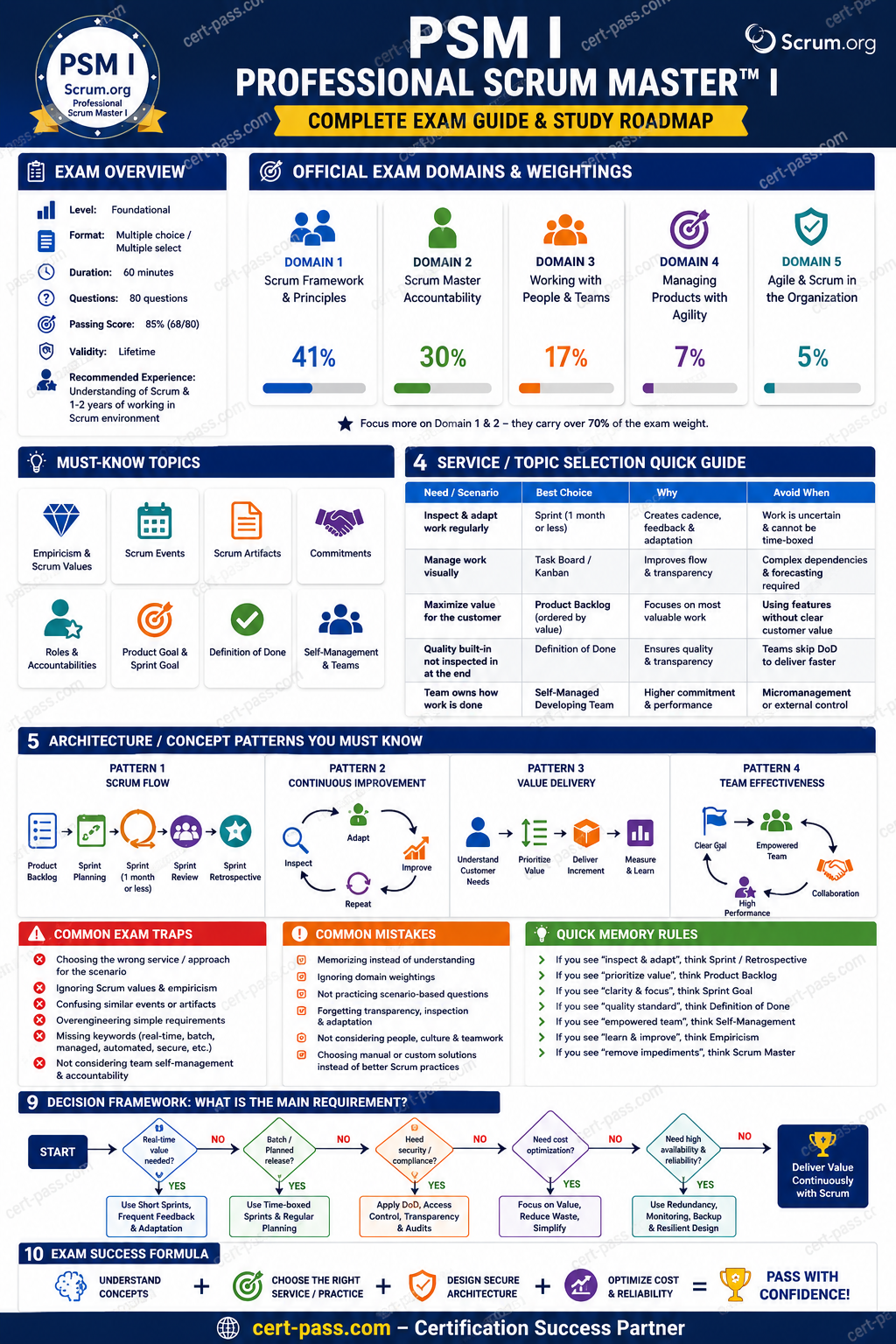
Your Professional Scrum Master™ I Roadmap

Professional Scrum Master™ I certification preparation infographic

You're viewing 5 of 19 free modules

The remaining 14 modules cover advanced topics, exam traps, and scenarios that appear on the certification exam.

Unlock All : $ 29

1. Exam Overview

What the exam is testing

PSM I tests whether you understand Scrum as defined in the Scrum Guide and whether you can apply it in realistic team, stakeholder, product, and organizational situations. It is not mainly a memorization test. It checks whether you can identify what Scrum requires, what is optional, and what is an anti-pattern.

The exam expects you to understand:

  • Scrum theory: empiricism, lean thinking, transparency, inspection, adaptation.
  • Scrum accountabilities: Scrum Master, Product Owner, Developers.
  • Scrum events: Sprint, Sprint Planning, Daily Scrum, Sprint Review, Sprint Retrospective.
  • Scrum artifacts and commitments: Product Backlog / Product Goal, Sprint Backlog / Sprint Goal, Increment / Definition of Done.
  • How Scrum works with stakeholders, governance, compliance, forecasting, product value, and complex adaptive work.

How to think like the exam

The exam rewards answers that are:

  • Empirical, not predictive command-and-control.
  • Scrum Guide aligned, not based on generic project management habits.
  • Team-empowering, not manager-driven task assignment.
  • Value-focused, not output-focused.
  • Transparent, not hiding problems until later.
  • Adaptive, not freezing plans against evidence.

When choosing an answer, ask:

  1. Does this preserve transparency?
  2. Does this support inspection and adaptation?
  3. Does this respect accountabilities?
  4. Does this avoid adding non-Scrum roles, approvals, phases, or gates?
  5. Does this help the Scrum Team deliver a Done Increment?

How to use this course

Read this course in three passes:

  1. Foundation pass: learn the framework, roles, events, artifacts, commitments, and time-boxes.
  2. Reasoning pass: study traps, scenarios, and elimination rules.
  3. Final pass: use the memory rules, rapid review, and exam-day checklist.

Do not study by memorizing answer letters. Study the reasoning behind why one answer protects Scrum and another answer weakens it.


2. Exam Domains

Scrum.org does not publish AWS-style numeric domain weights for PSM I. It publishes focus areas under Professional Scrum Competencies. The source question bank is organized around these official competency areas.

Official Scrum.org Competency Area Questions in Source Bank Approx. Source Priority What Matters Most
Understanding and Applying the Scrum Framework 672 64% Scrum theory, events, artifacts, commitments, Done, Sprint Goal, accountabilities
Developing People and Teams 231 22% Scrum Master service, coaching, facilitation, self-management, impediments
Managing Products with Agility 147 14% Product value, Product Owner accountability, Product Backlog, stakeholders, forecasting

Priority notes

The highest-value exam areas are:

  1. Sprint Goal, Sprint Backlog, and Developers' adaptation during the Sprint.
  2. Definition of Done and Increment quality.
  3. Product Owner accountability for Product Backlog ordering and value.
  4. Scrum Master accountability for coaching the team and organization.
  5. Sprint Review vs status meeting confusion.
  6. Daily Scrum purpose and who uses it.
  7. Self-management vs external assignment of work.
  8. Transparency, inspection, and adaptation as the basis of decisions.

What matters most

PSM I often tests whether you can reject plausible but wrong answers that sound professional, such as:

  • “Project manager assigns tasks.”
  • “Stakeholders approve the Increment at Sprint Review.”
  • “The Scrum Master enforces velocity targets.”
  • “The Product Owner changes the Sprint Goal mid-Sprint.”
  • “Testing is done in a later hardening Sprint.”
  • “The Daily Scrum is a status report to the Scrum Master.”

3. Start-to-Finish Study Path

Phase 1 : Foundation

Learn the exact Scrum structure:

  • Scrum is a lightweight framework for complex work.
  • Scrum is founded on empiricism and lean thinking.
  • The Scrum Team has three accountabilities: Product Owner, Scrum Master, Developers.
  • Scrum has five events inside the Sprint.
  • Scrum has three artifacts and each artifact has one commitment.

Foundation goal: you should be able to explain every event, artifact, commitment, and accountability without looking.

Phase 2 : Intermediate

Move from definitions to application:

  • Decide who owns each decision.
  • Identify whether a scenario requires transparency, inspection, or adaptation.
  • Recognize anti-patterns around approvals, handoffs, late testing, separate QA phases, and external task assignment.
  • Understand how Scrum handles governance without replacing empiricism.

Intermediate goal: you should be able to eliminate two wrong answers quickly in most questions.

Phase 3 : Advanced

Practice scenario reasoning:

  • When stakeholders disagree, increase transparency and inspect value.
  • When quality is low, improve Definition of Done and engineering practices.
  • When the organization blocks agility, Scrum Master coaches and removes impediments.
  • When scope changes, Product Owner manages Product Backlog; Sprint Goal remains stable unless the Sprint becomes obsolete.
  • When forecasts are requested, use empirical evidence, not fixed promises.

Advanced goal: you should know why the “professional-sounding” answer is often wrong.

Phase 4 : Final Review

Review these repeatedly:

  • Events and purposes.
  • Artifact commitments.
  • Accountabilities.
  • Time-boxes.
  • Definition of Done.
  • Increment rules.
  • Scrum Master service to Developers, Product Owner, and organization.
  • Product Owner value decisions.
  • Common traps.

4. Core Concepts by Domain

Domain 1: Understanding and Applying the Scrum Framework

Concepts

Scrum theory

Scrum is based on:

  • Empiricism: knowledge comes from experience and decisions are based on observation.
  • Lean thinking: reduce waste and focus on essentials.
  • Transparency: important information is visible and understood.
  • Inspection: frequently inspect artifacts and progress.
  • Adaptation: adjust when results deviate from goals.

Scrum Team

A Scrum Team is:

  • One Product Owner.
  • One Scrum Master.
  • Developers.
  • Small enough to remain nimble and large enough to complete significant work.
  • Self-managing and cross-functional.
  • Accountable for creating a valuable, useful Increment every Sprint.

There are no sub-teams or hierarchies inside the Scrum Team.

Accountabilities

Accountability Owns / Is accountable for Does not do
Product Owner Maximizing product value, Product Goal, Product Backlog ordering and transparency Does not assign Sprint tasks to Developers
Scrum Master Establishing Scrum, coaching, facilitation, removing impediments, serving team/PO/organization Does not manage Developers as a project manager
Developers Sprint Backlog, quality, creating Done Increment, adapting plan toward Sprint Goal Do not wait for external task assignment

Events

Event Purpose Key exam point
Sprint Container for all Scrum events and work toward Product Goal No changes that endanger Sprint Goal
Sprint Planning Decide why, what, and how for the Sprint Sprint Goal is created during planning
Daily Scrum Developers inspect progress toward Sprint Goal and adapt plan Not a status meeting for Scrum Master
Sprint Review Inspect Increment and adapt Product Backlog Not a formal approval gate
Sprint Retrospective Inspect how the team worked and plan improvements Focuses on process, quality, collaboration

Artifacts and commitments

Artifact Commitment Purpose
Product Backlog Product Goal Transparent ordered list of what is needed to improve product
Sprint Backlog Sprint Goal Plan by and for Developers for the Sprint
Increment Definition of Done Concrete stepping stone toward Product Goal

Definition of Done

The Definition of Done is a formal description of the state of the Increment when it meets required quality measures.

Exam rules:

  • Work not meeting the Definition of Done is not part of the Increment.
  • The Increment must be usable.
  • Multiple Scrum Teams on one product must share the same Definition of Done or a standard that ensures integrated quality.
  • Do not choose answers that defer testing, integration, security, or compliance to a later phase if these are needed for Done.

Sprint Goal

The Sprint Goal is the commitment for the Sprint Backlog. It provides focus and flexibility.

Important rules:

  • Developers adapt the Sprint Backlog during the Sprint as more is learned.
  • The Sprint Goal should not be changed casually.
  • If the Sprint Goal becomes obsolete, only the Product Owner can cancel the Sprint.
  • Stakeholders do not directly change the Sprint Goal during the Sprint.
lock

Patterns

This module is part of the full course. Unlock all 19 modules + 80+ practice questions.

lock_open Unlock for $ 29

One-time payment · 48h money-back guarantee

lock

Traps

This module is part of the full course. Unlock all 19 modules + 80+ practice questions.

lock_open Unlock for $ 29

One-time payment · 48h money-back guarantee

lock

Concepts

This module is part of the full course. Unlock all 19 modules + 80+ practice questions.

lock_open Unlock for $ 29

One-time payment · 48h money-back guarantee

lock

Patterns

This module is part of the full course. Unlock all 19 modules + 80+ practice questions.

lock_open Unlock for $ 29

One-time payment · 48h money-back guarantee

lock

Traps

This module is part of the full course. Unlock all 19 modules + 80+ practice questions.

lock_open Unlock for $ 29

One-time payment · 48h money-back guarantee

lock

Concepts

This module is part of the full course. Unlock all 19 modules + 80+ practice questions.

lock_open Unlock for $ 29

One-time payment · 48h money-back guarantee

lock

Patterns

This module is part of the full course. Unlock all 19 modules + 80+ practice questions.

lock_open Unlock for $ 29

One-time payment · 48h money-back guarantee

lock

Traps

This module is part of the full course. Unlock all 19 modules + 80+ practice questions.

lock_open Unlock for $ 29

One-time payment · 48h money-back guarantee

lock

5. Service Selection Guide

This module is part of the full course. Unlock all 19 modules + 80+ practice questions.

lock_open Unlock for $ 29

One-time payment · 48h money-back guarantee

lock

6. Architecture Patterns

This module is part of the full course. Unlock all 19 modules + 80+ practice questions.

lock_open Unlock for $ 29

One-time payment · 48h money-back guarantee

lock

7. Exam Traps

This module is part of the full course. Unlock all 19 modules + 80+ practice questions.

lock_open Unlock for $ 29

One-time payment · 48h money-back guarantee

lock

8. Quick Memory Rules

This module is part of the full course. Unlock all 19 modules + 80+ practice questions.

lock_open Unlock for $ 29

One-time payment · 48h money-back guarantee

lock

9. Final Revision Notes

This module is part of the full course. Unlock all 19 modules + 80+ practice questions.

lock_open Unlock for $ 29

One-time payment · 48h money-back guarantee

lock

10. Exam-Day Checklist

This module is part of the full course. Unlock all 19 modules + 80+ practice questions.

lock_open Unlock for $ 29

One-time payment · 48h money-back guarantee

What others say

star star star star star

"The compressed course cut my study time in half. Every domain for Professional Scrum Master™ I explained with clear examples. Passed first attempt."

Sarah M.

IT Professional

Scored 93%
star star star star star

"Every topic explained clearly. The exam traps section for Professional Scrum Master™ I alone was worth it. Highly recommend."

James K.

Cloud Engineer

Scored 91%

Unlock the full course

Stop guessing. Start passing.

5 of 19 modules free. The remaining 14 modules contain the exam traps, edge cases, and domain deep-dives that make the difference.

48h money-back guarantee Secure PayPal checkout

Unlock all 19 modules

From $ 29 · One-time payment

Unlock

Course Modules

19 modules

Unlock All Modules

Get full access to all 19 modules

auto_stories More Guides