Databricks Data Engineer Associate Fundamentals Guide 2026: What to Learn First
Quick answer
Databricks Data Engineer Associate is easiest to approach when the candidate studies the platform in the same order that a real project uses it. The best starting point is not an advanced tuning topic or a long list of notebook tricks. The best starting point is the core Databricks workflow: how data enters the platform, how Delta tables are organized, how Unity Catalog controls access, how jobs run, and how the pipeline is monitored after it goes live.
That order matters because the exam asks practical questions. A candidate who understands the basic platform flow can usually eliminate wrong answers faster than a candidate who memorizes random product names without a structure. This guide focuses on what to learn first so the rest of the exam feels logical instead of crowded.
For the official exam path, start here: Databricks Data Engineer Associate. For low friction practice, use Try 35 free Databricks Data Engineer Associate practice questions - no signup required. For a tighter review once the foundation is in place, Preview the compressed Databricks Data Engineer Associate course.
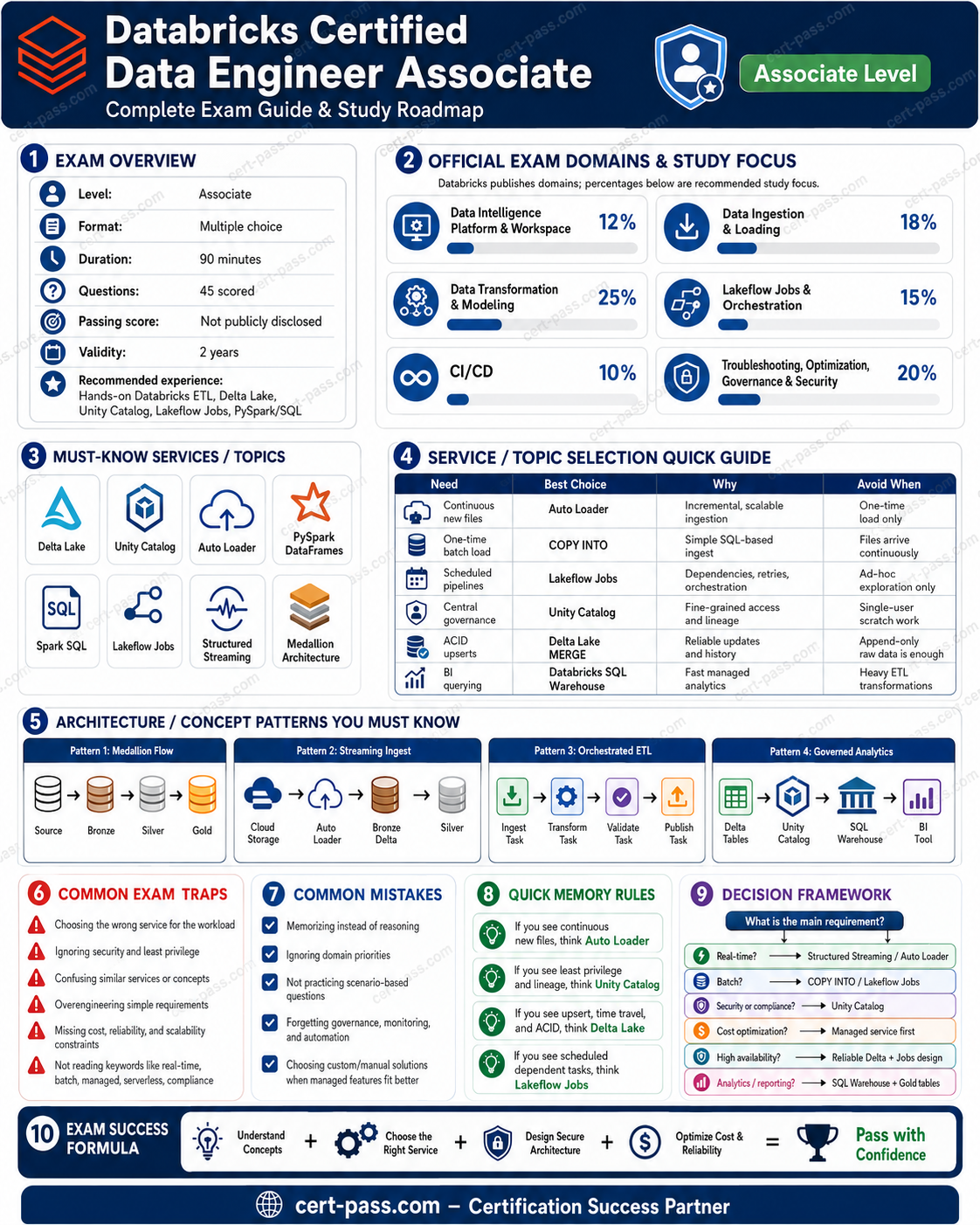
Official exam facts
| Detail | Current info |
|---|---|
| Exam name | Databricks Certified Data Engineer Associate |
| Exam code | Data Engineer Associate |
| Vendor | Databricks |
| Exam slug | databricks-data-engineer-associate |
| Questions | 45 scored questions |
| Duration | 90 minutes |
| Question type | Multiple choice |
| Registration fee | $200 |
| Prerequisites | None, but related training highly recommended |
| Recommended experience | Hands on experience performing the data engineering tasks outlined in the exam guide |
| Delivery method | Online or test center |
| Validity period | 2 years |
| Exam page | Databricks Data Engineer Associate |
| Official certification page | Databricks certification overview |
| Cert-Pass pricing start | EUR 29 |
| Full access pricing start | EUR 39 |
| Last verified | 2026-06-01 |
The official Databricks page is the source of truth for the current exam structure. It confirms the scored question count, time limit, registration fee, delivery method, recommended experience, and two year validity. That matters because the study plan should match the real exam shape. This is an associate certification, but it still expects practical understanding of how Databricks is used in production.
What this guide is trying to solve
Many candidates approach Databricks by learning features in the order they appear in documentation. That often creates confusion because the platform is easier to understand through workflow than through random feature lists. This guide solves that problem by organizing the exam around the order a good engineer would actually use:
- understand the Databricks lakehouse model;
- learn how data is stored in Delta tables;
- learn how notebooks, SQL, and jobs fit together;
- learn how Unity Catalog controls governance;
- learn how to monitor, test, and troubleshoot the pipeline.
If those five ideas are clear, the rest of the exam becomes much easier to absorb.
The best first principle: learn the platform flow
The exam is much easier when Databricks is seen as a system rather than as isolated tools. A data set usually moves through a sequence:
- it arrives from a source;
- it is ingested or transformed in a notebook or job;
- it becomes a Delta table;
- it is governed and shared through Unity Catalog;
- it is queried or consumed downstream;
- it is monitored and maintained.
That may sound obvious, but many exam mistakes happen because the candidate knows the name of a feature without understanding where it fits in the flow. The exam likes to test whether the candidate can choose the right layer.
The key question to ask during study is simple: what part of the pipeline is this topic about? If the answer is ingestion, storage, governance, orchestration, or troubleshooting, the candidate can narrow the answer choices quickly.
What to learn first and what to postpone
Learn first
| Topic | Why it comes first |
|---|---|
| Databricks lakehouse basics | Everything else sits on top of this model |
| Delta Lake fundamentals | Tables, reliability, ACID behavior, and data consistency are central |
| Notebooks and SQL workflows | Most practical work starts here |
| Jobs and orchestration | Pipelines need to run reliably, not just once |
| Unity Catalog | Governance and access control are common exam themes |
| Basic data quality checks | Data engineering is not only about moving data |
| Tables, views, and managed data | The exam often asks how data should be stored and shared |
| Monitoring and troubleshooting | Real pipelines fail, so the exam tests response logic |
Learn later
| Topic | Why it can wait |
|---|---|
| Edge case optimization patterns | Useful, but not the first foundation |
| Deep platform administration details | Less central for associate level questions |
| Rare advanced deployment choices | Better after the core flow is understood |
| Platform feature comparisons that do not affect day to day work | Easy to overstudy and underuse |
| Fancy notebook tricks | Not as important as clean pipeline logic |
This is an important filter. Many candidates waste time on topics that sound advanced but do not move the score much. Associate level study should focus on the core platform logic first.
Databricks concept 1: the lakehouse idea
The lakehouse concept combines data lake flexibility with warehouse style reliability and governance. In plain terms, that means the platform should support both scale and structure. The candidate should know why this matters:
- data can be stored in open formats;
- transformations can happen on top of that data;
- governance can still be applied;
- analytics and engineering can work from the same foundation;
- the platform can support both raw and refined layers.
If a question asks why Databricks is different from a simple file system or a basic warehouse, the lakehouse concept is often the answer direction.
A useful way to remember it is this: Databricks is not just a place to store files. It is a platform for organizing data work.
Databricks concept 2: Delta Lake as the core storage idea
Delta Lake is one of the most important things to understand first because it appears in many exam scenarios. Candidates should know that Delta supports more reliable table behavior than raw files alone.
Key ideas to know:
- Delta tables are central to managed Databricks data work;
- Delta helps with consistency and reliability;
- tables are easier to manage than ad hoc file paths;
- transaction support matters when multiple processes read and write data;
- table design affects downstream trust.
Delta table study checklist
| Question | What to know |
|---|---|
| Why use Delta instead of raw files? | Better table reliability and easier data management |
| How does a table support analytics? | It provides structured and governed access |
| Why are managed table patterns helpful? | They simplify maintenance and data sharing |
| Why does the exam care about table design? | Because bad table choices create downstream issues |
Delta is not just a storage format topic. It is a reliability and production workflow topic. That is why it is worth learning early.
Databricks concept 3: notebooks, SQL, and jobs
A candidate should understand how the platform's execution tools relate to each other.
Notebooks
Notebooks are often used for interactive development, exploration, and transformation logic. They are helpful for testing ideas and for documenting steps in a readable form.
SQL
SQL remains central for transformation and analysis. The exam expects the candidate to understand common SQL logic in the Databricks context.
Jobs
Jobs run code on a schedule or trigger. They turn a notebook or task into a repeatable pipeline. The exam often asks which approach is best when a process needs to run reliably in production.
How they fit together
| Tool | Best role |
|---|---|
| Notebook | Interactive development and explanation |
| SQL | Querying and transformation logic |
| Job | Reliable repeatable execution |
A common beginner mistake is to study notebooks as if they were the whole platform. They are not. They are one part of a larger execution flow. The exam often wants the candidate to choose the right deployment or runtime pattern, not just the right coding surface.
Databricks concept 4: Unity Catalog and governance
Unity Catalog is one of the most important governance concepts in the platform. The candidate should learn it early because many questions about access, organization, and sharing are really governance questions in disguise.
What to understand about Unity Catalog
- it helps manage access and governance;
- it organizes data assets more cleanly;
- it supports a more structured platform design;
- it helps teams control who can see what;
- it matters when data is shared across users or domains.
Governance study matrix
| Scenario | Likely topic |
|---|---|
| Who can access the table | Permissions and governance |
| Which team owns the asset | Organization and catalog structure |
| How to share governed data | Unity Catalog concepts |
| How to separate raw and trusted data | Data organization and governance |
If the exam question includes words like permissions, access, catalog, ownership, or governance, Unity Catalog should be near the top of the candidate's mind.
Databricks concept 5: pipelines and orchestration
The exam is not only about data models. It is also about whether the pipeline can run correctly in a real environment.
A candidate should understand:
- how tasks are chained;
- how jobs are scheduled;
- why repeatability matters;
- how failures are handled;
- why a pipeline should be easier to maintain than a collection of manual steps.
The platform becomes much easier to reason about when the candidate sees that orchestration is part of the data engineering job, not a separate afterthought.
Pipeline questions often test
- which step should run first;
- how to make the job reliable;
- how to handle retries;
- how to separate development from production;
- how to avoid manual reruns when the pipeline should be automated.
Databricks concept 6: data quality and validation
Databricks Data Engineer Associate is not only about moving data from point A to point B. It is also about making sure the result is trustworthy.
Candidates should understand:
- why simple validation checks matter;
- why data quality is part of the pipeline design;
- why bad data can cause downstream issues even if the job technically succeeds;
- why tests or checks should be placed where the data is transformed or published.
Useful data quality ideas
| Idea | Why it matters |
|---|---|
| Null checks | Prevent missing critical values |
| Deduplication | Avoid repeated business records |
| Schema consistency | Keep pipelines stable |
| Row count changes | Help detect unexpected behavior |
| Freshness checks | Catch late or missing source data |
The exam often prefers the answer that adds a sensible check or control rather than the answer that hopes the data will be fine.
What a first time learner should focus on in week 1
A strong week 1 plan keeps the scope small and manageable.
Week 1 goals
- understand the Databricks platform vocabulary;
- know what Delta Lake is and why it matters;
- know what notebooks, SQL, and jobs each do;
- know what Unity Catalog is used for;
- know the difference between data movement and data governance;
- know how the pipeline should be organized in broad terms.
Week 1 things to avoid
- deep optimization rabbit holes;
- advanced platform administration details;
- overfocusing on rare edge cases;
- trying to memorize every menu item or UI label;
- ignoring basic SQL and data engineering logic.
The goal is not to finish everything in week 1. The goal is to build a skeleton that the rest of the material can attach to.
Useful asset: learning order matrix
Use this matrix to decide what to study first and what to leave for later.
| Order | Topic | Mastery target |
|---|---|---|
| 1 | Lakehouse concept | Explain why Databricks combines engineering and analytics in one platform |
| 2 | Delta Lake | Explain why reliable table behavior matters |
| 3 | Notebooks and SQL | Explain how development and transformation work |
| 4 | Jobs and orchestration | Explain how pipelines become repeatable |
| 5 | Unity Catalog | Explain how governance and access are managed |
| 6 | Data quality | Explain how to make outputs trustworthy |
| 7 | Troubleshooting | Explain where to look when something fails |
| 8 | Optimization | Explain when to improve cost or performance |
This is the most useful asset in the guide because it prevents the beginner from studying in the wrong order.
How exam questions usually feel
Databricks questions often feel like practical workflow questions rather than pure memorization. The prompt may describe a team, a pipeline, a data sharing challenge, a permissions issue, or a table design problem. The answer choices usually reflect different platform layers.
The candidate should ask:
- Is this about storage, transformation, or access?
- Is the question about interactive work or scheduled work?
- Is the question about reliability or governance?
- Is the issue about the data itself or the system that moves the data?
Once the layer is clear, the candidate can often eliminate one or two answers immediately.
Common beginner mistakes
Mistake 1: learning the UI before the workflow
The UI can change. The workflow is more stable. Candidates should learn the sequence of data work first.
Mistake 2: treating notebooks like the whole platform
Notebooks are important, but they are only one part of Databricks. Jobs, governance, and Delta tables are equally important.
Mistake 3: ignoring governance until the end
Governance is not an advanced afterthought. It is part of how a data platform stays usable.
Mistake 4: overstudying advanced optimization first
Optimization is useful, but it is more valuable after the basic data flow is understood.
Mistake 5: trying to memorize service names without understanding use cases
The exam rewards use case reasoning. It is better to know what a feature does than to know only the name.
How to think about the platform as layers
A clean mental model for Databricks is to think in layers.
| Layer | What it answers |
|---|---|
| Ingestion | How does the data arrive? |
| Storage | How is the data organized and saved? |
| Transformation | How is the data cleaned or reshaped? |
| Orchestration | How does the pipeline run repeatedly? |
| Governance | Who can access the data? |
| Quality | Can the output be trusted? |
| Troubleshooting | What happens if something breaks? |
If a question is vague, try locating it in one of these layers. That usually points to the correct Databricks topic faster than trying to remember the answer from a study note.
Study sequence for the first two weeks
| Day | Focus | What to learn |
|---|---|---|
| 1 | Platform overview | Lakehouse, Delta, and the role of Databricks |
| 2 | Storage basics | Delta tables, managed data, and table organization |
| 3 | Work surface | Notebooks, SQL, and interactive development |
| 4 | Jobs | Repeatable execution and orchestration |
| 5 | Governance | Unity Catalog, permissions, and ownership |
| 6 | Data quality | Validation checks and trust |
| 7 | Mixed review | Explain the platform flow in one paragraph |
| 8 | Pipeline design | Source to table to downstream consumption |
| 9 | Troubleshooting | Where to look when a pipeline fails |
| 10 | Security and access | Permissions and catalog control |
| 11 | Cost and efficiency | Why good design reduces waste |
| 12 | Mixed questions | Apply the layers to scenarios |
| 13 | Weak spot cleanup | Revisit the hardest topics |
| 14 | Practice test | Check whether the core ideas are stable |
Service and concept mapping
| If the prompt says... | Think about... |
|---|---|
| Data should be stored reliably | Delta Lake |
| Data should be scheduled or automated | Jobs |
| Data should be explored or built interactively | Notebooks |
| Access should be controlled | Unity Catalog |
| Output should be trusted | Validation and data quality |
| A process failed and needs review | Troubleshooting |
| The data flow feels too manual | Orchestration |
| The learner is confused by the platform structure | Lakehouse mental model |
This mapping is intentionally simple because the beginner should learn the core decisions first.
What to do after learning the basics
Once the candidate understands the platform flow, the next step is to connect the ideas to practice questions. That is where the knowledge becomes testable.
The best progression is:
- read the study guide;
- review the exam facts;
- practice with scenario questions;
- read the explanations carefully;
- revisit the weak topic;
- repeat until the platform flow feels natural.
If the candidate wants to move from fundamentals into practice, the next best page is Databricks Data Engineer Associate Practice Questions 2026: 20 Realistic Examples. If the candidate wants to understand whether the credential is worth the effort, compare this guide with Databricks Data Engineer Associate Career Guide 2026.
Useful asset: first 30 day study plan
| Week | Focus | What to do |
|---|---|---|
| Week 1 | Platform flow | Learn lakehouse basics, Delta, notebooks, jobs, and Unity Catalog |
| Week 2 | Scenario practice | Turn the platform ideas into question style decisions |
| Week 3 | Weak spot review | Revisit the topics that still feel fuzzy |
| Week 4 | Mixed practice | Work full mixed sets and explain every wrong answer |
Use this plan if the platform still feels like a long list. A month is enough to make the structure much clearer if the learner stays in the correct order.
Quick scenario checklist
Before choosing an answer, ask these questions:
- Is the issue about storage, transformation, or governance?
- Is the data flow interactive or automated?
- Is the problem about trust, access, or maintenance?
- Does the question describe a platform layer or a business need?
- Is the simplest answer also the one that keeps the workflow stable?
This checklist is useful because Databricks questions often hide the correct topic inside a business description. The learner who can translate the wording into a platform layer will usually choose better answers.
What to leave for later
A beginner does not need to master every advanced detail at once. Topics that can wait until the foundation is clear include:
- deep optimization and tuning edge cases;
- rare administrative features;
- subtle deployment differences that do not affect the basic pipeline flow;
- obscure feature comparisons that rarely appear in beginner practice;
- platform trivia that does not change the design decision.
The exam is much easier when the candidate avoids the temptation to study everything equally. The important thing is to understand the main workflow first.
Related reading in the Cert-Pass library
To keep the cluster moving in a sensible order, the most useful pages are:
- Databricks Data Engineer Associate Career Guide 2026
- Databricks Data Engineer Associate Practice Questions 2026: 20 Realistic Examples
- Databricks Data Engineer Tips 2026: Delta Lake, Unity Catalog, Jobs, and CI/CD
- 30 Databricks Data Engineer Interview Questions and Answers 2026
- Databricks Data Engineer Associate Worth It 2026: Salary, ROI, and Job Market
For the official route and practice entry point, keep these links handy:
- Databricks Data Engineer Associate
- Try 35 free Databricks Data Engineer Associate practice questions - no signup required
- Preview the compressed Databricks Data Engineer Associate course
Common misconceptions
| Misconception | Better interpretation |
|---|---|
| Databricks is only for notebooks | The platform includes storage, governance, orchestration, and quality |
| Delta is just a file format detail | Delta is a central reliability and table management concept |
| Unity Catalog is optional trivia | Governance and access control are common exam themes |
| Jobs are only for scheduling | Jobs make the pipeline repeatable and maintainable |
| Data quality can wait until after launch | Quality is part of production readiness |
These misconceptions matter because they lead beginners to under study the very topics that most improve their score.
Mini practice prompts
| Prompt style | What to identify first |
|---|---|
| Data arrives from a source and must be made reliable | Delta and table organization |
| Multiple teams need governed access | Unity Catalog and permissions |
| A workflow must run every day without manual steps | Jobs and orchestration |
| The team needs a stable structure for storage and analytics | Lakehouse and Delta concepts |
| The output should be validated before use | Data quality and checks |
Working through these prompt types out loud is a strong way to prepare because it trains the learner to think in layers instead of memorizing isolated facts.
Final study rule
If a topic does not help explain the platform flow, it should probably not be the first topic studied. That is the best rule for beginners on this exam.
What should be learned first for Databricks Data Engineer Associate?
Start with the lakehouse concept, then Delta Lake, then notebooks and SQL, then jobs, then Unity Catalog.
Is Delta Lake important for the exam?
Yes. It is one of the core ideas behind how Databricks organizes reliable data work.
Is Unity Catalog something a beginner can ignore?
No. It is part of the core platform story because governance and access control are important exam themes.
Should the candidate study optimization first?
No. Optimization should come after the basic workflow and governance topics are clear.
Is this exam mostly about using notebooks?
No. Notebooks matter, but the exam is broader. It also covers tables, jobs, governance, and data quality.
How long is the certification valid?
The official Databricks page lists a validity period of 2 years.
What a simple first production pipeline should look like
A beginner often understands Databricks faster when the platform is turned into a plain pipeline story. The exam is not asking for a perfect architecture diagram. It is asking whether the candidate can recognize the order in which a healthy data workflow should happen.
| Layer | Example | Why it matters |
|---|---|---|
| Ingestion | Data arrives from a source system or file drop | The pipeline needs an entry point |
| Transformation | Notebook or SQL logic cleans and reshapes the data | Raw data must become usable |
| Storage | Delta table holds the structured result | Reliable tables are easier to manage |
| Governance | Unity Catalog controls access and ownership | Teams need permissions and order |
| Orchestration | Job runs the steps on a schedule or trigger | The work must repeat without manual effort |
| Quality | Validation checks confirm the output is trustworthy | A successful run is not enough if the data is bad |
| Consumption | A downstream query, report, or application reads the table | The work needs to create value |
If the candidate can explain that flow out loud, many exam questions become easier to classify. Questions about where a feature belongs, why a table should be managed a certain way, or how to make a process repeatable usually fit one of those layers. That is why the exam is easier when the learner studies the pipeline as a sequence instead of a pile of separate tool names.
How to answer exam questions by layer
One of the easiest ways to improve on Databricks questions is to ask which layer of the pipeline the prompt is describing. That habit turns a long scenario into a smaller decision.
| If the prompt sounds like this | The candidate should think about |
|---|---|
| raw data is arriving | ingestion |
| data must be cleaned or reshaped | transformation |
| the result must be saved reliably | Delta tables and storage |
| access must be controlled | Unity Catalog and governance |
| the process must repeat automatically | jobs and orchestration |
| the output must be trusted | quality checks |
This layer based approach matters because the associate exam often uses business language to describe a technical problem. When the learner can place the question in the right layer, the correct answer is usually easier to see and the wrong answers become easier to eliminate.
Final answer
The best way to study Databricks Data Engineer Associate is to learn the platform in workflow order. Start with the lakehouse idea, then Delta Lake, then notebooks and SQL, then jobs, then Unity Catalog, then quality and troubleshooting. That sequence gives the candidate a mental map that can absorb the rest of the exam without turning the platform into a confusing list of unrelated features.
Use the exam hub as the anchor: Databricks Data Engineer Associate. Use free practice to check the basics: Try 35 free Databricks Data Engineer Associate practice questions - no signup required. Use the compressed course when the foundation is ready and the candidate wants to tighten the final review: Preview the compressed Databricks Data Engineer Associate course.
The fastest path to confidence is simple: learn the order, not just the names, and then test that order against real scenario questions until the platform flow feels automatic for most candidates.