Databricks Data Engineer Associate Career Guide 2026
Quick answer
The Databricks Data Engineer Associate certification is most valuable when a job target already sits close to Databricks work: building pipelines, managing Delta tables, using Unity Catalog, troubleshooting production data flows, or supporting analytics engineering in a lakehouse environment. It is not a magic shortcut to a data engineering role, but it is a credible signal that the candidate understands Databricks in the way hiring teams actually use it.
That makes the credential useful for people who want to show practical familiarity with ingestion, transformations, orchestration, access control, and operational thinking. It is less useful when the target role is still broad, not yet platform specific, or centered mainly on another stack.
For the official exam baseline, start with the exam hub here: Databricks Data Engineer Associate. If the goal is to practice before paying for the full package, use Try 35 free Databricks Data Engineer Associate practice questions - no signup required. If the goal is a compact review of the highest priority topics, Preview the compressed Databricks Data Engineer Associate course.
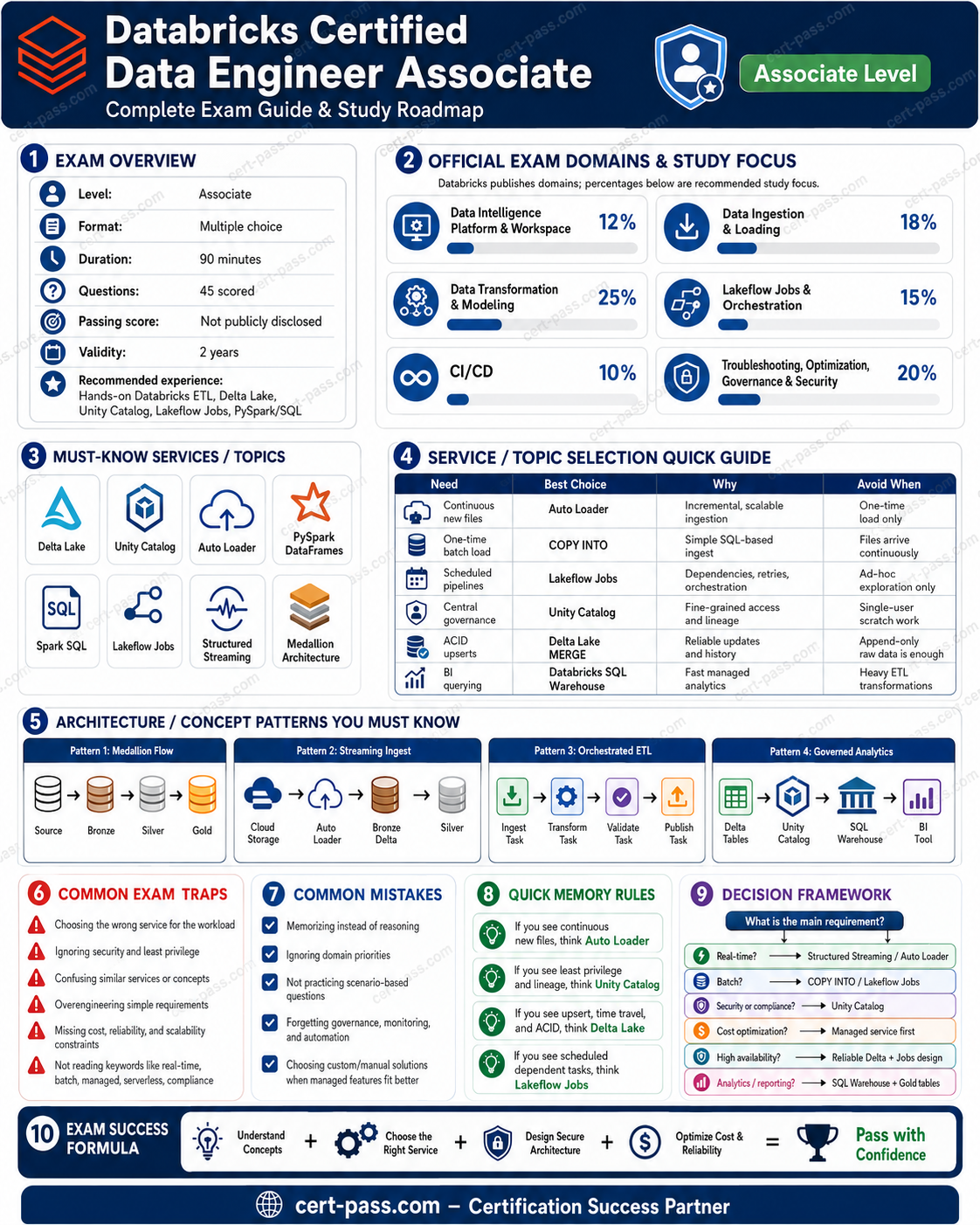
Official exam facts
| Detail | Info |
|---|---|
| Exam name | Databricks Certified Data Engineer Associate |
| Exam code | Data Engineer Associate |
| Vendor | Databricks |
| Exam page | Databricks Data Engineer Associate |
| Questions | 45 scored questions |
| Time limit | 90 minutes |
| Question type | Multiple choice |
| Registration fee | $200 |
| Prerequisites | None, but related training highly recommended |
| Recommended experience | Hands on experience performing the data engineering tasks outlined in the exam guide |
| Delivery method | Online or test center |
| Validity period | 2 years |
| Recertification | Required every two years |
| Official certification page | Databricks certification overview |
| Last verified | 2026-06-01 |
The official Databricks page is the source of truth for the current structure of the exam. It confirms the scored question count, time limit, registration fee, question type, prerequisites, experience recommendation, and two year validity. That matters because a career guide should begin with real exam facts, then move into what the credential means for work, interviews, and job search positioning.
What this certification actually signals
The Databricks Data Engineer Associate credential does not prove that a candidate can solve every data engineering problem. It signals something narrower and more useful: the candidate understands the Databricks way of organizing data work. That usually includes how to move data into the platform, how to model it with Delta, how to reason about access and governance, how to operate jobs, and how to make practical decisions when something breaks.
That signal matters because many hiring teams are not just looking for generic SQL ability. They want evidence that a candidate can work inside the Databricks ecosystem without needing constant basic guidance. A certification helps reduce uncertainty. It tells the reviewer that the candidate has studied the platform structure, the terminology, and the standard patterns that show up in actual Databricks projects.
The certification also signals a style of thinking. Databricks exam questions often ask which feature, object, or workflow best matches the scenario. That means the exam is not merely checking memory. It is testing whether the candidate can translate a problem statement into the correct Databricks decision. In real work, that habit matters a great deal. A person who can recognize the right layer of the problem usually makes better architecture and troubleshooting choices.
Who gets the most value from it
The strongest benefit comes to candidates whose target roles already mention Databricks, Delta Lake, Unity Catalog, notebooks, job orchestration, or lakehouse pipelines. If the team expects those tools, the certification can help the resume and can make interview conversations more concrete.
Best fit profiles
| Candidate profile | Why the cert helps |
|---|---|
| Early career data engineer | Gives a recognizable platform signal and a structured learning path |
| Analytics engineer working in Databricks | Shows practical understanding of transformations and governed data delivery |
| Platform engineer supporting data teams | Demonstrates awareness of the Databricks surface area and operational patterns |
| Cloud engineer moving toward data work | Helps bridge infrastructure experience into a data platform context |
| Student or career switcher with SQL fundamentals | Provides a clearer target than trying to learn the whole stack at once |
| Consultant or contractor | Helps reassure clients that the Databricks platform is not unfamiliar |
Weaker fit profiles
| Candidate profile | Why the cert is less useful |
|---|---|
| Role is still platform agnostic | A general data portfolio may matter more than a vendor credential |
| Team uses a different stack | Another platform certification may be more relevant |
| Candidate lacks SQL basics | The exam becomes harder because Databricks work still relies on strong query reasoning |
| Target role is mostly analytics reporting | A BI or dashboard portfolio might be more persuasive |
| Candidate wants leadership only | Architecture and delivery proof may matter more than an associate level badge |
The main decision is not whether the credential is good or bad in isolation. The decision is whether it matches the role the candidate wants next. If the target role mentions Databricks, it becomes much more useful. If it does not, the certificate may still help, but it will not be the highest value signal in the market.
What hiring teams usually infer
Hiring teams do not usually interpret the certification as proof of mastery. They interpret it as a sign of credible platform familiarity. That can still be helpful.
A hiring manager may infer the candidate can:
- talk about lakehouse concepts without confusion;
- distinguish batch and streaming style workflows at a high level;
- understand the role of Delta tables in managed analytics;
- use Unity Catalog terminology correctly;
- reason about jobs, notebooks, and orchestration at a practical level;
- avoid obvious platform mistakes in an interview;
- learn the employer's Databricks implementation faster than a completely new learner.
What the credential does not infer by itself:
- deep architecture judgment;
- experience with production incidents;
- scale specific tuning across every workload;
- business domain understanding;
- senior design ability without supporting evidence.
That distinction is important. The certification opens a door. It does not walk through the door for the candidate. The strongest job search strategy is to pair the credential with one or two concrete projects that show the candidate can actually use Databricks in a controlled setting.
The real career question behind the certification
The title of this page sounds like a career question, but the underlying question is usually simpler: does this certification make the candidate more employable for Databricks work?
The answer is yes, but only when the rest of the profile is consistent with that goal. The certification helps most when it sits on top of one or more of the following:
- SQL fluency;
- cloud basics;
- a small portfolio of pipelines or transformations;
- understanding of data modeling;
- some exposure to notebooks or job orchestration;
- a clear explanation of why Databricks is relevant to the target role.
If those pieces are missing, the certification still has value, but the return is weaker. In that case it may function more like an introduction than a career accelerator. The candidate should then focus on building a few visible proofs of work alongside the badge.
A useful decision framework
Use the following framework to decide whether the certification is worth the time for a given career path.
| Career situation | Likely value of the certification | Why |
|---|---|---|
| Targeting Databricks jobs now | High | Direct platform relevance |
| Targeting general data engineering roles | Medium to high | Helpful if Databricks is common in the local market |
| Switching from analyst work into data engineering | Medium | Works best with projects and SQL practice |
| Already senior in another cloud stack | Medium | Useful as a secondary signal, not the main proof |
| Looking for a first data job with no project work | Medium | Better than nothing, but not enough on its own |
| Targeting a different platform entirely | Low to medium | A more platform specific credential may fit better |
| Building consulting credibility around Databricks | High | Helps clients trust the platform baseline |
| Applying for roles that mention Unity Catalog or Delta Lake | High | Strong keyword overlap with the work |
This framework is simple, but that is the point. A candidate should not treat the certification as a universal answer. It has the most value when the job market and the certification line up.
What the exam is really testing
The exam is not trying to trick candidates with obscure trivia. It is trying to see whether the candidate can make correct Databricks decisions in realistic scenarios.
Typical reasoning areas include:
- how data enters the platform;
- how tables and files are organized;
- what role Delta plays in reliability and governance;
- when to use notebooks, jobs, workflows, or SQL style transformations;
- how to reason about access and Unity Catalog;
- how to interpret operational constraints;
- how to debug a broken pipeline without guessing.
The candidate does not need to memorize every product word. The candidate needs to understand the function of the major Databricks building blocks.
That means the most valuable study habit is not reading passively. It is learning to identify the layer of each scenario. Is the question about ingestion, transformation, governance, or operations? The answer choice usually becomes easier once the layer is clear.
Where the certification helps in interviews
The certification can help most in interviews that include scenario discussion.
When a hiring team asks how to build a pipeline, manage a Delta table, or organize a governed workspace, the credential helps the candidate speak with more confidence. It does not replace experience, but it can reduce the gap between beginners and more practiced candidates by giving them a shared vocabulary.
It also helps during screening. Resume scanners and recruiters often notice familiar platform keywords. Databricks can be one of those keywords. The certification can therefore improve the odds that the resume gets routed to someone who understands the platform or wants it on the team.
Still, the interview advantage comes from combining the badge with examples. A simple explanation of a notebook workflow, a job pipeline, a partitioning choice, or a Unity Catalog decision is much stronger than the certification line alone.
What to pair with the certification
A career guide should not just say that a certification is useful. It should explain what makes it useful in the real job search.
Pair the credential with at least one of these:
1. A small Databricks project
A strong project might show:
- ingestion from a sample source;
- a bronze to silver to gold flow;
- a Delta table design choice;
- a job schedule or workflow;
- simple data quality checks;
- a short explanation of why each choice was made.
2. A clean SQL portfolio
The certification becomes more credible when the candidate can show clean SQL transformations, joins, aggregations, and clear documentation. Many Databricks jobs still rely heavily on SQL reasoning.
3. A notebook based walkthrough
A notebook that explains the logic of a transformation or an operational pipeline can help hiring teams see that the candidate can think in the Databricks environment, not just talk about it.
4. A short architecture note
A one page explanation of a pipeline design can be surprisingly persuasive. It can describe source ingestion, Delta table layers, quality checks, and access considerations.
The point is to make the certification part of a larger signal, not the only signal.
Useful asset: role fit matrix
The table below is the most practical asset in this article because it helps a candidate decide whether the certification fits the next job target.
| Target role | How useful the certification is | What else should be shown |
|---|---|---|
| Junior data engineer | Very useful | SQL basics, one pipeline project, Git workflow |
| Mid level data engineer | Useful | Production examples, job orchestration, data quality choices |
| Analytics engineer in Databricks | Very useful | Model design, transformation logic, BI handoff |
| Cloud platform engineer supporting data teams | Useful | Security, workspace administration, catalog and permission concepts |
| BI developer | Somewhat useful | Dashboard work, semantic modeling, stakeholder communication |
| Consultant | Very useful | Client facing explanation, migration or implementation examples |
| Data architect | Moderately useful | Broader architecture evidence and governance strategy |
| General software engineer | Limited | Only useful if the role is moving into data platform work |
Use this matrix as a filter. If the target role sits in the top half, the certification can be a strong investment. If it sits in the bottom half, the candidate may need a different proof path.
What makes the certification worth the time
The certification becomes worth the effort when it solves one or more of these problems:
- the candidate needs a platform specific signal on the resume;
- the job market in the region uses Databricks often;
- the candidate is already studying the platform anyway;
- the candidate wants a structured entry into data engineering;
- the candidate needs a practical way to explain lakehouse concepts in interviews;
- the candidate wants to move from generic cloud talk into a real analytics platform story.
That is why this certification is often strongest for people who already have some adjacent experience. It helps convert loose familiarity into a recognized platform signal.
When it is not enough
The certification is not enough when the candidate wants it to replace experience.
A hiring team will still ask questions like:
- what size of data did you work with?
- how did you design the pipeline?
- what did you do when jobs failed?
- how did you handle schema changes?
- how did you manage access and collaboration?
- what changed after the first production launch?
The badge helps the candidate get into that conversation. It does not answer those questions by itself.
That means a candidate who only studies for the exam and does nothing else may end up with a weak story. The better approach is to use the exam as a learning structure while also producing one or two visible artifacts that show the same thinking in practice.
How to think about exam prep as career prep
The best part of this certification is that the exam topics overlap with career skills. That is what makes it useful beyond the test date.
| Exam topic | Career value |
|---|---|
| Ingestion patterns | Helps design real pipelines |
| Delta table concepts | Supports reliable analytics data delivery |
| Unity Catalog | Helps with access and governance conversations |
| Jobs and orchestration | Helps with production support and delivery |
| Data quality and troubleshooting | Helps with incident response and reliability |
| Query and transformation logic | Helps with modeling and analytics work |
| Workspace and platform thinking | Helps with onboarding and team communication |
A candidate who studies this way does not just memorize the exam. The candidate builds a platform vocabulary that can be used in interviews and project work.
Career path guidance by experience level
If the candidate is early career
The certification can be a strong entry point if the candidate already has SQL basics. The main goal is to show focused direction. A beginner does not need to know everything about Databricks. The goal is to show that the candidate has a clear area of interest and can explain it well.
Best move:
- learn the exam structure;
- build one small project;
- practice explaining data flow in plain language;
- link the badge to a simple portfolio example.
If the candidate is switching from analytics
This is one of the best use cases. Analysts often already understand reporting logic, filters, joins, and business questions. The certification helps translate those strengths into a platform specific engineering story.
Best move:
- emphasize data modeling and transformation thinking;
- show a project that includes source to model to output layers;
- explain why Databricks helps more than a spreadsheet or ad hoc SQL approach.
If the candidate already has engineering experience
The certification can help show platform adaptation. Engineers often need to prove that they can work inside the data stack rather than only in general software systems.
Best move:
- connect the badge to pipeline ownership;
- explain reliability, failure handling, and observability;
- focus on how Databricks fits into broader architecture.
If the candidate is already a data engineer
For an experienced data engineer, the certification is most useful when Databricks is already on the target job list or when the candidate needs to formalize existing knowledge. The badge will not replace architecture experience, but it can make the Databricks portion of the profile easier to trust.
Best move:
- tie the certification to current or past project work;
- highlight practical decisions and production habits;
- show that the credential reflects real platform use, not just exam prep.
Common mistakes candidates make
The biggest mistake is treating the certification as a destination instead of a signal.
Other common mistakes include:
- studying only for vocabulary and not for scenario judgment;
- ignoring SQL fundamentals because the platform feels more interesting;
- skipping actual project work;
- assuming the badge alone will change the job search;
- not preparing to explain the platform in simple words;
- targeting roles that do not care about Databricks and expecting the credential to carry all the weight.
The certification works best when the candidate can explain why it matters. If the reason is vague, the result is usually weaker.
A practical comparison lens
A focused career guide should help the candidate decide whether this credential is the best next step. That depends on what else is competing for time.
| If the priority is... | Databricks Data Engineer Associate is... |
|---|---|
| Breaking into Databricks work | A strong option |
| Building a general data resume | Helpful if Databricks appears in the target market |
| Proving cloud architecture breadth | Not the main option |
| Learning modern analytics engineering patterns | Very relevant |
| Getting quick platform vocabulary for interviews | Useful |
| Showing senior architecture depth | Only a partial signal |
| Changing from analyst to data engineer | Often a smart bridge |
This is not a general comparison article, so the point is not to rank every credential on earth. The point is to show when this one is the right tool for the next step.
How to make the credential pay off after passing
Passing is only the first half. The real payoff comes when the candidate uses the certification in job search materials and interviews.
Update the resume with context
Do not just add the badge. Add a short line that ties it to relevant work or projects.
Good examples of the style to aim for:
- Databricks Data Engineer Associate, with project work in Delta table design and job orchestration.
- Databricks Data Engineer Associate, focused on lakehouse pipelines, Unity Catalog, and transformation workflows.
- Databricks Data Engineer Associate, paired with hands on SQL and pipeline troubleshooting practice.
Prepare a short explanation
Be ready to answer:
- Why Databricks?
- What did the certification teach?
- Which topics were most useful?
- What project work supports the badge?
- How would the platform fit into a real team?
Keep a proof folder
A candidate can build a simple folder with:
- a project summary;
- a pipeline diagram;
- a few screenshots or notebook excerpts;
- a short explanation of design choices;
- notes from the exam study process.
That proof folder becomes very useful in interviews because it gives the candidate concrete things to discuss.
Study resources that pair well with the certification
If the candidate wants to study in the same library, the best progression is:
- the exam hub: Databricks Data Engineer Associate
- the free practice set: Try 35 free Databricks Data Engineer Associate practice questions - no signup required
- the compressed course: Preview the compressed Databricks Data Engineer Associate course
- this career guide again after the first pass
For related reading inside the library, compare this page with the study guide, practice set, and adjacent Databricks articles:
- Databricks Data Engineer Associate Fundamentals Guide 2026
- Databricks Data Engineer Associate Practice Questions 2026: 20 Realistic Examples
- Databricks Data Engineer Tips 2026: Delta Lake, Unity Catalog, Jobs, and CI/CD
- Databricks Data Engineer Associate Interview Questions and Answers 2026
- Databricks Data Engineer Associate Worth It 2026: Salary, ROI, and Job Market
The exam hub remains the cleanest starting point if the reader wants to jump back to the official path: Databricks Data Engineer Associate.
Useful asset: certification to job search bridge
This bridge table helps the candidate connect the badge to the next career step.
| After passing the exam | Do this next | Why it helps |
|---|---|---|
| Add the credential to the resume | Add one line of context underneath it | Prevents the badge from looking empty |
| Mention Databricks in interviews | Tie the answer to a project or study example | Makes the knowledge believable |
| Apply for jobs | Filter for postings that mention Databricks, Delta, or Unity Catalog | Matches the credential to real demand |
| Keep studying | Build one hands on project | Supports the certification with evidence |
| Network or post online | Share a short explanation of what was learned | Increases visibility without hype |
| Prepare for the recertification window | Keep notes on platform changes | Protects long term value |
This is a practical asset because it turns the certification into a workflow, not just a one time exam result.
Should a candidate take it before applying or after applying
Either path can work, but the better choice depends on current confidence.
- If the candidate is already interviewing for Databricks roles, taking the exam sooner can help strengthen the profile.
- If the candidate is still learning SQL and cloud basics, it may be smarter to build foundational skills first and then take the exam.
- If the candidate already has platform experience but no formal badge, the certification can help formalize that background.
The key question is whether the certification removes friction in the job search. If it does, the timing is good. If it does not, the candidate may need more project work first.
Why this article stays focused
This page is intentionally about career value, not about every Databricks feature under the sun. That focus matters because a career guide should help the reader decide whether the certification belongs in the plan. It should not become a second study guide.
The better questions here are:
- Who benefits most?
- What does the certification signal?
- What does it not prove?
- How does it help in interviews and resumes?
- What should it be paired with?
If the reader can answer those questions clearly, the certification is much easier to use in a smart career plan.
FAQ
Is the Databricks Data Engineer Associate certification worth it for beginners?
Yes, if the beginner is aiming for Databricks work and is also building SQL basics and a simple project. It is less useful as a standalone credential with no supporting work.
Does the certification guarantee a job?
No. It improves platform credibility, but hiring decisions still depend on skills, projects, and fit for the role.
Is it useful outside Databricks specific roles?
It can still help, but the value is strongest when the job market or target employer already uses Databricks.
What should be paired with the certification?
A simple project, strong SQL practice, and a clear explanation of pipeline or modeling decisions usually make the badge much stronger.
How often does the certification need renewal?
The official Databricks page lists a two year validity period and recertification every two years.
Where should the candidate start if not ready for the full exam?
Start with the exam hub, then use the free practice questions and the compressed course preview before moving into deeper study.
Final answer
The Databricks Data Engineer Associate certification is worth it when the candidate wants to work in or near Databricks and can pair the badge with real evidence of practical thinking. It is strongest as a platform signal, a resume filter helper, and an interview vocabulary builder. It is weaker as a substitute for project work, SQL skill, or broader engineering judgment.
For the official path, go back to Databricks Data Engineer Associate. For low friction practice, use Try 35 free Databricks Data Engineer Associate practice questions - no signup required. For a tighter study pass, Preview the compressed Databricks Data Engineer Associate course.
The best career use of this certification is simple: make the badge support a real Databricks story, not replace one.