

Cert-Pass
Log in Sign up
AWS AWS Certified auto_stories Free Compressed Course : 20% preview

AWS Certified Developer – Associate DVA-C02 Certification Course

bolt Everything you need to pass : in one free course.

41 expert modules derived from 65+ exam-style questions. Covers every domain and scenario : organized by blueprint weight so you study what matters most.

Full access from $ 29 One-time · No subscription
check_circle 6 of 41 modules free · No account needed
41
Modules
65+
Questions
AWS Certified Developer – Associate DVA-C02
200+ AWS Certified 93% First-Attempt Pass Rate 4.9/5 Rating
AWS

About This Course

AWS Certified Developer – Associate DVA-C02 · 41 modules

This course covers every domain tested on the AWS Certified Developer – Associate DVA-C02 exam. Based on our 65+ real practice questions and prepared by certification experts.

info What you'll learn:

  • Every exam domain with detailed explanations
  • Common exam traps that catch unprepared candidates
  • Key concepts, syntax, and configurations
  • Real-world scenarios aligned with exam objectives
  • Quick-reference cheat sheets for last-minute review

Your AWS Certified Developer – Associate DVA-C02 Roadmap

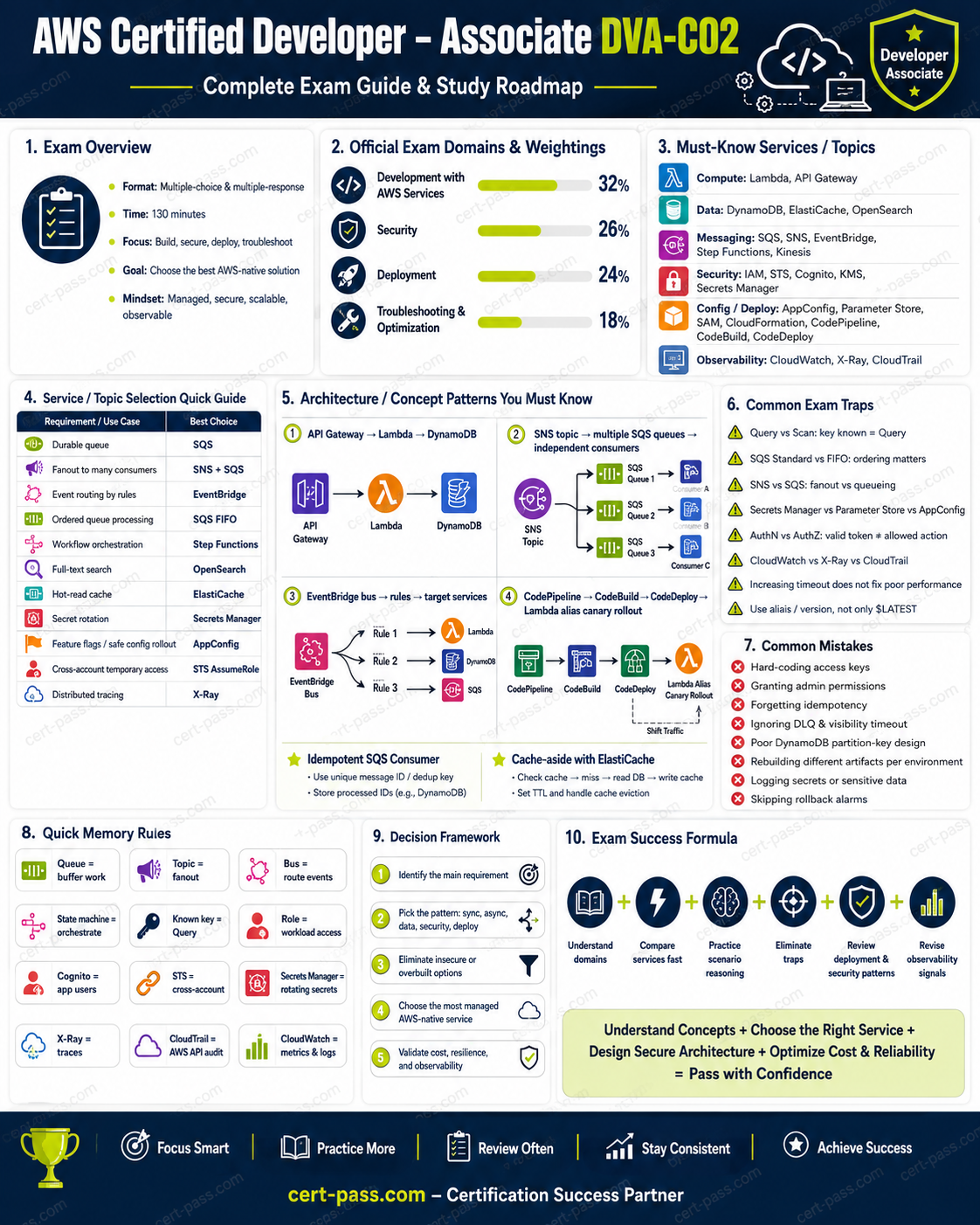
AWS Certified Developer – Associate DVA-C02 certification preparation infographic

You're viewing 6 of 41 free modules

The remaining 35 modules cover advanced topics, exam traps, and scenarios that appear on the certification exam.

Unlock All : $ 29

1. Exam Overview

The AWS Certified Developer – Associate (DVA-C02) exam validates the ability to develop, secure, deploy, troubleshoot, and optimize AWS Cloud applications. It is a developer-focused exam: scenarios usually ask for the best application-level implementation choice, not a full enterprise architecture redesign.

Exam format

Item Current exam format
Exam code DVA-C02
Duration 130 minutes
Total questions 65
Scored questions 50
Unscored questions 15
Question styles Multiple choice and multiple response
Passing scaled score 720 out of 1,000

What the exam rewards

The exam favors solutions that are:

  1. Managed: use an AWS feature instead of unnecessary custom code.
  2. Loosely coupled: avoid synchronous dependencies when asynchronous processing fits.
  3. Least privilege: grant only the actions and resources required.
  4. Observable: use metrics, structured logs, traces, alarms, and health checks.
  5. Repeatable: deploy immutable artifacts and infrastructure as code.
  6. Resilient: design for retries, duplicate messages, partial failures, and rollback.
  7. Access-pattern driven: choose a data store and index design from the query pattern.

How to read exam scenarios

Before comparing answers, identify four things:

  • Primary requirement: security, latency, ordering, durability, isolation, deployment safety, or troubleshooting?
  • Scope: application code, AWS service configuration, IAM permissions, data store design, or release pipeline?
  • Constraint words: MOST secure, least operational overhead, near real time, ordered, temporary, without changing code, before invoking the backend.
  • Failure model: transient error, poison message, duplicate delivery, hot partition, missing permission, bad deployment, or downstream outage?

A correct answer usually solves the main requirement directly with the smallest appropriate AWS-native mechanism.


2. Exam Domains

Domain Weight Main focus
Domain 1: Development with AWS Services 32% Application patterns, AWS SDK use, messaging, Lambda, data stores, caching, streaming
Domain 2: Security 26% Authentication, authorization, IAM roles, KMS, encryption, secrets, masking, multi-tenancy
Domain 3: Deployment 24% Packaging, configuration, testing, IaC, CI/CD, aliases, rollout strategies, rollback
Domain 4: Troubleshooting and Optimization 18% Logs, metrics, traces, alarms, integration debugging, caching, concurrency, profiling

Blueprint task map

Domain Official task groups
Domain 1 Develop code for applications hosted on AWS; develop code for AWS Lambda; use data stores in application development
Domain 2 Implement authentication and/or authorization; implement encryption; manage sensitive data in application code
Domain 3 Prepare artifacts; test in development environments; automate deployment testing; deploy with CI/CD services
Domain 4 Assist in root cause analysis; instrument code for observability; optimize applications

Revision 2.1 topics to know

The current guide explicitly emphasizes several skills that older study notes may underweight:

  • Amazon Q Developer for development assistance and test generation
  • Amazon EventBridge event-driven patterns
  • Retry logic, circuit breakers, and error handling for third-party integrations
  • Lambda real-time processing and transformation
  • Specialized stores such as Amazon OpenSearch Service
  • Fine-grained application authorization
  • Cross-service authentication in microservices
  • Data masking and sanitization
  • Multi-tenant access patterns
  • AWS AppConfig for environment configuration
  • Testing event-driven applications
  • Structured logging
  • Health checks and readiness probes
  • Application-level caching and performance analysis

3. Start-to-Finish Study Path

Use this order because each stage supports the next one.

Stage 1: Learn the application building blocks

Focus first on:

  • Lambda configuration and invocation behavior
  • API Gateway request flow
  • SQS, SNS, EventBridge, Step Functions, and Kinesis
  • DynamoDB keys, Query vs Scan, consistency, indexes, and TTL
  • AWS SDK retries and idempotency

Checkpoint: Given a scenario, you should quickly decide whether the answer is synchronous API, queue, pub/sub fanout, event routing, orchestration, or streaming.

Stage 2: Add security to every pattern

Study:

  • IAM roles and temporary credentials
  • STS AssumeRole for cross-account access
  • Cognito and bearer-token authorization
  • KMS and envelope encryption
  • Secrets Manager, Parameter Store, and AppConfig
  • Multi-tenant authorization and log sanitization

Checkpoint: When credentials appear in an answer, reject long-lived embedded keys unless the scenario explicitly requires something unusual.

Stage 3: Make releases repeatable

Study:

  • ZIP and container-image Lambda packaging
  • AWS SAM and CloudFormation
  • API Gateway stages and Lambda aliases
  • CodePipeline, CodeBuild, and CodeDeploy roles
  • Canary, blue/green, rolling, and rollback
  • Test fixtures, mocks, event-driven tests, and immutable artifacts

Checkpoint: You should know which service orchestrates, which builds, and which deploys.

Stage 4: Operate and optimize

Study:

  • CloudWatch metrics, logs, Logs Insights, alarms, and dashboards
  • AWS X-Ray traces and annotations
  • CloudTrail for AWS API auditing
  • Correlation IDs and structured logging
  • Readiness probes
  • Cache design, hot-key analysis, and Lambda performance tuning

Checkpoint: For each incident, identify whether the first evidence source is logs, metrics, traces, CloudTrail, or deployment output.

Suggested revision cycle

Pass What to do
First pass Read Sections 4–6 slowly and make service-choice flashcards
Second pass Study Sections 7–8 and explain why each trap fails
Practice pass Answer scenario questions and mark the decision rule used
Final pass Read Sections 8–10 within 24 hours of the exam

4. Core Concepts by Domain

Domain 1: Development with AWS Services

4.1 Application architecture decisions

Synchronous vs asynchronous

Pattern Use when Strength Main risk
Synchronous request/response Caller needs an immediate response Simple client interaction Tight coupling; downstream latency propagates
Asynchronous queue Work can be processed later Durable buffering and independent scaling Must handle retries and duplicates
Pub/sub fanout Multiple independent consumers need the same event Loose coupling and independent consumers Requires delivery and filtering design
Event routing Consumers depend on event attributes Flexible routing without producer awareness Event schema and rule matching matter
Workflow orchestration Steps, branches, retries, and state must be visible Explicit control flow Can be unnecessary for a simple one-step event

Choreography vs orchestration

  • Choreography: services react to events independently. Use EventBridge, SNS, or queues where no central workflow state machine is needed.
  • Orchestration: a workflow explicitly controls sequence, branching, retries, and state. Use Step Functions.

Decision rule:
If the question says “multiple services react independently”, think events and queues.
If it says “run A, then B, branch on result, retry C”, think Step Functions.

4.2 Messaging and integration services

SQS, SNS, EventBridge, Step Functions, and Kinesis

Service Best use Important behavior Common exam trap
Amazon SQS standard queue Durable work queue, decoupling, buffering At-least-once delivery; best-effort ordering Assuming exactly-once processing
Amazon SQS FIFO queue Ordered processing with deduplication requirements Ordering within message groups Assuming a standard queue provides strict order
Amazon SNS Pub/sub fanout Pushes a message to subscribers Using one SNS topic where each worker needs durable independent buffering without queues
SNS + SQS Fanout with durable independent consumers One queue per subscriber Using one shared queue when every consumer must receive every event
Amazon EventBridge Attribute-based event routing and loosely coupled integration Rules route events to targets Using API Gateway or a database polling table for internal event routing
AWS Step Functions Stateful orchestration Branching, retries, visible execution state Using SNS or SQS as a workflow engine
Amazon Kinesis Data Streams High-volume, near-real-time ordered streams Shards, partition keys, multiple consumers Using SQS when stream processing and ordered records are required

SQS rules you must know

Visibility timeout

After a consumer receives an SQS message, the message is hidden temporarily. If processing takes longer than the visibility timeout, another consumer may receive it and process it again.

Use: Set the visibility timeout longer than normal processing time. Extend it when required.

Dead-letter queue (DLQ)

A DLQ isolates messages that repeatedly fail.

Use when: A malformed or poison message is retried repeatedly and delays useful work.

Do not confuse:

  • Visibility timeout controls how long a received message stays hidden.
  • Retention period controls how long an unprocessed message remains stored.
  • DLQ max receive count controls when repeated failures are isolated.

Long polling

Long polling reduces empty receives and unnecessary API calls. It does not solve duplicate processing or poison messages.

Idempotency

SQS and many event-driven patterns can deliver more than once. Consumers must be safe to retry.

A common pattern:

  1. Receive an event with a unique business or idempotency key.
  2. Check whether the operation has already been applied.
  3. Apply the side effect only once.
  4. Record completion atomically when possible.

Exam rule: Never assume a standard queue gives exactly-once processing.

Third-party dependency resilience

For unreliable external APIs:

  • Set timeouts.
  • Use bounded retries.
  • Apply exponential backoff with jitter.
  • Add a circuit breaker after repeated failures.
  • Handle partial failure without cascading across the application.
  • Consider asynchronous buffering when immediate completion is unnecessary.

Reject: infinite immediate retries. They amplify outages.

lock

4.3 AWS Lambda

This module is part of the full course. Unlock all 41 modules + 65+ practice questions.

lock_open Unlock for $ 29

One-time payment · 48h money-back guarantee

lock

4.4 API Gateway

This module is part of the full course. Unlock all 41 modules + 65+ practice questions.

lock_open Unlock for $ 29

One-time payment · 48h money-back guarantee

lock

4.5 DynamoDB and data stores

This module is part of the full course. Unlock all 41 modules + 65+ practice questions.

lock_open Unlock for $ 29

One-time payment · 48h money-back guarantee

lock

4.6 AWS SDK use

This module is part of the full course. Unlock all 41 modules + 65+ practice questions.

lock_open Unlock for $ 29

One-time payment · 48h money-back guarantee

lock

4.7 IAM roles and temporary credentials

This module is part of the full course. Unlock all 41 modules + 65+ practice questions.

lock_open Unlock for $ 29

One-time payment · 48h money-back guarantee

lock

4.8 Authentication vs authorization

This module is part of the full course. Unlock all 41 modules + 65+ practice questions.

lock_open Unlock for $ 29

One-time payment · 48h money-back guarantee

lock

4.9 Encryption

This module is part of the full course. Unlock all 41 modules + 65+ practice questions.

lock_open Unlock for $ 29

One-time payment · 48h money-back guarantee

lock

4.10 Secrets and configuration

This module is part of the full course. Unlock all 41 modules + 65+ practice questions.

lock_open Unlock for $ 29

One-time payment · 48h money-back guarantee

lock

4.11 S3 presigned URLs and WAF

This module is part of the full course. Unlock all 41 modules + 65+ practice questions.

lock_open Unlock for $ 29

One-time payment · 48h money-back guarantee

lock

4.12 Deployment artifacts and dependency management

This module is part of the full course. Unlock all 41 modules + 65+ practice questions.

lock_open Unlock for $ 29

One-time payment · 48h money-back guarantee

lock

4.13 Infrastructure as code and environment configuration

This module is part of the full course. Unlock all 41 modules + 65+ practice questions.

lock_open Unlock for $ 29

One-time payment · 48h money-back guarantee

lock

4.14 API Gateway stages and Lambda aliases

This module is part of the full course. Unlock all 41 modules + 65+ practice questions.

lock_open Unlock for $ 29

One-time payment · 48h money-back guarantee

lock

4.15 Testing

This module is part of the full course. Unlock all 41 modules + 65+ practice questions.

lock_open Unlock for $ 29

One-time payment · 48h money-back guarantee

lock

4.16 CI/CD service responsibilities

This module is part of the full course. Unlock all 41 modules + 65+ practice questions.

lock_open Unlock for $ 29

One-time payment · 48h money-back guarantee

lock

4.17 Deployment strategies

This module is part of the full course. Unlock all 41 modules + 65+ practice questions.

lock_open Unlock for $ 29

One-time payment · 48h money-back guarantee

lock

4.18 Choose the right evidence source

This module is part of the full course. Unlock all 41 modules + 65+ practice questions.

lock_open Unlock for $ 29

One-time payment · 48h money-back guarantee

lock

4.19 Structured logging and correlation IDs

This module is part of the full course. Unlock all 41 modules + 65+ practice questions.

lock_open Unlock for $ 29

One-time payment · 48h money-back guarantee

lock

4.20 AWS X-Ray

This module is part of the full course. Unlock all 41 modules + 65+ practice questions.

lock_open Unlock for $ 29

One-time payment · 48h money-back guarantee

lock

4.21 CloudTrail

This module is part of the full course. Unlock all 41 modules + 65+ practice questions.

lock_open Unlock for $ 29

One-time payment · 48h money-back guarantee

lock

4.22 Metrics, alarms, and health checks

This module is part of the full course. Unlock all 41 modules + 65+ practice questions.

lock_open Unlock for $ 29

One-time payment · 48h money-back guarantee

lock

4.23 Optimization patterns

This module is part of the full course. Unlock all 41 modules + 65+ practice questions.

lock_open Unlock for $ 29

One-time payment · 48h money-back guarantee

lock

5. Service Selection Guide

This module is part of the full course. Unlock all 41 modules + 65+ practice questions.

lock_open Unlock for $ 29

One-time payment · 48h money-back guarantee

lock

6. Architecture Patterns

This module is part of the full course. Unlock all 41 modules + 65+ practice questions.

lock_open Unlock for $ 29

One-time payment · 48h money-back guarantee

lock

6.1 Durable fanout

This module is part of the full course. Unlock all 41 modules + 65+ practice questions.

lock_open Unlock for $ 29

One-time payment · 48h money-back guarantee

lock

6.2 EventBridge routing

This module is part of the full course. Unlock all 41 modules + 65+ practice questions.

lock_open Unlock for $ 29

One-time payment · 48h money-back guarantee

lock

6.3 Idempotent queue consumer

This module is part of the full course. Unlock all 41 modules + 65+ practice questions.

lock_open Unlock for $ 29

One-time payment · 48h money-back guarantee

lock

6.4 Serverless API with validation and authorization

This module is part of the full course. Unlock all 41 modules + 65+ practice questions.

lock_open Unlock for $ 29

One-time payment · 48h money-back guarantee

lock

6.5 Safe Lambda release

This module is part of the full course. Unlock all 41 modules + 65+ practice questions.

lock_open Unlock for $ 29

One-time payment · 48h money-back guarantee

lock

6.6 Multi-tenant access pattern

This module is part of the full course. Unlock all 41 modules + 65+ practice questions.

lock_open Unlock for $ 29

One-time payment · 48h money-back guarantee

lock

6.7 Troubleshooting workflow

This module is part of the full course. Unlock all 41 modules + 65+ practice questions.

lock_open Unlock for $ 29

One-time payment · 48h money-back guarantee

lock

7. Exam Traps

This module is part of the full course. Unlock all 41 modules + 65+ practice questions.

lock_open Unlock for $ 29

One-time payment · 48h money-back guarantee

lock

8. Quick Memory Rules

This module is part of the full course. Unlock all 41 modules + 65+ practice questions.

lock_open Unlock for $ 29

One-time payment · 48h money-back guarantee

lock

9. Final Revision Notes

This module is part of the full course. Unlock all 41 modules + 65+ practice questions.

lock_open Unlock for $ 29

One-time payment · 48h money-back guarantee

lock

10. Exam-Day Checklist

This module is part of the full course. Unlock all 41 modules + 65+ practice questions.

lock_open Unlock for $ 29

One-time payment · 48h money-back guarantee

lock

Official Alignment References

This module is part of the full course. Unlock all 41 modules + 65+ practice questions.

lock_open Unlock for $ 29

One-time payment · 48h money-back guarantee

What others say

star star star star star

"The compressed course cut my study time in half. The VPC and IAM sections were exactly what appeared on the real AWS Certified Developer – Associate DVA-C02 exam."

Sarah M.

Solutions Architect

Scored 94%
star star star star star

"Every AWS domain explained clearly. The exam traps section saved me from at least 3 tricky questions on AWS Certified Developer – Associate DVA-C02."

James K.

Cloud Engineer

Scored 91%

Unlock the full course

Stop guessing. Start passing.

6 of 41 modules free. The remaining 35 modules contain the exam traps, edge cases, and domain deep-dives that make the difference.

48h money-back guarantee Secure PayPal checkout

Unlock all 41 modules

From $ 29 · One-time payment

Unlock

Course Modules

41 modules

Unlock All Modules

Get full access to all 41 modules

auto_stories More Guides