
Cert-Pass
Log in Sign up
Snowflake Snowflake Certified auto_stories Free Compressed Course : 20% preview

SnowPro Advanced: Data Engineer Certification Course

bolt Everything you need to pass : in one free course.

15 expert modules derived from 65+ exam-style questions. Covers every domain and scenario : organized by blueprint weight so you study what matters most.

Full access from $ 29 One-time · No subscription
check_circle 5 of 15 modules free · No account needed
15
Modules
65+
Questions
SnowPro Advanced: Data Engineer
200+ Snowflake Certified 93% First-Attempt Pass Rate 4.9/5 Rating
Snowflake

About This Course

SnowPro Advanced: Data Engineer · 15 modules

This course covers every domain tested on the SnowPro Advanced: Data Engineer exam. Based on our 65+ real practice questions and prepared by certification experts.

info What you'll learn:

  • Every exam domain with detailed explanations
  • Common exam traps that catch unprepared candidates
  • Key concepts, syntax, and configurations
  • Real-world scenarios aligned with exam objectives
  • Quick-reference cheat sheets for last-minute review

Your SnowPro Advanced: Data Engineer Roadmap

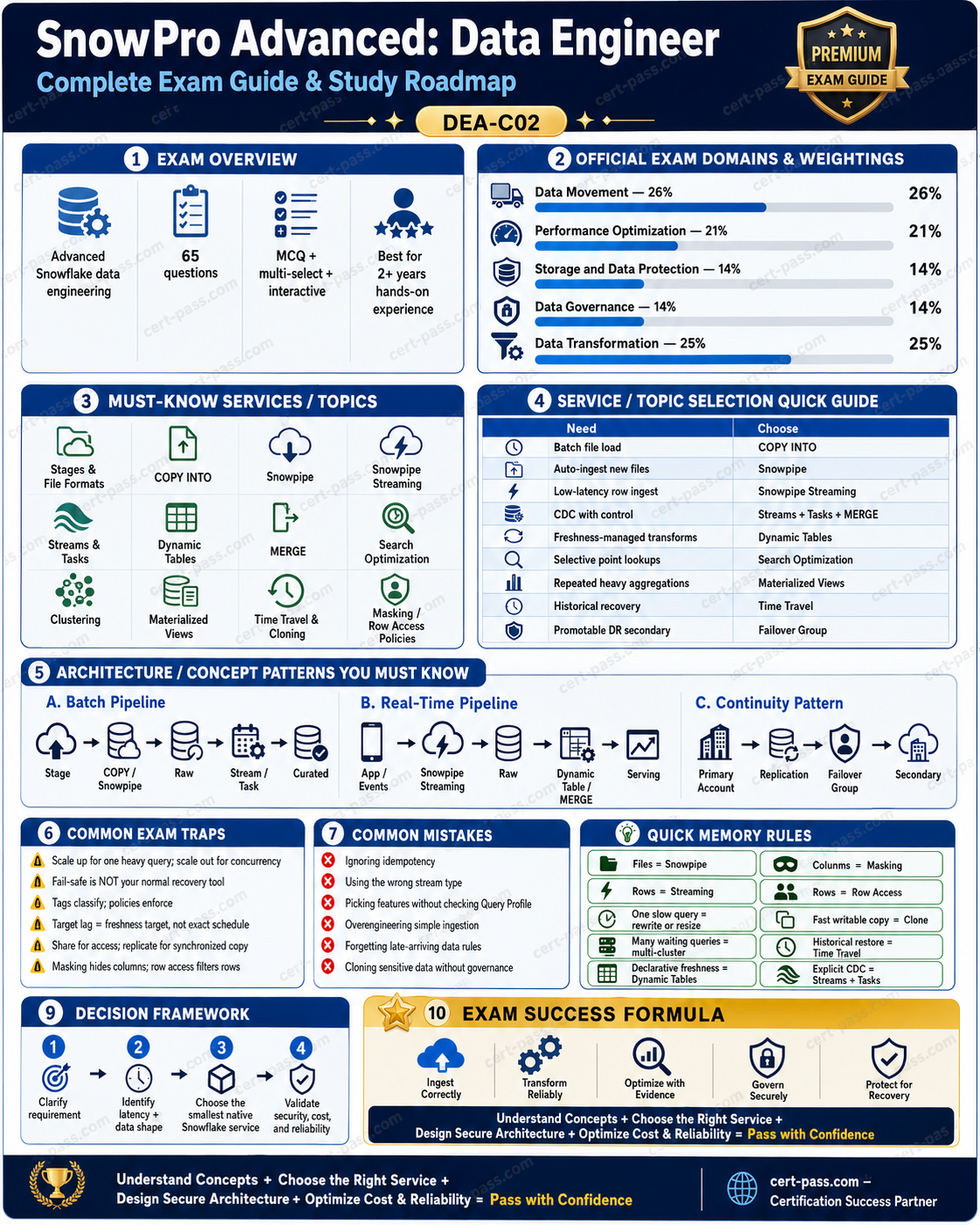
SnowPro Advanced: Data Engineer certification preparation infographic

You're viewing 5 of 15 free modules

The remaining 10 modules cover advanced topics, exam traps, and scenarios that appear on the certification exam.

Unlock All : $ 29

1. Exam Overview

1.1 What the certification validates

SnowPro Advanced: Data Engineer validates advanced Snowflake data-engineering judgment. The exam is not only about SQL syntax. Most scenarios test whether you can choose the capability whose tradeoff matches the requirement:

  • Source data from cloud storage, APIs, Kafka-like streams, and on-premises systems.
  • Design batch, event-driven, and near-real-time ingestion.
  • Transform and apply change data safely and repeatably.
  • Troubleshoot query performance using evidence rather than guesses.
  • Select scalable compute patterns for engineering workloads.
  • Protect data with appropriate recovery, continuity, and governance controls.
  • Share or replicate data across accounts, regions, and clouds without choosing an unnecessarily expensive or fragile pattern.

The active English exam is DEA-C02. Snowflake states that DEA-C02 contains 65 questions and can include multiple-choice, multiple-select, and interactive question types such as matching and drag-and-drop. The official exam page recommends production experience as a data engineer.

1.2 Domain emphasis

The supplied bank follows this DEA-C02 domain allocation:

Domain Weight Study priority Main question style
Domain 1.0: Data Movement 26% Very high Select the correct ingestion, export, sharing, or replication pattern
Domain 2.0: Performance Optimization 21% High Diagnose the bottleneck before selecting compute or storage optimization
Domain 3.0: Storage and Data Protection 14% Medium Distinguish historical recovery, continuity, persistence, and cost tradeoffs
Domain 4.0: Data Governance 14% Medium Choose the policy, role, metadata, or sharing control that directly enforces the requirement
Domain 5.0: Data Transformation 25% Very high Choose declarative versus imperative processing and apply CDC safely

1.3 How to think during the exam

For each scenario, reduce the wording to four facts:

  1. What is moving or changing? Files, rows, DML changes, semi-structured payloads, or shared objects.
  2. What matters most? Latency, idempotency, cost, recoverability, least privilege, or maintainability.
  3. Where should the work happen? Client, cloud storage, Snowflake-managed service, virtual warehouse, or consumer account.
  4. What evidence is available? Query profile, history views, stream state, load history, policy references, or access history.

The best answer normally solves the exact bottleneck with the smallest safe architectural change. Avoid answers that introduce a different service merely because it is a real Snowflake feature.

1.4 Current-platform awareness

Snowflake evolves continuously. DEA-C02 was introduced in 2025, while current documentation also describes newer capabilities such as Snowpipe Streaming high-performance architecture and additional dynamic-table refresh modes. Know the modern terminology, but keep the exam decision model stable:

  • File-based event ingestion → Snowpipe auto-ingest
  • Row-based low-latency ingestion → Snowpipe Streaming
  • Declarative freshness-managed transformations → dynamic tables
  • Explicit CDC and imperative DML → streams and tasks
  • Selective lookups → consider Search Optimization Service
  • Repeated expensive precomputable patterns → consider materialized views
  • Large-table pruning issues → evaluate clustering

2. Exam Domains

Domain 1.0: Data Movement

You should be able to design reliable movement into, within, and out of Snowflake.

Key areas:

  • Internal and external stages
  • Storage integrations and least-privilege cloud access
  • File formats and load options
  • COPY INTO <table> and COPY INTO <location>
  • Validation, load history, and error handling
  • Snowpipe auto-ingest
  • Snowpipe Streaming
  • Kafka connector use cases
  • External tables and metadata refresh
  • Directory tables
  • Iceberg-table decision context
  • API ingestion landing patterns
  • Secure Data Sharing and reader accounts
  • Replication and failover groups
  • Cross-cloud and cross-region movement
  • Idempotency and retry safety

Domain 2.0: Performance Optimization

You should be able to diagnose first and optimize second.

Key areas:

  • Query Profile and operator-level analysis
  • Query history and workload-level evidence
  • Warehouse sizing, auto-suspend, and auto-resume
  • Scale up versus scale out
  • Multi-cluster warehouses for concurrency
  • Workload isolation with separate warehouses
  • Micro-partition pruning
  • Clustering keys and Automatic Clustering
  • Search Optimization Service
  • Materialized views
  • Query Acceleration Service
  • Persisted query results and warehouse cache
  • Spilling, exploding joins, queueing, and skew
  • Resource monitors and cost controls

Domain 3.0: Storage and Data Protection

You should be able to map a business-protection requirement to the correct Snowflake mechanism.

Key areas:

  • Micro-partition storage fundamentals
  • Permanent, transient, and temporary tables
  • Time Travel
  • Fail-safe
  • UNDROP
  • Zero-copy cloning
  • Replication and failover groups
  • Continuity versus backup semantics
  • Encryption and governed external-storage identities
  • Internal stages and external stages
  • Non-production data protection after cloning

Domain 4.0: Data Governance

You should be able to enforce least privilege, policy-driven access, and auditability.

Key areas:

  • Account roles and database roles
  • Least privilege and separation of duties
  • Managed access schemas
  • Future grants
  • Dynamic masking policies
  • Row access policies
  • Secure views
  • Tags and tag-based masking
  • Policy-reference metadata
  • ACCESS_HISTORY
  • Data-quality monitoring and Data Metric Functions
  • Secure Data Sharing governance
  • Non-production access controls

Domain 5.0: Data Transformation

You should be able to build maintainable pipelines with explicit correctness guarantees.

Key areas:

  • Standard streams and append-only streams
  • Stream offsets and staleness
  • Scheduled tasks, triggered tasks, serverless tasks, and warehouse-managed tasks
  • Task graphs
  • Dynamic tables and target lag
  • Incremental versus full refresh tradeoffs
  • MERGE
  • Transactions and atomicity
  • Idempotency
  • Deduplication and deterministic winner selection
  • Late-arriving data
  • Quarantine paths
  • Schema evolution
  • Semi-structured data with VARIANT and FLATTEN
  • UDFs, UDTFs, stored procedures, and Snowpark
  • Slowly changing dimensions, especially Type 2

3. Start-to-Finish Study Path

Phase 1: Build the Snowflake mental model

Start with the separation of storage, compute, and cloud services.

Layer What it does Exam implication
Storage Stores table data in compressed micro-partitions and maintains metadata Do not propose manual partition management like a traditional database
Compute Virtual warehouses execute queries and DML Resize for compute or memory pressure; use multi-cluster for concurrency
Cloud services Coordinates metadata, authentication, optimization, and management operations Many management features are not solved by making a warehouse larger

Practice: create tables, inspect query history, suspend and resume warehouses, and observe how independent warehouses query the same data.

Phase 2: Master batch and streaming ingestion

Build these patterns in order:

  1. External stage + storage integration + file format
  2. Manual COPY INTO <table>
  3. Validation and load-history troubleshooting
  4. Snowpipe auto-ingest for new staged files
  5. Snowpipe Streaming for row-based low-latency ingestion
  6. External table and directory-table metadata workflows
  7. API landing pattern with retryable extraction

Practice: intentionally load a malformed file, test ON_ERROR, inspect history, and design a retry-safe correction.

Phase 3: Master CDC and transformations

Build a small raw-to-curated pipeline:

  1. Raw landing table
  2. Standard stream for general DML changes
  3. Append-only stream for insert-only events
  4. Triggered task or scheduled task
  5. Idempotent MERGE
  6. Transaction boundary for related DML
  7. Quarantine table for invalid records
  8. Dynamic-table alternative for a declarative freshness-managed version

Practice: simulate a retry, duplicate event, update, delete, and late-arriving record.

Phase 4: Tune with evidence

For each slow-query scenario:

  1. Check whether the issue is queueing, spilling, poor pruning, a bad join, or a repeated expensive pattern.
  2. Use Query Profile, query-history functions, and operator statistics.
  3. Apply the smallest targeted change.
  4. Re-measure cost and latency.

Practice: run a selective lookup, a scan-heavy aggregation, a join with a missing predicate, and concurrent queries from multiple sessions.

Phase 5: Add protection and governance

Practice:

  • Time Travel query and UNDROP
  • Clone a production-like table and restrict access to the clone
  • Compare permanent, transient, and temporary table behavior
  • Create masking and row access policies
  • Attach tags and inspect policy associations
  • Design a secure-share consumer pattern
  • Design a replication or failover-group continuity pattern

Phase 6: Mixed-scenario revision

Use the question bank in mixed batches. For every incorrect answer, record:

  • The requirement you overlooked
  • The feature you chose
  • The feature that directly solves the requirement
  • The clue that should eliminate your wrong option next time

4. Core Concepts by Domain

4.1 Domain 1.0: Data Movement

Stages, integrations, and file formats

A stage is a Snowflake object or location used to access files for loading or unloading.

Choice Use it when Do not confuse it with
Named external stage Reuse cloud-storage location, file-format settings, and governed access A storage integration, which provides the cloud identity and access boundary
Named internal stage Snowflake should manage the staged-file location A table stage or user stage when the location must be shared and managed explicitly
Storage integration Separate cloud credentials from SQL and use a Snowflake-managed cloud identity Hard-coded secrets in SQL
File format object Reuse parsing options across loads A stage; the format controls parsing, not storage access

Decision rule: use a storage integration for governed cloud access, a named stage for reusable location metadata, and a file format for reusable parsing behavior.

COPY INTO <table>: controlled batch ingestion

Use COPY INTO <table> when files already exist in a stage and you need an explicit batch load.

Core reasoning:

  • Snowflake tracks file-loading metadata for a target table.
  • Retry safety still requires deliberate design: use stable filenames, inspect history, and avoid careless forced reloads.
  • ON_ERROR should match the SLA. Skipping a file or continuing may be correct for a tolerant batch, but not when completeness is mandatory.
  • VALIDATION_MODE checks staged data without loading it.
  • VALIDATE examines errors produced by a previous COPY INTO operation.
  • MATCH_BY_COLUMN_NAME maps source fields to target columns by name when schema ordering can vary.
  • INFER_SCHEMA plus CREATE TABLE USING TEMPLATE can accelerate supported schema-on-load workflows.

Exam trap: choosing a warehouse resize when the real problem is malformed files, naming, metadata, or load semantics.

File sizing

Extremely small files increase metadata and scheduling overhead. Extremely large files can reduce parallelism and increase retry impact.

Decision rule: prefer reasonably sized files that allow parallelism without creating a small-file explosion. When a question highlights thousands of tiny files, address file sizing before warehouse size.

Snowpipe auto-ingest versus Snowpipe Streaming

Requirement Best fit Why
New files arrive in cloud storage and should load automatically Snowpipe auto-ingest Event-driven ingestion of staged files
Rows should be available within seconds without staging files Snowpipe Streaming Direct row-based streaming ingestion
Kafka topics should load into Snowflake Snowflake Kafka connector with streaming ingestion Connector handles Kafka consumption and Snowflake ingestion
Periodic controlled batch window COPY INTO <table> Explicit load orchestration is sufficient

Eliminate bad options: a materialized view, clustering key, or secure share cannot ingest data.

Snowpipe Streaming current-platform note

Current Snowflake documentation describes Snowpipe Streaming as the real-time ingestion service built on a high-performance architecture. Applications load rows directly into Snowflake tables without staging files or managing intermediate storage. For DEA-C02 scenarios, focus on the stable distinction: row-based low latency versus file-based auto-ingest.

API extraction pattern

Snowflake capabilities do not turn an analytical query or row access policy into a robust external-API client.

Use a controlled pattern:

  1. Extract from the API with an orchestrated client or integration layer.
  2. Land the response in a controlled stage or raw landing table.
  3. Store a source key, extraction timestamp, and request or batch identifier.
  4. Apply an idempotent load and transformation path.
  5. Retry extraction separately from transformation.

Exam trap: calling an external API during every analytical query. This couples query latency and availability to an external system and undermines reliability.

External tables, directory tables, and Iceberg tables

Capability What it represents Typical scenario
External table Queryable metadata and schema over data stored outside Snowflake Query files in external storage without fully loading them
Directory table Metadata about files in a stage File discovery, processing workflow, and metadata-driven orchestration
Iceberg table Open-table-format use case backed by cloud storage Interoperability with an external lakehouse ecosystem

Decision rule: external table for query access to external files; directory table for file metadata; Iceberg table when open-format interoperability is an explicit requirement.

Exam trap: assuming new external files always become visible automatically. Refresh metadata or configure supported automation.

Unloading

Use COPY INTO <location> to export table or query results to staged files.

Think about:

  • Output stage
  • File format
  • Partitioning or file-size requirements
  • Encryption and cloud permissions
  • Retry and downstream-consumer behavior

Exam trap: choosing COPY INTO <table> when the requirement is export.

Secure sharing, reader accounts, replication, and failover

Requirement Best fit Key property
Consumer with a Snowflake account needs governed read access Secure Data Sharing Provider shares objects without copying data
Consumer lacks a Snowflake account Reader account Provider-managed consumer access and compute
Objects must be synchronized across accounts, regions, or clouds Replication group Copies supported objects for continuity or distribution
Secondary must be promotable during a continuity event Failover group Adds promotion capability to replication

Decision rule: sharing is for governed consumption; replication is for synchronized copies; failover is for continuity and promotion.


lock

4.2 Domain 2.0: Performance Optimization

This module is part of the full course. Unlock all 15 modules + 65+ practice questions.

lock_open Unlock for $ 29

One-time payment · 48h money-back guarantee

lock

4.3 Domain 3.0: Storage and Data Protection

This module is part of the full course. Unlock all 15 modules + 65+ practice questions.

lock_open Unlock for $ 29

One-time payment · 48h money-back guarantee

lock

4.4 Domain 4.0: Data Governance

This module is part of the full course. Unlock all 15 modules + 65+ practice questions.

lock_open Unlock for $ 29

One-time payment · 48h money-back guarantee

lock

4.5 Domain 5.0: Data Transformation

This module is part of the full course. Unlock all 15 modules + 65+ practice questions.

lock_open Unlock for $ 29

One-time payment · 48h money-back guarantee

lock

5. Service Selection Guide

This module is part of the full course. Unlock all 15 modules + 65+ practice questions.

lock_open Unlock for $ 29

One-time payment · 48h money-back guarantee

lock

6. Architecture Patterns

This module is part of the full course. Unlock all 15 modules + 65+ practice questions.

lock_open Unlock for $ 29

One-time payment · 48h money-back guarantee

lock

7. Exam Traps

This module is part of the full course. Unlock all 15 modules + 65+ practice questions.

lock_open Unlock for $ 29

One-time payment · 48h money-back guarantee

lock

8. Quick Memory Rules

This module is part of the full course. Unlock all 15 modules + 65+ practice questions.

lock_open Unlock for $ 29

One-time payment · 48h money-back guarantee

lock

9. Final Revision Notes

This module is part of the full course. Unlock all 15 modules + 65+ practice questions.

lock_open Unlock for $ 29

One-time payment · 48h money-back guarantee

lock

10. Exam-Day Checklist

This module is part of the full course. Unlock all 15 modules + 65+ practice questions.

lock_open Unlock for $ 29

One-time payment · 48h money-back guarantee

What others say

star star star star star

"Virtual warehouses and data sharing concepts explained perfectly. The SnowPro Advanced: Data Engineer cheat sheet was gold for last-minute review."

Sarah M.

Data Engineer

Scored 93%
star star star star star

"Every Snowflake domain covered clearly. The semi-structured data and Snowpipe sections for SnowPro Advanced: Data Engineer were excellent."

James K.

Analytics Engineer

Scored 91%

Unlock the full course

Stop guessing. Start passing.

5 of 15 modules free. The remaining 10 modules contain the exam traps, edge cases, and domain deep-dives that make the difference.

48h money-back guarantee Secure PayPal checkout

Unlock all 15 modules

From $ 29 · One-time payment

Unlock

Course Modules

15 modules

Unlock All Modules

Get full access to all 15 modules

auto_stories More Guides