Official source note
aws cloud practitioner clf c02 salary 2026 is the main focus of this page, and the safest way to study it is to keep the exam hub open while you work through the official facts and the service selection patterns. AWS describes AWS Cloud Practitioner CLF-C02 as a foundational certification built around practical cloud literacy, service selection, and scenario thinking. The main Cert Pass hub remains /exams/aws-aws-cloud-practitioner-clf-c02.
Exam facts
- Exam name: AWS Cloud Practitioner CLF-C02
- Exam slug: aws-aws-cloud-practitioner-clf-c02
- Vendor: AWS
- Cert Pass landing page: /exams/aws-aws-cloud-practitioner-clf-c02
- Study hub: /exams/aws-aws-cloud-practitioner-clf-c02
- Official vendor page: AWS Certified Cloud Practitioner
Why this article exists
The goal here is not to collect trivia. The goal is to build the habit of reading a scenario, identifying the category, and choosing the simplest service that directly fits the requirement.
Fast study map
Use the exam hub twice during review: /exams/aws-aws-cloud-practitioner-clf-c02 and /exams/aws-aws-cloud-practitioner-clf-c02. Those internal links should act as the stable anchor for practice, revision, and final review.
AWS Cloud Practitioner CLF C02 Salary 2026: Career Value and Compensation Factors
AWS Cloud Practitioner CLF C02 is often discussed as a salary question, but the more accurate framing is career value. The certification is foundational, so it does not create a salary number by itself. What it does create is credibility: a candidate can show that they understand the AWS vocabulary, the common service families, the shared responsibility model, and the basic cost and support conversation that many entry level and adjacent roles need. If a candidate wants the main exam hub while thinking about career direction, the best internal destination is /exams/aws-aws-cloud-practitioner-clf-c02, and the official AWS certification page remains the vendor source for the certification's scope.
Official source note
AWS describes the certification as a foundational, high level understanding of AWS Cloud, services, and terminology. That wording matters because it tells candidates what the exam is not trying to do. It is not a deep design exam. It is a broad literacy exam. The official page is here: AWS Certified Cloud Practitioner.
Exam facts
- Exam name: AWS Cloud Practitioner CLF C02
- Exam slug: aws-aws-cloud-practitioner-clf-c02
- Vendor: AWS
- Questions: 65
- Time limit: 90 minutes
- Passing score: 70 out of 100 on the scaled score model
- Prerequisites: None required
- Official certification page: AWS Certified Cloud Practitioner
- Cert Pass practice landing page: /exams/aws-aws-cloud-practitioner-clf-c02
- Cert Pass study hub: /exams/aws-aws-cloud-practitioner-clf-c02
Domain breakdown
- Domain 3, Cloud Technology and Services: 34 percent
- Domain 2, Security and Compliance: 30 percent
- Domain 1, Cloud Concepts: 24 percent
- Domain 4, Billing, Pricing, and Support: 12 percent
Study links
The main internal destination for this cluster is /exams/aws-aws-cloud-practitioner-clf-c02. When a question or study section needs a quick reset, use the same landing page again: /exams/aws-aws-cloud-practitioner-clf-c02.
What the certification signals to employers
The certification tells an employer that a candidate can participate in a cloud conversation without starting from zero. That matters in support roles, operations roles, project coordination, customer success, technical sales, junior cloud analyst roles, and career transition roles. It is useful because many teams do not need a beginner who can design a full multi account landing zone on day one. They need someone who can understand what the team is talking about, ask better questions, and learn the AWS environment faster.
That signal is small compared with years of experience, but it is still real. In practical hiring terms, the credential can help a candidate move from "I have heard of AWS" to "I can explain what AWS services do and how they fit together." That shift often improves interview confidence, resume clarity, and role fit.
Why compensation depends on the broader profile
Compensation is influenced by many factors that sit outside the certification itself.
- Location and market demand
- Years of experience
- Role family and seniority
- Industry and company size
- Breadth of technical skill
- Hands on AWS experience
- Communication ability
- Security, networking, and troubleshooting background
- Ability to connect cloud concepts to business value
The certification helps most when it is paired with one or more of those factors. A candidate who already works in support, operations, or technical customer facing work may be able to use the certification to strengthen the argument for a cloud oriented role. A candidate who is changing careers may use it to show commitment and baseline knowledge. A candidate already inside an AWS team may use it to formalize knowledge and make later certification steps easier.
Role paths where the certification tends to help
1. Cloud support
Support teams often need people who can recognize AWS service names, understand basic account issues, and speak clearly about what is happening in a customer environment. CLF C02 helps because it teaches the vocabulary of IAM, CloudTrail, CloudWatch, S3, EC2, RDS, and billing tools.
2. Junior cloud operations
Operations work benefits from a candidate who understands monitoring, logs, alarms, and cost awareness. CLF C02 does not make someone an expert operator, but it gives enough foundation to enter conversations about what CloudWatch does, what Config does, and why shared responsibility matters.
3. Technical sales or solution support
Many customer facing roles need a clear explanation of AWS value, not just deep implementation skill. The certification helps a candidate explain elasticity, pay as you go pricing, global reach, and managed services in plain language.
4. Project coordination and delivery support
Project work in cloud environments benefits from a candidate who can understand what services teams are using and why. The certification creates a useful bridge between technical and non technical conversation.
5. Entry cloud analyst or apprentice style roles
For entry roles, the credential can help prove motivation, structure, and baseline literacy. It does not replace hands on work, but it can open the conversation.
What the exam teaches that employers care about
The content of the exam maps to workplace usefulness more directly than it might appear at first glance.
- Cloud concepts help a candidate explain why a team should use AWS rather than fixed infrastructure.
- Security and compliance help a candidate discuss permissions, audit history, encryption, and governance.
- Technology and services help a candidate understand the difference between compute, storage, networking, database, and integration services.
- Billing, pricing, and support help a candidate participate in cost and support discussions.
Those topics appear in interview conversations all the time. A hiring manager may not ask about the exam itself, but the same concepts show up as job requirements.
How to talk about the certification without overclaiming
The strongest way to discuss CLF C02 is to be specific and modest. The certification proves foundational AWS knowledge. It does not prove senior architecture skill, deep DevOps capability, or hands on production ownership. Being honest about that boundary makes the credential more credible, not less.
A good way to frame it is:
- It demonstrates familiarity with AWS core services and cloud fundamentals.
- It shows understanding of the shared responsibility model and basic security concepts.
- It shows comfort with cost tools and support plan basics.
- It makes the candidate easier to train on more advanced AWS tasks.
That framing helps employers understand where the certification fits in the larger skill stack.
Adjacent skills that increase the value of the certification
The certification is stronger when it sits next to useful practical skills.
- Basic troubleshooting
- Ticket handling and documentation
- Customer communication
- Networking fundamentals
- Operating system basics
- Security awareness
- Scripting familiarity
- Cost awareness
- Familiarity with cloud console navigation
- Experience reading logs and alerts
If those skills are present, the certification becomes a better signal because it sits on top of something concrete. If they are not yet present, the certification can still be helpful, but the career impact is usually smaller until the rest of the profile grows.
How employers tend to interpret the credential
Employers usually read CLF C02 in one of three ways.
- As evidence that the candidate is new to AWS but serious about learning.
- As evidence that the candidate can participate in cloud discussions without constant translation.
- As evidence that the candidate is preparing for a more technical AWS track.
That interpretation is useful because it tells a candidate what to do next. The certification is rarely the finish line. It is the start of a more focused path.
Career paths after the certification
A useful way to think about post certification growth is to pair the credential with a role direction.
If the goal is support or operations
Go deeper on CloudWatch, CloudTrail, IAM, S3, EC2, RDS, basic networking, and incident response habits. The value here is practical troubleshooting and service familiarity.
If the goal is architecture
Move toward associate level architecture study, especially networking, compute choice, storage design, resiliency patterns, and cost tradeoffs.
If the goal is security
Focus on IAM, KMS, Secrets Manager, CloudTrail, Config, WAF, Shield, GuardDuty, Inspector, and Macie. The foundational certification becomes the entry point into a stronger security story.
If the goal is technical sales or customer success
Focus on cloud value, pricing, managed services, support plans, and the ability to explain AWS simply to non technical stakeholders.
Why the official AWS description matters for career framing
The official AWS certification page says the credential validates foundational understanding of AWS Cloud, services, and terminology. That wording is important because it keeps the career story honest. It says the credential is valuable, but it also says what level it represents. A candidate who uses that wording correctly can avoid inflated claims and can build a more durable narrative around career growth.
Salary conversations done the right way
The best salary conversation is not "What does the certification pay?" The better conversation is "How does this certification fit the role I want?" That question is much more useful because compensation is tied to capability and demand, not just a logo on a resume.
A candidate can improve the compensation story by combining the certification with:
- A clearer job target
- Practical AWS lab work
- Experience with tickets or projects
- Evidence of troubleshooting skill
- Communication and documentation ability
- Related certifications on the next step of the path
That combination is far more persuasive than the credential alone.
What not to claim
It is tempting to overstate the value of any certification, especially a first one. The safer approach is to avoid claims that are unsupported or too broad.
- Do not claim that the certification guarantees a specific salary.
- Do not claim it replaces experience.
- Do not claim it proves production design expertise.
- Do not claim it is enough by itself for a senior role.
Clear boundaries make the credential more believable and make the career story stronger.
A practical 90 day growth plan
A strong way to turn the certification into career movement is to attach a next step plan.
Month 1
Reinforce the exam material and build a small hands on lab routine. Learn the service families well enough to describe them from memory.
Month 2
Pick a role direction and study the adjacent skills that support it. For example, a support focused candidate can study logs and alerts, while a security focused candidate can study IAM and KMS in more depth.
Month 3
Create a simple portfolio of notes, diagrams, or lab exercises that show practical understanding. That evidence is often more useful in a hiring conversation than the certification alone.
How the certification helps in interviews
Interviewers often want proof that a candidate can learn cloud concepts and speak clearly about them. The certification helps because it gives the candidate a stable vocabulary.
A candidate who can explain the difference between CloudTrail, CloudWatch, and Config, or between S3, EBS, and EFS, appears more prepared than a candidate who knows only the exam title. That practical fluency can improve interview quality even before deep hands on experience is available.
Extended official revision notes
AWS Certified Cloud Practitioner CLF-C02 - Compressed Exam Preparation Course
Purpose: This course converts the CLF-C02 practice question bank into a clean, non-repetitive study guide. It focuses on service selection, scenario reasoning, exam traps, and fast revision.
Source question bank analyzed: 1005 questions
Detected domain balance: Cloud Concepts 241, Security and Compliance 300, Cloud Technology and Services 343, Billing/Pricing/Support 121
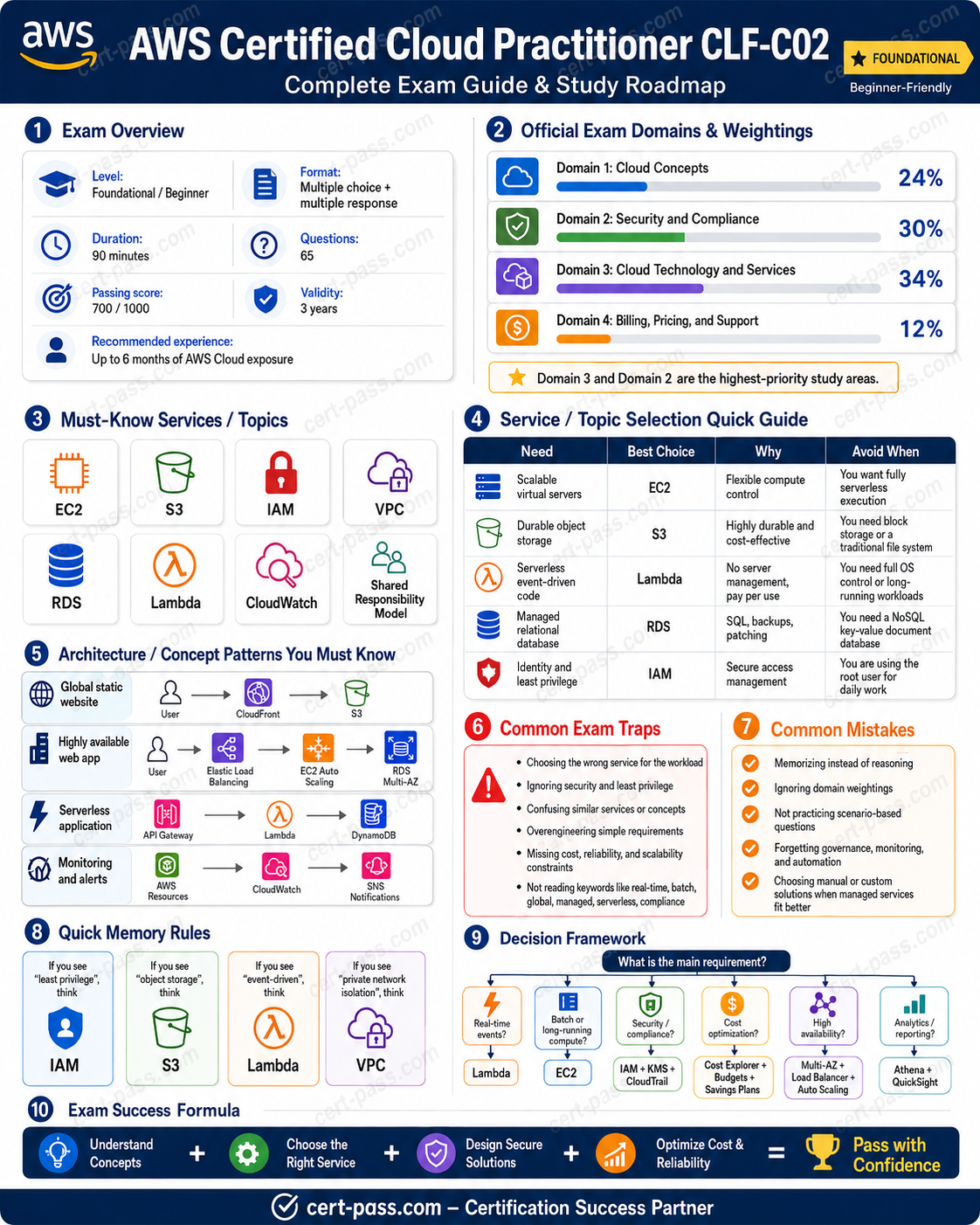
1. Exam Overview
What the exam is testing
The AWS Certified Cloud Practitioner CLF-C02 validates foundational understanding of the AWS Cloud. It is not a deep engineering exam, but it expects you to recognize:
- Core AWS Cloud value propositions
- The AWS shared responsibility model
- Security, governance, and compliance foundations
- Major AWS service categories and common use cases
- Billing, pricing, support, cost tools, and purchasing options
- Basic architecture patterns for reliability, elasticity, scalability, and availability
How to think like the exam
The exam usually asks: “Which AWS service or concept best fits this business need?”
A strong answer normally matches the scenario using the least complicated correct service:
- Need object storage → Amazon S3
- Need managed relational database → Amazon RDS or Aurora
- Need serverless code execution → AWS Lambda
- Need identity and access → IAM
- Need account governance at scale → AWS Organizations / Control Tower
- Need audit history of API calls → AWS CloudTrail
- Need metrics and alarms → Amazon CloudWatch
- Need cost visibility → AWS Cost Explorer
- Need budget thresholds → AWS Budgets
- Need compliance reports → AWS Artifact
- Need DDoS protection → AWS Shield
- Need web application filtering → AWS WAF
- Need content delivery → Amazon CloudFront
How to use this course
- Read the domain overview first.
- Study the service-selection tables.
- Review the traps and “if you see X, think Y” patterns.
- Practice questions by explaining why wrong answers fail.
- Use the final checklist before exam day.
2. Exam Domains
The official CLF-C02 exam domains are:
| Domain | Official Weight | What it means for study |
|---|---|---|
| Domain 1: Cloud Concepts | 24% | Cloud value, cloud economics, Well-Architected principles, migration benefits |
| Domain 2: Security and Compliance | 30% | Shared responsibility, IAM, encryption, compliance, governance, monitoring |
| Domain 3: Cloud Technology and Services | 34% | Core AWS services, compute, storage, databases, networking, analytics, AI/ML |
| Domain 4: Billing, Pricing, and Support | 12% | Pricing models, cost tools, support plans, Marketplace, billing dashboards |
Priority notes
The highest-yield areas are:
- Cloud Technology and Services - most service-selection questions.
- Security and Compliance - many scenario traps around IAM, CloudTrail, Config, KMS, WAF, Shield, and Artifact.
- Cloud Concepts - conceptual questions about benefits, elasticity, scalability, and Well-Architected.
- Billing/Pricing/Support - fewer questions but easy points if memorized well.
Most repeated themes extracted from the source bank
| Theme | Why it matters |
|---|---|
| IAM and least privilege | Identity/security questions appear constantly. |
| EC2 vs Lambda vs containers | Common compute service-selection trap. |
| S3 vs EBS vs EFS vs Glacier | Very frequent storage comparison. |
| CloudTrail vs CloudWatch vs Config | Classic monitoring/audit/governance confusion. |
| WAF vs Shield vs GuardDuty vs Inspector vs Macie | Security-service differentiation is heavily tested. |
| Cost Explorer vs Budgets vs Pricing Calculator | Billing questions often test timing and purpose. |
| RDS vs DynamoDB vs Redshift vs ElastiCache | Database selection appears in many scenarios. |
| Route 53, CloudFront, Direct Connect, VPN | Networking and edge services are common. |
| Organizations, SCPs, Control Tower | Multi-account governance patterns. |
| AWS Artifact and compliance reports | Easy marks if remembered. |
3. Start-to-Finish Study Path
Phase 1 - Foundation
Learn these first:
- What cloud computing means
- AWS global infrastructure: Regions, Availability Zones, edge locations
- Public cloud benefits: pay-as-you-go, elasticity, scalability, agility
- Shared responsibility model
- Basic IAM: users, groups, roles, policies, MFA
- Basic storage, compute, networking, and database categories
Phase 2 - Intermediate
Focus on service choice:
- EC2, Lambda, ECS, EKS, Fargate, Elastic Beanstalk, Lightsail
- S3, EBS, EFS, FSx, S3 Glacier
- VPC, Route 53, CloudFront, VPN, Direct Connect
- RDS, Aurora, DynamoDB, Redshift, ElastiCache
- CloudWatch, CloudTrail, Config, Trusted Advisor
- WAF, Shield, GuardDuty, Inspector, Macie, KMS, Secrets Manager
Phase 3 - Advanced exam reasoning
Practice eliminating wrong answers:
- Is the question asking for audit, metrics, or configuration compliance?
- Is the workload object, block, or file storage?
- Is the database relational, key-value, warehouse, or cache?
- Is the need forecasting future costs, tracking current spend, or alerting on budget limits?
- Is the security need identity, encryption, threat detection, vulnerability scanning, or web filtering?
Phase 4 - Final review
Spend the final day memorizing:
- Shared responsibility boundaries
- Support plan differences
- Cost tool differences
- Storage and database selection
- Monitoring/security service differences
- Well-Architected pillars
4. Core Concepts by Domain
Domain 1: Cloud Concepts
Concepts
Domain 1 tests whether you understand the why behind cloud computing.
Key ideas:
- Pay-as-you-go: pay only for what you use.
- Economies of scale: AWS can offer lower variable costs due to large-scale operations.
- Elasticity: automatically match capacity to demand.
- Scalability: ability to grow or shrink resources.
- Agility: launch resources quickly.
- High availability: reduce downtime by using multiple Availability Zones.
- Fault tolerance: system continues operating despite failures.
- Global reach: deploy near users around the world.
- Operational excellence: improve operations through automation and monitoring.
AWS Cloud value proposition
| Concept | Meaning | Exam pattern |
|---|---|---|
| Trade fixed expense for variable expense | Avoid large upfront data center costs | “No need to buy servers before knowing demand” |
| Benefit from massive economies of scale | AWS passes scale efficiencies to customers | “Lower variable cost” |
| Stop guessing capacity | Scale up/down based on demand | “Avoid overprovisioning” |
| Increase speed and agility | Provision resources in minutes | “Experiment quickly” |
| Stop spending money on running data centers | AWS manages physical facilities | “Focus on business value” |
| Go global in minutes | Deploy in multiple Regions | “Serve users worldwide with low latency” |
Well-Architected Framework
| Pillar | Main idea | Exam clue |
|---|---|---|
| Operational Excellence | Run and monitor systems effectively | Automation, runbooks, observability |
| Security | Protect data, systems, and assets | IAM, encryption, detection |
| Reliability | Recover from failures | Multi-AZ, backups, fault tolerance |
| Performance Efficiency | Use resources efficiently | Right service and instance choice |
| Cost Optimization | Avoid unnecessary cost | right sizing, Savings Plans, Budgets |
| Sustainability | Minimize environmental impact | efficient utilization, managed services |
Domain 1 patterns
- If the question says rapidly respond to demand, think elasticity.
- If it says support growth over time, think scalability.
- If it says continue during failures, think fault tolerance or high availability.
- If it says deploy close to global users, think Regions, Availability Zones, CloudFront, edge locations.
- If it says reduce undifferentiated heavy lifting, think AWS managed services.
Domain 1 traps
- Elasticity vs scalability: elasticity is dynamic adjustment; scalability is the ability to handle increased load.
- Availability vs durability: availability means accessible when needed; durability means data is not lost.
- Fault tolerance vs backup: backup helps recovery; fault tolerance keeps service running.
- Region vs Availability Zone: Region is a geographic area; AZ is isolated data center grouping inside a Region.
- Edge location vs Region: edge locations cache/deliver content; Regions host primary AWS resources.
Domain 2: Security and Compliance
Concepts
Domain 2 is one of the most important sections. You must know who is responsible for what, and which AWS security service solves each problem.
Shared Responsibility Model
| Responsibility | AWS | Customer |
|---|---|---|
| Physical data centers | Yes | No |
| Hardware infrastructure | Yes | No |
| Global infrastructure | Yes | No |
| Managed service infrastructure | Yes | Depends on service |
| Data classification | No | Yes |
| IAM users, roles, and permissions | No | Yes |
| Application security | No | Yes |
| Guest OS patching on EC2 | No | Yes |
| Encryption configuration | Shared | Customer configures usage |
| Network traffic protection | Shared | Customer configures controls |
IAM essentials
| IAM element | Use |
|---|---|
| User | Long-term identity for a person or app, but roles are preferred for AWS services |
| Group | Collection of users with common permissions |
| Role | Temporary credentials; best for AWS services and cross-account access |
| Policy | JSON permissions document |
| MFA | Stronger sign-in protection |
| Least privilege | Grant only required permissions |
Security and compliance service map
| Need | Service |
|---|---|
| Manage identities and permissions | IAM |
| Centralize multi-account management | AWS Organizations |
| Restrict accounts at organization level | Service Control Policies |
| Set up governed multi-account landing zone | AWS Control Tower |
| Audit API calls | AWS CloudTrail |
| Monitor metrics/logs/alarms | Amazon CloudWatch |
| Track resource configuration and compliance | AWS Config |
| Get compliance reports | AWS Artifact |
| Encrypt and manage keys | AWS KMS |
| Store and rotate secrets | AWS Secrets Manager |
| SSL/TLS certificates | AWS Certificate Manager |
| Detect threats | Amazon GuardDuty |
| Scan vulnerabilities | Amazon Inspector |
| Discover sensitive data in S3 | Amazon Macie |
| Web application firewall | AWS WAF |
| DDoS protection | AWS Shield |
| Best-practice recommendations | AWS Trusted Advisor |
Domain 2 patterns
- If the question asks who manages the physical security of AWS data centers, answer AWS.
- If it asks who configures IAM permissions, answer customer.
- If it asks for API activity history, choose CloudTrail.
- If it asks for CPU metrics and alarms, choose CloudWatch.
- If it asks for resource compliance drift, choose AWS Config.
- If it asks for downloadable compliance reports, choose AWS Artifact.
- If it asks for DDoS protection, choose AWS Shield.
- If it asks for SQL injection or cross-site scripting filtering, choose AWS WAF.
- If it asks for sensitive data discovery in S3, choose Macie.
- If it asks for vulnerability scanning of EC2/container workloads, choose Inspector.
Domain 2 traps
| Trap | Correct reasoning |
|---|---|
| CloudTrail vs CloudWatch | CloudTrail records API calls; CloudWatch monitors metrics/logs/alarms. |
| CloudWatch vs Config | CloudWatch tells what is happening operationally; Config tracks configuration history and compliance. |
| WAF vs Shield | WAF filters web requests; Shield protects against DDoS. |
| GuardDuty vs Inspector | GuardDuty detects threats; Inspector scans vulnerabilities. |
| KMS vs Secrets Manager | KMS manages encryption keys; Secrets Manager stores/rotates secrets. |
| IAM role vs IAM user | Roles provide temporary credentials and are preferred for AWS services. |
| SCP vs IAM policy | SCP sets account permission boundaries; IAM policy grants permissions within those boundaries. |
| Artifact vs Audit Manager | Artifact provides reports/agreements; Audit Manager helps collect evidence for audits. |
Domain 3: Cloud Technology and Services
Concepts
This is the largest domain. It tests whether you can identify major AWS services and choose the correct one for a scenario.
AWS global infrastructure
| Component | Meaning |
|---|---|
| Region | Separate geographic area containing multiple Availability Zones |
| Availability Zone | Isolated location within a Region |
| Edge location | Site used by CloudFront and edge services to reduce latency |
| Local Zone | Places selected AWS resources close to large population centers |
| Wavelength Zone | AWS infrastructure at 5G telecom edge |
| Outposts | AWS infrastructure deployed on premises |
Compute services
| Service | Best use | Avoid when |
|---|---|---|
| Amazon EC2 | Full control over virtual servers | You want fully serverless execution |
| AWS Lambda | Event-driven, short-running serverless code | You need long-running full OS control |
| Amazon ECS | Container orchestration on AWS | You specifically need Kubernetes APIs |
| Amazon EKS | Managed Kubernetes | You do not need Kubernetes complexity |
| AWS Fargate | Serverless containers | You need direct server/host control |
| Elastic Beanstalk | Easy app deployment with managed platform | You need deep infrastructure customization |
| Amazon Lightsail | Simple VPS for small workloads | You need enterprise-scale architecture |
Storage services
| Service | Type | Best use |
|---|---|---|
| Amazon S3 | Object storage | Static websites, backups, data lakes, objects |
| Amazon EBS | Block storage | Persistent volumes for EC2 |
| Amazon EFS | File storage | Shared Linux file system across EC2 |
| Amazon FSx | Managed file systems | Windows File Server, Lustre, NetApp ONTAP, OpenZFS |
| S3 Glacier | Archive storage | Low-cost long-term archives |
| Storage Gateway | Hybrid storage | Connect on-premises environments to AWS storage |
| AWS Backup | Centralized backup | Backup automation across AWS services |
| AWS DataSync | Data movement | Move large datasets to/from AWS |
Database services
| Service | Best use |
|---|---|
| Amazon RDS | Managed relational databases |
| Amazon Aurora | High-performance AWS-compatible relational database |
| Amazon DynamoDB | Serverless key-value/document database with low latency |
| Amazon Redshift | Data warehouse and analytics |
| Amazon ElastiCache | In-memory cache |
| Amazon Neptune | Graph database |
| Amazon DocumentDB | MongoDB-compatible document database |
| Amazon QLDB | Ledger database |
Networking and content delivery
| Service | Best use |
|---|---|
| Amazon VPC | Isolated virtual network |
| Subnets | Segment VPC resources |
| Security Groups | Instance-level virtual firewall |
| Network ACLs | Subnet-level stateless firewall |
| Route 53 | DNS and domain routing |
| CloudFront | CDN and edge caching |
| Elastic Load Balancing | Distribute traffic across targets |
| Direct Connect | Dedicated private connection to AWS |
| Site-to-Site VPN | Encrypted connection over internet |
| Transit Gateway | Central hub for VPC/on-premises connectivity |
| API Gateway | Managed APIs, often with Lambda |
Integration and application services
| Service | Best use |
|---|---|
| Amazon SQS | Message queue and decoupling |
| Amazon SNS | Pub/sub notifications |
| Amazon EventBridge | Event bus and event-driven integration |
| AWS Step Functions | Workflow orchestration |
| Amazon MQ | Managed message broker for existing broker-based apps |
| AWS AppSync | Managed GraphQL APIs |
Analytics, ML, and business applications
| Service | Best use |
|---|---|
| Amazon Athena | Query S3 data with SQL |
| AWS Glue | Serverless data integration/ETL and catalog |
| Amazon Kinesis | Streaming data ingestion and processing |
| Amazon EMR | Big data frameworks such as Spark/Hadoop |
| Amazon QuickSight | Business intelligence dashboards |
| Amazon SageMaker | Build/train/deploy ML models |
| Amazon Bedrock | Generative AI foundation models |
| Amazon Lex | Chatbots |
| Amazon Polly | Text-to-speech |
| Amazon Transcribe | Speech-to-text |
| Amazon Translate | Translation |
| Amazon Comprehend | NLP and text insights |
| Amazon Connect | Cloud contact center |
| Amazon WorkSpaces | Virtual desktops |
| Amazon AppStream 2.0 | Stream desktop applications |
Domain 3 patterns
- Need simple object storage → S3.
- Need EC2 boot volume or database volume → EBS.
- Need shared Linux file system → EFS.
- Need archive rarely accessed data → S3 Glacier.
- Need managed relational database → RDS/Aurora.
- Need NoSQL key-value with single-digit millisecond latency → DynamoDB.
- Need data warehouse analytics → Redshift.
- Need in-memory caching → ElastiCache.
- Need DNS → Route 53.
- Need CDN → CloudFront.
- Need dedicated private network connection → Direct Connect.
- Need encrypted tunnel over internet → VPN.
- Need decoupled queue → SQS.
- Need fanout notifications → SNS.
- Need event routing → EventBridge.
- Need workflow state machine → Step Functions.
Domain 3 traps
| Trap | Correct reasoning |
|---|---|
| S3 vs EBS | S3 is object storage; EBS is block storage for EC2. |
| EBS vs EFS | EBS attaches to EC2 as a volume; EFS is shared file storage. |
| RDS vs DynamoDB | RDS is relational SQL; DynamoDB is NoSQL key-value/document. |
| Redshift vs RDS | Redshift is analytics warehouse; RDS is transactional database. |
| CloudFront vs Route 53 | CloudFront caches/delivers content; Route 53 resolves DNS. |
| Direct Connect vs VPN | Direct Connect is dedicated private connectivity; VPN uses encrypted internet tunnel. |
| SQS vs SNS | SQS queues messages; SNS publishes notifications to subscribers. |
| Lambda vs EC2 | Lambda is serverless event execution; EC2 gives server control. |
| ECS vs EKS | ECS is AWS-native containers; EKS is Kubernetes. |
| Glue vs Athena | Glue catalogs/transforms data; Athena queries S3 with SQL. |
Domain 4: Billing, Pricing, and Support
Concepts
This domain tests whether you can identify the right cost, billing, and support tool.
Pricing models
| Model | Best for |
|---|---|
| On-Demand | Flexible workloads with no long-term commitment |
| Reserved Instances | Steady-state EC2/RDS usage with commitment |
| Savings Plans | Flexible compute savings with usage commitment |
| Spot Instances | Fault-tolerant workloads that can be interrupted |
| Dedicated Hosts | Compliance/licensing requiring physical server visibility |
| Free Tier | Initial exploration within usage limits |
Cost and billing tools
| Need | Tool |
|---|---|
| Estimate before deployment | AWS Pricing Calculator |
| Analyze historical and current cost | AWS Cost Explorer |
| Set cost/usage alerts | AWS Budgets |
| View bills and invoices | AWS Billing Dashboard |
| Allocate costs by team/project | Cost allocation tags |
| Programmatic cost data | Cost and Usage Report |
| Find optimization recommendations | Trusted Advisor / Compute Optimizer |
| Buy third-party software/services | AWS Marketplace |
Support plans
| Plan | Typical use |
|---|---|
| Basic | Account/billing support, docs, whitepapers |
| Developer | Business-hours technical support for testing/development |
| Business | 24/7 technical support and production workloads |
| Enterprise On-Ramp | Production/business-critical support with faster access than Business |
| Enterprise | Mission-critical workloads, TAM, fastest response levels |
Domain 4 patterns
- Need future cost estimate → Pricing Calculator.
- Need visualize past/current spend → Cost Explorer.
- Need alert when spend exceeds threshold → Budgets.
- Need architecture best-practice checks → Trusted Advisor.
- Need third-party AMIs/software → Marketplace.
- Need production technical support 24/7 → Business or higher.
- Need TAM → Enterprise support.
Domain 4 traps
| Trap | Correct reasoning |
|---|---|
| Pricing Calculator vs Cost Explorer | Calculator estimates future workloads; Cost Explorer analyzes actual spend. |
| Budgets vs Cost Explorer | Budgets alerts on thresholds; Cost Explorer visualizes and analyzes costs. |
| Trusted Advisor vs Compute Optimizer | Trusted Advisor covers broad best practices; Compute Optimizer focuses compute recommendations. |
| Reserved Instances vs Savings Plans | RIs are more specific; Savings Plans are more flexible for compute usage. |
| Spot vs Reserved | Spot is interruptible and cheap; Reserved is committed and predictable. |
| Basic support vs Developer | Basic does not include general technical support cases. |
5. Service Selection Guide
Security and Governance
| Scenario | Choose | Why |
|---|---|---|
| User needs temporary access to AWS resources | IAM role | Uses temporary credentials |
| Enforce permission limits across accounts | SCP | Applies at organization/account boundary |
| Govern many accounts quickly | AWS Control Tower | Landing zone and guardrails |
| Find API caller history | CloudTrail | Records API calls |
| Detect non-compliant resource config | Config | Tracks configuration and rules |
| Download AWS compliance reports | Artifact | Compliance reports and agreements |
| Encrypt data with managed keys | KMS | Key management service |
| Rotate database credentials | Secrets Manager | Secret storage and rotation |
| Detect compromised credentials or unusual activity | GuardDuty | Threat detection |
| Scan workloads for vulnerabilities | Inspector | Vulnerability management |
| Find PII in S3 | Macie | Sensitive data discovery |
| Protect web app from SQL injection/XSS | WAF | Layer 7 web request filtering |
| Protect against DDoS attacks | Shield | DDoS protection |
Compute
| Scenario | Choose | Why |
|---|---|---|
| Need virtual machine with OS control | EC2 | Full compute control |
| Need event-driven serverless execution | Lambda | No server management |
| Need simple app deployment | Elastic Beanstalk | Platform handles deployment |
| Need simple VPS | Lightsail | Simplified compute bundle |
| Need containers without managing servers | Fargate | Serverless container runtime |
| Need Kubernetes | EKS | Managed Kubernetes |
| Need AWS-native container orchestration | ECS | Integrated AWS container service |
Storage
| Scenario | Choose | Why |
|---|---|---|
| Store files, images, backups, logs | S3 | Durable object storage |
| Persistent disk for EC2 | EBS | Block storage |
| Shared Linux file system | EFS | Multi-instance file access |
| Windows file shares | FSx for Windows File Server | Managed SMB file system |
| Long-term archive | S3 Glacier | Low-cost archival |
| Hybrid on-premises storage | Storage Gateway | Connects on-premises apps to AWS storage |
| Move large data sets | DataSync / Snowball | Online/offline migration options |
Databases
| Scenario | Choose | Why |
|---|---|---|
| Managed MySQL/PostgreSQL/SQL Server | RDS | Managed relational database |
| High-performance cloud-native relational | Aurora | AWS-optimized relational database |
| Serverless NoSQL key-value | DynamoDB | Low-latency NoSQL |
| Analytics warehouse | Redshift | Columnar analytics |
| Cache frequent reads | ElastiCache | In-memory performance |
| Graph relationships | Neptune | Graph database |
| MongoDB-compatible document workload | DocumentDB | Managed document database |
Networking
| Scenario | Choose | Why |
|---|---|---|
| Isolate cloud network | VPC | Private network boundary |
| Control instance inbound/outbound traffic | Security Group | Stateful instance firewall |
| Control subnet traffic | Network ACL | Stateless subnet firewall |
| DNS and domain routing | Route 53 | Managed DNS |
| CDN and edge caching | CloudFront | Low-latency content delivery |
| Dedicated private connection | Direct Connect | Private network link |
| Encrypted connection over internet | VPN | Encrypted tunnel |
| Hub for multiple VPCs | Transit Gateway | Central connectivity |
6. Architecture Patterns
Pattern 1 - Highly available web application
Scenario: A business wants a web application to remain available if one data center fails.
Recommended solution:
- Deploy across multiple Availability Zones.
- Use Elastic Load Balancing.
- Use Auto Scaling.
- Store static assets in S3 and serve with CloudFront.
- Use RDS Multi-AZ or DynamoDB depending on data model.
Why alternatives are wrong:
- A single EC2 instance is not highly available.
- Backups alone do not provide active availability.
- One Availability Zone is a single point of failure.
Pattern 2 - Static website hosting
Scenario: Host static HTML, CSS, images, and JavaScript with low cost.
Recommended solution:
- Amazon S3 static website hosting
- CloudFront for global performance
- Route 53 for DNS
- ACM for TLS certificates when using CloudFront
Why alternatives are wrong:
- EC2 works but adds unnecessary server management.
- RDS is not for static site hosting.
- EBS cannot serve objects directly as a public static website service.
Pattern 3 - Serverless event processing
Scenario: Run code when an object is uploaded.
Recommended solution:
- S3 event notification
- Lambda function
- CloudWatch Logs for logging
Why alternatives are wrong:
- EC2 requires server management.
- RDS does not execute event-driven code.
- CloudTrail logs API activity but does not process application logic.
Pattern 4 - Decoupled application
Scenario: One application component sends tasks to another component without tight coupling.
Recommended solution:
- SQS for queues
- SNS for pub/sub fanout
- EventBridge for event routing
- Lambda/ECS/EC2 workers for processing
Why alternatives are wrong:
- Direct synchronous calls increase coupling.
- CloudWatch is for monitoring, not message queuing.
- Route 53 is DNS, not messaging.
Pattern 5 - Secure multi-account environment
Scenario: Company wants centralized account management and guardrails.
Recommended solution:
- AWS Organizations
- Organizational Units
- SCPs
- AWS Control Tower for landing zone setup
- IAM Identity Center for workforce access
Why alternatives are wrong:
- IAM groups only manage users inside one account.
- Security groups control network traffic, not account governance.
- CloudTrail audits activity but does not enforce account-level guardrails.
Pattern 6 - Compliance evidence
Scenario: Auditor asks for AWS SOC/ISO compliance reports.
Recommended solution:
- AWS Artifact
Why alternatives are wrong:
- CloudTrail shows API history, not AWS compliance reports.
- Config tracks resource compliance, not AWS audit report downloads.
- IAM manages permissions, not compliance documentation.
Pattern 7 - Cost control
Scenario: A team wants to know when monthly cost exceeds a threshold.
Recommended solution:
- AWS Budgets
Why alternatives are wrong:
- Pricing Calculator estimates planned workloads before deployment.
- Cost Explorer analyzes cost trends but is not primarily the budget alert tool.
- CloudWatch monitors service metrics, not billing thresholds in the same way.
Pattern 8 - Hybrid connectivity
Scenario: Company needs a dedicated low-latency private connection to AWS.
Recommended solution:
- AWS Direct Connect
Why alternatives are wrong:
- Site-to-Site VPN uses the internet.
- CloudFront is a CDN, not private hybrid connectivity.
- Transit Gateway connects networks but does not itself create the dedicated physical link.
7. Exam Traps
Misleading wording patterns
| Wording | Think |
|---|---|
| “Who accessed this resource?” | CloudTrail |
| “CPU exceeded 80%” | CloudWatch |
| “Resource changed from compliant to non-compliant” | Config |
| “Download compliance reports” | Artifact |
| “Protect against SQL injection” | WAF |
| “Protect against DDoS” | Shield |
| “Find sensitive data in S3” | Macie |
| “Scan EC2 for vulnerabilities” | Inspector |
| “Detect suspicious account behavior” | GuardDuty |
| “Estimate cost before migration” | Pricing Calculator |
| “Analyze last month’s cost” | Cost Explorer |
| “Alert when spending exceeds $X” | Budgets |
| “Static website objects” | S3 |
| “Persistent EC2 disk” | EBS |
| “Shared file system” | EFS |
| “Archive for years” | S3 Glacier |
| “DNS” | Route 53 |
| “Cache content near users” | CloudFront |
Wrong-but-plausible answer patterns
- Choosing CloudWatch for audit history: wrong when the question asks who made an API call. Use CloudTrail.
- Choosing CloudTrail for performance metrics: wrong when the question asks CPU, memory, alarms, logs, or dashboards. Use CloudWatch.
- Choosing IAM policy when the scenario needs organization-wide guardrails: use SCPs.
- Choosing EC2 when the scenario emphasizes no server management: use Lambda or Fargate.
- Choosing RDS for key-value scale: use DynamoDB.
- Choosing DynamoDB for SQL joins and relational schema: use RDS/Aurora.
- Choosing S3 for EC2 boot disks: use EBS.
- Choosing EBS for shared file access: use EFS.
- Choosing VPN when the question says dedicated private connection: use Direct Connect.
- Choosing Cost Explorer for alerts: use AWS Budgets.
Elimination strategy
When stuck, classify the requirement:
-
Security?
- Identity → IAM
- Encryption keys → KMS
- Secrets → Secrets Manager
- Threat detection → GuardDuty
- Web filtering → WAF
- DDoS → Shield
-
Monitoring/governance?
- Metrics/alarms/logs → CloudWatch
- API calls → CloudTrail
- Resource config/compliance → Config
- Best practice checks → Trusted Advisor
-
Storage?
- Object → S3
- Block → EBS
- Shared file → EFS/FSx
- Archive → Glacier
-
Compute?
- Server control → EC2
- Serverless function → Lambda
- Containers → ECS/EKS/Fargate
- Simple app platform → Elastic Beanstalk
-
Cost?
- Estimate → Pricing Calculator
- Analyze → Cost Explorer
- Alert → Budgets
- Recommendations → Trusted Advisor/Compute Optimizer
8. Quick Memory Rules
Rules of thumb
- S3 stores objects, EBS stores blocks, EFS stores files.
- CloudTrail tracks API calls; CloudWatch watches performance; Config checks configuration.
- WAF filters web requests; Shield handles DDoS.
- GuardDuty detects threats; Inspector finds vulnerabilities; Macie finds sensitive data.
- KMS manages keys; Secrets Manager manages secrets.
- RDS is relational; DynamoDB is NoSQL; Redshift is analytics; ElastiCache is cache.
- Route 53 routes DNS; CloudFront delivers cached content.
- Direct Connect is dedicated; VPN is encrypted internet.
- SQS queues; SNS publishes; EventBridge routes events; Step Functions orchestrates workflows.
- Pricing Calculator predicts; Cost Explorer analyzes; Budgets alerts.
Fast service mapping
| If you see... | Think... |
|---|---|
| “least privilege” | IAM policy |
| “temporary credentials” | IAM role |
| “centralized account management” | AWS Organizations |
| “prevent actions across accounts” | SCP |
| “landing zone” | Control Tower |
| “audit API calls” | CloudTrail |
| “metric alarm” | CloudWatch |
| “configuration drift” | Config |
| “compliance reports” | Artifact |
| “PII in S3” | Macie |
| “SQL injection” | WAF |
| “DDoS” | Shield |
| “serverless function” | Lambda |
| “managed Kubernetes” | EKS |
| “serverless containers” | Fargate |
| “object lifecycle” | S3 lifecycle policies |
| “data warehouse” | Redshift |
| “DNS failover” | Route 53 |
| “low latency global content” | CloudFront |
| “large offline transfer” | Snowball |
| “hybrid storage” | Storage Gateway |
9. Final Revision Notes
Highest-yield review points
- Understand the shared responsibility model deeply.
- Memorize CloudTrail vs CloudWatch vs Config.
- Memorize S3 vs EBS vs EFS vs Glacier.
- Know when to use EC2, Lambda, ECS, EKS, Fargate.
- Know database choices: RDS, Aurora, DynamoDB, Redshift, ElastiCache.
- Know security services: IAM, KMS, Secrets Manager, WAF, Shield, GuardDuty, Inspector, Macie, Artifact.
- Know cost tools: Pricing Calculator, Cost Explorer, Budgets, Trusted Advisor.
- Know support plans and what TAM means.
- Know global infrastructure: Regions, AZs, edge locations.
Last-day revision list
- Read all service selection tables.
- Practice 50 mixed questions.
- For every wrong answer, ask: “What clue did I miss?”
- Review cost tools and support plans.
- Review security service differences.
- Review storage/database differences.
- Sleep; do not overload with deep professional-level details.
10. Exam-Day Checklist
Must-know topics
- Official domains and their relative weights
- AWS shared responsibility model
- IAM users, groups, roles, policies, MFA
- Organizations, OUs, SCPs, Control Tower
- CloudTrail, CloudWatch, Config, Trusted Advisor
- WAF, Shield, GuardDuty, Inspector, Macie
- KMS, Secrets Manager, ACM, Artifact
- EC2, Lambda, ECS, EKS, Fargate, Elastic Beanstalk
- S3, EBS, EFS, FSx, Glacier
- RDS, Aurora, DynamoDB, Redshift, ElastiCache
- VPC, security groups, NACLs, Route 53, CloudFront
- VPN, Direct Connect, Transit Gateway
- SQS, SNS, EventBridge, Step Functions
- Athena, Glue, Kinesis, EMR, QuickSight
- Pricing Calculator, Cost Explorer, Budgets
- On-Demand, Reserved, Savings Plans, Spot
- AWS Support plans and AWS Marketplace
Final confidence checklist
Before taking the exam, you should be able to answer these quickly:
- What does AWS manage vs what does the customer manage?
- Which service audits API calls?
- Which service monitors CPU and logs?
- Which service checks configuration compliance?
- Which storage service is object, block, file, or archive?
- Which database fits relational, NoSQL, warehouse, or cache?
- Which tool estimates cost before deployment?
- Which tool analyzes actual spend?
- Which tool sends budget alerts?
- Which support plan includes a TAM?
- Which service is for WAF filtering vs DDoS protection?
- Which network service is DNS vs CDN vs private connectivity?
Appendix A - High-Frequency Services Detected in the Question Bank
The source question bank most frequently referenced these topics, so they deserve extra review:
| Rank | Service / Concept | Approximate Mentions |
|---|---|---|
| 1 | IAM | 261 |
| 2 | EC2 | 222 |
| 3 | AWS Artifact | 186 |
| 4 | Route 53 | 183 |
| 5 | Amazon EBS | 174 |
| 6 | Amazon S3 | 151 |
| 7 | CloudFront | 148 |
| 8 | Polly | 132 |
| 9 | VPC | 117 |
| 10 | AWS WAF | 109 |
| 11 | Lambda | 97 |
| 12 | AWS Shield | 91 |
| 13 | SNS | 91 |
| 14 | AWS Budgets | 91 |
| 15 | SQS | 86 |
| 16 | AWS Config | 84 |
| 17 | S3 Glacier | 81 |
| 18 | Amazon EFS | 81 |
| 19 | AWS Organizations | 75 |
| 20 | Amazon RDS | 72 |
| 21 | Snowball | 72 |
| 22 | Amazon Macie | 71 |
| 23 | Well-Architected | 68 |
| 24 | Direct Connect | 64 |
| 25 | DataSync | 63 |
| 26 | AWS KMS | 62 |
| 27 | Redshift | 62 |
| 28 | Cost Explorer | 62 |
| 29 | ElastiCache | 60 |
| 30 | AWS Pricing Calculator | 59 |
Appendix B - Mini Mock Reasoning Examples
Example 1
A company wants to know which user deleted an S3 bucket.
- Correct thinking: this is API activity/audit history.
- Best answer: AWS CloudTrail
- Why not CloudWatch: CloudWatch monitors metrics/logs/alarms, not primarily API caller history.
Example 2
A company needs to store old compliance records for seven years at the lowest cost and does not need immediate access.
- Correct thinking: archive storage.
- Best answer: S3 Glacier
- Why not EBS: EBS is block storage for EC2, not low-cost long-term archive.
Example 3
A team wants an alert when monthly AWS spend exceeds $5,000.
- Correct thinking: budget threshold alert.
- Best answer: AWS Budgets
- Why not Cost Explorer: Cost Explorer helps analyze cost trends, but Budgets is the alerting tool.
Example 4
A company wants to protect an application from SQL injection.
- Correct thinking: layer 7 web request filtering.
- Best answer: AWS WAF
- Why not Shield: Shield protects from DDoS, not application-layer rule filtering in the same way.
Example 5
A startup wants to run code only when an image is uploaded to S3 and does not want to manage servers.
- Correct thinking: serverless event-driven compute.
- Best answer: AWS Lambda
- Why not EC2: EC2 requires server provisioning and management.
Appendix C - Fast Wrong Answer Diagnostics
When an answer seems plausible, reject it if:
- It solves a different layer of the stack.
- It is operational when the requirement is governance.
- It is governance when the requirement is monitoring.
- It is monitoring when the requirement is auditing.
- It is relational when the workload is key-value.
- It is block storage when the need is object storage.
- It is a future estimate tool when the need is actual cost analysis.
- It is a cost analysis tool when the need is budget alerting.
- It adds unnecessary complexity for a foundational cloud scenario.
End of Course
FAQ
Is AWS Cloud Practitioner CLF C02 worth it for career growth?
Yes, if it is used as a foundation rather than a final destination. It helps candidates enter cloud conversations and prepares them for stronger next steps.
Does the certification directly increase salary?
Not directly. Salary depends on the role, the market, and the rest of the skill stack. The certification can help improve the profile that leads to better opportunities.
Which roles benefit the most?
Support, operations, customer facing technical roles, project coordination, junior cloud roles, and career transition paths usually benefit the most.
What should come after the certification?
The next step should match the job target. For architecture, move to associate level study. For operations, deepen monitoring and troubleshooting. For security, deepen IAM and security services.
Where should a candidate keep the study path anchored?
The best home base is /exams/aws-aws-cloud-practitioner-clf-c02, because it stays aligned with the exam slug used across the cluster.
Final CTA
If the goal is to turn foundational AWS knowledge into a clearer career story, open /exams/aws-aws-cloud-practitioner-clf-c02 and use it as the anchor for practice, review, and the next certification step.