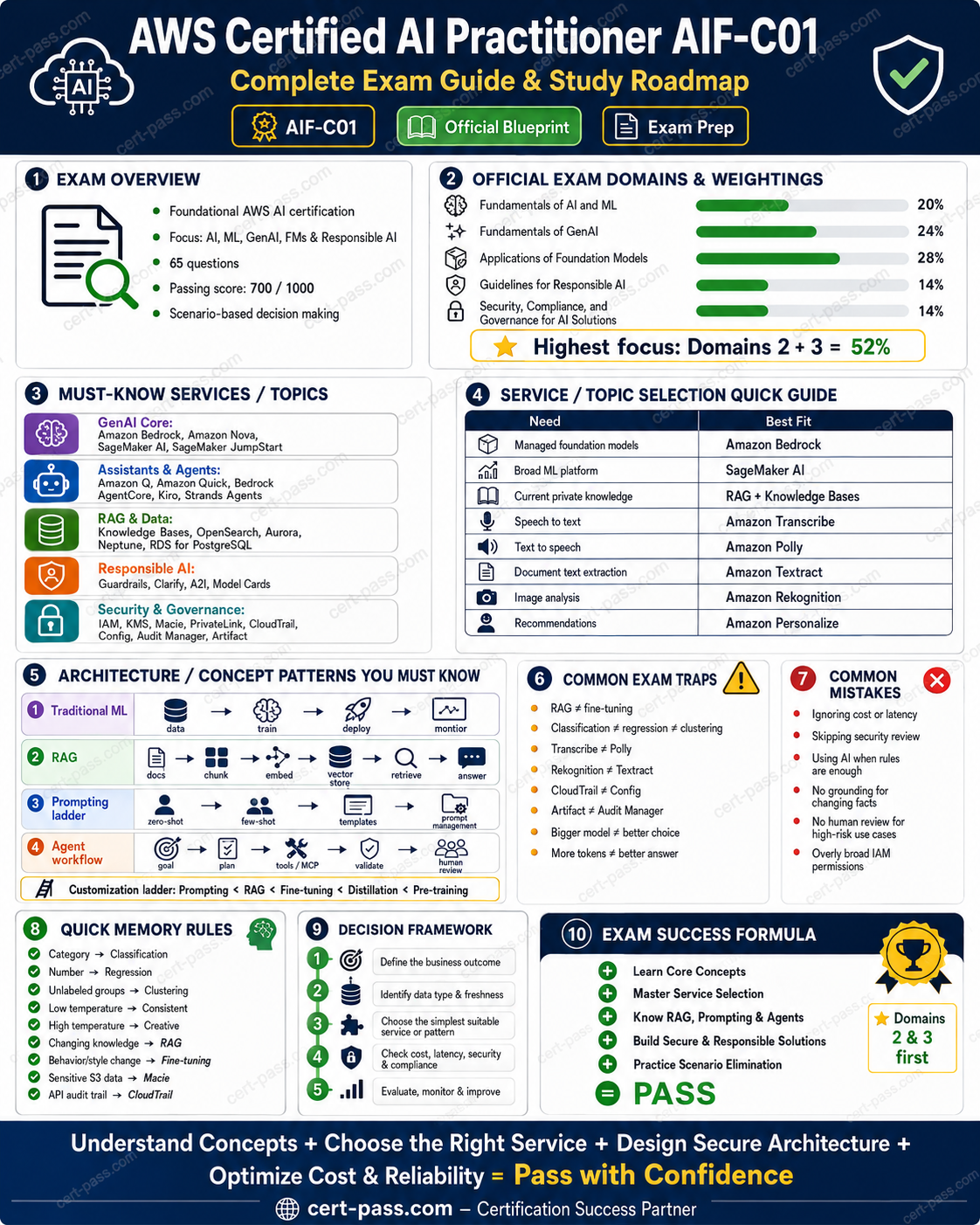

AWS Certified AI Practitioner AIF-C01 Common Mistakes and Exam Traps
Many candidates approach AWS Certified AI Practitioner AIF-C01 with the wrong study strategy. They memorize service names, skim a few AI definitions, and assume that a foundational exam will be easy. That approach usually fails on scenario questions. The better question is not whether the exam is hard. The better question is which mistakes cause avoidable point loss and how to remove them before test day.
This article focuses on the most common traps, why they matter, and how to fix them quickly. For the official exam page and a broader study path, use AWS Certified AI Practitioner AIF-C01 and the official AWS certification page at AWS Certified AI Practitioner.
Official exam facts
| Detail | Info |
|---|---|
| Exam code | AIF-C01 |
| Certification | AWS Certified AI Practitioner |
| Vendor | AWS |
| Level | Foundational |
| Duration | 90 minutes |
| Questions | 65 questions |
| Exam fee | 100 USD |
| Passing score | Not publicly listed on the official page |
| Official source | AWS Certified AI Practitioner |
Mistake 1: studying services without learning use cases
The first common error is simple. A candidate memorizes product names but does not learn what each service actually solves. That creates a shallow memory that breaks on scenario questions. The exam rarely asks, "What is this service called?" It asks, "Which service best solves this business need?"
Fix it by pairing every service with a concrete problem:
- Bedrock for managed foundation model access and generative apps
- SageMaker for building, tuning, and deploying ML workflows
- Comprehend for text analysis
- Rekognition for image and video analysis
- Transcribe for speech to text
- Polly for text to speech
- Translate for language conversion
- Lex for conversational interfaces
- Q for workplace assistance and knowledge access
If the service list can be recited but the use case cannot be explained in one sentence, the study method needs to change.
Mistake 2: treating generative AI as the same thing as all AI
Generative AI is important, but it is only one part of the broader AI landscape. Some candidates overfocus on chatbots and prompt writing and then miss questions about classification, sentiment, speech, or governance.
Fix it by separating the categories:
- AI is the broad field
- machine learning is a subset of AI
- generative AI is a subset that produces new content
- responsible AI applies across the stack
That distinction prevents a very common exam error. When a scenario is about sentiment analysis, image tagging, or speech conversion, the answer is not automatically a generative AI service just because the prompt mentions AI.
Mistake 3: ignoring responsible AI because it feels abstract
Governance, safety, transparency, privacy, and bias may feel less exciting than model generation, but they are central to the exam. Candidates who skip these topics often miss questions that are easier than they appear.
Fix it by learning what the vocabulary means in practical terms:
- bias means an unfair or unbalanced outcome
- explainability means being able to describe how the system reached a result
- privacy means sensitive data must be protected
- governance means the organization controls usage, risk, and policy alignment
- human oversight means people remain in the loop for high risk decisions
When a scenario mentions trust, compliance, safety, or sensitive data, that is a signal to look for a responsible AI answer rather than a purely technical service answer.
Mistake 4: confusing Bedrock and SageMaker
This is one of the most important distinctions on the exam. Both services are part of AWS AI, but they solve different problems.
Bedrock is about consuming foundation models and building managed generative AI applications. SageMaker is about building, training, tuning, and deploying ML solutions.
A candidate who blurs those two will lose easy points. If the scenario describes a team that wants access to managed foundation models and does not want to operate the full ML lifecycle, Bedrock is usually the better fit. If the scenario is about custom ML workflows, model deployment, or lifecycle management, SageMaker becomes the stronger answer.
Mistake 5: reading too fast and missing the real task
A lot of wrong answers happen because the candidate reads for keywords instead of reading for the actual task. The question may mention a familiar service, but the business goal may be completely different from the first impression.
Fix it with a three step reading method:
- identify the business goal
- identify the AI task type
- match the AWS service to the task
This simple method stops keyword chasing. The exam rewards careful reading, not speed reading.
Mistake 6: assuming the fanciest service is always correct
Exam distractors often sound impressive. They may describe a more advanced service, a more technical workflow, or a more complex deployment pattern. But the exam usually wants the simplest valid solution.
Fix it by asking one question: does this answer solve the actual problem with the least unnecessary complexity?
If a question describes a simple transcription need, a full custom ML workflow is likely too much. If the question asks for text sentiment, a visual service is obviously off target. The best answer is usually the cleanest fit, not the most advanced option.
Mistake 7: not practicing scenario language
The exam uses business language more than textbook language. Candidates who only study definitions struggle when a question is wrapped in a use case story.
Fix it by practicing translation between business wording and technical meaning.
Examples:
- "faster customer replies" may mean managed generative AI
- "analyze the tone of feedback" may mean text analysis
- "convert recorded meetings to text" may mean speech to text
- "create a chatbot for common questions" may mean Lex or a managed conversational workflow
- "build and run custom ML models" may mean SageMaker
This translation skill is one of the fastest ways to improve score potential.
Mistake 8: underestimating cloud basics
Even though this is an AI exam, AWS knowledge still matters. Candidates often miss questions because they do not understand the role of managed services, scalability, shared responsibility, or the difference between consuming a service and building one from scratch.
Fix it by reviewing basic AWS thinking:
- managed service versus self managed system
- cost and complexity tradeoffs
- security and governance considerations
- when to choose a managed API versus a build it yourself approach
Candidates do not need deep infrastructure knowledge, but they do need enough AWS literacy to think like an AWS user.
Mistake 9: skipping review of the official AWS page
The official certification page is not just decoration. It is the source of record for exam details. Candidates who do not read the official page may miss current information about the exam scope, fee, or wording.
Fix it by checking the official page before the exam and again while planning a study schedule. Use the official AWS source and the Cert-Pass page together so the exam path stays grounded.
Mistake 10: doing practice questions without reviewing why answers are wrong
Some learners rush through questions and only look at the answer key. That is not enough. The value comes from understanding why the distractors failed.
Fix it with a review habit:
- correct answer: why it works
- incorrect answers: why each one fails
- pattern: what the question was really testing
If a candidate can explain the wrong answers clearly, the same trap is less likely to work on the live exam.
The most common exam traps by topic
| Topic | Typical trap | Better habit |
|---|---|---|
| Bedrock vs SageMaker | Choosing the more technical service by habit | Identify whether the question is about consuming models or building them |
| Generative AI | Using generative AI for every AI question | First determine whether the task is generative, analytical, or operational |
| Responsible AI | Treating governance as optional | Read trust, fairness, security, and privacy prompts carefully |
| Service selection | Picking a service because the name sounds relevant | Match the actual task to the service capability |
| Prompt quality | Thinking prompts solve everything | Remember that service choice and data quality still matter |
A simple correction plan for weak candidates
A candidate who is already deep into study but still misses scenario questions should not restart from zero. The better move is to correct the weak layer.
Step 1: rebuild the service map
Write a one line explanation for each major AWS AI service. If a service cannot be described clearly in one sentence, it is not ready.
Step 2: review responsible AI separately
Do not leave governance for the end. It should be studied as a first class topic.
Step 3: practice 20 to 30 scenario questions
Focus on identifying the business goal before reading the options. Then explain why the wrong choices are wrong.
Step 4: retake weak sections only
Do not waste time on what already feels strong. Fix the specific gap that causes mistakes.
Step 5: do one final timed run
Use a timed set to check reading discipline, service mapping, and endurance.
A 7 day recovery plan
Day 1
Review AI, ML, and generative AI definitions.
Day 2
Review the AWS service map and write one sentence for each service.
Day 3
Study responsible AI, bias, privacy, security, and governance.
Day 4
Practice Bedrock versus SageMaker scenarios.
Day 5
Practice text, speech, translation, and vision service scenarios.
Day 6
Do mixed timed questions and write down every mistake.
Day 7
Review notes, retest weak areas, and rest before exam day.
FAQ
Are exam traps mostly about trick wording?
No. Most are about scenario reading and service fit, not pure trickery.
Should candidates memorize every service feature?
No. The goal is to understand the problem each service solves.
Is responsible AI really important for a foundational exam?
Yes. It is one of the easiest ways to lose or gain points.
What is the biggest mistake overall?
Treating the exam as a memorization test instead of a decision making test.
Common wrong answer patterns
The answer choices on this exam often fail in predictable ways. Once those patterns are visible, the wrong options become much easier to eliminate.
Pattern 1: the answer is correct in theory but wrong for the scenario
A service may be technically related to AI, but it may not solve the exact task in the question. This happens when a candidate recognizes a buzzword and stops reading too early. The fix is to keep reading until the business outcome is fully clear.
Pattern 2: the answer is too heavy for the requirement
Some distractors propose a solution that is far more complex than the problem requires. The exam usually prefers the simplest valid answer. A small workflow does not need a heavy platform if a managed service already solves the task.
Pattern 3: the answer confuses model building with model use
A candidate may choose SageMaker when the question is really about using managed foundation models. Or the opposite may happen: a candidate may choose a managed generative tool when the scenario clearly describes custom training and deployment. The build versus consume distinction is one of the highest value ideas on the exam.
Pattern 4: the answer ignores the human or policy angle
When the question talks about risk, oversight, fairness, approval, or sensitive data, the answer may be about governance rather than capability. Candidates who focus only on the technical layer miss the real intent of the question.
How to study from mistakes instead of around them
Many candidates try to avoid weak topics because they feel uncomfortable. That feels efficient in the short term, but it slows progress. A better approach is to use mistakes as a map.
If a mistake happened because the service map was weak, rebuild the service map. If a mistake happened because the question was read too quickly, slow down and practice reading discipline. If a mistake happened because responsible AI was ignored, move governance into the main study schedule. If a mistake happened because Bedrock and SageMaker were blurred together, create a comparison note and revisit it repeatedly.
This approach works because every wrong answer points to a fix. The exam does not reward guesswork. It rewards a stable decision pattern that survives pressure.
A last pass checklist before the real exam
Use this checklist on the final study day:
- can explain the difference between AI, ML, and generative AI
- can name the main AWS AI services and their common use cases
- can explain when Bedrock is more suitable than SageMaker
- can explain why responsible AI matters in real deployments
- can reject distractors that are too advanced, too generic, or off topic
- can answer scenario questions without rushing the first option that looks familiar
If all six items are strong, the candidate is in a good position for test day.
FAQ
Are exam traps mostly about trick wording?
No. Most are about scenario reading and service fit, not pure trickery.
Should candidates memorize every service feature?
No. The goal is to understand the problem each service solves.
Is responsible AI really important for a foundational exam?
Yes. It is one of the easiest ways to lose or gain points.
What is the biggest mistake overall?
Treating the exam as a memorization test instead of a decision making test.
Official source and related links
Official AWS source:
Cert-Pass exam page:
-
2026-06-03
-
Draft ready for internal review