AWS Certified AI Practitioner AIF-C01 Practice Questions: Try a Free Test
AWS Certified AI Practitioner AIF-C01 practice questions are most useful when they do more than quiz recall. This set is built as exam-style practice questions aligned to the latest official AWS certification page and the current AIF-C01 domain emphasis. The goal is to help candidates spot the difference between a plausible answer and the best answer, which is the real skill this exam rewards.
If you are preparing for AWS Certified AI Practitioner AIF-C01, start here: work through the questions, read the explanations carefully, and then return to the weak domains before attempting another run. This article is designed to support the exam page, the free practice path, and the full study guide, so it fits naturally into a complete preparation plan rather than standing alone as a random quiz.
For the official exam facts and the main certification hub, use the matching exam page and the AWS vendor page before scheduling your test. For deeper review, pair this quiz with the study guide and the common mistakes article so you can correct misunderstandings before they become exam-day traps.
Official exam facts at a glance
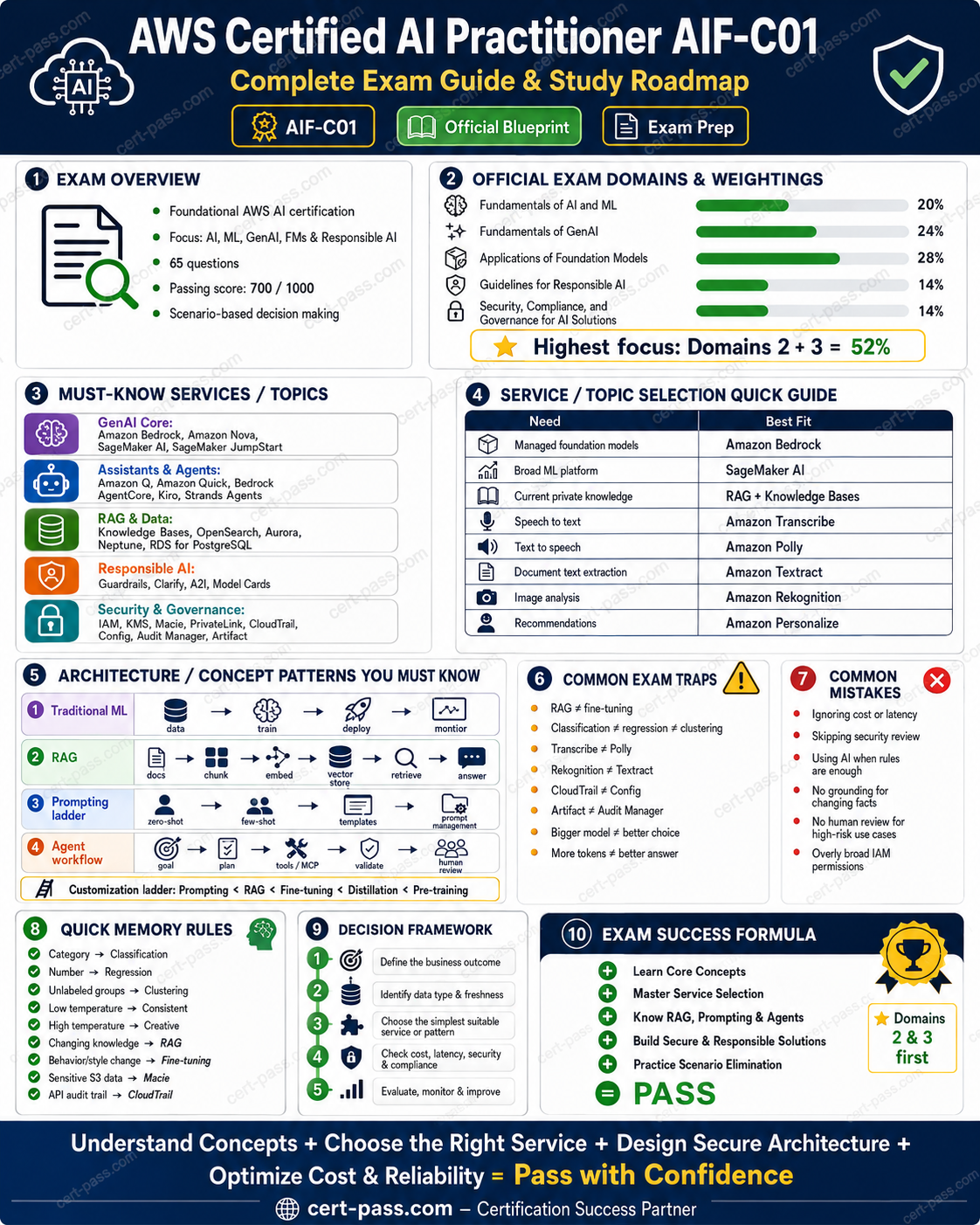
| Detail | Information |
|---|---|
| Exam | AWS Certified AI Practitioner AIF-C01 |
| Vendor | AWS |
| Level | Foundational |
| Duration | 90 minutes |
| Format | 65 questions |
| Cost | 100 USD |
| Certification validity | 3 years |
| Primary focus | AI, ML, generative AI, responsible AI, security, and governance |
| Official source | https://aws.amazon.com/certification/certified-ai-practitioner/ |
| Last verified | 2026-06-03 |
A few notes matter here. AWS positions this certification as foundational, so the exam is less about deep engineering design and more about recognizing the right service, the right AI concept, and the right governance approach in business-relevant scenarios. The official page lists the exam as 65 questions over 90 minutes with a cost of 100 USD. That means pacing matters, but so does judgment. Candidates who study only definitions often miss the subtle wording that separates a technically true statement from the best business answer.
What these practice questions are designed to do
These AWS Certified AI Practitioner AIF-C01 practice questions are not meant to copy protected exam content. They are exam-style practice questions built around the same style of thinking the certification expects:
- identify the AWS service that best matches the task
- distinguish foundation model concepts from general AI vocabulary
- recognize responsible AI and governance requirements
- choose the simplest correct answer instead of the most complicated one
- notice when a distractor sounds right but does not address the business need
That last point is important. The AIF-C01 exam often rewards candidates who can connect the requirement to the correct outcome. For example, a question may describe text-to-speech, but the wrong answers may mention analytics, compliance artifacts, or networking tools. The candidate must notice the mismatch quickly and avoid overthinking.
How to use this free practice test
Use the questions in three passes:
- First pass - timed: answer without looking at the explanation.
- Second pass - review: read why the correct option wins and why the distractors fail.
- Third pass - weak areas: revisit only the domains that caused mistakes.
A good practice routine is to keep a notebook with three columns:
- concept
- why the right answer was right
- why the distractor felt tempting
If you can explain the wrong option in plain language, you are much closer to exam readiness. If you only memorize the answer key, the exam will still expose the gap.
Topic map: where the questions focus
| Topic area | What to watch for | Common trap |
|---|---|---|
| Fundamentals of AI and ML | Core concepts, task types, basic ML lifecycle | Confusing a service name with a concept |
| Fundamentals of GenAI | Prompts, foundation models, output controls | Picking a general cloud service instead of an AI-specific one |
| Applications of foundation models | Use cases, customization, deployment, constraints | Choosing a tool that is real but not relevant |
| Guidelines for responsible AI | Human review, explainability, fairness, transparency | Treating compliance documentation as a review workflow |
| Security, compliance, and governance | Privacy, access control, audit needs, risk management | Selecting a security control that does not address the AI process |
Practice questions
1. Business metric for a GenAI assistant
A retail team is testing a GenAI sales assistant and wants to measure whether the assistant improves commercial performance without adding unnecessary operational complexity. Which choice best addresses the requirement?
A. Track conversion rate as a business metric and evaluate it against the business outcome.
B. Track only the number of VPC subnets in the environment.
C. Track the number of IAM users and ignore the sales funnel.
D. Track the size of the largest S3 bucket and treat that as the success metric.
Correct answer: A
The best answer is the one that measures the actual business result. Conversion rate is a legitimate business metric for a sales assistant, and pairing it with the business outcome keeps the design grounded. The other options describe infrastructure counts that do not say anything about commercial effectiveness. A common trap on AIF-C01 is to choose a real AWS-related term that has no connection to the scenario. That is why this question is about judgment, not just vocabulary.
2. Human review for low-confidence predictions
A customer support provider wants human reviewers to handle low-confidence AI predictions before a final action is taken. Which AWS service best supports that workflow?
A. AWS Artifact
B. Amazon Augmented AI (Amazon A2I)
C. Amazon CloudFront
D. Amazon Polly
Correct answer: B
Amazon A2I is designed for human review workflows. That is exactly what this scenario describes. AWS Artifact provides compliance documentation, not a review workflow. CloudFront is a content delivery service. Polly converts text to speech. The right answer is not the most famous AWS service, but the one that fits the operational need. AIF-C01 often tests whether you can match the business description to the right managed service.
3. Architecture associated with modern LLMs
A workshop asks which architecture is commonly associated with modern large language models. Which answer is best?
A. A VPC route table
B. Transformer-based architecture
C. A relational database index
D. An S3 lifecycle rule
Correct answer: B
Modern large language models are commonly associated with transformer-based architecture. The wrong answers are real technical terms, but they are not model architectures. This is a classic exam pattern: the correct answer is conceptually central, while the distractors are infrastructure or storage terms that sound technical but do not solve the question. If a question asks about the model itself, stay focused on the model concept rather than the cloud plumbing around it.
4. AWS service for building and deploying ML models
An organization needs AWS capabilities to build, train, customize, and deploy machine learning models. Which option is best?
A. AWS Artifact
B. Amazon Polly
C. Amazon SageMaker AI
D. Amazon CloudFront only
Correct answer: C
Amazon SageMaker AI is the AWS service associated with building, training, customizing, and deploying ML models. The other options are unrelated to the core ML lifecycle. This is a good reminder that the exam expects service recognition, but not blind memorization. If the scenario mentions model development, deployment, or training, the answer often points toward a managed ML platform rather than a specialized downstream service.
5. Explainability for a high-impact decision
A governance checkpoint says the organization must justify how an AI-assisted recommendation affects a high-impact decision. What is the best recommendation?
A. Prefer an explainable approach and document limitations.
B. Remove model documentation to reduce noise.
C. Rely only on model size as proof of quality.
D. Use an opaque approach without review.
Correct answer: A
High-impact decisions need explainability and documentation. The best answer does not claim that every model output can be fully transparent, but it does commit to an explainable approach and records the limitations. The distractors are the opposite of responsible practice. This is the kind of question where the wording matters: the exam is testing whether the candidate understands governance, not just whether the candidate can repeat a buzzword.
6. Text-to-speech requirement
A public-sector team needs to generate spoken audio from written accessibility content. Which AWS service best fits?
A. Amazon Polly
B. Amazon Comprehend
C. Amazon Transcribe
D. Amazon Textract
Correct answer: A
Amazon Polly converts text into spoken audio, so it directly matches the requirement. Transcribe does the opposite by converting speech to text. Textract extracts text from documents. Comprehend analyzes text for meaning. The strongest answer is the one that matches the input and output types exactly. That is a common AIF-C01 trap: many services are AI-related, but only one is the correct service for the task.
7. Limiting overly long responses
A team wants to limit excessively long GenAI responses and manage cost. Which action best addresses the requirement?
A. Set an appropriate maximum output length and test it against quality, latency, and cost goals.
B. Remove all prompt controls and let the model decide automatically.
C. Increase output length without limit.
D. Focus only on IAM policy count.
Correct answer: A
The best option combines control and validation. Setting a maximum output length helps manage verbosity and cost, and testing the setting ensures the choice actually works in practice. The distractors are either too vague or entirely unrelated. AIF-C01 often rewards candidates who pick a simple, measurable control rather than a complicated theory-heavy answer.
8. Nontechnical explanations for affected users
A nonprofit is designing explanations for nontechnical users affected by an AI-assisted decision. What should the team do?
A. Provide clear explanations, feedback mechanisms, and a path for human review.
B. Expose only raw model internals.
C. Remove all feedback options.
D. Use unexplained technical jargon.
Correct answer: A
Human-centered design means the explanation has to be understandable and useful. Nontechnical users need clear language, a chance to give feedback, and a path for human review when needed. The other options are bad practice because they make the decision harder to understand or impossible to challenge. This is a responsible AI question disguised as a user experience question.
9. Foundation model usage in a business setting
A company wants to use a foundation model for a customer service workflow and needs to keep the implementation straightforward. Which recommendation is best?
A. Select the simplest model and workflow that meet the business requirement.
B. Use the most complex architecture available even if it adds friction.
C. Avoid measuring the outcome after deployment.
D. Replace the entire business process before testing the model.
Correct answer: A
The exam often prefers the simplest adequate solution. The strongest answer does not chase complexity for its own sake. Instead, it aligns the model and workflow to the business requirement. The wrong choices either ignore measurement, add unnecessary complexity, or propose an unrealistic transformation. AIF-C01 expects practical thinking, especially when the scenario says to minimize operational overhead.
10. Appropriate use of Amazon Bedrock style foundation model access
A team wants to experiment with foundation models without spending months building and hosting custom infrastructure. Which approach is most aligned with that goal?
A. Use a managed AI service that provides access to foundation models and related tooling.
B. Build every component from scratch before testing the use case.
C. Focus only on storage and networking services.
D. Ignore the model and ask the database to generate responses.
Correct answer: A
The question is about reducing unnecessary operational work while still enabling foundation model experimentation. A managed AI service is the best fit because it gives the team a practical path to trial and iterate. The other choices either ignore the requirement or make the solution more complex than necessary. Even when the exam does not name a service explicitly, the scenario usually points to a service category that fits the workflow.
11. Responsible AI and documentation
Which action best supports responsible AI governance during deployment?
A. Document the model purpose, known limitations, and review path.
B. Hide the model purpose from the operations team.
C. Treat the model output as automatically correct.
D. Skip review because the model is new.
Correct answer: A
Documentation helps teams understand what the model is for, where it can fail, and who should review it. The exam is unlikely to reward a careless or opaque deployment pattern. If a scenario mentions governance, trust, or accountability, documentation and review are usually part of the best answer. The wrong options show the kind of overconfidence the exam is trying to filter out.
12. Distinguishing AI concepts from AWS services
A candidate sees a question about categorizing examples. Which statement is correct?
A. A transformer is a model architecture.
B. A transformer is an AWS billing report.
C. A transformer is a VPC security group.
D. A transformer is an S3 storage class.
Correct answer: A
The answer is the conceptual classification. A transformer is a model architecture, not an AWS operational feature. AIF-C01 checks whether you can distinguish AI concepts from cloud services. That distinction matters because many distractors sound technical but belong to a completely different layer of the stack.
13. Choosing the right service for speech recognition
A media team wants to convert recorded speech into text for review and indexing. Which AWS service is the best fit?
A. Amazon Polly
B. Amazon Transcribe
C. Amazon Comprehend
D. AWS Artifact
Correct answer: B
Amazon Transcribe converts speech to text. Polly does the reverse. Comprehend analyzes text after it already exists. Artifact is unrelated. This question looks simple, but many candidates still hesitate because all four answers are AWS products. The right tactic is to map the data flow first, then pick the service that matches the direction of conversion.
14. Privacy and access control
A team is preparing an AI workflow that handles sensitive customer information. Which step best supports the requirement?
A. Restrict access to the data and apply the minimum necessary permissions.
B. Share data broadly so every team can experiment at once.
C. Skip logging to avoid creating records.
D. Put all data into one public bucket for simplicity.
Correct answer: A
Least privilege and controlled access are core security practices. Sensitive customer data should be protected by restricting access to only what is needed. The distractors are intentionally unsafe. AIF-C01 does not require deep security engineering, but it does expect you to recognize the directionally correct governance choice when the prompt includes sensitive data.
15. When to use human review
A healthcare organization wants to reduce unnecessary risk when AI confidence is low. What should it do?
A. Route low-confidence cases to human review before final action.
B. Force every decision to be automated regardless of confidence.
C. Ignore uncertain predictions.
D. Use a public demo environment for production decisions.
Correct answer: A
Human-in-the-loop review is a standard response when confidence is low and the outcome matters. The other options either increase risk or fail to address uncertainty. The exam often presents a responsible AI situation without using the phrase directly, so the candidate must recognize the control from the scenario itself.
16. Best first step for a new GenAI pilot
A project lead wants to launch a GenAI pilot with limited operational overhead and measurable outcomes. What is the best first step?
A. Define the business outcome, the success metric, and the simplest path to test it.
B. Build every feature at once.
C. Skip measurement until the end.
D. Select a tool before defining the use case.
Correct answer: A
AIF-C01 favors practical planning. Before selecting tools, define the outcome and how success will be measured. That avoids overengineering and helps the team stay honest about what the pilot can and cannot prove. The wrong options reverse the planning order or eliminate measurement entirely, which is a frequent exam trap.
17. What makes a response too long?
A support team notices that model responses are verbose and slow down the workflow. What should the team adjust first?
A. The response length limit.
B. The public website theme.
C. The number of office chairs.
D. The DNS zone file.
Correct answer: A
If the responses are too long, the first control to review is the output length limit. The other options are unrelated. This is a simple question, but it reflects an important exam habit: do not overcomplicate the answer when the scenario points to a direct control.
18. Business value and AI adoption
A manager asks why the team should evaluate AI output against a real business metric instead of a technical vanity metric. Which answer is best?
A. Business metrics show whether the system helps the organization reach its intended outcome.
B. Technical metrics are always useless.
C. Only model size matters.
D. AI success can be assumed once the model is deployed.
Correct answer: A
The best explanation is simple: business metrics connect the system to the outcome the organization actually cares about. Technical metrics still matter, but they do not replace the business result. This is a recurring theme in the certification. Candidates who can frame the value in business terms usually do better than candidates who memorize definitions only.
19. Choosing a simple and measurable pilot
A team wants to prove value from a small GenAI pilot before scaling it. Which approach is best?
A. Define a narrow use case, choose one success metric, and review the results after the pilot.
B. Launch every possible feature at once.
C. Skip the metric because the model output looks promising.
D. Start with the most expensive design available.
Correct answer: A
A small pilot should be narrow and measurable. The exam often rewards the answer that keeps the experiment controlled and tied to a concrete success metric. The wrong choices either add unnecessary complexity or remove measurement entirely. If you see language about a pilot, a proof of concept, or a low-risk test, the best answer is usually the one that defines scope before scale.
20. Matching text analysis to the right concept
A support team wants to understand the sentiment and main topics in customer feedback. Which service category is most relevant?
A. Text analytics and NLP services
B. Content delivery services
C. Network load balancers
D. Backup storage services
Correct answer: A
Sentiment and topic extraction are text analysis tasks, so the relevant category is natural language processing. The distractors are unrelated infrastructure or storage services. This kind of question checks whether you can classify the workload before naming a tool. The safest way to handle it is to identify the data type first and then choose the service family that processes that data type.
21. Governance when outcomes affect people
A hiring support workflow produces recommendations that influence a final decision. What is the best governance practice?
A. Keep a human in the loop and document how the recommendation is used.
B. Remove review to make the workflow faster.
C. Let the model make final decisions without oversight.
D. Ignore documentation because the model is automated.
Correct answer: A
When AI affects people, governance matters. Human oversight and documentation are the safest and most defensible practices. The other options increase risk and remove accountability. AIF-C01 often presents a scenario where the technically elegant answer is not the right organizational answer. In those cases, the best choice is the one that improves trust, reviewability, and clarity.
22. Choosing the right output control
A team notices that model responses sometimes ramble and increase cost. What should the team tune first?
A. The maximum output length or response cap.
B. The DNS TTL.
C. The number of security groups.
D. The number of subnets in the VPC.
Correct answer: A
If the problem is verbosity and cost, output control is the first place to look. The exam often expects you to connect the complaint to the control that changes the output behavior. The other options are network or infrastructure settings that do not directly influence how long a model response is. The best answer is simple, measurable, and directly related to the problem.
23. Understanding the right order of work
A manager wants to adopt AI responsibly and asks what should happen first. Which answer is best?
A. Define the business problem and success metric before selecting tooling.
B. Select tools first and ask questions later.
C. Deploy immediately and fix the plan after launch.
D. Skip stakeholder review because the model is new.
Correct answer: A
The right order is to define the problem, then define success, then select tooling. That sequence keeps the project aligned to business value and avoids solution-first thinking. AIF-C01 often favors practical workflow logic over buzzwords. When the question asks what should happen first, the answer usually starts with the business outcome rather than the technology choice.
Score your results by domain
Use this quick review framework after finishing the questions.
| If you missed mostly... | Revisit... | What to focus on |
|---|---|---|
| Service questions | AWS AI services and use cases | Match service to input, output, and workflow |
| Concept questions | AI and GenAI fundamentals | Architecture, model types, and core terminology |
| Governance questions | Responsible AI and risk controls | Explainability, human review, documentation |
| Security questions | Security, compliance, and access control | Least privilege, data sensitivity, auditability |
| Business metric questions | Outcome measurement and pilot design | Choose the metric that reflects the business result |
Common mistakes to avoid
Even strong candidates miss questions for the same reasons:
- they know the AWS service but not the exact use case
- they choose a technically true option that does not solve the scenario
- they ignore the business outcome and focus only on infrastructure details
- they confuse speech-to-text with text-to-speech
- they assume every AI issue needs the most complex solution
- they forget that responsible AI is often about process, review, and documentation
A good review habit is to ask one question before locking in an answer: What problem is the scenario actually asking me to solve? If the answer is not clear, read the prompt again and identify the target outcome. That habit alone removes a lot of exam-day noise.
How to use this quiz together with the rest of the AWS AIF-C01 cluster
This free practice path works best as part of a wider cluster, not as a standalone page. Use it with:
- the AWS Certified AI Practitioner AIF-C01 study guide
- the AWS Certified AI Practitioner AIF-C01 common mistakes and exam traps article
- the main AWS exam page for the certification overview
- the free practice questions CTA on the exam page
- the paid course preview when you want a fuller review path
Recommended links:
- AWS Certified AI Practitioner AIF-C01 exam page
- Try 35 free AWS Certified AI Practitioner AIF-C01 practice questions
- Read the AWS Certified AI Practitioner AIF-C01 study guide
- Review the AWS Certified AI Practitioner AIF-C01 study guide
- Browse AWS certification options
FAQ
Are these real AWS exam questions?
No. These are exam-style practice questions designed to reflect the blueprint, topic emphasis, and decision patterns of AWS Certified AI Practitioner AIF-C01 without reproducing protected exam content.
How hard is AWS Certified AI Practitioner AIF-C01?
It is a foundational exam, but it still rewards careful reading. The hardest part is often choosing the best answer among several plausible options, especially when the prompt mixes AI concepts with AWS service names.
How many questions should I practice before taking the exam?
There is no universal number, but the most useful approach is to work through enough questions to cover every domain more than once. If repeated misses cluster around the same topic, return to the study guide before adding more quizzes.
What should I study if I keep missing service questions?
Review the purpose of each AWS AI service and make sure you can distinguish the input, output, and workflow it supports. For example, speech-to-text, text-to-speech, document extraction, sentiment analysis, and human review each point to different services.
Should I memorize every fact on the AWS certification page?
Memorize the core facts that matter for planning, but focus more on use cases, service matching, and responsible AI thinking. AIF-C01 is usually won by practical understanding, not by memorizing a long list of isolated terms.
What is the best next step after this practice test?
Review the mistakes article, revisit the study guide, and then retake a fresh set of practice questions. If you can explain why the wrong answers are wrong, you are moving in the right direction.
Official source and verification
Official AWS certification page: https://aws.amazon.com/certification/certified-ai-practitioner/