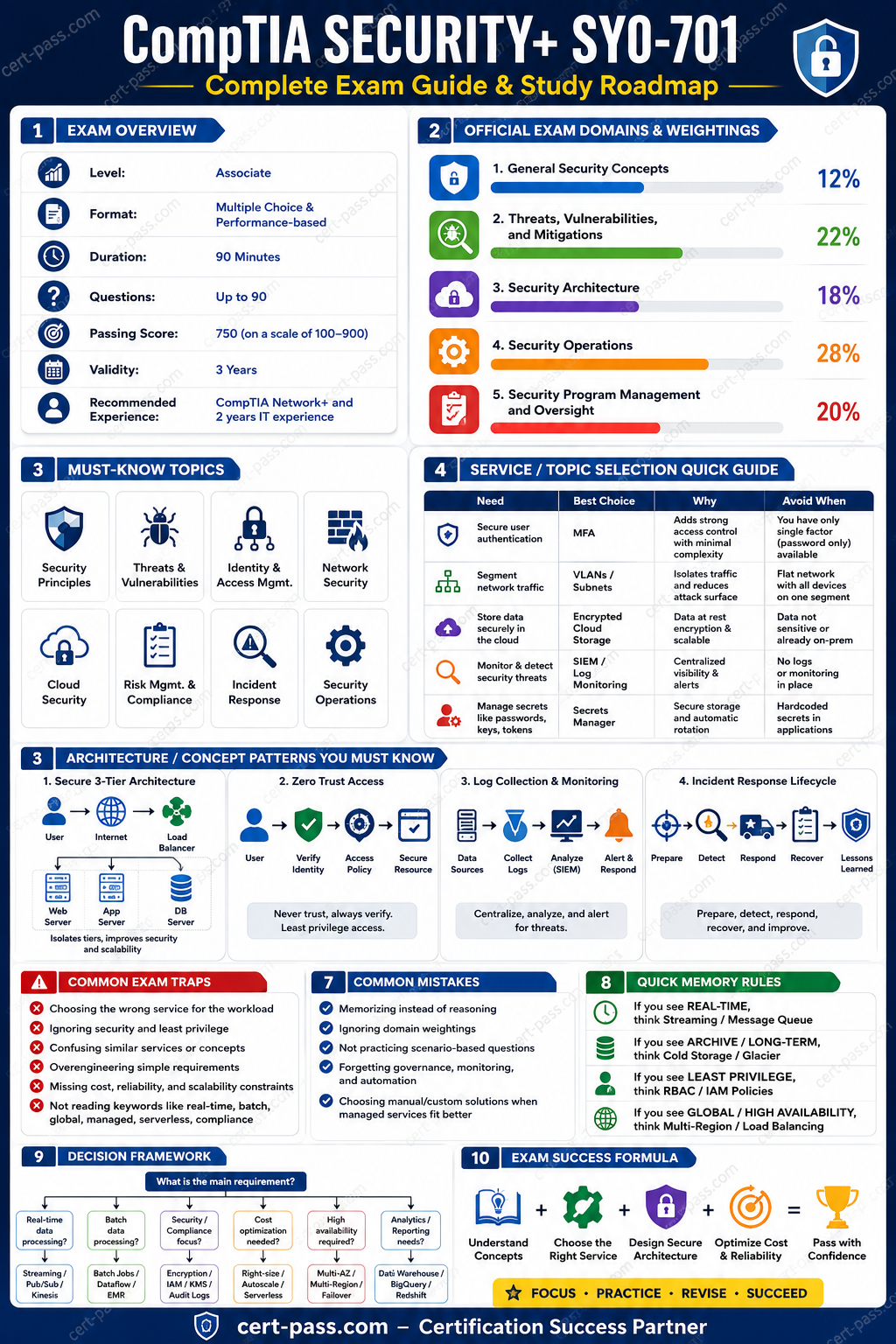

Is Security+ SY0-701 Worth It in 2026?
Security+ SY0-701 is worth it in 2026 for many candidates who want a broad, recognized cybersecurity foundation, but the answer depends on the candidate's current role, experience, and next career step. Some people need the certification as a structured entry point into security. Others already have stronger hands-on experience and may gain more from a different specialization first.
The most useful way to evaluate Security+ is to ask what it actually gives the candidate. It offers a common security vocabulary, a broad overview of security operations and risk, and a good base for future certifications or job transitions. It also gives hiring managers a familiar signal that the candidate understands fundamental security topics rather than just isolated tools.
If the candidate wants the official exam page, start here: Security+ SY0-701 exam page. For full topic review, use the study guide: Security+ SY0-701 Study Guide 2026. For exam-style practice, use the question set: Security+ SY0-701 Practice Questions 2026. To avoid common traps, review: Security+ SY0-701 Common Mistakes and Exam Traps 2026. For the official vendor source, use: CompTIA Security+ official page.
Official exam facts
| Detail | Info |
|---|---|
| Exam code | SY0-701 |
| Certification | Security+ |
| Vendor | CompTIA |
| Time limit | 90 minutes |
| Passing score | 70% |
| Official source | CompTIA Security+ official page |
| Cert-Pass exam page | Security+ SY0-701 exam page |
| Free practice CTA | Try 35 free Security+ SY0-701 practice questions |
| Study support | Security+ SY0-701 Study Guide 2026 |
| Retirement date | Not announced |
Who Security+ is best for
Security+ tends to be most valuable for candidates in one of these situations:
- they are trying to enter cybersecurity for the first time
- they work in IT support, systems, networking, or help desk and want to move toward security
- they need a structured way to learn the language of security before specializing
- they want a credential that covers a broad security baseline without locking them into one vendor
- they need a certification that can support a transition into junior analyst, SOC, or general security support roles
For these candidates, Security+ can be a strong return on study time because it shapes how they think about risk, incidents, access, and governance. It is not only about passing a test. It is about building a base that makes later training easier.
When Security+ may not be the best first move
Security+ is not always the perfect answer. A candidate who already works in a specialized area may benefit more from a deeper certification that matches the role they want next.
For example:
- a cloud engineer may need cloud security or platform-specific depth next
- a network professional may need more architecture or vendor-specific security depth
- a manager may want governance, risk, and compliance depth
- a candidate already working in a SOC may need a more advanced analyst path after the baseline
That does not mean Security+ is useless. It means the candidate should ask whether the certification is the fastest bridge to the next goal or just another box to tick.
The real value of Security+ in 2026
Security+ remains useful because it sits in the middle of three things that matter to employers and learners:
- a recognized entry-level security baseline
- broad enough coverage to help with role transition
- enough practical relevance to matter in real work
The exam covers operations, threats, architecture, and governance. That mix is valuable because many jobs expect people to understand at least the basics of each area even if they specialize later.
A candidate who earns Security+ usually walks away with more than a certificate. They usually walk away with a more structured way of reading alerts, thinking about controls, and discussing risk with other teams.
What Security+ does not do
It is also important to be honest about the limits of Security+.
Security+ does not make someone an expert by itself. It does not replace hands-on experience. It does not turn a beginner into a senior security engineer. And it does not solve the problem of a weak portfolio or no practical experience.
The certification is best understood as a base layer. It helps the candidate speak the language, understand the map, and start the journey. It is not the final destination.
What the candidate gains from Security+
Here are the practical benefits many candidates get from the certification:
- a broader understanding of threats and mitigations
- better awareness of incident response and monitoring concepts
- more confidence talking about risk, policy, and access control
- a stronger baseline for future certifications
- a more credible entry point for security-related job applications
- a more organized study path than random self-study alone
Those benefits matter most for candidates who are building from the ground up or who have spent years in IT without a formal security framework.
Cost versus value: how to think about the tradeoff
The best way to think about whether Security+ is worth it is not to ask whether it is universally good. It is to ask whether it is worth the candidate's time, money, and energy for the specific role they want.
A candidate should ask:
- Will this certification help me qualify for the next role I want?
- Will it improve my confidence with core security concepts?
- Will it help me understand my current work more clearly?
- Does my target employer recognize the credential?
- Is there a better certification that matches my role more closely?
If the answer to several of those questions is yes, Security+ is usually a good investment.
Security+ for different career stages
For beginners
For beginners, Security+ is often one of the best first certifications because it gives structure. Beginners usually need a framework more than they need a niche specialization. Security+ offers that framework in a way that is broad enough to be useful and practical enough to matter.
For IT professionals moving into security
For IT professionals, Security+ often works as a bridge. Someone in support, infrastructure, or systems can use the exam to formalize what they already know and fill in gaps around governance, monitoring, and incident response.
For security candidates already working in the field
For candidates already in a security role, the value depends on the path. If the candidate lacks a formal baseline, Security+ can still be useful. If the candidate already has strong experience and is aiming higher, the next step might be a deeper specialization instead.
How Security+ supports future learning
One of the strongest arguments in favor of Security+ is that it makes future learning easier. Once a candidate understands the vocabulary of access control, threats, monitoring, risk, and governance, later study becomes much more efficient.
A future cloud, infrastructure, or analyst certification will usually assume at least some of that baseline. Security+ helps prepare the candidate for that next step.
The most efficient learning sequence is often:
- build the baseline with Security+
- strengthen practical experience
- move into a specialization that matches the target role
What employers often see in Security+
Employers usually see Security+ as a signal that the candidate is serious about security and understands the broad picture. It may not be the only thing that gets a candidate hired, but it can help the candidate get past the first filter when combined with practical experience and a clear resume story.
The certification can be especially helpful when a candidate has:
- clear hands-on experience in IT
- a targeted role goal
- a strong resume that connects the credential to the job path
- practice questions and study materials that show real preparation
How to maximize the value of Security+
The certification is more valuable when the candidate studies it properly. That means:
- using a full study guide instead of shortcuts only
- practicing with exam-style questions
- reviewing mistakes carefully
- learning the reason behind the correct answer
- connecting the exam topics to real work scenarios
- building a simple study plan and sticking to it
The best candidates do not treat the certification as a one-day event. They treat it as a foundation for better thinking.
When Security+ is probably worth it
Security+ is probably worth it if the candidate:
- is new to cybersecurity
- wants to move from IT to security
- needs a recognized baseline credential
- wants a broad foundation before choosing a specialty
- wants a study path that improves real understanding, not just test-taking
When Security+ may not be worth it right now
Security+ may not be the best investment right now if the candidate:
- already has stronger, more relevant security experience
- needs a role-specific certification immediately
- has a target role that depends on a different platform or specialty
- has no time to study and would only rush through the exam
- is trying to solve a career problem that a certification alone cannot solve
How to decide quickly
A simple decision frame helps:
- If you need a baseline, Security+ is usually worth it.
- If you need breadth, Security+ is usually worth it.
- If you need deep specialization immediately, another path may be better.
- If you want to build a security career from an IT background, Security+ is often a strong first move.
Good study path if you choose Security+
If the candidate decides the certification is worth it, the cleanest path is:
- read the study guide
- take practice questions
- review common mistakes
- revisit weak domains
- use the official CompTIA page before the exam
- do one final mixed review before test day
The following pages help keep that path focused:
- Security+ SY0-701 Study Guide 2026
- Security+ SY0-701 Practice Questions 2026
- Security+ SY0-701 Common Mistakes and Exam Traps 2026
- Try 35 free Security+ SY0-701 practice questions
Frequently asked questions
Is Security+ worth it for a complete beginner?
Usually yes, if the candidate wants a broad introduction to cybersecurity and a structured way to learn the basics.
Is Security+ enough to get a security job by itself?
Not by itself. It is most effective when combined with relevant experience, a clear target role, and practical study.
Is Security+ outdated in 2026?
No. The exam remains relevant because the topics it covers are still central to everyday security work.
Should I take Security+ before a cloud certification?
That depends on the candidate's goal. If the candidate needs security fundamentals first, Security+ can be a strong precursor.
What is the biggest value of Security+?
Its biggest value is that it builds a broad security baseline that helps candidates speak and think more clearly about the field.
Final verdict
Security+ SY0-701 is worth it in 2026 for many candidates, especially beginners and IT professionals moving toward security. It is not the only valuable certification, and it is not the deepest one, but it is a strong foundation. The real value comes from the way it helps the candidate understand risk, response, architecture, and governance in a practical way.
If the candidate needs a broad, recognized, and useful first security credential, Security+ is still a solid choice. If the candidate already knows the basics and needs a more specific specialization, it may be better to choose a different path next.