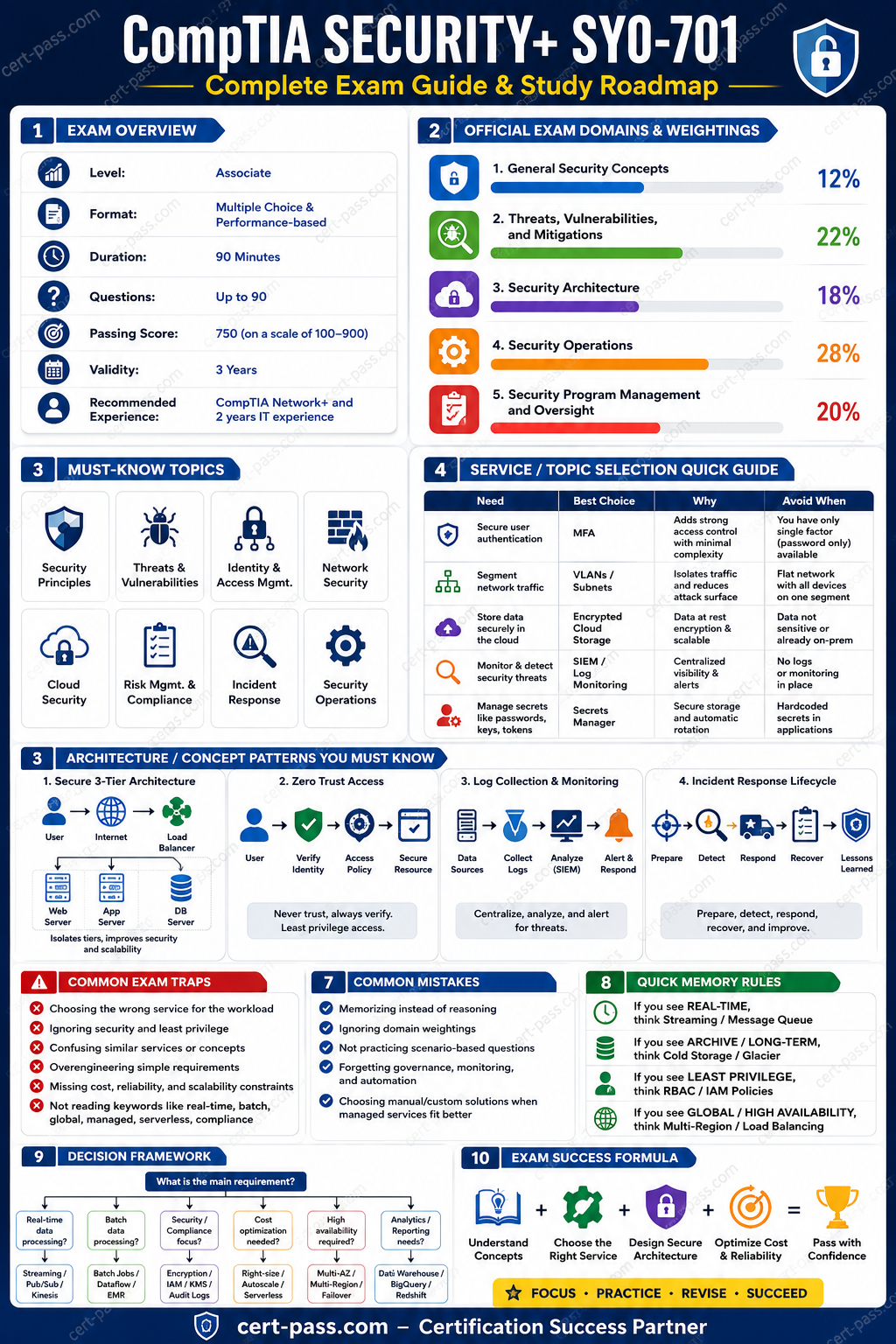

Security+ SY0-701 Common Mistakes and Exam Traps 2026
Why Security+ candidates miss easy points
Security+ SY0-701 common mistakes usually come from the same pattern: the candidate knows the topic in a loose way, but the question is asking for a more precise decision. The exam rarely rewards guessing. It rewards reading carefully, recognizing the real problem, and choosing the best control, not just any familiar security term.
If the candidate wants the official exam page, start here: Security+ SY0-701 exam page. For topic review, use the study guide: Security+ SY0-701 Study Guide 2026. For exam-style practice, use the live question set: Security+ SY0-701 Practice Questions 2026 and the free practice CTA: Try 35 free Security+ SY0-701 practice questions. For the official source, review the CompTIA page: CompTIA Security+ official page.
Official exam facts
| Detail | Info |
|---|---|
| Exam code | SY0-701 |
| Certification | Security+ |
| Vendor | CompTIA |
| Time limit | 90 minutes |
| Passing score | 70% |
| Official source | CompTIA Security+ official page |
| Cert-Pass exam page | Security+ SY0-701 exam page |
| Free practice CTA | Try 35 free Security+ SY0-701 practice questions |
| Study support | Security+ SY0-701 Study Guide 2026 |
| Retirement date | Not announced |
Mistake 1: choosing the most technical answer instead of the best answer
A very common trap is to see a technical answer and assume it must be right because it sounds advanced. Security+ usually does not work that way. The exam often asks for the most appropriate response in context, not the fanciest tool in the list.
For example, if a company is trying to stop stolen password use, MFA is usually a better answer than a complex architecture redesign. If a company wants to reduce lateral movement, segmentation is often more effective than adding more monitors. The candidate must match the solution to the problem.
How to avoid this trap
- Read the exact problem being described.
- Decide whether the question is about prevention, detection, or response.
- Choose the simplest valid control that addresses the risk.
- Do not overvalue jargon.
Mistake 2: missing the action word
Words like first, next, best, most likely, and most effective change the question. Candidates who skip over those words may answer a different question than the one that was actually asked.
If the question asks for the first step in incident response, the answer is usually not recovery. If the question asks for the best long-term mitigation against phishing, the answer may be training, MFA, or filtering, not just one isolated action.
How to avoid this trap
- Circle or mentally highlight the action word.
- Ask whether the question is asking for sequence or strategy.
- Do not answer until the action word is interpreted.
Mistake 3: confusing prevention with detection
This is one of the most common Security+ errors. A firewall, MFA, segmentation, and allowlisting are not the same as a SIEM, IDS, or log review. Some tools stop bad behavior, while others help see it.
A question may ask how to detect suspicious behavior on a network. If the answer choice is a monitoring system, that may be correct. If the question asks how to stop untrusted software from running, an allowlist may be better. The exact verb matters.
How to avoid this trap
- Prevention blocks or reduces the action.
- Detection identifies or alerts on the action.
- Response contains or removes the issue.
Mistake 4: forgetting the human factor
Many candidates study only technology and forget that Security+ often asks about people, policy, and process. If an issue is caused by employee behavior, a technical fix may not be enough by itself.
Repeated phishing clicks, poor password choices, unsafe data handling, and policy violations often need awareness training, policy reinforcement, or access control changes. The exam wants candidates to think about the broader security program.
How to avoid this trap
- Ask whether the problem is technical, procedural, or behavioral.
- If the issue repeats because of user behavior, think training or policy.
- If the issue repeats because of overly broad access, think least privilege.
Mistake 5: mixing up policy, standard, procedure, and guideline
These terms are small, but they matter. Security+ may ask which document should define required behavior, which should provide step-by-step instructions, or which should offer flexible advice.
A policy is mandatory direction. A standard is more specific and consistent. A procedure is the exact process. A guideline is advice, not a hard rule.
How to avoid this trap
- Policy = what is required.
- Standard = how something is uniformly done.
- Procedure = the step-by-step method.
- Guideline = flexible recommendation.
Mistake 6: choosing risk acceptance when the question is really about mitigation
Risk language is easy to confuse. If a company decides to live with the risk for now, that is acceptance. If the company adds controls to reduce the risk, that is mitigation. If the company removes the risky activity, that is avoidance.
Candidates sometimes see the word risk and jump too quickly to acceptance. But many questions are describing a compensating control or a temporary control, not a conscious decision to do nothing.
How to avoid this trap
- Acceptance means living with the risk.
- Mitigation means reducing the risk.
- Avoidance means removing the risky activity.
- Transfer means shifting part of the burden elsewhere.
Mistake 7: forgetting incident response order
Security Operations questions often depend on sequence. If the threat is not yet contained, recovery is premature. If the threat is still present, eradication is premature. The candidate needs to know the broad flow of response.
A simple mental model helps:
- detect or identify
- analyze or triage
- contain
- eradicate
- recover
- review and improve
That sequence is not the only possible wording, but it is close enough to keep a candidate oriented.
How to avoid this trap
- Ask what stage the incident is in.
- Do not jump to recovery too early.
- Containment often comes before eradication.
Mistake 8: treating backups as the same thing as recovery testing
A backup strategy is not complete if nobody tests restoration. Security+ often cares about whether the company can actually recover, not just whether it stores copies.
A candidate may see ransomware or system failure and choose the backup answer, but the stronger answer may be verified backups, restore testing, or disaster recovery planning. The exam is often looking for readiness, not just storage.
How to avoid this trap
- A backup is not useful unless it can be restored.
- Recovery testing proves the plan works.
- Redundancy helps availability, but it does not replace testing.
Mistake 9: overthinking access control questions
A lot of Security+ access control questions are simpler than they appear. The candidate sees a big scenario, but the answer is often just least privilege, MFA, role-based access, or separation of duties.
If a user has too much access, least privilege is often the answer. If a user needs to prove identity more strongly, MFA is often the answer. If duties need to be divided to reduce fraud, separation of duties is often the answer.
How to avoid this trap
- Access problems often have standard fixes.
- Start with the simplest strong control.
- Do not invent unnecessary complexity.
Mistake 10: confusing scanning, testing, and validation
Security+ can ask about vulnerability scanning, penetration testing, and validation. Candidates sometimes blur these together.
A scan finds potential weaknesses. A penetration test attempts to exploit them in a controlled way. Validation confirms whether a fix worked. These are not the same activity.
How to avoid this trap
- Scan = discover.
- Test = attempt to exploit or prove behavior.
- Validate = confirm the fix or control works.
Mistake 11: forgetting that third-party risk is still risk
The exam may describe a vendor, contractor, cloud provider, or outside partner. Candidates sometimes assume the company is no longer responsible because the work is outsourced. That is not how Security+ thinks about risk.
A company still needs access rules, contract language, vendor oversight, and data handling requirements. Outsourcing work does not outsource accountability.
How to avoid this trap
- Ask who has access.
- Ask what data is being shared.
- Ask what the contract or governance layer requires.
Mistake 12: underestimating Security Program Management and Oversight
Some candidates treat governance questions as less important and rush through them. That is a mistake. Policy, training, risk management, and compliance questions are often the easiest points available if the candidate has taken time to learn the vocabulary.
If a question asks about reducing repeated employee mistakes, the right answer may be training or policy. If it asks how to classify data, the answer may involve data classification and handling rules. If it asks how to respond to a risk that cannot be fixed immediately, the answer may involve mitigation, acceptance, or transfer.
How to avoid this trap
- Study the document hierarchy.
- Know the difference between a risk decision and a technical fix.
- Learn the organizational vocabulary, not just the technical one.
Mistake 13: ignoring the clue words that point to one control over another
Security+ question writers often embed clue words. For example, a question mentioning repeated login failures may point to rate limiting or account lockout. A question mentioning a fake invoice may point to phishing or awareness. A question mentioning untrusted software may point to allowlisting.
Candidates who read the whole scenario but ignore the clue words often choose the wrong answer even when they know the topic.
How to avoid this trap
- Identify the key noun and the key verb.
- Ask what exact behavior the question wants to change.
- Use the clue words to narrow the choice set.
Mistake 14: using memorization instead of pattern recognition
Security+ is easier when the candidate learns patterns. If the answer choices are MFA, stronger passwords, account lockout, and printer firmware, the first three are likely more relevant to credential protection than the fourth.
The exam is often pattern-based. The candidate must recognize that an answer choice belongs to the right family of solutions. This is why practice questions with explanations matter so much.
How to avoid this trap
- Group controls by purpose.
- Practice identifying families such as prevention, detection, response, and governance.
- Review why an answer is correct, not just that it is correct.
Mistake 15: not reviewing wrong answers properly
The biggest hidden mistake is leaving the answer explanation unread. If the candidate only checks whether the answer was right or wrong, the same mistake will often show up again.
The correct review process is to ask what clue was missed and what rule should be remembered next time. That turns the missed question into a reusable lesson.
How to avoid this trap
- Review every missed question.
- Write one short lesson from each mistake.
- Re-test weak areas after a break.
Fast trap checklist before the exam
Use this checklist during final review:
- Did I read the action word?
- Did I confuse prevention with detection?
- Did I choose the most technical answer instead of the best answer?
- Did I ignore policy or governance clues?
- Did I jump to recovery before containment?
- Did I miss a human factor such as training or awareness?
- Did I forget that backups need restore testing?
- Did I overcomplicate a simple access control question?
Frequently asked questions
Are Security+ questions usually tricky?
They can be if the candidate reads too quickly or ignores the action word. Most of the difficulty comes from scenario wording and answer choice similarity, not from obscure facts.
Should I memorize every acronym?
No. The candidate should know the major terms, but understanding the purpose of the control is more important than memorizing a giant list of abbreviations.
What is the biggest mistake on Security+?
One of the biggest mistakes is choosing the most technical answer instead of the best contextual answer. Another is skipping explanation review after practice.
How should I use this article with the study guide?
Use the study guide to learn the material, then come back to the mistakes page to test whether the candidate can avoid the most common traps.
Is the official CompTIA page enough on its own?
It is the best source for current certification information, but most candidates still need a study guide and practice questions to prepare properly.