AI-102 Worth It in 2026? Career Value and Decision Guide
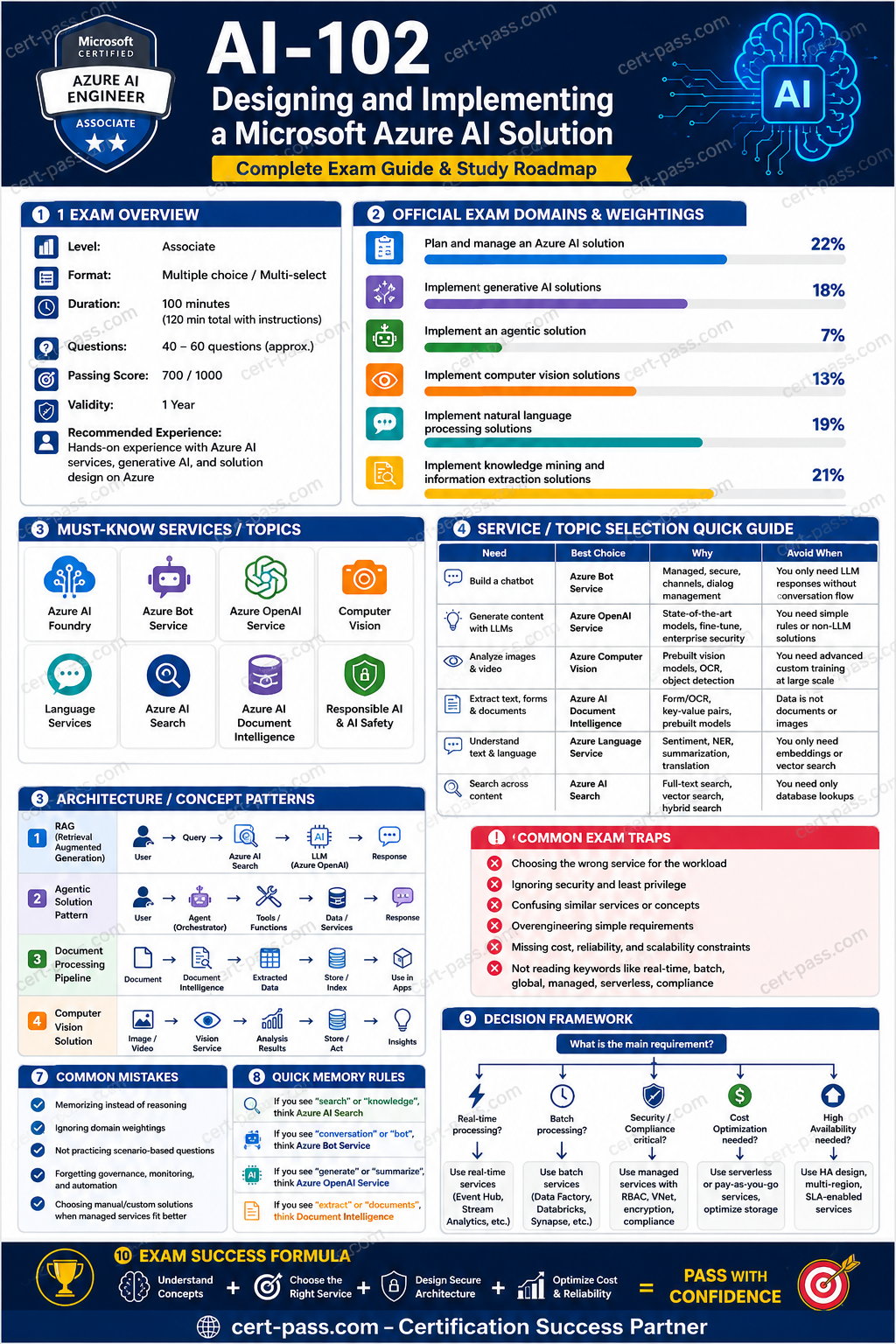
AI-102 Azure AI Engineer Associate can still be worth it in 2026, but only for the right candidate. It is most useful for someone who wants to prove applied Azure AI skills, understands that the exam retires on June 30, 2026, and wants a credential that supports a near term Azure AI or applied machine learning role.
That retirement date changes the decision immediately. If the plan is to sit the exam before retirement and use it as a focused career signal, AI-102 can still create real value. If the plan is to build a long term certification roadmap with no deadline pressure, the exam is less attractive because the shelf life is short.
The practical answer is simple: AI-102 is worth it when it fits the candidate's immediate job target, current skill level, and available study time. It is less compelling when the candidate wants a broad AI badge with no Azure context or when the timeline is too tight to prepare properly.
Exam facts
| Detail | Information |
|---|---|
| Exam | AI-102 Azure AI Engineer Associate |
| Vendor | Microsoft |
| Retirement date | June 30, 2026 |
| Focus | Designing and implementing Azure AI solutions |
| Main use case | Applied Azure AI work, solution implementation, AI service selection |
| Best fit | Candidates already working with Azure or targeting Azure AI roles |
The retirement date is the most important fact in this article. A certification can still be worth it and still be time limited. That is the case here. Candidates should verify Microsoft's official certification page before scheduling anything and should not treat AI-102 as a forever credential.
Quick answer
AI-102 is worth it in 2026 when:
- the next role involves Azure or Microsoft cloud tooling,
- the candidate wants to work with AI applications rather than AI theory only,
- the exam can be completed before retirement,
- the candidate needs a practical credential rather than a research credential,
- and the study plan can cover the service landscape with enough depth.
It is less worth it when:
- the candidate wants a long runway certification with no retirement pressure,
- the target role is not Azure based,
- the candidate is still learning cloud basics,
- or there is not enough time to study properly before June 30, 2026.
Why this guide exists
A lot of AI certification content answers the wrong question. It asks whether the badge sounds impressive instead of asking whether the credential improves the next job move. AI-102 is a good example because it sits at the intersection of cloud, AI, and implementation detail. It can look broad on paper, but in practice it is a focused Azure exam with a retirement clock attached.
This guide is meant to answer a narrower question: if a candidate is deciding in 2026 whether to spend time on AI-102, what is the real value, who should take it, and who should skip it.
That is the better way to judge the certification because it keeps the decision tied to the role, the timeline, and the platform. A credential only matters when it fits the next step.
What AI-102 actually signals
AI-102 does not simply say, "this person knows AI." It says something more specific: the candidate can work with Azure AI services, choose the right service for a use case, and think about implementation rather than just theory.
That is useful when the target role expects Azure based AI deployment, application integration, or practical service selection. It is especially useful for teams that already use Microsoft cloud tools because it gives the candidate a shared vocabulary for the conversation.
The signal is narrower than some people expect. AI-102 is not a broad AI research credential. It is not a universal machine learning badge. It is not a substitute for experience building models from scratch. It is a practical Azure implementation certification, and that is why its value depends so heavily on the employer's environment.
A candidate with no Azure background may still pass, but the payoff is usually smaller unless the role target is clearly Azure centered. A candidate who already uses Azure services is more likely to extract real value because the certification matches the tools they already need to understand.
When AI-102 is worth it
AI-102 is worth it when the candidate can answer yes to most of these:
- the next role involves Azure or Microsoft cloud tooling,
- the candidate wants applied AI skills, not only AI theory,
- the exam can be completed before retirement,
- the candidate needs a practical credential instead of a broad academic one,
- and the study effort can support real service selection and solution design.
The strongest case is a candidate who already works in cloud, data, software, or analytics and wants to add applied AI to the profile. In that situation, AI-102 can support a realistic story about implementation skills. It can show that the candidate understands how AI features fit into a business solution, which is often more valuable than a generic badge.
Another good case is a candidate who is applying for Microsoft centered roles. If the employer expects Azure services, the certification can act as proof that the candidate has moved beyond surface level familiarity. Even with the retirement date, the credential can still create value if it aligns with an immediate hiring need.
A third good case is a candidate who wants to strengthen interview confidence. AI-102 study can force the candidate to learn service boundaries, solution patterns, and common design choices. That knowledge can be useful even after the exam retirement date because the real return may come from the skill development, not only the badge.
When AI-102 is less compelling
AI-102 is less compelling when the candidate wants a long horizon certification with no retirement risk. A retiring exam can still be worthwhile, but the candidate has to be honest about timing. If there is not enough time to prepare properly and schedule the exam, the value drops quickly.
It is also less compelling for someone who wants a general AI credential without Azure context. In that case, the exam may feel too platform specific. The candidate might spend a lot of time learning Microsoft service behavior that does not help the target role very much.
The exam is also a weaker choice for someone who is still learning basic cloud concepts. If the candidate does not yet understand core cloud ideas, jumping into AI-102 can create unnecessary friction. A foundation or broader cloud first step may deliver better results.
Finally, AI-102 is less attractive if the candidate's long term goal is not tied to Azure. If the job target is platform neutral, or if the team uses a different cloud ecosystem, the time investment may be better spent elsewhere.
The retirement date changes the decision
Retirement changes everything because it affects both urgency and usefulness. A non retiring exam can be planned at a normal pace. A retiring exam requires a real decision about timing.
AI-102 retiring on June 30, 2026 means the candidate must ask a simple question: can the exam be used soon enough to justify the study time. If the answer is yes, the exam can still be a smart move. If the answer is no, the candidate should not force it just because the badge exists today.
This is why the retirement date belongs near the top of any AI-102 article. It is not a minor detail. It is the central constraint. Candidates planning around retirement should keep the schedule realistic, verify the official Microsoft page, and avoid assuming that the credential has the same long term value as a non retiring exam.
A retiring exam can still help a resume, especially in the short term. But the candidate should treat it as a near term signal, not a permanent anchor for a long certification roadmap.
The practical return on effort
The return on effort depends on what the candidate wants from the exam.
If the goal is to learn Azure AI implementation and strengthen a Microsoft focused resume, the return can be strong. The candidate gains useful technical vocabulary, a clearer understanding of service selection, and a concrete credential to list in the short term.
If the goal is to maximize long term certification durability, the return is weaker because the exam is retiring. In that situation, the candidate may still learn useful skills, but the badge itself will age out faster than a non retiring exam.
If the goal is to move into an AI adjacent role, the return can be moderate to strong depending on the current background. A developer, cloud engineer, or data professional may gain a lot from the study process because the exam pushes them toward practical solution thinking.
If the goal is to enter AI from zero, the return may be lower. A beginner may need too much foundational work before the certification starts to pay off. In that case, the candidate may be better served by a broader learning path first.
The key point is that AI-102 is not a universal yes or no. It is a yes if the candidate can convert the learning into a specific career story. It is a no if the badge would sit outside the actual job target.
Simple decision rule
Use this rule:
- take AI-102 if you can finish before retirement,
- take it if you want Azure AI specific proof,
- take it if your next role is Microsoft centered,
- take it if you already understand the basics of cloud or application delivery.
Skip AI-102 if:
- you want a long lasting credential with no retirement concern,
- your target role is not Azure based,
- you are still learning the basics of cloud,
- or you do not have enough time to study properly before June 30, 2026.
That rule is intentionally practical. It respects the exam's actual shelf life and actual job relevance.
Domain breakdown
A useful way to judge whether AI-102 is worth it is to look at the type of work it expects.
| Domain area | What it usually means | Why it matters |
|---|---|---|
| Azure AI solution planning | Choosing the right AI approach for a use case | Shows the candidate can think in solution terms |
| Generative AI implementation | Working with modern AI app patterns | Useful for current applied AI conversations |
| Agentic solution implementation | Building AI workflows with tool use and orchestration ideas | Helpful for more advanced implementation roles |
| Computer vision | Image based AI solutions | Important when the employer uses visual processing workflows |
| Natural language processing | Text classification, extraction, and language tasks | Very common in business AI use cases |
| Knowledge mining and extraction | Search, enrichment, and information extraction | Useful in enterprise AI and content heavy systems |
This breakdown helps because it shows AI-102 is not just a marketing badge. It asks the candidate to reason about practical AI solution components. That can be valuable if the candidate wants to talk credibly about implementation in an interview.
At the same time, the domain list also explains why the exam is not the best first move for everyone. If the candidate is not ready to think about service selection and applied solution design, the study load may feel heavy.
What employers may care about
Employers usually do not hire a candidate because of a badge alone. They hire because the badge supports a story about useful skills.
For AI-102, the most persuasive story is often that the candidate can help design and implement Azure based AI solutions with enough confidence to contribute quickly. That is a stronger story than simply saying the candidate passed an AI exam.
In practical hiring terms, the exam can help when the employer needs someone who understands the Azure ecosystem, can speak about AI service choices, and can work across application and cloud boundaries. It can be less useful when the company is focused on model research, platform agnostic AI, or non Microsoft environments.
That is why the value is contextual. The same certification can look powerful in one interview and merely acceptable in another. The candidate should assess whether the hiring team would actually care about Azure AI implementation knowledge.
AI-102 versus a more general AI path
A lot of candidates confuse specialization with limitation. AI-102 is specialized, but that is not a weakness if the target role is also specialized.
A general AI learning path may be better for someone exploring the field without a specific platform target. It can build broader awareness before committing to a vendor ecosystem.
AI-102 is better when the candidate already knows the environment is Azure. In that situation, specialization is an advantage because it maps directly to the technology stack they will use. The candidate is not trying to study everything. They are trying to become useful in a particular stack.
That is the tradeoff. Breadth helps with exploration. Specialization helps with role fit. AI-102 is a specialization exam, so it should be chosen for specialization reasons.
A practical study perspective
From a study perspective, AI-102 is most worth it when the candidate can use the exam to force a structured review of Azure AI concepts.
A good study approach usually includes:
- reading the official skills outline first,
- mapping each domain to a real use case,
- using practice questions to identify weak spots,
- reviewing the Azure services that appear in the official blueprint,
- checking where the candidate is strong enough already and where deeper study is needed.
That process is useful even if the candidate does not end up caring about the badge as much as they expected. The learning itself can improve how the candidate discusses AI solutions.
The downside is that a rushed study plan can make the exam feel like a memorization task. That is usually a sign the candidate is too close to the retirement date or too far from the required background. In that case, the study effort may not be worth the stress.
What to do if the candidate is undecided
If the candidate is not sure, the best move is to separate the decision into two questions.
First: does the target role actually want Azure AI skills?
Second: can the candidate realistically complete the exam before retirement?
If the answer to both is yes, AI-102 is probably worth it. If the answer to either is no, the candidate should look elsewhere.
That is a better decision process than comparing AI-102 to random certifications just because they all mention AI. A credential only has value when the candidate can connect it to a role and a timeline.
A simple return on investment view
The ROI question is not just about salary. It is about whether the time spent studying produces a useful outcome.
AI-102 has a good ROI when:
- the candidate can use it soon,
- the target role is Azure AI related,
- the badge supports a clear interview narrative,
- and the learning improves practical confidence.
AI-102 has a weaker ROI when:
- the candidate is racing the retirement date without enough time,
- the target role is not Azure based,
- the candidate wants a long lasting certification signal,
- or the study plan is too loose to produce a real skill gain.
A good ROI answer is often boring, and that is fine. The question is not whether the badge sounds exciting. The question is whether the effort turns into something the candidate can use.
Comparison table for decision making
| Candidate situation | AI-102 value level | Why |
|---|---|---|
| Azure developer targeting AI features | High | Matches platform and role |
| Cloud engineer moving into applied AI | High | Builds a concrete Azure AI story |
| Beginner exploring AI with no cloud base | Low to moderate | Too much platform detail too soon |
| Non Azure AI candidate | Low | Platform mismatch |
| Candidate with enough time before retirement | Moderate to high | Can still extract value before June 30, 2026 |
| Candidate with a long term certification plan | Lower | Retirement shortens shelf life |
This table is useful because it turns a vague question into a decision matrix. The goal is not to say the exam is universally good or bad. The goal is to place the candidate into a realistic bucket.
What a bad fit looks like
A bad fit usually shows up before the candidate even starts studying.
The candidate may be looking for a broad AI credential, but the exam is Azure specific.
The candidate may want a long term badge, but the exam retires soon.
The candidate may not yet understand the cloud basics that make the AI services easier to learn.
The candidate may be targeting a role that does not use Microsoft tooling at all.
If two or more of those are true, the exam is probably not the right investment. That is not failure. It is just a cleaner way to protect study time.
Real world scenarios
A cloud engineer at a Microsoft heavy company may find AI-102 very useful because it gives language and structure to the kind of AI features the team may already be asked to deliver.
A software developer building internal tools on Azure may use the certification to strengthen their ability to discuss service selection, prompt based features, and solution design with more confidence.
A beginner who wants an AI badge for general career signaling may not get enough return because the Azure specificity and retirement timing create too many constraints.
A data professional who is already in the Microsoft ecosystem may find the exam helpful if their work is moving toward applied AI features rather than pure analytics.
These examples matter because they show the exam can be very right for one person and very wrong for another. That is exactly why a worth it page should stay focused on decision making rather than course material.
How AI-102 compares with adjacent paths
AI-102 is often compared with broader cloud or data certifications, but the comparison should be about purpose, not prestige.
A cloud foundation exam is usually better when the candidate still needs the basics.
A data platform certification is usually better when the role is more about pipelines, analytics, and warehouse or lakehouse work than about AI application implementation.
A broader Azure or cloud path is usually better when the candidate wants to build context first and then move into AI later.
AI-102 is best when the candidate is already past the basic context stage and wants to specialize in Azure AI work. That is why it can be worth it even though it is retiring. Specialization still matters when the job target is specialized.
A practical timing model
The candidate should think in terms of timing windows.
If the exam is being used in the next hiring cycle, the certification can have real near term value.
If the exam is being used as a long term learning project, the retirement clock becomes more important and may make the effort less attractive.
If the exam is being used to support a role change within the same employer, it can still be useful because internal mobility often values immediate relevance more than long shelf life.
That timing model is one reason the retirement notice belongs in the opening section. Without it, the article would hide the most important factor.
What to say in an interview
A certification matters more when the candidate can explain why they chose it.
A strong interview answer might sound like this: the candidate chose AI-102 because the target role uses Azure, the work involves practical AI solutions, and the certification helped them study the implementation details they needed anyway.
That kind of answer is better than saying the candidate collected an AI badge because it looked interesting. Hiring teams care more about deliberate skill development than random badge accumulation.
Common mistakes when judging AI-102
The first mistake is assuming that every AI certificate has the same value. They do not. AI-102 is tied to Azure implementation, so its value depends on the role and the platform.
The second mistake is ignoring the retirement date. A retiring exam should never be treated like a normal evergreen option.
The third mistake is using the badge as a substitute for role fit. If the target job has nothing to do with Azure, the certification may not move the needle very much.
The fourth mistake is studying too late and turning the process into a rush. A rushed attempt can produce stress without producing durable skill gain.
The fifth mistake is stopping at the title of the certification and not looking at the actual services and solution patterns it covers. The real value is in the implementation vocabulary.
Three candidate profiles
A Microsoft focused application developer who is already building cloud based solutions can often get real value from AI-102 because the exam reinforces the same environment they expect to use at work.
A cloud support or cloud operations candidate can also benefit if they are moving toward more applied AI responsibilities, but the payoff depends on whether their employer actually uses Azure AI services.
A candidate who wants to enter the AI field from scratch may get less value because the exam assumes enough background to think about service choice, implementation patterns, and solution design.
These three profiles are useful because they show how one exam can fit one person well and another person poorly.
What makes the badge useful after study
Even with a retirement date, the learning can still matter after the exam itself is gone. The candidate may finish with better Azure vocabulary, stronger service selection instincts, and a clearer sense of how AI features are deployed in real systems.
That practical knowledge can help in interviews, on the job, and in later certifications. In that sense, AI-102 can still be worth it as a learning accelerator even when the badge itself is time limited.
Related Cert Pass reading
If the candidate decides AI-102 is not the right fit, the next step may be a broader cloud comparison or path guide.
Useful follow ups include:
- Cloud Certification Path Guide
- Cloud Certification Worth It in 2026?
- Cloud Certification Study Plan While Working Full Time
- AWS Cloud Practitioner vs Azure AI Engineer
These pages help the reader choose a path before spending time on a retiring exam.
FAQ
Is AI-102 still worth taking in 2026?
Yes, for the right candidate. It is worth it when the exam fits an Azure AI role and can be completed before the June 30, 2026 retirement date.
Should a beginner take AI-102?
Usually not first. A beginner who is still learning cloud basics may benefit more from a broader foundation before moving into AI-102.
Does AI-102 prove real AI skills?
It proves applied Azure AI knowledge and implementation familiarity. It does not prove that the candidate has model research experience or broad AI expertise across every platform.
Is the retirement date a deal breaker?
Not automatically. It is a major factor, though. If the exam can be completed in time and supports the target role, it can still be worthwhile.
What role is AI-102 best for?
It is best for Azure centered AI implementation roles, especially where the candidate needs to work with Microsoft cloud services and practical solution design.
Should the candidate choose AI-102 over a broader AI certification?
Only if the target job is Azure based. If the role is platform neutral, a broader learning path may be more useful.
Is AI-102 good for a resume even if it retires soon?
Yes, if the candidate can complete it before retirement and the role target is relevant. A near term credential can still improve a resume and help with interviews.
What if the candidate misses the June 30 deadline?
Then the value drops sharply because the exam is no longer a reliable long term plan. At that point, the candidate should switch to a newer or broader path instead of forcing the old one.
Is AI-102 better than a generic AI certificate?
Not always. It is better when the job target is Azure specific. A generic AI credential can be better when the candidate needs broader platform neutrality.
Does this exam make sense for cloud professionals?
Yes, especially for cloud professionals who want to move closer to AI solution implementation. It is less useful for people whose work does not touch Azure.
Official source and verification
Before scheduling the exam, always verify the current details on Microsoft's official certification page: