AZ-900 Azure Fundamentals Study Guide for 2026
Quick answer
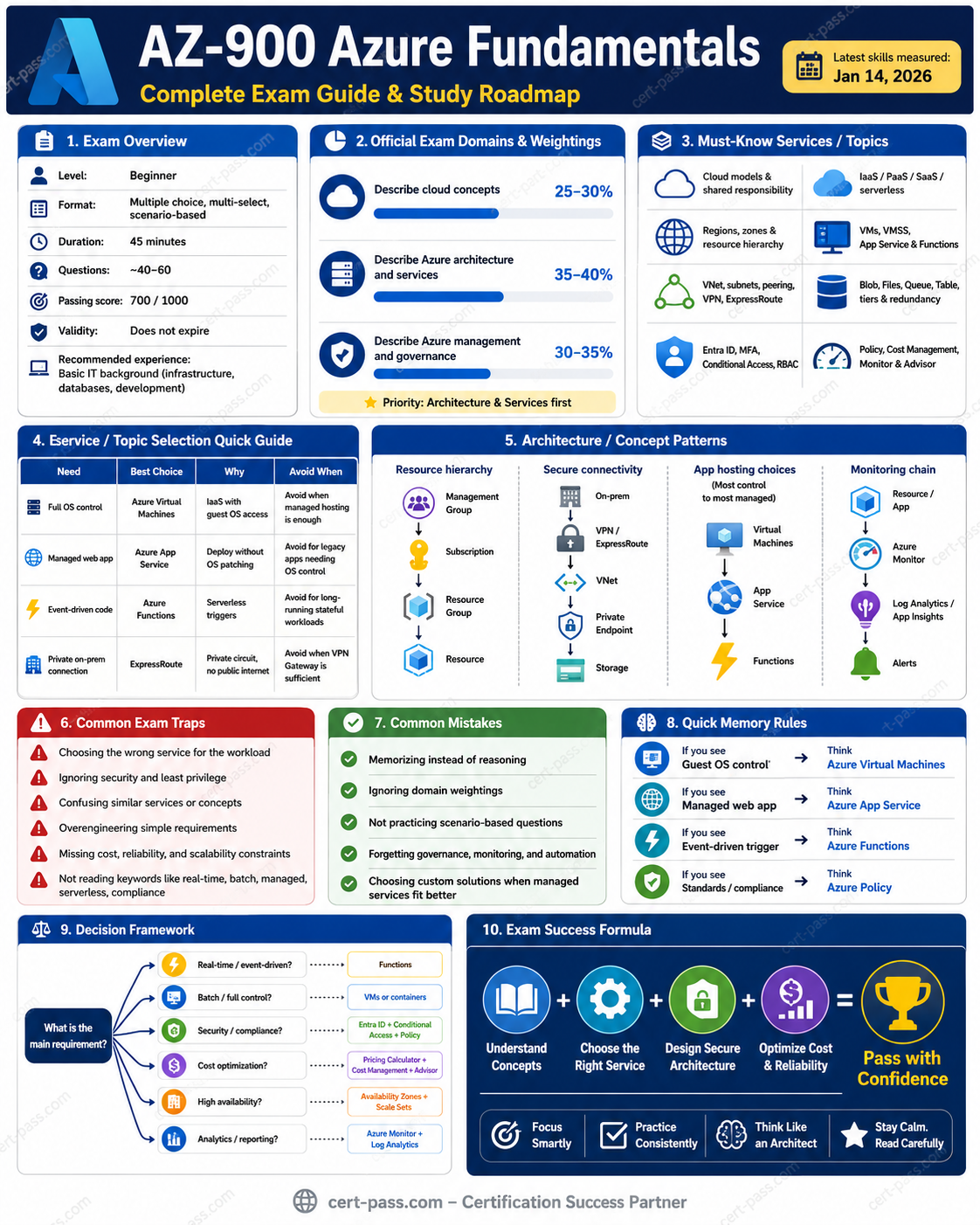
The best way to study AZ-900 Azure Fundamentals is to focus on how Azure categories fit together, then learn how to spot the simplest correct service for a short scenario. The exam is not designed to test deep engineering design. It is designed to test whether the candidate can recognize cloud concepts, understand the Azure platform at a basic level, and avoid getting distracted by nearby services that solve a different problem.
That is why a strong AZ-900 study guide should not read like a giant Azure encyclopedia. It should read like a decision guide. The candidate needs to know what cloud concepts mean, how Azure is organized, which service families solve which problems, and how governance, identity, monitoring, and cost fit into the picture. If those pieces are clear, the exam becomes much easier.
The official exam page is here: AZ-900 Azure Fundamentals. For a quick first practice round, use Try 35 free AZ-900 practice questions - no signup required. For a structured follow up path, Preview the compressed AZ-900 course.
Official exam facts
| Detail | Current info |
|---|---|
| Exam name | AZ-900 Azure Fundamentals |
| Vendor | Microsoft |
| Exam code | AZ-900 |
| Questions | 50 |
| Time limit | 45 minutes |
| Passing score | 700+ scaled score |
| Retirement date | No retirement date announced |
| Main Cert Pass page | AZ-900 Azure Fundamentals |
| Official vendor page | Microsoft Azure Fundamentals |
| Cert-Pass practice access | Practice options start at EUR 29 |
| Full access | Complete access starts at EUR 39 |
| Last verified | 2026-06-01 |
Those facts are useful because they shape how the study plan should work. Fifty questions in forty five minutes means the candidate does not have much time to overthink. The exam rewards fast recognition, clean category thinking, and calm elimination of the wrong answer. It does not reward vague memory or overbuilt architecture language.
What AZ-900 is really testing
AZ-900 is a fundamentals exam, but that does not mean it is trivial. It tests whether the candidate understands the core building blocks of Azure enough to make sensible choices in simple situations. That usually means the exam is checking three things at once.
First, it checks cloud literacy. The candidate should know why organizations use cloud services, what flexibility and scalability mean, and how cloud changes the old on premises model.
Second, it checks Azure literacy. The candidate should know the major Azure categories, the basic purpose of common services, and the difference between management tools, governance tools, and monitoring tools.
Third, it checks decision making. The candidate needs to look at a scenario and identify the simplest Azure concept that actually solves the problem.
That combination is why a good study guide should teach categories, not just definitions.
The best mental model for AZ-900
A simple mental model is often enough to make the exam much easier.
- Compute runs applications.
- Storage keeps data.
- Networking moves traffic.
- Identity controls access.
- Governance controls rules.
- Monitoring shows what is happening.
- Pricing tells the candidate what it costs.
If the candidate can mentally place each question into one of those buckets, the answer choices become far easier to compare.
Azure areas the candidate must know
AZ-900 topics are broad, but some areas appear more often than others.
| Area | What to understand |
|---|---|
| Cloud concepts | Benefits of cloud, service models, deployment models |
| Azure architecture | Regions, availability zones, resource groups, subscriptions |
| Compute | VMs, App Service, containers, serverless basics |
| Storage | Blob storage, file storage, disks, tiers, redundancy |
| Networking | VNet, DNS, load balancing, connectivity concepts |
| Identity | Microsoft Entra concepts, roles, permissions, access control |
| Governance | Azure Policy, resource locks, management groups |
| Monitoring | Azure Monitor, Service Health, Advisor |
| Cost | Pricing calculator, cost management, support plans |
These are not just topic names. They are the map of the exam.
Cloud concepts in plain language
Many beginners get tripped up by cloud concepts because the exam uses business language instead of technical jargon.
Cloud benefits to know
- high availability;
- scalability;
- elasticity;
- reliability;
- disaster recovery;
- reduced capital expense;
- faster deployment;
- global reach.
Deployment models to know
| Model | Meaning |
|---|---|
| Public cloud | Services delivered over the public cloud platform |
| Private cloud | Cloud environment dedicated to one organization |
| Hybrid cloud | Combination of on premises or private infrastructure with public cloud |
| Multi cloud | Using more than one cloud provider |
The candidate should know the model from the wording of the scenario. If the question mentions on premises plus Azure, hybrid cloud is usually the right pattern.
Service models to know
The exam also expects the candidate to understand service models.
| Model | Who manages more |
|---|---|
| IaaS | Customer manages more |
| PaaS | Provider manages more |
| SaaS | Provider manages most |
The important idea is not to memorize a chart blindly. The candidate should know that the amount of management moves from customer heavy to provider heavy as the service model becomes more managed.
Azure architecture basics
AZ-900 includes basic architecture ideas because a candidate should know how Azure is organized.
Core concepts
- Region: a geographic area where Azure has data centers.
- Availability zone: a separate location within a region for resiliency.
- Resource group: a container for related Azure resources.
- Subscription: a billing and management boundary.
- Management group: a way to organize multiple subscriptions.
These are frequent exam concepts because they help explain how Azure scales, how resources are organized, and how governance is applied.
Compute basics
A foundational candidate should know the main compute choices at a high level.
| Service | Simple purpose |
|---|---|
| Virtual Machines | Full control over a virtual server |
| Azure App Service | Hosting apps without managing the server stack directly |
| Azure Functions | Event driven serverless compute |
| Containers | Portable application packaging and deployment |
The exam usually asks which service best fits a simple use case. The answer depends on how much control or management the scenario needs.
Storage basics
Storage questions are common because they test whether the candidate can distinguish data types and storage use cases.
| Service | Use |
|---|---|
| Blob Storage | Unstructured object data |
| Azure Files | Managed file shares |
| Disk Storage | Virtual machine disks |
| Archive tier | Long term low access storage |
The candidate should also know that redundancy and access tier choices affect durability and cost.
Networking basics
Networking questions usually test the candidate's ability to identify traffic control, resolution, and connectivity needs.
| Service or concept | Purpose |
|---|---|
| Azure DNS | Name resolution |
| Virtual Network | Private network boundary |
| Load Balancer | Distribute traffic |
| VPN Gateway | Encrypted connectivity |
| ExpressRoute | Private dedicated connectivity |
The exam does not require deep networking design. It does require enough recognition to avoid choosing the wrong category.
Identity and access basics
Identity and access are foundational because the exam expects the candidate to know that access is controlled, not assumed.
Important ideas
- users and groups represent identities;
- roles determine permissions;
- least privilege is the rule that users should get only the access they need;
- identity and access are not the same as governance or monitoring.
If a question is about who can do what, the answer is usually an identity and access concept.
Governance basics
Governance is about rules and control. It is one of the easiest areas to confuse with monitoring, so it deserves special attention.
| Tool | Purpose |
|---|---|
| Azure Policy | Enforce rules and standards |
| Resource locks | Prevent accidental deletion or change |
| Management groups | Organize subscriptions |
If the question mentions approved locations, required tags, or restrictions, the candidate should think about Azure Policy. If the question mentions preventing deletion, resource locks are often the best match.
Monitoring basics
Monitoring is about visibility, alerts, and health.
| Tool | Purpose |
|---|---|
| Azure Monitor | Metrics, logs, alerts |
| Azure Service Health | Platform incidents and maintenance |
| Azure Advisor | Recommendations for cost, reliability, security, and performance |
The common trap is to mix these tools together. Monitoring tells the candidate what is happening. Service Health tells the candidate about Azure platform problems. Advisor tells the candidate what could be improved.
Cost basics
Cost questions are common because Azure Fundamentals includes budgeting and billing language.
Important ideas
- pay as you go means pay for what is used;
- the pricing calculator helps estimate costs;
- cost management helps track and control spend;
- support plans offer different levels of help and response.
The candidate should be able to tell whether the question is about estimating cost, optimizing cost, or getting support.
Useful asset: study priority table
| Priority | Topic | Why it matters |
|---|---|---|
| 1 | Cloud concepts | Foundational language appears everywhere |
| 2 | Azure architecture | Regions, zones, groups, and subscriptions are common |
| 3 | Identity and access | Security and permissions are heavily tested |
| 4 | Governance | Policy and locks are common trap areas |
| 5 | Monitoring | Service Health, Monitor, and Advisor are easy to confuse |
| 6 | Cost | Pricing and support questions are practical and frequent |
| 7 | Compute, storage, networking | Core service families drive scenario questions |
If the candidate has limited time, this is the order to use.
What good study looks like
Good AZ-900 study is not about reading endlessly. It is about building familiarity quickly and checking it with questions.
A better study cycle
- Learn the concept.
- See it in a scenario.
- Explain why the correct answer fits.
- Explain why the wrong answers fail.
- Review the concept again the next day.
What to avoid
- only reading summaries without practice;
- memorizing tool names without use cases;
- skipping cost and governance;
- assuming fundamentals means no real preparation;
- studying too many unrelated services at once.
How to read AZ-900 questions
The best approach is to read the ask, identify the category, and then compare the answers.
A simple method
- What is the scenario asking for?
- Is it about cloud concept, service, governance, monitoring, identity, or cost?
- Which Azure feature directly solves that problem?
- Which answer only sounds close but does not actually fit?
This approach is especially useful in foundational exams because the distractors are often built from nearby concepts that sound right at first glance.
Common mistake patterns
| Mistake | What it means |
|---|---|
| Choosing a monitoring tool for a governance problem | The candidate blurred two categories |
| Choosing a networking service for a cost problem | The candidate missed the business goal |
| Choosing a deeper technical service than needed | The candidate overcomplicated the answer |
| Confusing region with availability zone | The candidate missed basic architecture language |
| Confusing Service Health with Advisor | The candidate mixed incident data with recommendations |
| Confusing CLI with PowerShell | The candidate missed management tool syntax |
These mistakes are normal, but they should be corrected before the exam.
7 day study plan for AZ-900
| Day | Focus | Goal |
|---|---|---|
| 1 | Exam facts and cloud concepts | Understand the exam shape |
| 2 | Azure architecture basics | Learn regions, zones, groups, subscriptions |
| 3 | Compute and storage | Recognize the main service families |
| 4 | Networking and identity | Learn access and connectivity concepts |
| 5 | Governance and monitoring | Separate policy, locks, monitor, service health, advisor |
| 6 | Cost and support | Understand pricing and operational planning |
| 7 | Practice questions and review | Build confidence and close gaps |
This plan works because it moves from broad concepts to practical recognition.
Ready check
| Question | Yes or no |
|---|---|
| Can the candidate explain public, private, and hybrid cloud? | |
| Can the candidate tell IaaS, PaaS, and SaaS apart? | |
| Can the candidate define region and availability zone? | |
| Can the candidate identify Azure Policy and resource locks? | |
| Can the candidate tell Azure Monitor, Service Health, and Advisor apart? | |
| Can the candidate distinguish Azure CLI from Azure PowerShell? | |
| Can the candidate explain pay as you go pricing? |
If most answers are yes, the candidate is likely ready for a final review or exam date.
How practice questions should be used
Practice questions are most useful when the candidate treats them like a diagnosis tool. They show what part of the concept map is still unclear.
After each question set, ask:
- Was the mistake about the cloud concept?
- Was the mistake about the service family?
- Was the mistake about governance or monitoring?
- Was the mistake about identity or cost?
- Was the mistake caused by reading too fast?
That reflection turns a practice set into actual improvement.
Related reading in the Cert-Pass library
The most useful adjacent pages are:
- AZ-900 Practice Questions and Answers for 2026
- AZ-900 Common Mistakes and Exam Traps for 2026
- AZ-900 Study Plan 2026: 2-Day, 5-Day, and 7-Day Options
- Cloud Certification Comparison 2026: AWS, Azure, GCP, Databricks, Snowflake, and Scrum
- AWS Cloud Practitioner CLF C02 Study Guide 2026
For the official route and practice access, keep these links handy:
- AZ-900 Azure Fundamentals
- Try 35 free AZ-900 practice questions - no signup required
- Preview the compressed AZ-900 course
What to learn first if the candidate is starting from zero
A beginner should not try to learn AZ-900 in a random order. The following order is usually the most efficient.
First layer: cloud concepts
Start with why cloud exists, what public cloud means, and how service models differ. If the candidate can explain those ideas clearly, the rest of the exam has a better foundation.
Second layer: Azure organization
Then learn subscriptions, resource groups, regions, availability zones, and management groups. These ideas explain how Azure is structured.
Third layer: service families
Next, learn compute, storage, networking, identity, governance, monitoring, and cost. At this stage, the candidate should be able to sort a service into the right bucket.
Fourth layer: tools and decision points
After the categories are clear, study the tools that solve common business problems, such as Azure CLI, Azure PowerShell, Azure Policy, Azure Monitor, Service Health, Advisor, and the pricing calculator.
Fifth layer: practice questions
Only after those layers are in place should the candidate spend the main study time on practice questions. That order keeps practice useful instead of confusing.
The difference between knowing a service and knowing the exam
Many candidates know Azure service names but still miss exam questions because they do not know what the exam is actually asking.
For example:
- knowing that Azure Monitor exists is not enough;
- knowing when Azure Monitor is the best answer is what matters;
- knowing that Azure Policy exists is not enough;
- knowing when a policy question is really a governance question is what matters.
That is why the guide focuses on category thinking.
A short exam day routine
The candidate can reduce avoidable mistakes by using a simple routine on exam day.
- Read the question carefully.
- Identify the topic category.
- Eliminate answers that solve a different problem.
- Pick the simplest valid Azure choice.
- Move on without second guessing once the answer is clear.
This routine is simple, but it prevents a lot of point losses.
What a strong answer explanation sounds like
A useful explanation says both why the correct choice is right and why the close distractors are wrong.
For example, when a question is about service incidents, the correct answer is Service Health because it tells the customer about platform issues and maintenance. Azure Advisor is tempting because it also sounds helpful, but it is about recommendations, not incident reporting. That kind of difference is exactly the kind of thing the exam wants the candidate to recognize.
Common topics worth revisiting twice
Some topics are easy to forget because the words sound familiar.
| Topic | Why revisit it |
|---|---|
| Service Health versus Advisor | They sound related but solve different problems |
| Azure CLI versus Azure PowerShell | Both are management tools, but syntax and usage differ |
| Azure Policy versus resource locks | Both control behavior, but in different ways |
| Region versus availability zone | Both are geography concepts, but at different levels |
| Pricing calculator versus cost management | Both deal with cost, but one estimates and one tracks |
Reviewing those pairs twice can save several questions.
How to use this guide with practice questions
This guide works best when it is paired with a practice page. The study guide gives the structure. The practice page checks whether the structure is actually understood.
A good sequence is:
- Read the guide section on cloud concepts.
- Answer a short practice set.
- Review wrong answers.
- Read the guide section on the topic that caused the miss.
- Retake similar questions.
That loop is much more effective than passive rereading.
Why AZ-900 matters even if the candidate plans to move on quickly
Some candidates think the foundation exam is only useful as a checkbox. That is too narrow. AZ-900 gives the candidate a stable Azure vocabulary, a first look at cloud structure, and a way to understand future Azure material faster.
That benefit is easy to underestimate because it shows up later. The candidate who learns the basics now usually studies associate level or role specific Azure material more comfortably later.
One line recap before the FAQ
AZ-900 is not about deep engineering detail. It is about learning Azure categories well enough to make simple, correct choices under time pressure.
One week review checklist
A final review checklist can keep the candidate focused.
Before the exam
- review cloud concepts one more time;
- review the differences between the main Azure tools;
- review governance and monitoring pairs;
- review the service families that appear most often;
- make sure the candidate can explain why each wrong answer is wrong.
During the review
The goal is not to learn new material at the last minute. The goal is to tighten the understanding of what is already familiar.
Self assessment for readiness
| Question | If yes, confidence is improving |
|---|---|
| Can the candidate explain cloud versus on premises clearly? | |
| Can the candidate identify the right service family quickly? | |
| Can the candidate tell governance from monitoring? | |
| Can the candidate distinguish Azure Monitor from Service Health and Advisor? | |
| Can the candidate explain the difference between Azure CLI and Azure PowerShell? | |
| Can the candidate answer pricing questions without guessing? |
If several of those are still unclear, the candidate should spend the next session on concept review instead of just more questions.
What success looks like in AZ-900 study
Success does not mean the candidate can recite every Azure product name. Success means the candidate can look at a short scenario and quickly identify the category, the right tool, and the simplest valid answer. That is the skill the exam rewards and the skill that will make later Azure learning easier.
Why the pace matters
Because the exam is short, the candidate should practice making decisions at the same pace the test requires. Long pauses on every question are a sign that the concepts are still too fuzzy. A good study routine gradually reduces that hesitation.
Final reminder before the FAQ
The strongest AZ-900 study strategy is simple: learn the categories, use practice questions to test them, and revisit the weak pairs until the answer becomes obvious.
How to measure progress
Progress in AZ-900 is not just about the number of correct answers. It is about how quickly the candidate can categorize a question.
A useful sign of progress is when the candidate starts answering questions by saying things like, "This is a governance question," or "This is a monitoring question," before looking at the options in detail. That means the mental map is starting to work.
Another good sign is that wrong answers become easier to explain. Once the candidate can explain why the wrong options are wrong, the exam feels less random.
Final note on study focus
If the candidate is tempted to study too many Azure services at once, the answer is to slow down and return to the core categories. AZ-900 rewards clarity, not breadth for its own sake.
Yes. It is one of the clearest ways to learn Azure fundamentals before moving into a more technical path.
Is AZ-900 hard?
It is approachable, but only if the candidate learns the concepts instead of memorizing random service names.
What is the hardest topic for most candidates?
Governance, monitoring, and the difference between similar Azure tools are common trouble spots.
Should the candidate memorize every Azure service?
No. The exam is about understanding the major categories and the most common use cases.
How should practice questions be reviewed?
By labeling the mistake type and revisiting the underlying concept rather than only rereading the explanation.
Is this enough to pass by itself?
It can be a strong foundation, especially when combined with official pages and a focused practice session.
Final answer
AZ-900 Azure Fundamentals is easiest to pass when the candidate studies it as a category recognition exam. The exam is broad, but the broadness is manageable if the candidate focuses on cloud concepts, Azure architecture, compute, storage, networking, identity, governance, monitoring, and cost. The real skill is not memorizing every service name. It is learning to spot the simplest Azure concept that actually solves the scenario.
The best study path is therefore straightforward: learn the official facts, study the major categories, practice with scenario questions, and review the mistakes until the patterns are obvious. That method is much more effective than trying to cram a huge Azure reference manual.
For the official exam page, use AZ-900 Azure Fundamentals. For immediate practice, use Try 35 free AZ-900 practice questions - no signup required. For a tighter next step, use Preview the compressed AZ-900 course.
The shortest summary is simple: AZ-900 gets easier when the candidate learns to think in Azure categories before looking at the answer choices.
Last 24 hour rule
In the final day before the exam, the candidate should not try to learn a completely new Azure service. The better move is to review the weakest pairings, rerun a few practice questions, and keep the study scope narrow. That last review is what turns a decent study session into a steady result and a calmer exam day. It also reduces second guessing. That extra calm can help a lot.
How to use this study guide with practice questions
The most efficient way to use a fundamentals guide is to move from topic to question immediately. Read one section, then answer a short set of questions about the same idea before moving on. That keeps the terms fresh and exposes weak spots early.
A simple loop works well:
- Read the section on a single service family.
- Close the page and explain the idea in plain language.
- Answer a few related questions.
- Note any service names that still feel similar.
- Return to the guide only for the weak areas.
This method helps with Azure because many questions look easy until two closely related services are placed side by side. The candidate who learns the relationship between the services usually performs better than the candidate who only memorizes definitions.
Final review checklist
Before the exam, the candidate should be able to do all of the following without hesitation:
- Identify the main Azure cloud service models.
- Explain governance, compliance, and cost ideas in simple language.
- Choose the correct service family for a basic scenario.
- Recognize when identity, monitoring, storage, or networking is the real topic.
- Eliminate answers that solve the wrong problem.
That final review is often the difference between knowing the topic in theory and recognizing it quickly under time pressure. The guide is strongest when it is used as a working checklist, not as a chapter to read once.
How to handle weak areas without restarting the whole course
If the candidate notices a topic gap late in the process, the answer is usually not to begin from page one. It is better to isolate the weak area and fix only that part. For AZ-900, that often means one of a few common buckets: identity, governance, storage, networking, or cost.
A quick repair loop works well:
- Re-read the topic summary.
- Explain the service in one short sentence.
- Answer 5 to 10 questions only on that topic.
- Compare the wrong choices to the service that the question actually describes.
- Repeat the same review the next day.
That keeps the study plan efficient and prevents a small gap from turning into a full reset. It also helps the candidate stay calm because the weak area becomes a defined task instead of a vague problem.
How to use this guide with a one-day final review
If the exam is close, do not try to reread every paragraph. Use the guide as a checklist. Focus on the areas that are most likely to appear and the areas that still feel vague after practice questions.
A good final review is short and specific:
- Review identity and governance first.
- Revisit storage and networking next.
- Check the service models one more time.
- Read the section titles out loud and explain each one in a sentence.
- Finish with a few mixed questions and note the ones that still feel slow.
That kind of review keeps the material active without turning the night before the exam into another full study session. It is usually more effective to sharpen a few weak areas than to try to cover everything again.
Final confidence check
The candidate is in a good position when the following feel straightforward:
- The difference between IaaS, PaaS, and SaaS.
- The difference between identity and authorization.
- The difference between monitoring, governance, and cost management.
- The difference between storage options and the types of problems they solve.
Once those comparisons feel clear, the rest of the exam usually becomes much more predictable.