AZ-900 Practice Questions and Answers for 2026
Quick answer
AZ-900 practice questions should do more than test memory. They should train the candidate to read a cloud scenario, identify the Azure concept it is really asking about, and eliminate answer choices that solve the wrong problem. That matters because Azure Fundamentals is not a deep technical exam. It is a foundational exam built around cloud concepts, Azure architecture and services, and Azure management and governance. The most effective practice set therefore teaches recognition, not guessing.
For the official exam hub, start here: AZ-900 Azure Fundamentals. For immediate practice, use Try 35 free AZ-900 practice questions - no signup required. For a cleaner study pass after practice, Preview the compressed AZ-900 course.
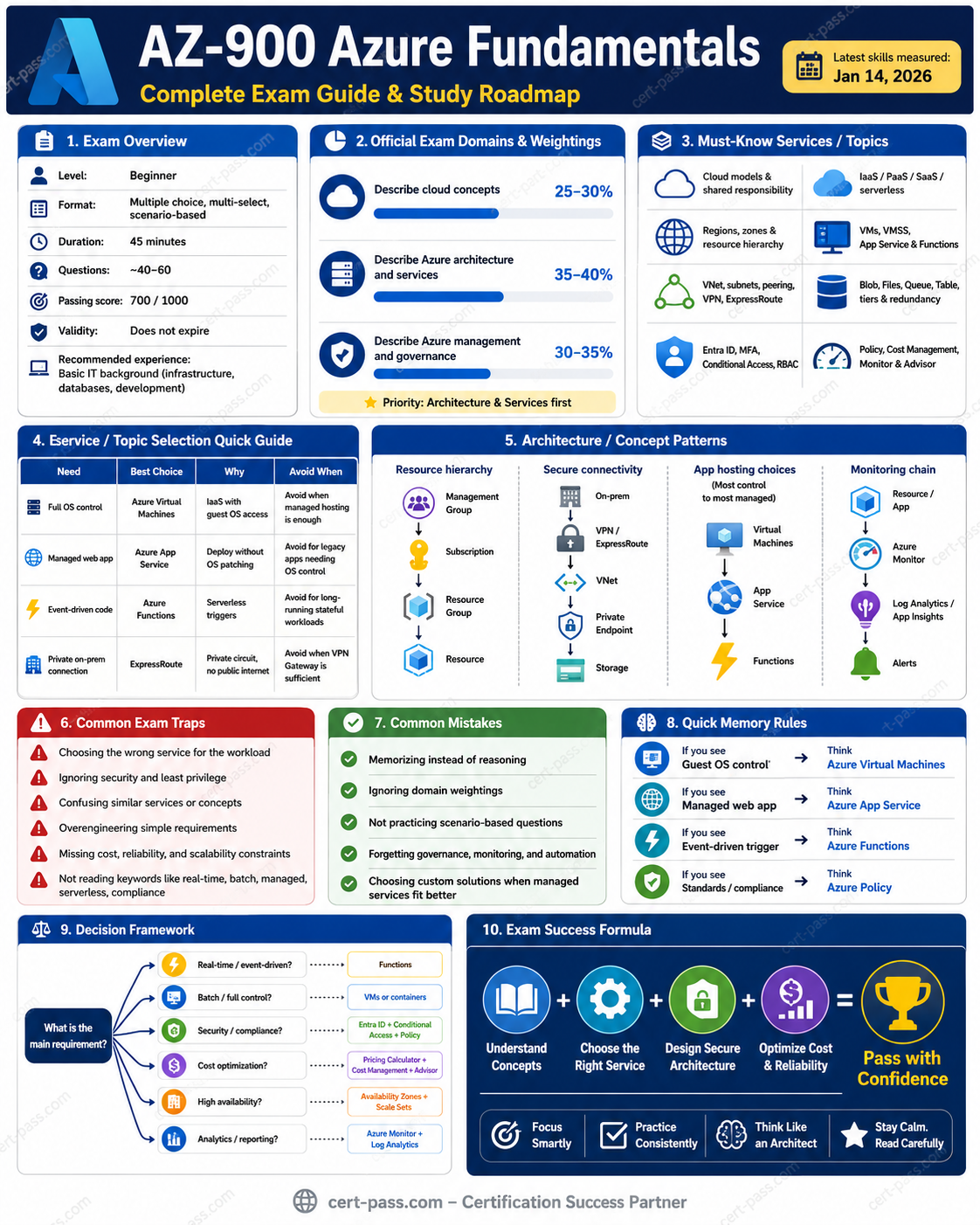
Official exam facts
| Detail | Current info |
|---|---|
| Exam name | AZ-900 Azure Fundamentals |
| Vendor | Microsoft |
| Exam slug | azure-az-900-azure-fundamentals |
| Question count | 50 |
| Time limit | 45 minutes |
| Passing score | 700+ scaled score |
| Certification level | Foundational |
| Cert Pass practice access | EUR 29 |
| Full access | EUR 39 |
| Official vendor page | Microsoft Azure Fundamentals |
| Cert Pass exam page | AZ-900 Azure Fundamentals |
| Free practice page | Try 35 free AZ-900 practice questions - no signup required |
| Study guide | Preview the compressed AZ-900 course |
| Last verified | 2026-06-01 |
The exam facts matter because they shape the pacing. With 50 questions in 45 minutes, the candidate cannot spend too long on any single item. The test rewards quick recognition of Azure concepts, not deep troubleshooting. That is why a good practice page should feel like a guided decision drill rather than a textbook chapter.
How to use this practice set
Use the questions in three passes.
Pass 1: answer without looking ahead
Read the scenario once and choose the best answer based on the current understanding.
Pass 2: review the explanation
The explanation should tell the candidate not only why the correct answer is right, but also why the nearby distractors are wrong.
Pass 3: label the mistake type
If the answer was wrong, mark the mistake as one of these:
- wrong service family;
- wrong cloud concept;
- wrong management tool;
- shared responsibility confusion;
- governance confusion;
- cost confusion;
- networking confusion.
That pattern labeling is what turns practice into progress.
Practice questions
Question 1
A company wants to keep its existing datacenter systems while also using Azure for a new customer portal. Which cloud model best matches that setup?
- A. Public cloud
- B. Private cloud
- C. Hybrid cloud
- D. Community cloud
Correct answer: C. Hybrid cloud
Hybrid cloud is the right choice when an organization combines on premises or private infrastructure with public cloud services. The key clue is that the company keeps existing datacenter systems while also using Azure for a new workload. That means the solution spans both environments. Public cloud only would not fit because it ignores the on premises part. Private cloud would not fit because Azure is part of the plan. Community cloud is not the usual answer for this kind of enterprise scenario. The exam often tests this distinction because hybrid cloud is one of the most common foundational cloud concepts.
Question 2
A manager asks for a cloud model where the customer is responsible for the applications and data, while the provider manages most of the application platform. Which service model is this?
- A. Infrastructure as a Service
- B. Platform as a Service
- C. Software as a Service
- D. On premises hosting
Correct answer: B. Platform as a Service
Platform as a Service is the model where the provider manages more of the platform layers and the customer focuses on the application and data. This is a common AZ-900 concept because it sits between IaaS and SaaS in the shared responsibility spectrum. IaaS would leave more management to the customer, including operating system level responsibilities. SaaS would leave even less to the customer because the provider manages the application itself. On premises hosting is not a cloud service model. The key in this question is recognizing how the responsibility shifts as the service model becomes more managed.
Question 3
A team wants to deploy a simple web app and prefers a service that reduces the amount of infrastructure management. Which Azure service type is the best match?
- A. Infrastructure as a Service
- B. Platform as a Service
- C. Bare metal hosting
- D. Traditional colocation
Correct answer: B. Platform as a Service
This is a classic service model question. If the goal is to reduce infrastructure management, Platform as a Service is usually the better match because Azure manages more of the underlying environment. The team can focus on the application instead of maintaining the whole stack. IaaS still requires more management because the customer handles more of the virtual machine and OS side. Bare metal hosting and colocation are not Azure service models in the way this question needs. The exam often uses broad language like reduce management, simplify deployment, or focus on code. Those phrases usually point toward a more managed service model.
Question 4
Which Azure tool is best for running command line automation using az commands?
- A. Azure PowerShell
- B. Azure CLI
- C. Azure Service Health
- D. Azure Advisor
Correct answer: B. Azure CLI
Azure CLI is the Azure command line tool that uses az commands. That syntax is the big clue in the question. Azure PowerShell is also a management tool, but it uses PowerShell cmdlets, not az commands. Azure Service Health is about incidents and maintenance. Azure Advisor is about recommendations and optimization guidance. This kind of question is very common in AZ-900 because the exam wants the candidate to recognize the tool by its purpose and syntax, not just by name.
Question 5
A cloud administrator wants to manage Azure resources with PowerShell cmdlets instead of command line az syntax. Which tool should be used?
- A. Azure PowerShell
- B. Azure CLI
- C. Azure Service Health
- D. Azure DNS
Correct answer: A. Azure PowerShell
This question is the mirror image of the previous one. Azure PowerShell is the tool that uses PowerShell cmdlets to manage Azure resources. The exam likes to pair similar tools and make the candidate choose based on syntax or use case. Azure CLI uses az commands. Azure Service Health is for service status, not administration. Azure DNS is a networking service, not a management shell. If the candidate learns this pair cleanly, the question becomes easy rather than confusing.
Question 6
A company needs a service that can tell it about Azure service incidents, planned maintenance, and health advisories that may affect its resources. Which service should it use?
- A. Azure Advisor
- B. Azure Service Health
- C. Azure Monitor logs
- D. Azure Resource Graph
Correct answer: B. Azure Service Health
Azure Service Health is the right answer because it provides personalized information about incidents, planned maintenance, and health advisories that may affect the subscription or resources. Azure Advisor gives recommendations for optimization, but it is not the primary service health feed. Azure Monitor logs are used for monitoring and analysis, but they are not the same as the targeted service health experience. Azure Resource Graph helps query resources, not service incidents. This is a good example of why practice questions matter: several services sound related, but only one fits the exact use case.
Question 7
A project requires a way to control who can access Azure resources and what they can do. Which service should the team focus on first?
- A. Azure Load Balancer
- B. Azure IAM concepts through Microsoft Entra and role based access control
- C. Azure DNS
- D. Azure Blob Storage
Correct answer: B. Azure IAM concepts through Microsoft Entra and role based access control
The question is about identity and access control, so the candidate should think about the Azure identity layer and role based access control. The exact wording may vary, but the concept is the same: who can do what. Load balancing, DNS, and storage are not the primary tools for access control. AZ-900 does not require deep identity design, but it does require the candidate to know that access is managed through identity and permissions, not through unrelated infrastructure services.
Question 8
A company wants to protect a resource from accidental deletion by adding an approval step to critical changes. Which Azure governance feature best supports this?
- A. Management groups
- B. Resource locks
- C. Azure DNS zones
- D. Availability zones
Correct answer: B. Resource locks
Resource locks are used to prevent accidental deletion or modification of critical resources. That is exactly what this question is about. Management groups are for organizing subscriptions and governance at scale, but they do not directly block deletion. DNS zones are about name resolution. Availability zones are about resilience. This question tests whether the candidate can identify governance features by the business problem they solve. The clue is accidental deletion, which is a lock question, not a networking or availability question.
Question 9
A finance team wants to estimate Azure cost before deployment and avoid surprise monthly charges. Which concept should they review first?
- A. Azure Service Health
- B. Azure pricing calculator
- C. Azure DNS private zones
- D. Azure Arc
Correct answer: B. Azure pricing calculator
The Azure pricing calculator is the first place to review when a team wants to estimate cost before deployment. This is a direct billing and pricing question, which means the candidate should look for a tool or concept related to forecasting spend. Service Health is about incidents, not cost. DNS private zones are networking related. Azure Arc is about extending management across environments, not price estimation. A lot of candidates miss these because they recognize the Azure branding but do not match the service to the business goal.
Question 10
Which Azure service helps organizations set and enforce rules such as approved locations or required tags?
- A. Azure Policy
- B. Azure Blob Storage
- C. Azure DNS
- D. Azure Virtual Desktop
Correct answer: A. Azure Policy
Azure Policy is the governance tool used to define and enforce standards. If the question mentions tags, allowed regions, or rules that resources must follow, Azure Policy is usually the right answer. Blob Storage, DNS, and Virtual Desktop solve other problems. This is a common AZ-900 governance concept because it shows how organizations maintain control in the cloud. The candidate should remember that policy is about guardrails, not just documentation.
Question 11
A company needs a networking service that translates human readable names into IP addresses. Which Azure service should be used?
- A. Azure Load Balancer
- B. Azure DNS
- C. Azure ExpressRoute
- D. Azure Service Bus
Correct answer: B. Azure DNS
Azure DNS is the naming service that resolves names into IP addresses. This is one of the cleanest networking fundamentals in AZ-900. Load Balancer distributes traffic, ExpressRoute creates private connectivity to Azure, and Service Bus is a messaging service. The question is specifically about name resolution, so Azure DNS is the best fit. If the candidate notices the keyword translate names into IP addresses, the answer is straightforward.
Question 12
A company wants a dedicated private connection from its on premises environment to Azure instead of using the public internet. Which service should it review?
- A. Azure VPN Gateway or ExpressRoute based connectivity
- B. Azure Advisor
- C. Azure Monitor
- D. Azure Backup
Correct answer: A. Azure VPN Gateway or ExpressRoute based connectivity
This question is about private connectivity. The candidate should think about connectivity options rather than monitoring, optimization, or backup. Azure VPN Gateway can provide secure connectivity over encrypted tunnels, while ExpressRoute provides a more private dedicated connection option. The exact answer may depend on wording, but both belong to the connectivity concept. Advisor, Monitor, and Backup do not solve the connectivity problem. The important skill here is matching the business need to the service family.
Question 13
Which Azure service would help a team view performance metrics and set alerts for its application?
- A. Azure Monitor
- B. Azure Service Health
- C. Azure Policy
- D. Azure Resource Manager only
Correct answer: A. Azure Monitor
Azure Monitor is the Azure service for metrics, alerts, and observability. Service Health is about Azure platform incidents and maintenance, not the application's own performance monitoring. Azure Policy handles governance. Azure Resource Manager is the resource deployment and management layer, not the monitoring tool. Many candidates blur Monitor and Service Health, so this question is a good reminder that one is for the application's operational visibility and the other is for Azure platform status.
Question 14
A startup wants to avoid paying for a large upfront license and prefers to pay only for the cloud resources it uses. Which cloud benefit is being described?
- A. Pay as you go pricing
- B. Capital expenditure only
- C. On premises ownership
- D. Fixed hardware commitment
Correct answer: A. Pay as you go pricing
This is a cloud concept and pricing question. Pay as you go means the customer pays for the resources consumed rather than making a large upfront purchase. That is one of the core cloud benefits that AZ-900 expects the candidate to understand. Capital expenditure, on premises ownership, and fixed hardware commitment are closer to traditional IT models. The exam likes to test cloud value because a cloud fundamentals candidate should understand why organizations move workloads to Azure in the first place.
Question 15
Which statement best describes the difference between Azure regions and availability zones?
- A. Regions are groups of data centers in a geographic area, while availability zones are physically separate locations within a region
- B. Availability zones are global service plans, while regions are support tiers
- C. Regions are pricing options, while availability zones are billing tools
- D. Availability zones are only for DNS configuration
Correct answer: A. Regions are groups of data centers in a geographic area, while availability zones are physically separate locations within a region
This is a core Azure architecture concept. Regions are geographic areas where Azure has data centers. Availability zones are separate locations within a region that help with resilience and fault tolerance. The other options are intentionally wrong and should be easy to eliminate if the candidate knows the concepts. Questions like this often reward simple vocabulary clarity more than deep technical knowledge.
Question 16
A team asks which statement best describes the shared responsibility model in Azure cloud services. Which answer is best?
- A. Microsoft is responsible for everything in the subscription
- B. The customer is responsible for nothing in the cloud
- C. Microsoft manages the cloud infrastructure, while the customer manages what they place in the cloud
- D. The model only applies to on premises systems
Correct answer: C. Microsoft manages the cloud infrastructure, while the customer manages what they place in the cloud
This is one of the most important fundamentals in the exam. The candidate should know that the cloud provider manages the cloud itself, while the customer remains responsible for the data, identities, and configurations they control. The exact division depends on the service model, but the basic idea remains the same. The exam often tests this idea in plain language rather than in formal wording, so the candidate should be comfortable explaining it simply.
Question 17
A team wants suggestions for improving the cost efficiency and reliability of its Azure environment. Which service should it review first?
- A. Azure Advisor
- B. Azure Service Health
- C. Azure DNS
- D. Azure Policy only
Correct answer: A. Azure Advisor
Azure Advisor provides recommendations for cost, reliability, operational excellence, security, and performance. That is why it is the best fit here. Service Health is about incidents and maintenance. DNS handles name resolution. Azure Policy is a governance control, not a recommendation engine. This question is useful because it helps the candidate separate recommendation tools from monitoring tools and governance tools. That distinction appears often on the exam and is easy to miss when the candidate reads too quickly.
| Question | Correct answer | Main concept |
|---|---|---|
| 1 | C | Hybrid cloud |
| 2 | B | Platform as a Service |
| 3 | B | Managed service choice |
| 4 | B | Azure CLI |
| 5 | A | Azure PowerShell |
| 6 | B | Azure Service Health |
| 7 | B | Identity and access control |
| 8 | B | Resource locks |
| 9 | B | Pricing calculator |
| 10 | A | Azure Policy |
| 11 | B | Azure DNS |
| 12 | A | Private connectivity |
| 13 | A | Azure Monitor |
| 14 | A | Pay as you go |
| 15 | A | Region versus availability zone |
How to review wrong answers
The fastest way to improve is not to reread the whole set. It is to classify the wrong answer.
If the mistake was a service family error
Review the purpose of the service family first. If the candidate confused monitoring with governance, or networking with storage, the issue is category recognition.
If the mistake was a concept error
Review cloud basics such as shared responsibility, pay as you go, and region versus zone. Those ideas appear across many questions.
If the mistake was a tool syntax error
Review Azure CLI versus Azure PowerShell and the way each tool is used.
If the mistake was a governance error
Review Azure Policy, resource locks, management groups, and the difference between governance and monitoring.
Suggested 7 day practice sequence
| Day | Focus | Result |
|---|---|---|
| 1 | First pass through the questions | Baseline score |
| 2 | Review wrong answers by category | Clear the biggest confusion |
| 3 | Revisit cloud concepts | Stronger foundation |
| 4 | Revisit management and governance | Better tool recognition |
| 5 | Revisit architecture and services | Better service selection |
| 6 | Take a timed mixed set | Build pacing |
| 7 | Final review and retest | Confirm readiness |
Related reading in the Cert-Pass library
The most useful adjacent pages are:
- AZ-900 Azure Fundamentals Study Guide for 2026
- AZ-900 Common Mistakes and Exam Traps for 2026
- AZ-900 Study Plan 2026: 2-Day, 5-Day, and 7-Day Options
- Azure AI-102 Study Guide 2026
- Azure AI-102 Study Plan 2026: Week by Week Schedule
For the official route and practice access, keep these links handy:
- AZ-900 Azure Fundamentals
- Try 35 free AZ-900 practice questions - no signup required
- Preview the compressed AZ-900 course
How to read answer choices
AZ-900 answer choices often feel obvious only after the explanation is read. The trick is to slow down and match the answer to the exact wording of the scenario.
A useful method
- Find the main noun in the question.
- Find the business goal.
- Find the Azure concept that directly solves it.
- Remove answers that are technically related but not the best fit.
For example, if the question is about cost estimation, the best answer should be a pricing tool or pricing concept, not a monitoring service. If the question is about service incidents, the best answer should be Service Health, not Advisor. That kind of discipline is what makes practice questions useful.
Common traps in AZ-900
Trap 1: confusing governance with monitoring
Governance tools like Azure Policy and resource locks are not the same as monitoring tools like Azure Monitor.
Trap 2: confusing CLI and PowerShell
Both are management tools, but the syntax is different and the exam likes to ask about that difference.
Trap 3: confusing Service Health and Advisor
Service Health is about incidents and maintenance. Advisor is about recommendations.
Trap 4: confusing regions and availability zones
Regions are broader geographic areas. Availability zones are separate locations within a region.
Trap 5: confusing pricing and support
Pricing tools estimate cost. Support plans provide help and response levels.
These traps are worth reviewing separately because they show up often and cost easy points.
What to do after finishing the question set
A single practice run is not enough if the candidate wants a real improvement. The next step is a short review cycle.
Review cycle
- Count the missed questions.
- Label each miss by mistake type.
- Review the concept that caused the miss.
- Retake similar questions.
- Check whether the same error appears again.
If the same mistake keeps repeating, the candidate does not need more random questions. The candidate needs a better explanation of that specific concept.
Mini readiness checklist
| Check | Pass or not |
|---|---|
| Can the candidate distinguish Azure CLI from Azure PowerShell? | |
| Can the candidate identify Azure Policy and resource locks? | |
| Can the candidate explain shared responsibility in one sentence? | |
| Can the candidate tell Service Health from Advisor? | |
| Can the candidate explain pay as you go pricing? | |
| Can the candidate distinguish regions from availability zones? |
If the candidate can do most of these without hesitation, the exam is usually within reach.
Why this question style works
The exam style here is useful because it rewards concept recognition over memorization alone. The candidate learns how to respond when the scenario is slightly changed, not just when the wording is identical. That is important for Azure Fundamentals because the exam often uses practical business language.
One line recap before the FAQ
The best AZ-900 practice questions are the ones that teach the candidate how to think like the exam, not just how to remember Azure words.
Are these AZ-900 practice questions enough to pass?
They are a strong start, but the best outcome comes from combining questions with a quick review of cloud concepts, governance, and service families.
Is AZ-900 hard for beginners?
It is approachable, but the broad coverage can still be tricky if the candidate only memorizes terms without understanding the concepts.
Should the candidate memorize Azure service names first?
Not first. It is better to understand the service family and the problem it solves before memorizing smaller details.
What is the most important topic in AZ-900?
Shared responsibility, cloud concepts, and core service recognition tend to matter a lot because they appear across many questions.
How should wrong answers be reviewed?
By labeling the mistake type and then revisiting the related concept instead of simply rereading the full explanation.
Can this practice page be used as a final review?
Yes. It is especially useful as a final review when the candidate wants scenario style questions and a compact answer explanation.
Final answer
AZ-900 practice questions are most useful when they train the candidate to think in categories, not just in memorized facts. The exam is designed to check whether the candidate understands cloud concepts, Azure architecture and services, and Azure management and governance at a foundational level. That means the best practice strategy is to keep answering scenario style questions, review the explanations carefully, and label each mistake so the next round is more focused.
For the official exam page, use AZ-900 Azure Fundamentals. For immediate practice, use Try 35 free AZ-900 practice questions - no signup required. For a tighter review after practice, use Preview the compressed AZ-900 course.
The shortest summary is simple: AZ-900 gets easier when the candidate learns to recognize the Azure concept behind each question before looking at the distractors.
How to review every missed question
A practice set is most useful when each missed answer turns into a rule. Do not just note the right option and move on. Write down why the wrong option looked tempting, then identify the service or concept that made it wrong.
Use this short review pattern:
- Name the topic of the question.
- Identify the exact clue in the prompt.
- Explain why the correct answer fits that clue.
- Explain why the distractors belong to a different concept.
- Retest the same topic later the same day.
A simple scoring habit
Keep three labels for each question:
- Clear win: the answer felt obvious and fast.
- Slow win: the answer was correct but needed extra thought.
- Miss: the answer was wrong or uncertain.
That small tracking habit shows which areas are stable and which areas still need work. It is also a better use of time than rereading every page of the course.
Best follow-up after a practice set
After one full set, the candidate should return to the exact topics that caused hesitation. In AZ-900, the usual trouble spots are identity, governance, storage, networking, and cost. If those five areas become clearer, the rest of the exam usually feels much more manageable.
How to turn practice questions into a study plan
Practice questions are not just a scorecard. They are also a map of what needs more attention. If the same service pair keeps appearing in wrong answers, that pair should become part of the next review block.
A simple study-plan loop works well:
- Take a mixed set of questions.
- Sort the misses by topic.
- Review the exact service or concept that caused the miss.
- Retest with a smaller set on the same topic.
- Repeat until the topic feels automatic.
Why this method helps
It prevents the candidate from studying in circles. Instead of reading more and more notes, the candidate uses the question set to show exactly where the understanding breaks down. That is usually a faster way to improve than trying to memorize the whole subject again.
Good questions to ask after each set
- Which topic caused the most hesitation?
- Was the miss caused by the wording or by the service choice?
- Did the wrong answer belong to a different Azure category?
- Is the candidate confusing a feature with a service?
- Which topic needs a quick review before the next set?
That reflection step turns a practice session into a real study tool.