AWS Cloud Practitioner CLF C02 Study Guide 2026
Quick answer
AWS Cloud Practitioner CLF C02 is the right starting point for candidates who want a clean foundation in AWS before moving into deeper technical certifications. The exam is designed to test basic cloud language, major AWS service families, core security ideas, pricing basics, and support concepts. It is not trying to turn a beginner into an architect. It is trying to confirm that the candidate can recognize the AWS platform at a professional entry level and make sensible choices when the answer depends on cloud fundamentals.
That makes the best study strategy straightforward. Learn the official exam facts, learn the service families, learn the shared responsibility model, and then practice with scenario style questions until the answer patterns become familiar. For the official exam hub, start here: AWS Cloud Practitioner CLF C02. For immediate practice, use Try 35 free AWS Cloud Practitioner practice questions - no signup required. For a tighter review once the basics are in place, Preview the compressed AWS Cloud Practitioner course.
Official exam facts
| Detail | Current info |
|---|---|
| Exam name | AWS Cloud Practitioner CLF C02 |
| Vendor | AWS |
| Exam slug | aws-aws-cloud-practitioner-clf-c02 |
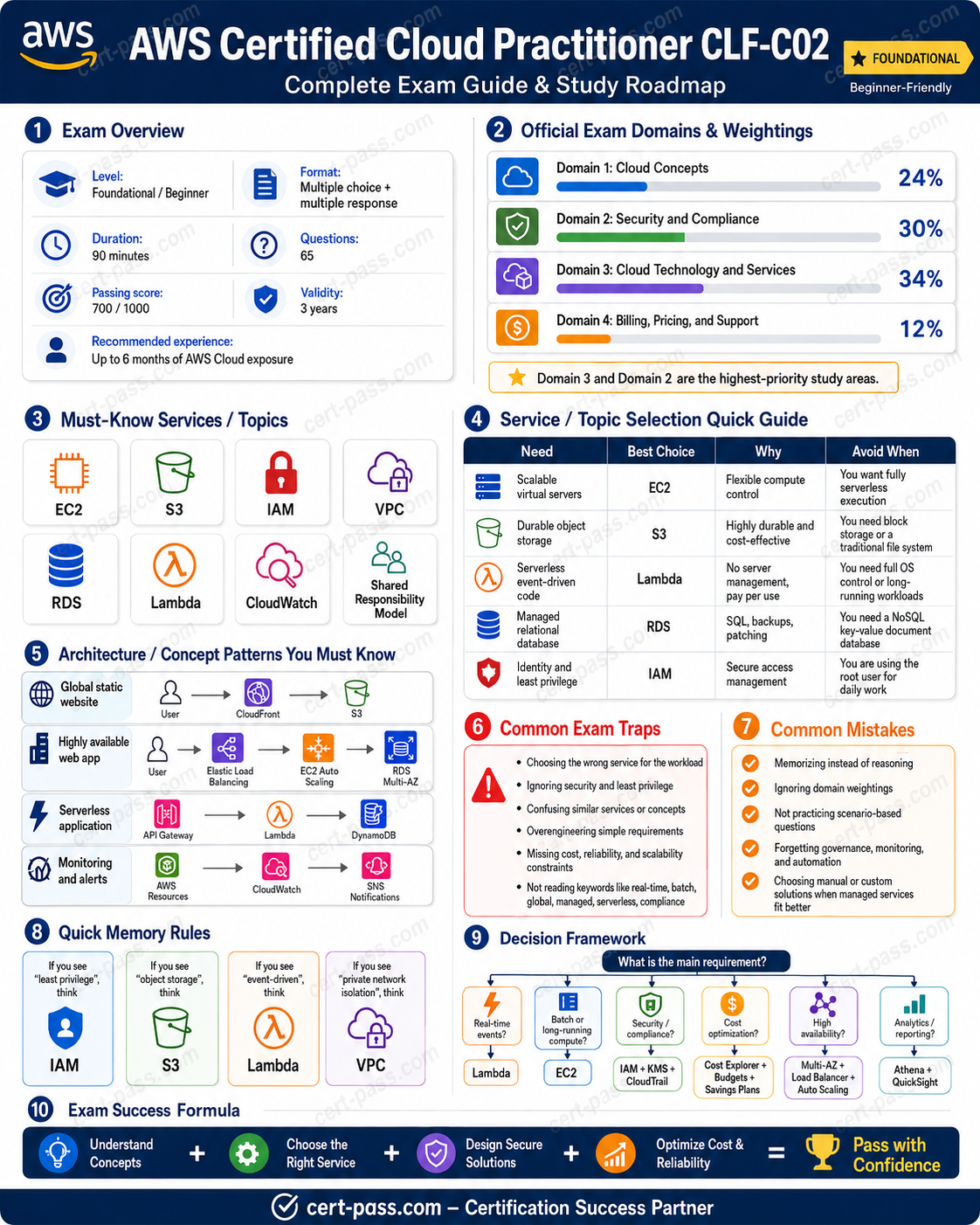
| Question count | 65 |
| Question types | Multiple choice and multiple response |
| Duration | 90 minutes |
| Level | Foundational |
| Passing score | 700 scaled score |
| Certification validity | 3 years |
| Official vendor page | AWS Certified Cloud Practitioner |
| Cert Pass exam page | AWS Cloud Practitioner CLF C02 |
| Practice access | Try 35 free AWS Cloud Practitioner practice questions - no signup required |
| Full study path | Preview the compressed AWS Cloud Practitioner course |
| Last verified | 2026-06-01 |
Those facts matter because they define the study plan. A foundational exam with 65 questions and 90 minutes rewards clarity, not overengineering. The candidate should focus on service purpose, not deep configuration detail. The correct answer is often the one that matches the cloud category, the security idea, or the pricing model most directly.
What this exam is really testing
AWS Cloud Practitioner is a broad, non technical entry exam. It is not asking for deep architecture design. It is asking whether the candidate understands how AWS is organized and how cloud concepts map to AWS services.
The exam usually tests five things:
- whether the candidate understands cloud value and basic AWS terminology;
- whether the candidate can identify the right service family for a simple problem;
- whether the candidate knows the basics of security and compliance;
- whether the candidate understands the shared responsibility model;
- whether the candidate can reason about pricing, support, and billing at a simple level.
That means the right study path is not to memorize every service feature. It is to build a mental map of what each service family is for.
The simplest way to think about AWS Cloud Practitioner
A useful mental model is this:
- compute runs work;
- storage keeps data;
- networking moves traffic;
- security controls access and encryption;
- databases organize data in different ways;
- observability helps answer what happened;
- pricing and support help operate the account.
If the candidate can classify a question into one of those buckets, the answer often becomes much easier to find.
Domain breakdown and how to use it
The official domains tell the candidate where to spend time.
| Domain area | What it means in practice |
|---|---|
| Cloud concepts | Understand the value of cloud and the AWS model |
| Security and compliance | Understand identity, access, and basic responsibility ideas |
| Cloud technology and services | Recognize the major AWS service families |
| Billing, pricing, and support | Understand cost models and support plans |
The domains are intentionally broad. The candidate should not try to study them as isolated trivia lists. They work best when studied as a sequence: first cloud basics, then security, then services, then pricing.
What beginners usually misunderstand
Most beginners make the same few mistakes.
Mistake 1: memorizing names without categories
A candidate may know EC2, S3, and RDS by name but still not know what problem each one solves. That is not enough. The exam asks for service purpose, not just vocabulary.
Mistake 2: studying only one service family
Some candidates focus too much on compute and ignore security, billing, and support. Cloud Practitioner is broader than that.
Mistake 3: confusing free tier, pricing, and support
These are different ideas. The exam may ask about account cost, pricing model, or support level, and the wrong answer may look attractive if the candidate has not separated those concepts.
Mistake 4: treating shared responsibility like a slogan
The shared responsibility model is not just a phrase. It affects which tasks belong to AWS and which tasks belong to the customer.
Mistake 5: skipping practice questions
The exam is scenario based enough that passive reading alone is usually not enough. Practice questions reveal which concepts are still fuzzy.
The core AWS service families to know
Cloud Practitioner is much easier when the candidate knows the main families and what they do.
| Service family | What it is for | Example services |
|---|---|---|
| Compute | Running workloads | EC2, Lambda, Elastic Beanstalk |
| Storage | Keeping data | S3, EBS, EFS, Glacier |
| Database | Organizing and querying data | RDS, DynamoDB, Aurora |
| Networking | Routing and delivery | VPC, Route 53, CloudFront, ELB |
| Security | Identity, access, encryption | IAM, KMS, WAF, Shield |
| Monitoring | Metrics, logs, alerts | CloudWatch, CloudTrail |
| Migration | Moving workloads and data | DMS, Snow Family, DataSync |
| Analytics | Processing and insight | Athena, Redshift, Glue |
The candidate does not need deep mastery of every service. The key is knowing which family is the right one for the question.
Shared responsibility model in plain language
This topic appears often because it is one of the most important cloud fundamentals.
The easiest way to think about it is this:
- AWS is responsible for the cloud itself;
- the customer is responsible for what they put in the cloud and how they configure it.
That sounds simple, but it shows up in many questions. If the prompt is about securing the operating system, patching a workload, setting an IAM policy, or controlling data access, the candidate needs to know whether that task belongs to AWS or the customer.
Useful rule of thumb
| Area | Usually AWS manages | Usually customer manages |
|---|---|---|
| Physical data centers | Yes | No |
| Hardware infrastructure | Yes | No |
| Virtual resource configuration | No | Yes |
| Identity and access settings | No | Yes |
| Data classification | No | Yes |
| OS patching on customer controlled instances | No | Yes |
The exam often tests this idea indirectly.
Security and compliance are not optional topics
Cloud Practitioner is foundational, but security still matters. The exam expects the candidate to know the purpose of IAM, basic encryption concepts, and the idea that access should be controlled rather than left open.
Topics worth knowing well
- IAM users, groups, roles, and policies;
- least privilege;
- encryption at rest and in transit;
- basic logging and auditing ideas;
- shared responsibility;
- security groups versus network access controls at a high level.
Why security questions feel tricky
The answer choices often look similar. The candidate needs to identify whether the question is about identity, encryption, logging, or network access.
Billing and pricing basics
Many beginners underestimate this part of the exam, but billing questions are common enough that they deserve real attention.
Concepts to understand
| Concept | Simple meaning |
|---|---|
| Pay as you go | Pay for what is used |
| On demand | No long term commitment for capacity |
| Reserved style pricing | Commit for better pricing over time |
| Free tier | Limited introductory use for new accounts or services |
| Support plans | Levels of help and response from AWS |
The candidate should know how to identify the business goal behind the question. Is it about lowest cost, predictable cost, or better support? Those are different answers.
Useful asset: study priority table
Use this table to decide where to spend the most time.
| Priority | Topic | Why it matters |
|---|---|---|
| 1 | Shared responsibility model | It appears in many forms |
| 2 | Service families | It makes most scenario questions easier |
| 3 | IAM and security basics | Security is heavily tested |
| 4 | Billing and pricing | Cost questions are common |
| 5 | Monitoring and logging | Often used to differentiate answers |
| 6 | Migration and support | Helpful for practical business questions |
If the candidate has limited time, this order is better than trying to study everything evenly.
What good preparation looks like
Good preparation for Cloud Practitioner is practical and repetitive.
Strong habits
- learn the official exam facts first;
- understand the major service families;
- review shared responsibility until it feels natural;
- use practice questions to expose weak areas;
- review wrong answers and write down the rule behind the correction;
- spend extra time on billing and security because those are easy to misunderstand.
Weak habits
- memorizing feature names without purpose;
- reading too many long articles without testing recall;
- skipping pricing and support because they seem boring;
- assuming foundational means easy enough to wing;
- using only one question set and never reviewing mistakes.
How to read exam questions
A useful method is to read the last line of the question first, then read the scenario for the constraint.
Step by step
- Identify the ask.
- Identify the constraint.
- Classify the topic area.
- Eliminate answers that solve the wrong problem.
- Choose the simplest valid AWS answer.
This works well because Cloud Practitioner questions usually have a clear topic if the candidate stops and labels the problem first.
Common traps in answer choices
| Trap | Why it is tempting | Why it fails |
|---|---|---|
| A familiar service in the wrong family | The name sounds right | It solves a different problem |
| A more advanced service than needed | Sounds professional | The question is foundational |
| A security answer when the question is about billing | Security feels important | It does not solve the actual ask |
| A cost answer when the question is about access | Cheap sounds good | It ignores the real requirement |
| A monitoring answer when the question is about audit history | Logging feels similar | The service purpose is different |
The best way to avoid these traps is to label the question before looking at the answers.
14 day study plan for Cloud Practitioner
| Day | Focus | Goal |
|---|---|---|
| 1 | Exam facts and structure | Know the target |
| 2 | Cloud concepts | Understand the cloud value proposition |
| 3 | Shared responsibility | Learn customer versus AWS tasks |
| 4 | IAM basics | Know identity and access rules |
| 5 | Compute services | Learn EC2, Lambda, and the idea of compute |
| 6 | Storage services | Learn S3, EBS, EFS, and Glacier |
| 7 | Database basics | Know relational versus non relational at a high level |
| 8 | Networking basics | Learn VPC, Route 53, CloudFront, and load balancing |
| 9 | Monitoring and logging | Separate CloudWatch and CloudTrail |
| 10 | Billing and pricing | Learn free tier, pay as you go, and support |
| 11 | Practice questions | Expose weak spots |
| 12 | Review wrong answers | Turn mistakes into rules |
| 13 | Mixed review | Build recall across domains |
| 14 | Final mock exam | Check readiness |
This plan is simple on purpose. Cloud Practitioner rewards breadth and clarity more than deep specialization.
What to focus on for each major area
Cloud concepts
The candidate should understand why companies move to the cloud, what benefits they expect, and how cloud changes cost and agility.
Security and compliance
The candidate should understand why permissions matter, why encryption matters, and why not every task belongs to AWS.
Services and technology
The candidate should know what each major service family is for. That is more valuable than memorizing tiny feature differences.
Billing and support
The candidate should know how AWS charges for usage and what support options are trying to solve.
Useful asset: readiness checklist
| Question | Yes or no |
|---|---|
| Can the candidate explain shared responsibility simply? | |
| Can the candidate identify the major service families? | |
| Can the candidate tell CloudWatch from CloudTrail? | |
| Can the candidate explain basic pricing concepts? | |
| Can the candidate answer scenario questions without guessing? | |
| Can the candidate explain why a wrong answer is wrong? |
If most answers are yes, the candidate is likely close to ready.
The role of practice questions
Practice questions are not just for memorization. They teach pattern recognition.
When reviewing a wrong answer, the candidate should ask:
- Was the mistake about the service family?
- Was the mistake about security?
- Was the mistake about pricing?
- Was the mistake about shared responsibility?
- Was the mistake about reading the question too quickly?
This turns practice into improvement instead of just repetition.
How this exam connects to future certs
Cloud Practitioner is often the first step, not the final step. It creates a foundation for more technical AWS certifications such as architecture, data, or specialty paths.
That means the candidate should study with a long term mindset. The goal is not just to pass once. The goal is to make the next certification easier because the basics are already in place.
Useful asset: next step map
| If the candidate wants... | Good next step |
|---|---|
| More AWS architecture depth | AWS Solutions Architect Associate |
| More AWS data focus | A data oriented AWS path |
| More AWS support and operations clarity | A broader infrastructure path |
| A quick first credential | Cloud Practitioner itself |
The exam is therefore useful as a foundation builder, not just as a standalone badge.
Related articles in the Cert-Pass library
The most useful adjacent pages are:
- AWS Cloud Practitioner CLF C02 for Beginners: What to Learn First
- AWS Cloud Practitioner CLF C02 FAQ: 20 Common Questions Answered
- AWS Cloud Practitioner CLF C02 Practice Questions: 25 Exam Style Examples
- AWS Solutions Architect Associate SAA C03 Exam Guide: Common Mistakes and How to Pass
- Cloud Certification Comparison 2026: AWS, Azure, GCP, Databricks, Snowflake, and Scrum
For the official route and practice access, keep these links handy:
- AWS Cloud Practitioner CLF C02
- Try 35 free AWS Cloud Practitioner practice questions - no signup required
- Preview the compressed AWS Cloud Practitioner course
Why some candidates overprepare in the wrong way
A common problem with Cloud Practitioner study is overpreparing in the wrong direction. Candidates sometimes spend too much time learning details that matter more in associate or specialty exams while leaving the foundational topics underdeveloped.
Common overpreparation mistakes
| Mistake | Why it wastes time |
|---|---|
| Learning deep EC2 tuning before understanding service families | The exam is still asking for basic recognition first |
| Memorizing too many niche services | The biggest gains come from the core services |
| Treating pricing as an afterthought | Billing questions are common enough to matter |
| Ignoring support plans | Support is part of the exam scope |
| Reading only broad cloud theory | The test is AWS specific |
The candidate should aim for balanced preparation, not maximum technical depth.
How to know the candidate is ready
Readiness for Cloud Practitioner is usually visible in a few simple signs.
Ready signs
- the candidate can explain what the major service families do;
- the candidate can tell when a question is about security, pricing, or service choice;
- the candidate can describe shared responsibility without confusion;
- the candidate can answer practice questions without relying on guesswork;
- the candidate can explain why wrong answers are wrong.
If those behaviors are present consistently, the candidate is probably close.
Not ready signs
- the candidate still mixes up storage and compute;
- the candidate cannot explain IAM at a basic level;
- the candidate has not studied billing or support;
- the candidate only recognizes the right answer after seeing the explanation;
- the candidate is still trying to memorize every service name.
Exam day routine
A simple routine helps reduce avoidable mistakes.
- Read the question ask first.
- Identify the topic area.
- Remove answer choices that solve the wrong problem.
- Prefer the simplest valid AWS answer.
- Move on instead of overthinking a question once the best answer is clear.
Cloud Practitioner is not a speed contest, but it does reward steady decision making. The candidate should avoid spending too much time on a single item if the problem is only a confusing wording choice.
Which topics deserve the most repetition
Some topics are worth repeating several times because they appear in many different forms.
High repetition topics
- shared responsibility;
- IAM basics;
- storage versus compute;
- basic networking ideas;
- pricing and billing;
- support plans;
- CloudWatch versus CloudTrail;
- public cloud versus on premise language.
These are the ideas that often separate a pass from a near miss.
Candidate type guide
The exam is useful for more than one type of learner.
Newcomer to cloud
The exam gives a first map of the AWS world. It is a good starting point because it reduces confusion before more technical study begins.
Career switcher
The exam helps show that the candidate understands the AWS vocabulary and cloud basics enough to keep up in interviews or in a junior cloud role.
Business or operations professional
The exam is helpful for understanding what AWS teams mean when they discuss cost, support, security, and service choices.
Future associate level candidate
The exam becomes a foundation. It is not the end goal, but it makes later study easier and less chaotic.
Why the official page still matters
Even when a candidate uses third party study material, the official AWS certification page should stay open during preparation. That page is the source of truth for exam format, validity, and current positioning.
The official page is here: AWS Certified Cloud Practitioner.
That source should be checked again if the candidate is planning an exam date, because certification details can change.
A simple rule for every practice session
At the end of every practice set, the candidate should answer one question:
What pattern caused the mistakes?
If the mistakes were mostly about pricing, the next session should revisit pricing. If the mistakes were mostly about service families, the next session should revisit service purpose. If the mistakes were mostly about shared responsibility, that topic needs another review pass. That feedback loop is what makes practice efficient.
What not to spend too much time on
There are also areas where the candidate can easily lose time without much payoff.
- obscure service edge cases;
- deep configuration steps for associate level services;
- very specific launch announcements if they do not map to the current exam scope;
- topics that are clearly outside the Cloud Practitioner level;
- overly technical architecture diagrams.
This exam is broad, not deep. The preparation should match that shape.
Useful asset: wrong answer tracker
| Wrong answer type | What it usually means | What to study next |
|---|---|---|
| Security mistake | The candidate missed IAM or shared responsibility | Review identity and responsibility concepts |
| Billing mistake | The candidate did not understand pricing or support | Review cost models and support plans |
| Service family mistake | The candidate chose the wrong type of service | Review the purpose of major AWS families |
| Monitoring mistake | The candidate confused logs, metrics, or audit | Review CloudWatch and CloudTrail |
| Cloud concept mistake | The candidate missed the basic cloud advantage | Review cloud benefits and terminology |
This tracker turns vague disappointment into a focused study plan.
One final perspective on value
Cloud Practitioner is valuable because it makes the rest of AWS easier. Many candidates skip the foundational exam and later find that service names, pricing ideas, and security language feel random. This exam reduces that friction. It gives the candidate a stable vocabulary and a practical map of the platform.
That is why it is often worth doing well even if the candidate plans to move quickly into a more technical cert later.
Quick recap for busy candidates
If time is short, remember these four ideas:
- learn the official exam facts;
- learn the major service families;
- learn shared responsibility and security basics;
- use practice questions to expose weak areas.
That is enough to build a real passing foundation and a better starting point for later AWS study for anyone new.
Is AWS Cloud Practitioner hard?
It is approachable, but it still requires real study. The broad coverage makes shallow preparation risky.
Do beginners need to know coding for this exam?
No. It is a foundational cloud exam, not a programming exam.
What is the hardest part for most candidates?
Many candidates struggle most with security, shared responsibility, and billing concepts because those ideas are easy to confuse.
Is Cloud Practitioner a good first AWS certification?
Yes. It is often the easiest way to build a stable AWS foundation before moving to more technical exams.
Should the candidate memorize every AWS service?
No. The better goal is to know the major families and the purpose of the most common services.
How should the candidate use practice questions?
By reviewing every wrong answer and writing down the rule that explains why it was wrong.
How to review practice sets
The fastest way to improve with Cloud Practitioner practice is to turn each missed answer into a short rule. The candidate should not review a full question bank as if every mistake were the same kind of mistake. The better method is to label the error, fix the gap, and retest the same idea later.
| Missed pattern | What it usually means | Next review step |
|---|---|---|
| Shared responsibility mistake | The customer and AWS roles were mixed up | Revisit the responsibility model with one real example |
| Service family mistake | The candidate chose the right type of service in the wrong family | Review the service families and the problem each family solves |
| Pricing mistake | The candidate did not separate estimate, analysis, and alerting | Review Pricing Calculator, Cost Explorer, and Budgets together |
| Logging mistake | The candidate confused audit history with operational monitoring | Revisit CloudTrail versus CloudWatch |
| Access control mistake | The candidate used the wrong security tool | Review IAM, KMS, and basic network controls |
A good review loop is simple: answer a set, mark the weak topics, write one line for each wrong answer, and then take a smaller mixed set a day later. That spacing helps the candidate remember the rule instead of just the answer. For a foundation exam, that habit matters more than trying to study every service in equal detail.
What the next practice pass should check
After one review round, the candidate should not simply reread the same notes. The better move is to test the same idea in a different shape. If the first practice set showed confusion around shared responsibility, the next set should include a mix of responsibility, security, and billing questions so the learner can tell whether the rule is actually stable.
A good second pass should answer three questions:
- can the candidate explain why the correct answer is correct;
- can the candidate explain why the tempting wrong answer is wrong;
- can the candidate answer the same concept when the wording changes.
That kind of review is especially useful for a foundational exam because the same AWS idea often appears in multiple formats. The score improves when the candidate recognizes the pattern quickly instead of treating each question as new.
Final answer
AWS Cloud Practitioner CLF C02 is best treated as a foundation building exam. It is broad, but the broadness is intentional. The exam wants the candidate to understand cloud basics, AWS service families, security language, shared responsibility, and billing concepts well enough to make sensible decisions in simple scenarios.
The best way to prepare is to keep the study path simple. Learn the official facts. Learn the major service families. Learn shared responsibility. Learn the basic pricing and support ideas. Then practice enough questions to make the patterns familiar. That approach is more effective than trying to memorize every service detail at once.
For the official exam path, start with AWS Cloud Practitioner CLF C02. For immediate practice, use Try 35 free AWS Cloud Practitioner practice questions - no signup required. For a more structured review, use Preview the compressed AWS Cloud Practitioner course.
The shortest summary is this: Cloud Practitioner is worth studying carefully because it teaches the AWS language that makes every later certification easier.