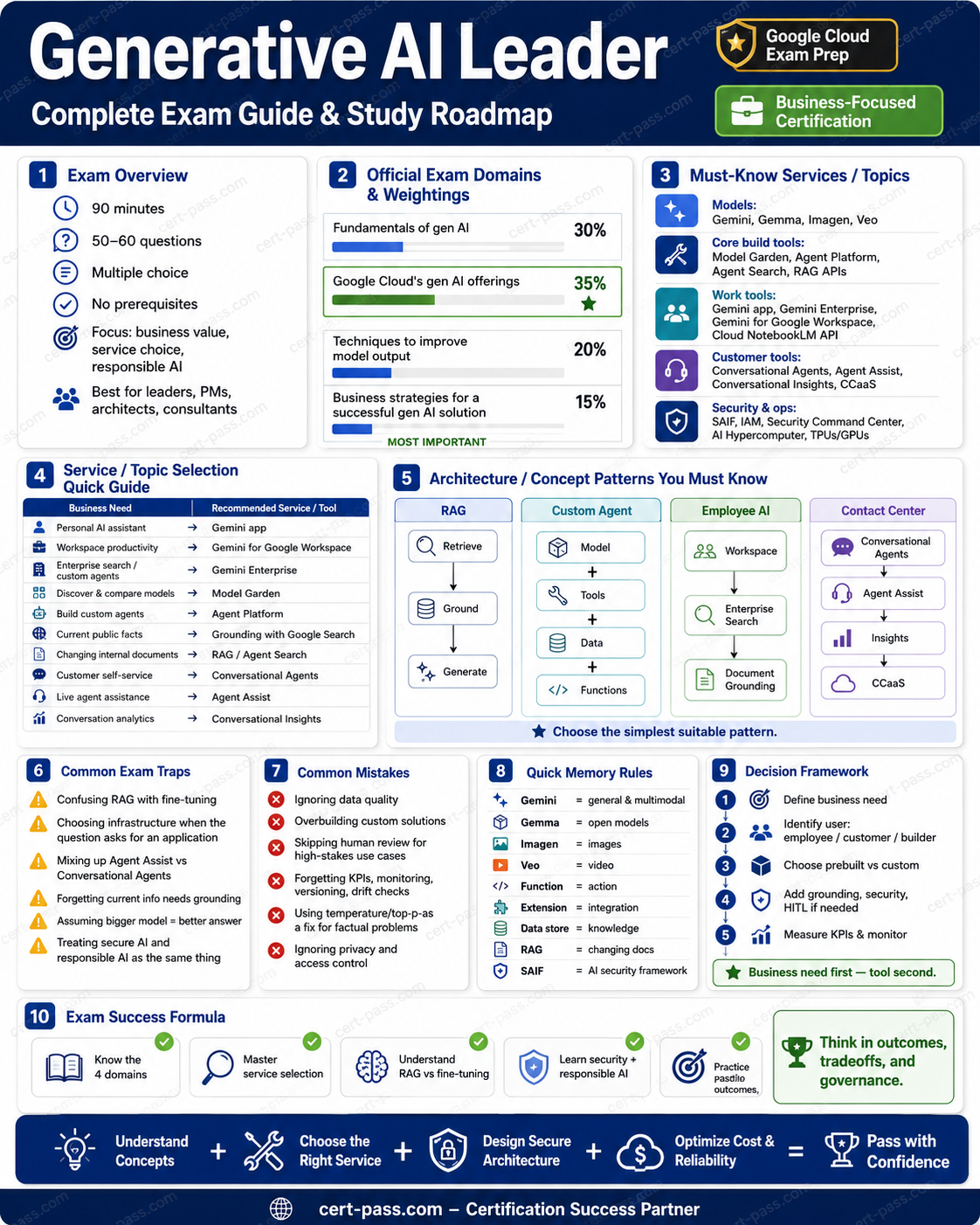

Google Generative AI Leader Common Mistakes and Exam Traps 2026
Google Generative AI Leader common mistakes usually come from reading the question too narrowly. Candidates often focus on the word generative AI and forget that the exam is really asking about business fit, governance, adoption, and practical decision-making.
If you are preparing for the Google Generative AI Leader exam, this guide will help you spot the traps that cost points. Start with the official certification page, then use this article to review the mistakes that appear most often in scenario questions.
Official exam facts at a glance
| Detail | Information |
|---|---|
| Certification | Google Generative AI Leader |
| Vendor | Google Cloud |
| Exam length | 90 minutes |
| Registration fee | $99 plus tax where applicable |
| Question format | 50 to 60 multiple-choice questions |
| Delivery method | Online-proctored or onsite-proctored |
| Languages | English, Japanese, Spanish, Portuguese |
| Prerequisites | None |
| Validity period | 3 years |
| Renewal | Certification renewal is available |
| Official page | https://cloud.google.com/learn/certification/generative-ai-leader |
| Last verified | 2026-06-03 |
The official page is the source of truth for the current exam format and renewal information. This article focuses on the traps that show up when candidates know the terms but not the decision logic.
The biggest mistake: turning every question into a model question
A common error is to assume the right answer must involve the model itself. That is not always true. Many questions are about governance, output length, use-case selection, or business strategy. If the requirement is about privacy, monitoring, or adoption, the answer often lives outside the model prompt.
The exam rewards candidates who can say, in effect: the problem is not the model, the problem is the workflow.
Mistake 1: choosing training when prompt engineering is enough
If the scenario says the team wants to change instructions, examples, context, or output constraints, the right answer is usually prompt engineering. Candidates lose points when they jump to retraining or model replacement.
Trap pattern
- retraining sounds more advanced
- prompt engineering sounds too simple
- the question is actually about improving behavior without a new model
Better approach
Ask whether the issue is instructions, context, or output format. If yes, prompt engineering is the first place to look.
Mistake 2: confusing unsupervised learning with supervised learning
The exam frequently uses simple language about data exploration, grouping, or pattern discovery. If there is no label, supervised learning is usually the wrong answer.
Trap pattern
- you see a business problem and assume prediction
- you miss the phrase about unlabeled data
- you pick the more familiar learning term
Better approach
If the scenario is about finding patterns in unlabeled data, think unsupervised learning first.
Mistake 3: treating a static FAQ like an intelligent assistant
A static FAQ can answer repetitive questions, but it cannot reason, invoke tools, or complete organization-specific tasks. If the scenario needs action, context, or dynamic behavior, a custom agent is usually the right fit.
Trap pattern
- the question sounds simple
- the wrong option offers a static resource
- the actual requirement needs reasoning or tool use
Better approach
Match the solution to the workflow. If the assistant must act, a static document is not enough.
Mistake 4: forgetting governance when proprietary data is involved
When the question mentions control over proprietary data, security posture, or governance, the answer should not be only about prompts or model size. Governance controls matter.
Trap pattern
- you focus on model capability
- you ignore privacy or access control language
- you miss the enterprise requirement for control
Better approach
Look for the option that preserves privacy, security, and governance while still enabling the solution.
Mistake 5: assuming bigger context always means better output
Some candidates think the right answer is to enlarge the context window or dump in more information. That often makes the output worse, not better.
Trap pattern
- more context sounds safer
- the question actually asks for concise output or controlled scope
- too much data becomes the wrong solution
Better approach
Use only the context the task needs, and choose output controls when the requirement is brevity.
Mistake 6: skipping validation after a pilot
A solution can look good in a demo and still fail in production. The exam often checks whether you understand the need to validate against representative scenarios before declaring success.
Trap pattern
- the demo worked
- the team wants to move fast
- the question asks about business readiness, not just proof of concept
Better approach
Choose validation, measurement, and scenario testing rather than trusting a one-time demo.
Mistake 7: confusing language terms
NLP, generative AI, and prompt engineering are related but not interchangeable. Some questions test whether you know the role of each term.
Trap pattern
- the wording looks familiar
- you choose the best-known buzzword
- the question is actually about a narrower concept
Better approach
Read the question as a definition problem. If it asks about understanding human language, NLP is the right foundation.
Quick trap review table
| If the question says... | Watch for this trap |
|---|---|
| Change instructions or examples | Do not jump to training |
| Unlabeled data | Do not pick supervised learning |
| Needs reasoning and tool use | Do not settle for a static FAQ |
| Proprietary data must stay controlled | Do not ignore governance |
| Response must be concise | Do not solve it with more context |
| Pilot must be validated | Do not trust the demo alone |
| Human language understanding | Do not confuse NLP with general AI |
How to avoid losing points
- Identify the actual requirement.
- Decide whether the issue is prompt, model, data, governance, or business strategy.
- Eliminate options that solve the wrong problem.
- Pick the answer that changes the fewest things while still meeting the requirement.
That last step matters. The exam often prefers the smallest adequate solution.
A short study routine
If these mistakes feel familiar, spend one short session per topic:
- prompt engineering versus model training
- learning types and unlabeled data
- governance and data control
- use-case selection and validation
- output length and response control
- agent versus static resource decisions
Internal links and next steps
- Google Generative AI Leader exam page
- Try 35 free Generative AI Leader practice questions
- Google Generative AI Leader study guide 2026
- Google Generative AI Leader practice questions
FAQ
What is the most common mistake on this exam?
Treating every question like a prompt or model-selection question. Many scenarios are really about governance, business value, or use-case fit.
Should I memorize Google product names?
No. Understand the purpose of the product or capability and how it fits the business requirement.
What should I review first after this article?
Review the official page, then revisit the practice questions and write down why each wrong answer is wrong.
Is the exam renewable?
Yes. The official page shows certification renewal is available.
Official source and verification
Official Google Cloud certification page: https://cloud.google.com/learn/certification/generative-ai-leader