
Databricks Certified Generative AI Engineer Associate Common Mistakes and Exam Traps 2026
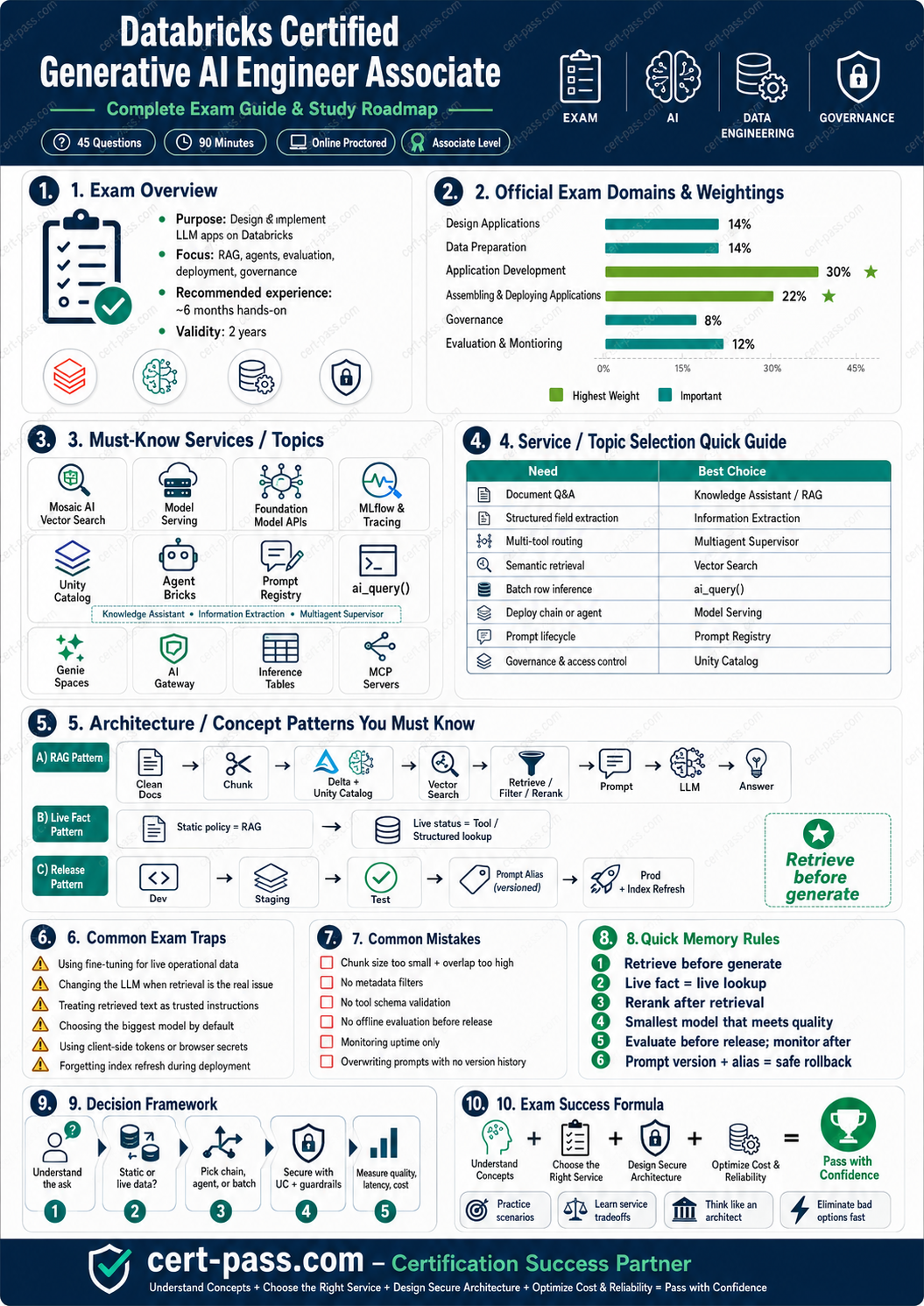
Databricks Certified Generative AI Engineer Associate common mistakes usually happen when a candidate understands the tools but not the workflow. The exam is designed to test whether you can build a generative AI solution that is interactive, governed, observable, and maintainable on the Databricks Platform.
If you are preparing for the Databricks Generative AI Engineer Associate exam, this guide will help you spot the traps that appear most often in architecture, retrieval, deployment, governance, and monitoring questions. Start with the official certification page, then use this article to review the mistakes that can quietly cost points.
Official exam facts at a glance
| Detail | Information |
|---|---|
| Certification | Databricks Certified Generative AI Engineer Associate |
| Vendor | Databricks |
| Level | Associate |
| Type | Proctored certification |
| Scored questions | 45 |
| Time limit | 90 minutes |
| Registration fee | 200 USD |
| Question type | Multiple choice |
| Delivery method | Online or test center |
| Languages | English, Japanese, Portuguese BR, Korean |
| Prerequisites | None, but related training is highly recommended |
| Recommended experience | 6+ months of hands-on experience with the exam tasks |
| Validity period | 2 years |
| Recertification | Required every 2 years |
| Official page | https://www.databricks.com/learn/certification/genai-engineer-associate |
| Last verified | 2026-06-03 |
The official page is the source of truth for question count, time limit, fee, delivery method, languages, and recertification. This article focuses on the mistakes that show up when a candidate knows the platform but misses the correct production pattern.
The biggest mistake: treating every question like a prompt question
A lot of candidates expect the exam to be mostly about prompt wording. It is not. Many questions are really about retrieval, tracing, serving pattern, governance, data minimization, or monitoring. If the requirement is about production behavior, prompt wording is only one part of the answer.
The exam rewards candidates who think end to end.
Mistake 1: using the wrong execution pattern
A common trap is to pick a batch-style function for a live interactive assistant. If the scenario needs multi-turn reasoning and tool use in real time, a served agent is usually the correct direction.
Trap pattern
- a SQL-style function sounds simple and powerful
- the question is actually about an interactive assistant
- the wrong answer solves batch inference, not conversation flow
Better approach
Match the execution style to the interaction style. Interactive problem, interactive serving pattern.
Mistake 2: hiding traces
When an agent misbehaves, you need visibility into tool calls, spans, latency, and outputs. If you cannot trace the workflow, you cannot debug the workflow.
Trap pattern
- the final answer looks enough for logs
- the actual failure happens earlier in the chain
- the wrong answer removes the observability you need
Better approach
Use MLflow tracing so you can inspect the path, not just the output.
Mistake 3: retrieving after generation
In retrieval-augmented generation, the retrieval should happen before the model writes the answer. Some candidates reverse the order because they think the model can fill in gaps later.
Trap pattern
- generation feels like the main event
- retrieval seems like a supporting step
- the wrong order breaks grounding
Better approach
Retrieve first, then generate from the selected evidence.
Mistake 4: sending too much sensitive context
The exam often rewards data minimization. If the task does not require a field, do not send it. If direct identifiers are unnecessary, mask them.
Trap pattern
- more context sounds safer
- the question explicitly asks to minimize sensitive exposure
- the wrong answer over-shares data
Better approach
Use only the fields needed for the task and mask direct identifiers when possible.
Mistake 5: trusting retrieved documents too much
Retrieved content is evidence, not authority. It may contain instructions that should not be followed. If the exam mentions governance, prompt injection, or controlled rollback, the answer should treat retrieved text as untrusted.
Trap pattern
- the document was retrieved successfully
- the candidate assumes that makes it safe
- the wrong answer lets the document change tool policy or instructions
Better approach
Keep retrieved content below trusted instructions and do not let it override policy.
Mistake 6: skipping AI Gateway or governance controls
If the question asks about centralized governance, rate limits, usage tracking, or inference observability, the answer is rarely just another prompt tweak. Databricks has platform-level controls for a reason.
Trap pattern
- the problem looks like a developer issue
- the real issue is production governance
- the wrong answer leaves usage ungoverned
Better approach
Use the platform controls that observe and govern the endpoint.
Mistake 7: ignoring production monitoring and rollback
A solution can work once and still regress later. The exam expects you to think about stored requests, responses, traces, and cross-version comparison when production behavior changes.
Trap pattern
- the demo worked
- the team wants to move on
- the wrong answer does not preserve enough historical evidence to compare versions
Better approach
Monitor live behavior and compare versions using stored artifacts.
Mistake 8: using too much tool complexity for a simple problem
Some candidates over-engineer the solution because they want to show technical depth. The exam usually wants the simplest correct production pattern, not the most complicated one.
Trap pattern
- extra tools look impressive
- the requirement is straightforward
- the wrong answer increases maintenance without benefit
Better approach
Choose the smallest solution that still satisfies the workflow, governance, and monitoring requirement.
Quick trap review table
| If the question says... | Watch for this trap |
|---|---|
| Multi-turn real-time assistant | Do not pick a batch-only pattern |
| Need to debug the agent | Do not hide traces |
| Need grounded answers | Do not generate before retrieval |
| Minimize sensitive data | Do not send every field |
| Retrieved docs are involved | Do not trust them as instructions |
| Need governance or rate limits | Do not skip platform controls |
| Production behavior changed | Do not skip cross-version monitoring |
How to avoid losing points
- Decide whether the problem is interaction, retrieval, governance, or monitoring.
- Match the Databricks pattern to the production requirement.
- Eliminate options that solve the wrong layer.
- Prefer the least complex solution that still gives you observability and control.
That last step is important. The exam usually prefers controlled engineering over overbuilt architecture.
A short study routine
If these mistakes feel familiar, review one area at a time:
- served agents versus batch functions
- MLflow tracing and debugging
- RAG ordering and evidence handling
- data minimization and masking
- prompt injection and trust boundaries
- AI Gateway governance
- monitoring and rollback patterns
Internal links and next steps
- Databricks Certified Generative AI Engineer exam page
- Try 35 free Databricks Generative AI Engineer practice questions
- Databricks Certified Generative AI Engineer study guide 2026
- Databricks Generative AI Engineer practice questions
FAQ
What is the most common mistake on this exam?
Assuming everything is a prompt issue and missing the production pattern behind the question.
Should I memorize product names?
No. Understand the purpose of the control and the type of problem it solves.
What should I review first after this article?
Review served agents, MLflow tracing, retrieval order, and governance controls.
How long is the credential valid?
The official page shows a 2-year validity period and required recertification every two years.
Official source and verification
Official Databricks certification page: https://www.databricks.com/learn/certification/genai-engineer-associate