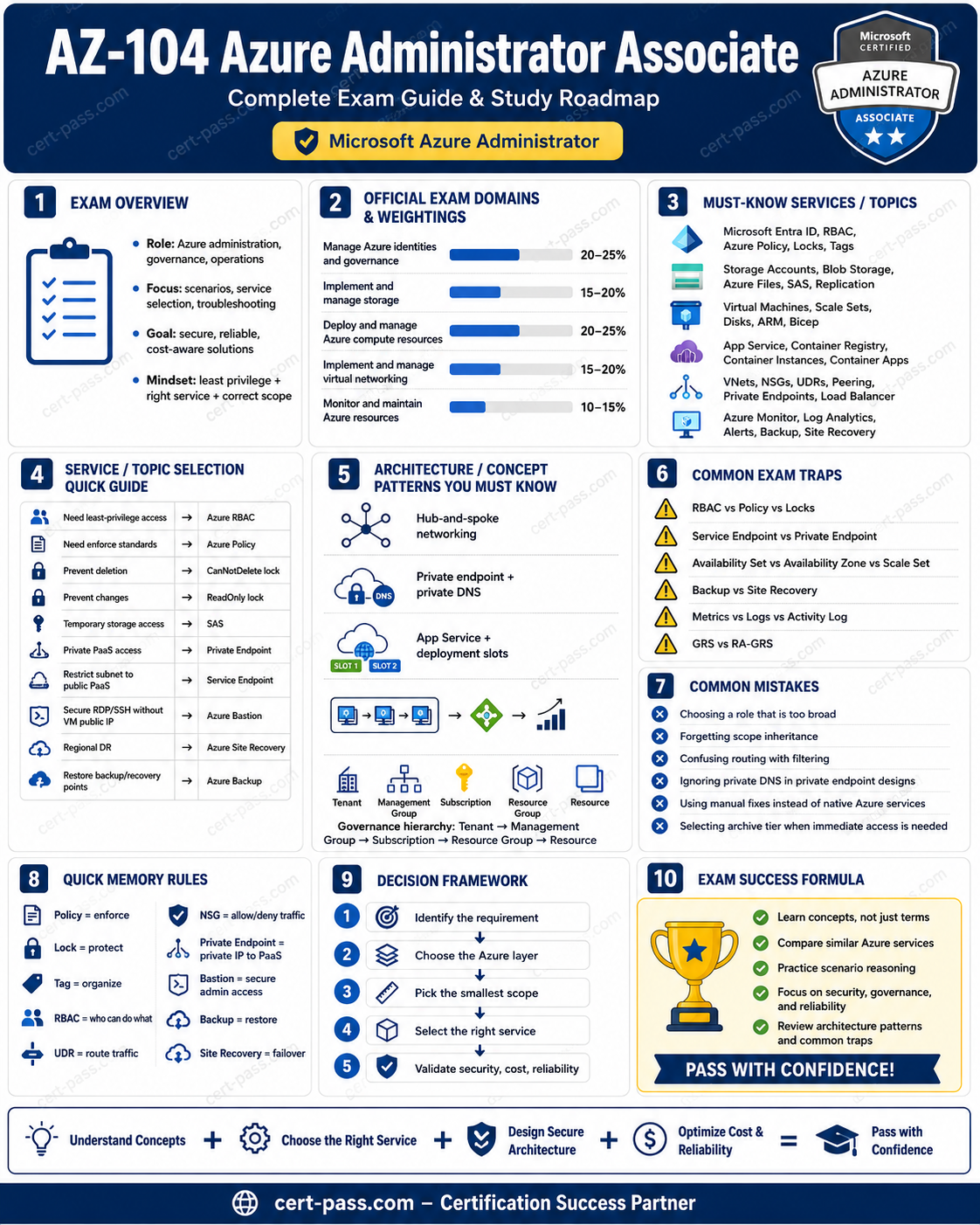
AZ-104 Azure Administrator Associate Common Mistakes and Exam Traps 2026
AZ-104 Azure Administrator Associate common mistakes usually happen when candidates know the service names but miss the requirement. The exam is very good at separating a correct Azure feature from a merely familiar one.
If you are preparing for AZ-104, this guide will help you spot the traps that appear most often in storage, networking, identity, monitoring, and governance questions. Start with the official Microsoft Learn page, then use this article to review the mistakes that can cost easy points.
Official exam facts at a glance
| Detail | Information |
|---|---|
| Certification | AZ-104 Azure Administrator Associate |
| Vendor | Microsoft |
| Role | Administrator |
| Level | Intermediate |
| Product focus | Azure |
| Exam duration | 100 minutes |
| Exam policy | Proctored exam |
| Interactive components | May be included |
| Renewal frequency | 12 months |
| Last updated | 2026-04-17 |
| Official page | https://learn.microsoft.com/en-us/credentials/certifications/azure-administrator/ |
| Last verified | 2026-06-03 |
The official page is the source of truth for exam duration, policy, and renewal. This article focuses on the traps that appear when a candidate knows the service family but not the exact feature.
The biggest mistake: choosing the wrong Azure feature family
A common error is to pick something that sounds related rather than something that directly satisfies the requirement. Storage, networking, identity, and monitoring each have their own controls. If the question is about retention, do not answer with a network feature. If the question is about routing, do not answer with a logging feature.
The exam rewards exact matching more than broad familiarity.
Mistake 1: confusing storage retention with network security
If the requirement is to move blobs on a schedule or delete them after a time period, you need lifecycle management. If the requirement is to control access, you need a network or identity control.
Trap pattern
- a firewall feels like a good general answer
- the question is actually about blob age or retention
- the wrong answer changes the wrong layer
Better approach
Ask whether the problem is access, lifecycle, or recovery. Then choose the matching feature.
Mistake 2: mixing routing with filtering
A frequent exam trap is to talk about NSGs when the real question is about route selection. If the question asks why a VM sends traffic a certain way, inspect effective routes.
Trap pattern
- you see a network issue
- you default to security rules
- the actual issue is next hop selection
Better approach
Use effective routes when the question is about path selection, and NSGs when the question is about allow or deny rules.
Mistake 3: using public endpoints when private access is required
If the scenario says public network access should be disabled, the right answer is usually not a service endpoint. A private endpoint with the right DNS support is usually the better fit.
Trap pattern
- service endpoint sounds private
- it still uses the service's public endpoint
- the requirement asked for a private IP
Better approach
Read the requirement literally. If it says private IP, choose the private endpoint path.
Mistake 4: confusing Azure Files with blobs
Azure Files and Blob Storage solve different problems. Blob versioning does not protect file shares, and Azure Files soft delete does not manage blob version history.
Trap pattern
- the storage account wording makes everything look interchangeable
- the exam is testing service-specific knowledge
- the wrong answer is from the wrong storage feature set
Better approach
Identify the workload first. Is it a blob object, a file share, or a different storage type?
Mistake 5: using shared keys when identity is required
If the question says users must access a share by identity, a shared storage key or broad SAS is not the best answer. Identity-based access and share-level permissions are better aligned with the requirement.
Trap pattern
- SAS feels flexible
- the requirement explicitly mentions identities
- the wrong answer weakens accountability
Better approach
Match the access model to the requirement: identity for people, shared secrets only when the scenario allows it.
Mistake 6: choosing the wrong connectivity feature for PaaS
Private endpoint and service endpoint are not interchangeable. One gives private IP connectivity, the other does not.
Trap pattern
- both sound like network controls
- the question wants private reachability
- the service endpoint answer is too weak
Better approach
If public network access must be disabled, think private endpoint first.
Mistake 7: forgetting about guest OS telemetry
Candidates often remember platform metrics but forget that guest-level counters require the right agent and data collection setup.
Trap pattern
- you know Azure Monitor exists
- you miss the difference between platform and guest telemetry
- the wrong answer is too generic
Better approach
Look for Azure Monitor Agent plus a data collection rule when the scenario mentions guest OS performance counters.
Mistake 8: choosing a public load balancer for a private service
If the service must be reachable only from inside a virtual network, a public load balancer is the wrong direction. An internal load balancer keeps the frontend private.
Trap pattern
- load balancer sounds like the right class of solution
- the public one exposes the service more broadly than required
- the question is about reachability scope
Better approach
Private requirement means internal load balancer or a private connectivity pattern, not a public frontend.
Quick trap review table
| If the question says... | Watch for this trap |
|---|---|
| Move or delete blobs on a schedule | Do not answer with firewall controls |
| Traffic path seems wrong | Do not confuse routes with NSGs |
| Public access must be disabled | Do not pick a service endpoint |
| File share recovery is needed | Do not answer with blob versioning |
| Users need identity-based SMB access | Do not answer with shared keys first |
| Guest counters in Log Analytics | Do not stop at platform metrics |
| Service must stay inside VNet | Do not choose a public load balancer |
How to avoid losing points
- Identify the service.
- Identify the layer: access, routing, retention, monitoring, or reachability.
- Eliminate answers that solve a different layer.
- Choose the smallest Azure feature that directly satisfies the requirement.
That is a strong AZ-104 habit. The exam often rewards precise, supportable actions over broad or flashy ones.
A short study routine
If these mistakes feel familiar, review one area at a time:
- storage and lifecycle
- virtual networking and routing
- Azure Files and private access
- identity and share permissions
- monitoring agents and data collection rules
- internal versus public reachability
Internal links and next steps
- AZ-104 Azure Administrator Associate exam page
- Try 35 free AZ-104 practice questions
- AZ-104 Azure Administrator Associate study guide 2026
- AZ-104 Azure Administrator Associate practice questions
FAQ
What is the most common mistake on AZ-104?
Choosing a related Azure feature that solves the wrong layer of the problem.
Should I memorize every Azure service?
No. Learn the exact feature each scenario calls for and how it maps to the requirement.
What should I study first after this article?
Storage, networking, and identity are the highest-yield areas.
Does the certification renew?
Yes. The official page shows a 12-month renewal frequency.
Official source and verification
Official Microsoft Learn certification page: https://learn.microsoft.com/en-us/credentials/certifications/azure-administrator/