AWS Certified AI Practitioner AIF-C01 Study Guide 2026
If the question is whether AWS Certified AI Practitioner AIF-C01 is worth studying in 2026, the short answer is yes for candidates who want a practical entry point into AI concepts on AWS without jumping straight into a heavyweight specialist track. The exam is foundational, but it is not trivial. It expects a clear grasp of AI and machine learning ideas, generative AI basics, responsible AI, and the AWS services that support common AI use cases.
This guide focuses on what the exam actually rewards, where candidates often lose time, and how to prepare in a way that fits the official scope. If the goal is to compare the certification against other AWS options, start with the exam landing page at AWS Certified AI Practitioner AIF-C01 and the AWS certification page at AWS Certified AI Practitioner.
Quick answer
AWS Certified AI Practitioner is best for candidates who want a clear, vendor-specific introduction to AI concepts and AWS AI services. It is useful for cloud learners, technical stakeholders, product people, consultants, analysts, and junior practitioners who need enough AI literacy to discuss use cases, risks, and service selection without specializing in model training or deep infrastructure design. The exam is especially helpful when a candidate needs to speak confidently about the relationship between foundation models, generative AI applications, and AWS managed services such as Amazon Bedrock and Amazon SageMaker.
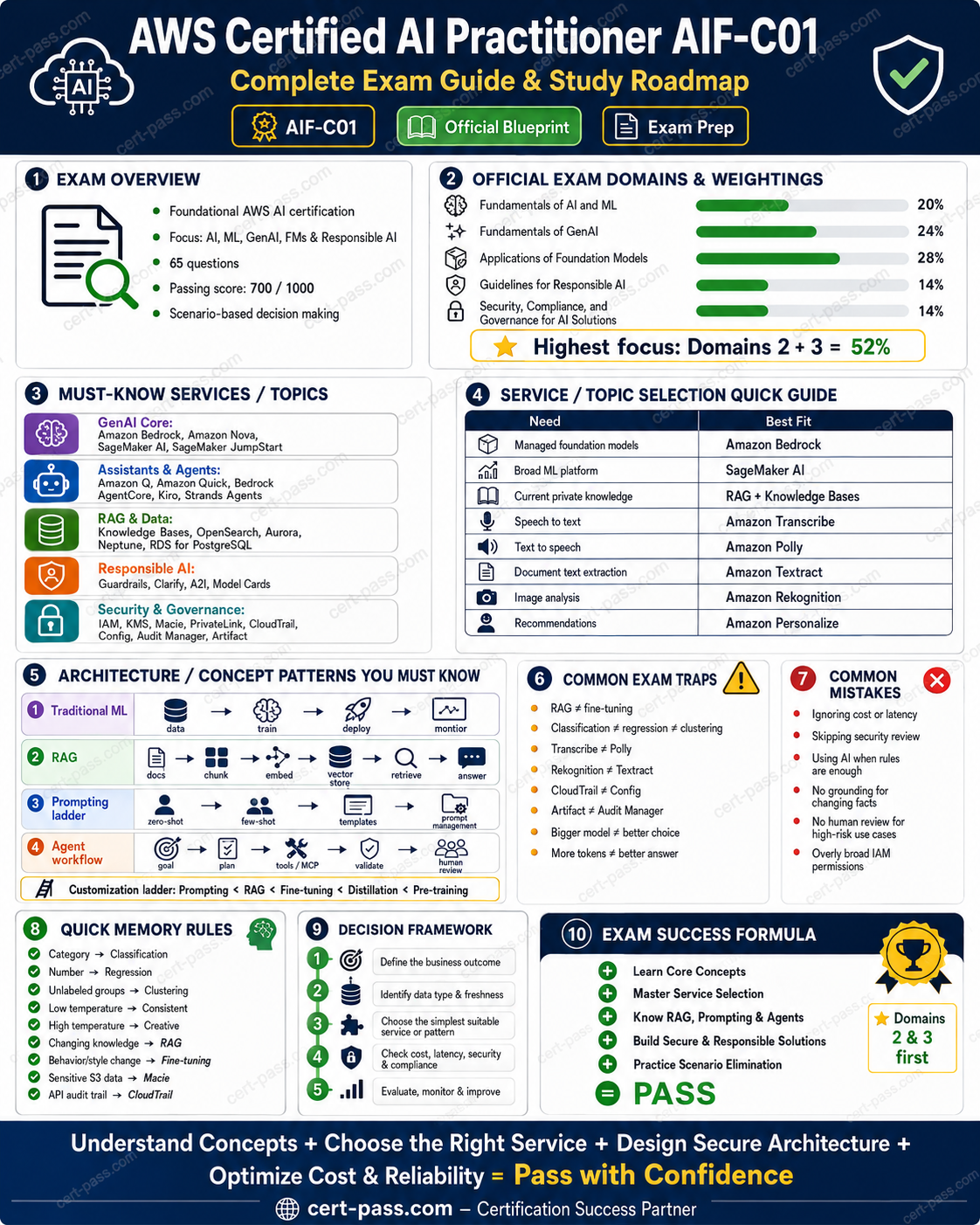
Official exam facts
| Detail | Info |
|---|---|
| Exam code | AIF-C01 |
| Certification | AWS Certified AI Practitioner |
| Vendor | AWS |
| Level | Foundational |
| Duration | 90 minutes |
| Questions | 65 questions |
| Exam fee | 100 USD |
| Passing score | Not publicly listed on the official page |
| Retirement date | Not announced |
| Official source | AWS Certified AI Practitioner |
| Cert-Pass exam page | AWS Certified AI Practitioner AIF-C01 |
The official AWS page describes the certification as a foundational credential and states that it validates knowledge of artificial intelligence, machine learning, and generative AI concepts and use cases. The page also shows a 90 minute exam, 65 questions, and a 100 USD exam fee. For the most current details, the AWS page should always be treated as the source of record.
What AWS Certified AI Practitioner is really testing
This exam is not trying to turn candidates into machine learning engineers. It is testing whether a person can understand AI vocabulary, identify the right type of AI solution for a business need, and make sensible decisions around responsible AI, governance, and AWS service selection.
That distinction matters because many candidates study the exam the wrong way. They spend too much time memorizing service names and too little time understanding when a service fits the problem. The better strategy is to learn the shape of the problem first, then map the service to that problem.
A candidate should be able to do all of the following:
- recognize basic AI, machine learning, and generative AI concepts
- explain what foundation models are at a practical level
- choose the right AWS service for a common use case
- understand responsible AI principles and basic governance concerns
- interpret simple tradeoffs around cost, latency, quality, and customization
- distinguish between building a model and consuming a managed AI capability
The exam is therefore less about raw technical depth and more about decision making. In practice, that means a candidate should focus on scenarios such as chatbots, content generation, classification, summarization, search, recommendation, image understanding, and speech workflows.
The AWS service map candidates should know
One of the easiest ways to raise exam readiness is to build a service map that connects problem type to AWS product. The exam is not only about definitions. It rewards candidates who can identify the most appropriate managed service for a specific outcome.
| Use case | Service to know | Why it matters |
|---|---|---|
| General foundation model access | Amazon Bedrock | Bedrock is central for managed access to foundation models and generative AI workflows. |
| Model development and customization | Amazon SageMaker | SageMaker matters when a use case requires training, tuning, deployment, or ML lifecycle work. |
| Text analysis | Amazon Comprehend | Useful for sentiment, entities, key phrases, and other text analysis tasks. |
| Image analysis | Amazon Rekognition | Helps with image and video analysis scenarios. |
| Speech to text | Amazon Transcribe | Useful when audio needs to be converted into text. |
| Text to speech | Amazon Polly | Converts text into natural sounding speech. |
| Translation | Amazon Translate | Useful when content needs language conversion. |
| Chat and voice interface | Amazon Lex | Relevant for conversational experiences and bots. |
| Business search and Q&A | Amazon Q | Useful for workplace knowledge and assistance scenarios. |
Candidates do not need to become experts in each service, but they should know the problem each service solves. The most common exam trap is choosing a service because the name sounds AI related rather than because it is the best operational fit.
Why the foundational level still requires disciplined study
Foundational does not mean superficial. Many candidates underestimate the exam because it is positioned as an entry level certification. The problem is that entry level exams are often broad. They test vocabulary, concepts, and decision making across many small domains instead of one deep specialization.
That breadth creates a special kind of challenge. A candidate may know enough to answer a question about generative AI, but still miss an item about governance or a service selection question that uses a subtle wording change. The exam expects clear reasoning under time pressure, not just recognition.
The best preparation strategy is to build a study plan that covers three layers:
- concept layer: AI, ML, generative AI, foundation models, prompt basics, responsible AI
- service layer: Bedrock, SageMaker, Comprehend, Rekognition, Translate, Transcribe, Polly, Lex, Q
- scenario layer: choosing the right tool for the right business goal
When those three layers are covered together, the exam becomes much easier to navigate.
Candidate profile: who should take this exam
This certification fits a wide audience, but it is especially useful for people who need credible AI fluency without becoming full time AI engineers.
Typical candidates include:
- cloud learners who want an AWS AI starting point
- analysts who need to understand AI driven workflows
- product managers and business stakeholders working on AI use cases
- consultants who must discuss generative AI with clients
- junior cloud practitioners expanding into AI services
- developers who want a broad AI credential before deeper specialization
It is less useful for people who already work deeply with model training, large scale ML systems, or advanced inference pipelines and need a higher level technical certification. For those candidates, the foundational exam may be too broad and too light.
What to study first
The most efficient starting point is not the service list. It is the AI concepts list.
A strong study order looks like this:
- Understand what AI, machine learning, and generative AI mean.
- Learn the difference between training, inference, and customization.
- Learn what foundation models are and why they matter.
- Study responsible AI concepts such as fairness, transparency, security, and governance.
- Map AWS services to common use cases.
- Practice scenario questions until the service choice feels automatic.
That order helps because many AWS questions are framed around business goals, not technology labels. When the candidate can quickly identify whether a prompt is about text generation, multimodal analysis, workflow automation, or model lifecycle management, the answer choices become much easier to eliminate.
Responsible AI is not a side topic
Responsible AI appears in almost every modern AI exam because it is not optional in real deployments. The exam can easily ask about bias, explainability, privacy, governance, security, data protection, or human oversight.
Candidates should be able to explain, in plain language, why these topics matter:
- bias can lead to unfair or inconsistent outcomes
- explainability helps stakeholders understand system behavior
- privacy controls protect sensitive data
- governance keeps AI use aligned with business and policy requirements
- human review remains important for high risk decisions
A practical way to study this domain is to read each scenario as a risk management problem. If the question sounds like it is asking about trust, control, safety, or compliance, the answer probably sits in the responsible AI bucket rather than the pure model capability bucket.
Domain priorities for faster preparation
The official blueprint should always guide weighting, but a candidate can still study in a priority order that matches likely exam value.
| Priority | Area | Study focus |
|---|---|---|
| High | Generative AI concepts | Foundation models, prompt basics, model output, and common use cases |
| High | AWS AI service selection | Bedrock, SageMaker, and the core AI services map |
| High | Responsible AI | Governance, bias, privacy, security, and human oversight |
| Medium | Traditional ML concepts | Supervised learning, unsupervised learning, and evaluation basics |
| Medium | Data and deployment basics | How data quality, deployment choices, and costs affect AI systems |
| Medium | Business use cases | Matching technology to the business outcome |
| Lower | Deep architecture detail | Enough to understand service differences, but not exhaustive engineering depth |
This priority list helps prevent overstudying areas that are unlikely to carry the most exam weight. A strong candidate does not try to memorize every feature. The candidate learns to make good choices.
Study guide by concept area
AI and machine learning basics
The exam assumes that candidates understand the rough shape of AI and ML. That means knowing the difference between a rules based system and a learning system, understanding the idea of training data, and recognizing that ML models learn patterns from data rather than following hardcoded instructions.
Useful study points include:
- supervised learning uses labeled examples
- unsupervised learning finds patterns without labels
- reinforcement learning uses reward driven feedback
- inference is when the model is used to generate a prediction or response
- model quality depends on data quality, context, and evaluation method
These concepts appear simple, but they are often embedded inside scenarios. The question may not ask for a definition directly. Instead it may describe a business workflow and expect the candidate to choose the best type of AI or ML capability.
Generative AI basics
Generative AI is the part of the exam that feels most visible to candidates because it is tied to chatbots, text generation, summarization, and image generation. The core idea is that generative models create new content based on patterns learned from training data.
A candidate should understand:
- what generative AI is used for
- how foundation models differ from narrowly trained models
- why prompts influence output quality
- why hallucination and factual errors are important risks
- why output quality is tied to context and guardrails
The safest exam approach is to think in terms of application design. If a business wants fast content drafting, summarization, code assistance, or conversational help, the question is probably pointing toward a generative AI service or foundation model workflow.
AWS AI and ML services
The candidate does not need to memorize every feature in every AWS product, but the exam does expect awareness of the core family.
A simple memory pattern is:
- Bedrock for managed foundation model access and generative applications
- SageMaker for building, training, tuning, and deploying ML solutions
- Comprehend for text analysis
- Rekognition for visual analysis
- Transcribe for speech to text
- Polly for text to speech
- Translate for language conversion
- Lex for conversational interfaces
- Q for workplace assistance and knowledge access
The trick is to avoid overgeneralizing. For example, when a question describes a need for managed foundation models, the answer should point to Bedrock rather than a generic ML platform. When the question describes custom model development, SageMaker becomes more likely.
A practical decision framework for scenario questions
Most exam questions can be solved with a simple three step frame.
- Identify the business goal.
- Identify the AI task type.
- Select the AWS service that matches the task with the least unnecessary complexity.
This approach works because AWS exam questions often present tempting but overly complex options. The best choice is usually the one that satisfies the requirement with the most appropriate level of service.
For example:
- if the goal is content generation, look for a managed generative AI path
- if the goal is speech transcription, think Transcribe
- if the goal is image analysis, think Rekognition
- if the goal is custom ML lifecycle work, think SageMaker
- if the goal is text analysis, think Comprehend
The question is rarely asking for the fanciest answer. It is asking for the best fit.
Common mistakes candidates make
1. Memorizing service names without use cases
This is the most common error. Candidates learn a list of product names but cannot explain when to use each one. The exam rewards scenario understanding more than vocabulary recitation.
2. Ignoring responsible AI
Some candidates treat governance as filler material. That is a mistake because responsible AI is central to real deployments and appears naturally in exam scenarios.
3. Confusing generative AI with all AI
Generative AI is important, but it is not the same as every AI workflow. Image classification, speech transcription, recommendation, and pattern detection are not all generative AI tasks.
4. Overstaying on deep model architecture
Foundational exams usually do not need deep research level detail. A candidate who spends too long on obscure model internals may miss the practical service selection layer.
5. Not practicing scenarios
Reading alone is not enough. The exam is scenario driven, so practice should be scenario driven as well.
A realistic 2 week study plan
This study plan is designed for a candidate who already knows the basics of cloud learning and wants a focused path.
Days 1 to 3: core concepts
- learn AI, ML, and generative AI definitions
- review training vs inference
- study foundation models
- understand prompt basics and output quality
Days 4 to 6: AWS service map
- Bedrock
- SageMaker
- Comprehend
- Rekognition
- Transcribe
- Polly
- Translate
- Lex
- Q
Days 7 to 9: responsible AI and governance
- fairness and bias
- privacy and security
- explainability and oversight
- model risk and safe deployment
Days 10 to 12: scenario practice
- work through mixed questions
- explain why the wrong answers are wrong
- identify service choice patterns
Days 13 to 14: review and reset
- retest weak areas
- review notes on service mapping
- do a final timed practice run
This plan is short enough to be realistic, but deep enough to build real confidence. For candidates with more time, the same structure can expand into a 4 week plan by spacing the review sessions apart and adding more question practice.
A realistic 4 week study plan
Week 1: concept foundation
Focus on AI basics, generative AI, foundation models, and the vocabulary used in AWS AI discussions.
Week 2: AWS services
Build a service map and practice identifying the right service for each business need.
Week 3: governance and scenarios
Study responsible AI, safety, security, and sample business scenarios. Use practice questions heavily.
Week 4: repetition and timing
Review weak areas, do mixed drills, and practice answering under time pressure.
The goal of a longer plan is not to collect more notes. It is to improve recall, reduce confusion, and make the service mapping automatic.
Readiness checklist
A candidate is probably ready when the following feels easy:
- explain AI, ML, and generative AI in plain language
- identify when a scenario calls for Bedrock vs SageMaker
- match common AWS AI services to common tasks
- explain why responsible AI matters
- reject distractor answers that sound technically impressive but do not solve the business problem
- complete mixed practice questions without needing to look up every service
If several of those items still feel shaky, the candidate should continue studying instead of rushing the exam date.
Example scenarios and how to think about them
Scenario 1: a support team wants AI generated responses
A support team wants faster replies for common customer questions. The best fit is usually a managed generative AI workflow rather than a custom model training project. Candidates should think about Bedrock or a similar managed foundation model path before jumping to SageMaker.
Scenario 2: a company wants to analyze customer sentiment
This is a text analysis problem. The likely direction is Comprehend, not a general chatbot service.
Scenario 3: a team wants to convert recorded meetings to text
This is speech to text. The likely answer is Transcribe.
Scenario 4: a business wants to localize content into another language
This is translation, so Translate is the obvious candidate.
Scenario 5: a product needs custom model training and deployment
This is the type of situation where SageMaker becomes relevant, because the workflow is about building and operating models, not just consuming a managed AI capability.
These examples show the exam style. The answer often becomes obvious once the task type is identified correctly.
Study notes on prompt quality
Prompt literacy is not only for advanced practitioners. Even a foundational exam can expect awareness that prompt wording affects output quality.
Good prompt habits include:
- be specific about the task
- define the expected output format
- provide relevant context
- avoid ambiguous instructions
- consider the risk of inaccurate output
Candidates should also understand that prompt quality is only one piece of the solution. A strong prompt cannot compensate for the wrong service choice, poor data, or an unsafe use case.
Comparison angle: where this certification fits in the AWS path
AWS Certified AI Practitioner makes sense when the goal is to build AI fluency before moving deeper into specialized tracks. It sits above pure beginner curiosity, but below serious hands on design and deployment specializations.
For a candidate already considering AWS cloud fundamentals or associate level certs, AI Practitioner can serve as a bridge into AI specific learning. It can also be useful for professionals who need to discuss AI strategy with technical teams but do not need the depth of a machine learning engineer.
If the next step is broader AWS cloud study, the natural follow on topics are the AWS certification landing page at AWS Certified AI Practitioner AIF-C01 and related AWS paths such as cloud practitioner and solutions architect study material.
Internal links and related resources
Use these resources to build a complete study path:
- AWS Certified AI Practitioner AIF-C01
- AWS Certified Cloud Practitioner CLF-C02
- AWS Solutions Architect Associate SAA-C03
- AWS Certification overview
- AWS Certified AI Practitioner
A candidate studying AI Practitioner should also cross reference AWS cloud basics, because service selection questions are easier when the broader AWS environment already feels familiar.
A simple revision strategy for the last 3 days
Day 1
- review the service map
- retake weak topic drills
- summarize responsible AI concepts in short notes
Day 2
- do mixed practice questions
- explain every wrong answer
- revisit any service confusion
Day 3
- read the official AWS page again
- review the exam facts table
- keep the final study session short and focused
This final phase should be about confidence, not cramming.
What to remember on exam day
The best exam day mindset is simple:
- read the scenario carefully
- identify the business need before the product name
- eliminate answers that solve a different problem
- choose the least complex valid solution
- keep responsible AI in mind when the question hints at trust, fairness, or governance
That approach is enough to handle most questions without panic.
FAQ
Is AWS Certified AI Practitioner good for beginners?
Yes. It is a foundational certification and is designed to introduce AI concepts and AWS AI services in a structured way. It is still broad enough to require careful study.
Does this exam require deep machine learning knowledge?
No. It requires AI literacy and practical service awareness, not advanced model engineering.
Is Amazon Bedrock important for this exam?
Yes. Bedrock is one of the most important AWS services to understand because it is closely tied to managed generative AI use cases.
Should candidates memorize every AWS AI service?
No. The better approach is to know the major services and the problem each one solves.
How much time should be spent on responsible AI?
A meaningful amount. Governance, safety, and trust are core parts of modern AI work and are likely to appear in scenario style questions.
Is this a good first AWS certification?
It can be, especially for candidates focused on AI rather than general AWS infrastructure. Candidates who want broader cloud fundamentals may still prefer a cloud baseline first.
Official source and verification
Official AWS source:
Cert-Pass exam page:
-
2026-06-03
-
Draft ready for internal review
Exam traps worth watching
The strongest distractors on this exam often look correct because they name an AWS service that is connected to AI in a broad sense. The mistake is usually one of scope rather than vocabulary. For example, a question may describe a simple analysis task and include an answer that points to a much heavier model lifecycle service. The right move is to ask whether the problem is about consuming AI, building AI, analyzing text, handling speech, or governing the outcome. Once the task type is clear, the overengineered option usually falls away.
Another common trap is the appearance of overly abstract business language. If the scenario talks about stakeholder trust, policy, sensitive data, or operational controls, the answer is probably about responsible AI or governance. If the scenario emphasizes content generation, assisted drafting, or conversational output, the answer is more likely tied to a managed generative AI workflow. Exam success often comes from reading the business objective carefully instead of reacting to the first product name that sounds advanced.
A short exam day checklist
Before the test begins, a candidate should be able to answer these questions without hesitation:
- What is the official exam code?
- Which AWS service is the most likely fit for a generative AI use case?
- Which service is best for speech to text or text to speech?
- Which concepts belong to responsible AI rather than service selection?
- Which services solve text analysis, image analysis, translation, or custom model development?
If the answers to those questions feel fuzzy, the candidate should spend one more review cycle on the service map and scenario practice. Small gaps at the foundational level often become big time sinks under pressure.
How to use this guide efficiently
This guide works best when it is treated as a map rather than a reading assignment. A candidate can start with the official facts table, then move into the service map, then return to the scenario sections when practice questions expose weak areas. The goal is not to remember every sentence. The goal is to internalize the decision pattern behind the exam.
A useful repetition loop is:
- read the concept section
- answer a few practice questions
- review the wrong answers
- revisit the corresponding service section
- repeat until the service choice feels obvious
That loop is simple, but it is effective because it connects knowledge to action. The exam rewards candidates who can make sound decisions quickly and consistently.
If the next step is to build the cluster around this exam, the natural follow ups are a practice questions article, a common mistakes article, a worth it article, and a study plan article that all point back to the same exam page.