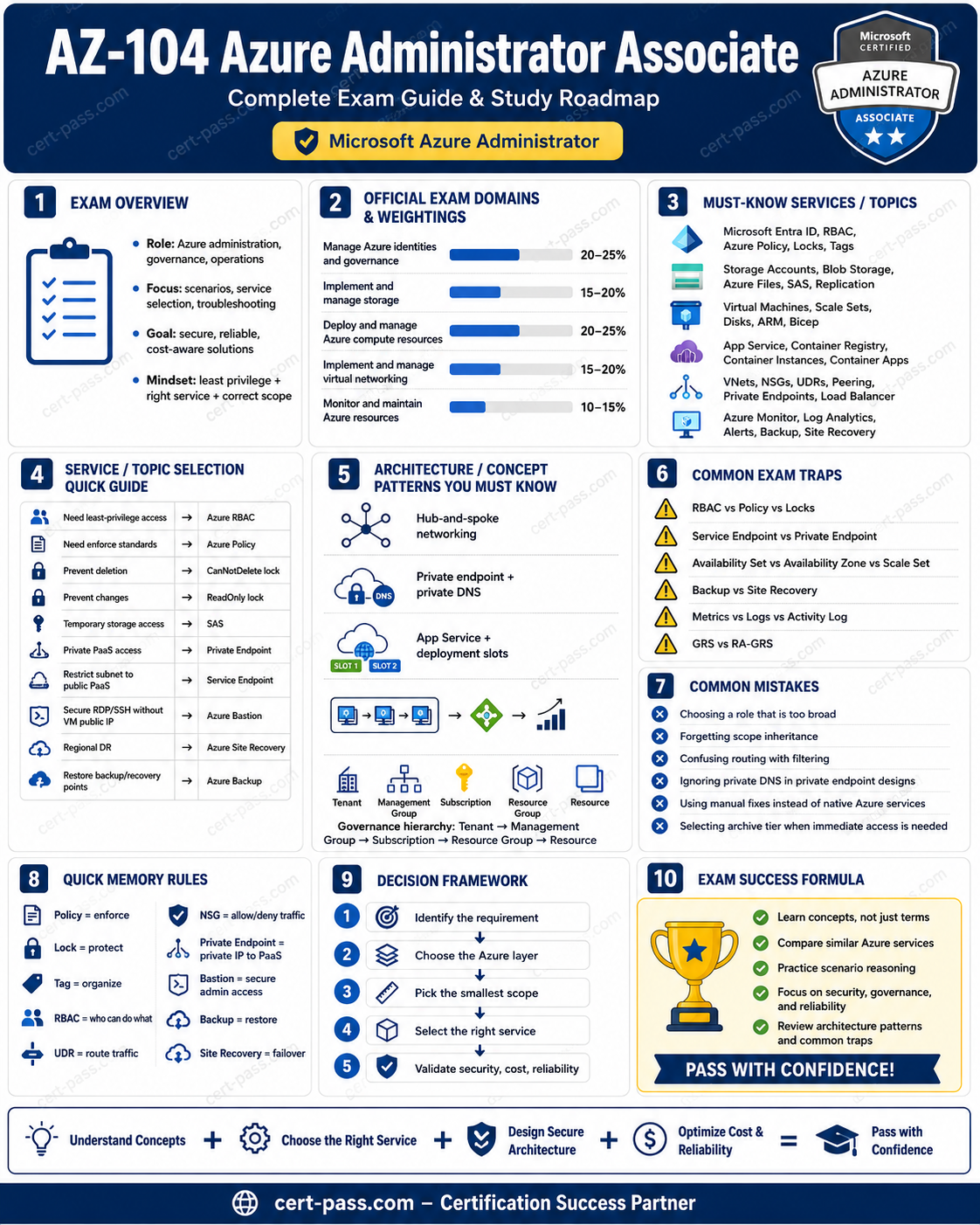
AZ-104 Azure Administrator Associate Study Guide 2026
AZ-104 Azure Administrator Associate study guide content should do more than list Azure services. This exam is designed for candidates who manage Azure environments in the real world, so the best preparation focuses on how identities, storage, compute, networking, monitoring, and governance fit together. If you understand how those pieces work as a system, the exam becomes much easier to reason about.
This study guide gives you the official exam facts, the main topic areas, the most common traps, and a practical review path. It is written for candidates who want a clear plan rather than a pile of disconnected notes. The goal is to help you think like an Azure administrator: solve access issues, choose the right resource scope, control costs, secure the environment, and monitor resources without unnecessary complexity.
Official exam facts at a glance
| Detail | Information |
|---|---|
| Certification | Microsoft Certified: Azure Administrator Associate |
| Exam code | AZ-104 |
| Vendor | Microsoft |
| Level | Intermediate |
| Role | Administrator |
| Exam duration | 100 minutes |
| Format | Proctored, with possible interactive components |
| Languages | English, Chinese (Simplified), Korean, Japanese, French, Spanish, German, Portuguese (Brazil), Chinese (Traditional), Italian |
| Renewal frequency | 12 months |
| Official page | https://learn.microsoft.com/en-us/credentials/certifications/azure-administrator/ |
| Last updated on Microsoft Learn | 04/17/2026 |
| Last verified | 2026-06-03 |
Microsoft Learn states that the exam is proctored and may include interactive components. It also lists the exam duration as 100 minutes and notes that the certification renews every 12 months. That matters because AZ-104 is not just a one-time memory test. It sits inside an ecosystem where Azure changes over time, so the certification expects practical, current knowledge.
What AZ-104 is actually testing
AZ-104 is about administering Azure environments, not just naming services. A successful candidate should be able to:
- manage identities and governance at the right scope
- deploy and manage compute resources
- implement and manage storage
- implement and manage virtual networking
- monitor and maintain Azure resources
If you look at the official page, those are the core assessed areas. The exam rewards candidates who understand the relationship between these areas. For example, identity decisions affect access. Access affects resource operations. Resource operations affect monitoring. Monitoring then reveals whether the configuration is healthy and cost efficient.
The five topic areas you must master
| Topic area | What it covers | Typical exam angle |
|---|---|---|
| Manage Azure identities and governance | Microsoft Entra, RBAC, scope, policy, cost controls | Who can do what, and at what scope? |
| Deploy and manage Azure compute resources | VMs, scaling, availability, app hosting basics | Which compute option fits the workload? |
| Implement and manage storage | Storage accounts, blobs, files, access methods, data protection | Which storage setting solves the requirement? |
| Implement and manage virtual networking | VNets, subnets, IPs, NSGs, routing, load balancing basics | Which networking control is needed without overexposing resources? |
| Monitor and maintain Azure resources | Azure Monitor, metrics, alerts, backup, health | How do you observe, alert, and recover efficiently? |
The exam often presents a realistic change request. Your job is to map the request to the right Azure capability and avoid granting too much access, choosing the wrong control plane, or picking a service that solves a different problem.
How to study AZ-104 efficiently
The strongest prep strategy is to study by scenario, not by isolated product.
Step 1: Learn scope and access first
A large share of administrator work comes down to scope. Know the difference between:
- management group
- subscription
- resource group
- resource
Know where to assign roles and how to limit access to only what is needed.
Step 2: Learn the storage and compute basics
Understand how Azure Storage, virtual machines, backup policies, and file access work. Many exam items ask which setting enables recovery, identity-based access, or policy-driven control.
Step 3: Learn networking by function
Do not just memorize VNet terms. Know what each control does:
- public IP versus private IP
- NSG versus route table
- load balancer versus application gateway in broad terms
- private connectivity versus internet exposure
Step 4: Learn monitoring as a system
Azure Monitor, metrics, logs, alerts, backup reports, and cost alerts often appear as practical operations questions. The key is choosing the tool that matches the question.
Manage Azure identities and governance
This is one of the most important sections because it affects almost every other Azure action. You should be comfortable with:
- Microsoft Entra identity basics
- role-based access control
- least privilege
- scope selection
- management groups and subscriptions
- Azure Policy concepts
- cost management and budget alerts
Common traps in this section
- assigning a role at subscription scope when resource group scope is enough
- choosing a monitoring or backup tool when the question is really about permissions
- confusing identity management with data storage access
- using a broad administrative role when a narrow built-in role would solve the problem
What to remember
If the question says a user should manage only a specific resource group, the answer usually focuses on the resource group scope, not the subscription or tenant root. If the question says a team needs cost notifications, look to Cost Management and budgets, not VM metrics.
Deploy and manage Azure compute resources
Compute questions usually involve virtual machines, availability, scaling, or workload fit. You should know when to choose a VM-related answer and when a platform service is a better fit.
Study these ideas:
- VM deployment basics
- scaling and availability concepts
- when to use a VM versus another compute form
- using Azure-native controls to manage lifecycle and access
- understanding resource relationships that affect compute reliability
Common traps in this section
- picking a networking answer for a compute problem
- assuming a VM extension solves everything
- forgetting that compute choices should match operational needs
- confusing storage protection with compute resilience
What to remember
If the scenario is about running a workload on a virtual machine, think about the compute resource itself, its access, its protection, and how it is monitored. If the requirement is broader and not VM-specific, check whether the question is really testing a platform service choice instead.
Implement and manage storage
Storage questions often ask how to protect data, control access, or support a specific workload. This section is about both the storage type and the feature that solves the problem.
Important concepts include:
- storage accounts
- blobs and blob soft delete
- Azure Files and identity-based access
- retention and recovery
- access methods and authorization
- storage protection versus workload backup
Common traps in this section
- using a SAS token when the question asks for identity-based access
- choosing a network rule when the real issue is recovery
- confusing blob versioning with soft delete
- forgetting that a storage account alone does not define the backup strategy
What to remember
If a blob was deleted and must be recovered during a retention window, soft delete is often the right concept. If users need SMB access to a share with identity-based authentication, look at Azure Files and the correct authorization model.
Implement and manage virtual networking
Networking questions usually sound technical but are often straightforward if you read the requirement carefully. The exam wants to know whether you can connect the right control to the right networking need.
Study these ideas:
- virtual networks and subnets
- public IP versus private IP
- NSGs and access control
- internal versus internet-facing exposure
- routing basics
- load balancer frontend needs
Common traps in this section
- choosing a DNS setting when the problem is really IP exposure
- picking a public endpoint when the workload should stay private
- confusing a load balancer frontend address with a private address
- adding unnecessary network components when one simple resource solves the problem
What to remember
If the load balancer must be internet-facing and needs a stable frontend address, a public IP is usually part of the answer. If the workload should remain internal, think private connectivity and access controls instead.
Monitor and maintain Azure resources
This section is a major source of practical questions because it tests how administrators stay on top of real environments.
Key topics include:
- Azure Monitor metrics
- logs and alerts
- backup policies
- backup reports
- recovery and retention concepts
- operational visibility
- cost and health monitoring
Common traps in this section
- using a metric alert to solve a backup health issue
- using a tag when the requirement asks for centralized alerting
- choosing logs when the question specifically needs near-real-time metrics
- confusing cost alerts with resource performance alerts
What to remember
Metrics are usually the right answer for near-real-time numerical charts. Backup reports and alerts are the right answer when the requirement is about backup failures or backup health. Cost Management budgets are the right answer when the requirement is about spending thresholds or forecasted cost.
A practical review table
| Scenario | Likely skill being tested | What the best answer usually does |
|---|---|---|
| A user must manage only one resource group | RBAC and scope | Assigns the narrowest role at the resource group |
| A VM needs scheduled backups and retention | Backup planning | Uses a backup policy and associates it properly |
| Users need SMB access with identities | Storage access | Uses Azure Files identity-based authentication |
| An internet-facing load balancer needs a stable address | Networking | Uses a public IP address |
| A team needs alerts on forecasted Azure cost | Governance and finance | Uses an Azure Cost Management budget |
| Backup failures must be visible centrally | Monitoring and operations | Uses Azure Backup reports and alerts |
What strong candidates do differently
Strong candidates do not just know Azure terminology. They think in terms of control, scope, and outcome.
They ask:
- What exactly is the requirement?
- Is the problem about access, recovery, exposure, or observability?
- Which Azure control addresses the problem with the least unnecessary complexity?
- Would a broader answer grant more access than needed?
- Is the question asking for a resource, a policy, an alert, or a report?
That mindset is crucial on AZ-104. The wrong answers are often technically related but not precise enough.
The most common mistakes to avoid
1. Over-granting access
Many questions are designed to catch candidates who assign too much permission. Always prefer the narrowest valid scope.
2. Choosing the wrong control layer
A storage problem is not automatically a networking problem. A cost problem is not a CPU problem. A backup problem is not a VM tagging problem.
3. Mixing up monitoring tools
Metrics, logs, backup alerts, and budget alerts solve different problems. Read the request carefully.
4. Forgetting operational fit
The exam cares about supportability. The answer should work in production, not just in theory.
5. Skipping the wording around scope
Words like only, least privilege, specific resource group, and centralized visibility are clues. They are not filler.
One-week study plan
If you want a compact plan, use this:
Day 1
Read the official AZ-104 page and note the exam topics and exam policy.
Day 2
Study identities, governance, scope, and RBAC.
Day 3
Study storage and recovery features, especially blob soft delete and Azure Files access.
Day 4
Study compute and common VM administration patterns.
Day 5
Study virtual networking, IP addressing, NSGs, and load balancer concepts.
Day 6
Study monitoring, Azure Monitor, backup reports, and cost alerts.
Day 7
Take practice questions, review every miss, and revisit the weak topics.
Internal links and next steps
Use this guide alongside the rest of the AZ-104 cluster:
- AZ-104 Azure Administrator Associate exam page
- Try 35 free AZ-104 practice questions
- AZ-104 common mistakes and exam traps
- Browse Microsoft certification options
FAQ
Is AZ-104 a good certification for Azure administrators?
Yes. It is the standard administrator-level Azure certification and is designed around real operational responsibilities.
Is AZ-104 harder than Azure Fundamentals?
Yes. It is an intermediate certification and expects deeper operational judgment than an entry-level fundamentals exam.
Do I need hands-on Azure experience?
It helps a lot. AZ-104 is easier to study when you have actually worked with identities, storage, compute, networking, and monitoring.
What is the best way to study for the exam?
Use the official Microsoft Learn page, study by topic area, and practice with scenario-based questions.
How often does the certification renew?
Microsoft Learn lists the renewal frequency as 12 months.
Official source and verification
Official Microsoft Learn certification page: https://learn.microsoft.com/en-us/credentials/certifications/azure-administrator/