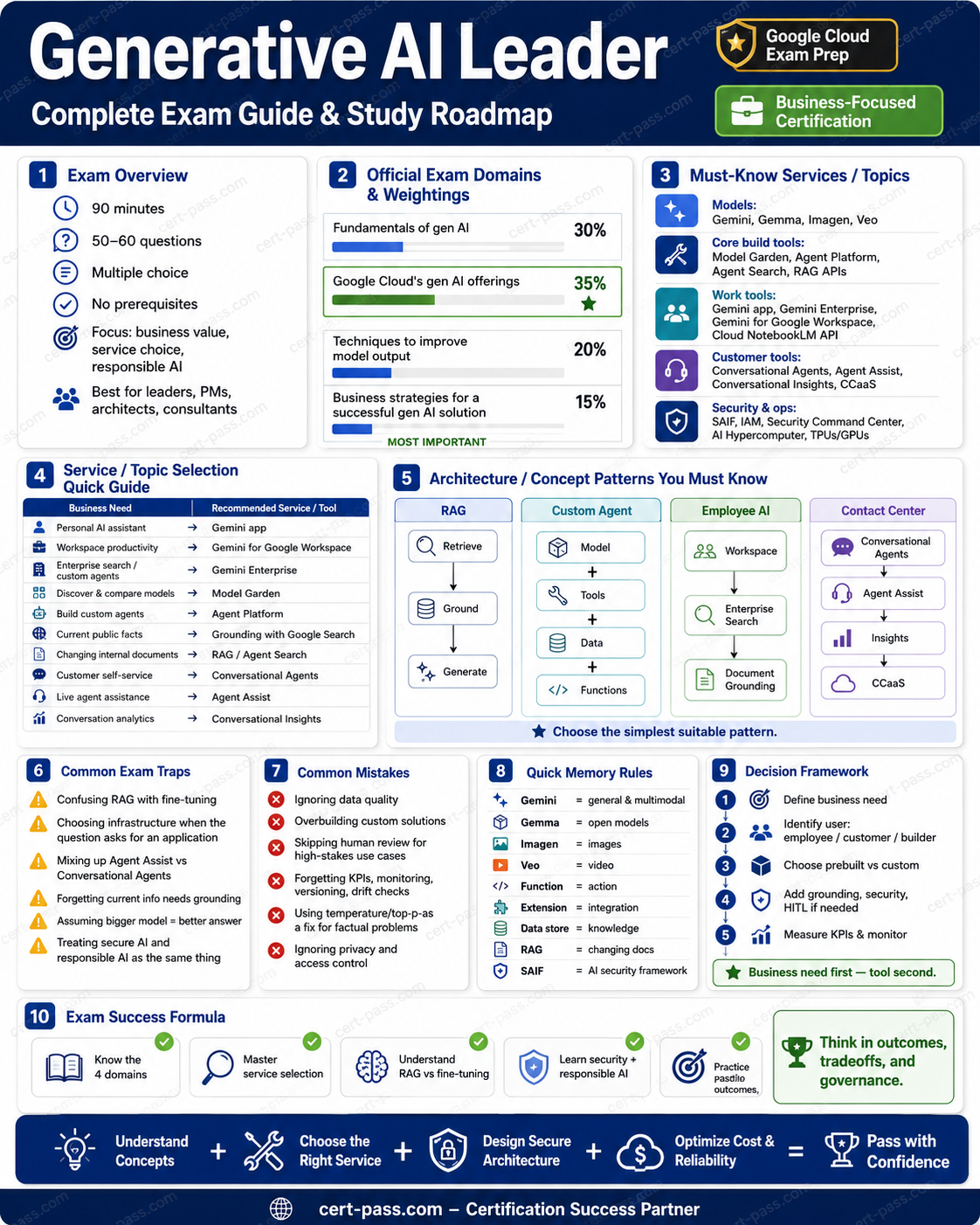

Generative AI Leader Study Guide 2026
Generative AI Leader study guide content is most useful when it helps candidates understand both the business side and the platform side of Google Cloud AI. This certification is not just about memorizing product names. It asks whether you can explain generative AI concepts clearly, recognize Google Cloud's generative AI offerings, improve model output with practical techniques, and support a business strategy that makes sense in the real world.
If you are preparing for Generative AI Leader, start with the official exam guide, then use this study guide to organize the material into a manageable plan. The exam is designed for leaders and practitioners who need a clear, practical understanding of generative AI rather than deep model engineering. That makes it a strong fit for product, operations, solutions, consulting, and management roles where AI decisions now influence day-to-day work.
This guide focuses on the exact topics the certification emphasizes, explains the common traps, and gives you a clean path from first review to exam readiness. It is designed to sit alongside a free practice path and a mistakes article so you can build a complete preparation cluster.
Official exam facts at a glance
| Detail | Information |
|---|---|
| Certification | Generative AI Leader |
| Vendor | Google Cloud |
| Exam length | 90 minutes |
| Exam format | 50 to 60 multiple-choice questions |
| Registration fee | 99 USD plus tax where applicable |
| Delivery | Online-proctored or onsite-proctored |
| Languages | English, Japanese, Spanish, Portuguese |
| Validity | 3 years |
| Official page | https://cloud.google.com/learn/certification/generative-ai-leader |
| Official exam guide | https://services.google.com/fh/files/misc/generative_ai_leader_exam_guide_english.pdf |
| Last verified | 2026-06-03 |
A few details matter immediately. The exam is proctored, time limited, and question based, so pacing and clarity matter. The official page lists a 99 USD registration fee plus tax where applicable, which makes it easier to plan compared with exams that hide pricing in secondary pages. The official guide PDF is also important because it is the most direct source for content boundaries and topic structure.
What Generative AI Leader is actually testing
Generative AI Leader is a leadership-level certification with practical substance. It is not asking you to train foundation models from scratch. Instead, it checks whether you can:
- explain the basics of generative AI in a business-friendly way
- recognize Google Cloud generative AI offerings and when they are useful
- understand how to improve output quality with better prompts, data, and controls
- evaluate the business fit of a generative AI solution
- reason about risk, governance, and responsible adoption
That makes the exam accessible to candidates who are not engineers, but it does not make it trivial. The difference between a pass and a miss is often the ability to pick the best practical recommendation instead of a technically plausible but incomplete one.
The four content sections you must master
The exam blueprint is organized into four main areas. Use them as your study map.
| Section | Share of exam | What to study |
|---|---|---|
| Section 1: Fundamentals of gen AI | 30% | Core concepts, terminology, and what generative AI does |
| Section 2: Google Cloud's gen AI offerings | 35% | Google Cloud products, tool selection, and workflow fit |
| Section 3: Techniques to improve gen AI model output | 20% | Prompting, output controls, evaluation, bias and fairness, data preparation |
| Section 4: Business strategies for a successful gen AI solution | 15% | Adoption strategy, governance, security, stakeholder alignment, responsible rollout |
The heaviest section is Google Cloud's gen AI offerings, so do not spend all of your time on theory alone. The exam expects you to know the practical tooling and how it supports real work.
A smart way to study this certification
The best preparation plan is not to read random blog posts. It is to move from concepts to tools to business decisions in that order.
Step 1: Learn the basic vocabulary
Make sure you can define:
- generative AI
- foundation model
- prompt
- output quality
- bias and fairness
- unstructured data
- agent
- function or tool call
- secure by design
If those terms are fuzzy, the rest of the exam becomes harder than it should be.
Step 2: Learn Google Cloud's AI product fit
You do not need to memorize every product detail, but you should know what Google AI Studio, Agent Studio, Gemini, TPUs, and related offerings are generally for. The exam often asks whether a candidate can choose the right platform for rapid prototyping, enterprise agent workflows, or infrastructure support.
Step 3: Practice output improvement thinking
A common mistake is to think prompt writing is the whole story. It is not. The exam also cares about:
- using representative data
- testing against realistic scenarios
- controlling output length or style
- evaluating bias and fairness
- checking whether the output meets the intended outcome
Step 4: Connect the technology to a business strategy
The final section asks whether you understand adoption at an organizational level. That includes leadership alignment, employee feedback, security posture, and practical rollout planning.
Fundamentals of gen AI: what you need to know
The first section is about the core idea behind generative AI. You should be able to explain that generative AI creates new content based on learned patterns, and that it can be used for text, code, images, audio, and other content types.
Important topics in this section include:
- what makes generative AI different from traditional analytics
- why unstructured data matters
- how foundation models are reused across tasks
- why prompt input affects output quality
- why some use cases need human review
Common trap in this section
Many candidates confuse generative AI with generic automation. The exam wants more than that. A workflow that categorizes tickets or summarizes feedback is not the same thing as a model that generates new content. If a question asks about the nature of the output, ask whether the system is creating something new or simply analyzing existing data.
What to remember
- unstructured data includes emails, PDFs, documents, audio, and free-form text
- generative AI often works with foundation models
- output quality depends on prompts, data, and guardrails
- not every AI solution is a generative AI solution
Google Cloud's gen AI offerings: the biggest section
This is the most important section to study carefully because it carries the largest share of the exam.
You should understand the role of Google Cloud offerings such as:
- Google AI Studio for rapid experimentation and prototyping
- Agent Studio for enterprise agent experiences
- Gemini as a modern generative AI family used across the Google ecosystem
- TPUs as Google-designed accelerators for AI workloads
- supporting services and workflows that help teams build, test, and deploy solutions
The exam is not just testing whether you can name a product. It is checking whether you know which offering matches the use case.
Examples of what the exam may ask
- Which tool is better for rapid Gemini prototyping?
- Which tool is more suited to enterprise agent building?
- Which Google-designed accelerator supports machine learning workloads?
- Which offering helps you design a function that an agent can call?
Common trap in this section
The trick is often that more than one answer sounds product-like. The best answer is the one that matches the workflow. For example, a question might sound like a document search or internal assistant project, but one answer fits experimentation while another fits production agent design. The exam wants you to know the difference.
What to remember
- tool fit matters more than brand familiarity
- rapid prototyping and enterprise deployment are not the same thing
- hardware accelerators are not the same as storage or identity tools
- a function or action is not the same thing as a model parameter
Techniques to improve gen AI model output
This section rewards practical thinking. You are expected to know that output quality can be improved by changing the prompt, the data, the instructions, and the validation process.
Study the following themes:
- prompt structure and clarity
- controlling output length and style
- using representative examples or scenarios
- testing the model against real use cases
- identifying and reducing bias and fairness issues
- improving data preparation before deployment
Why this section matters
A lot of AI failures do not happen because the model is broken. They happen because the input is unclear, the evaluation is weak, or the deployment process ignores edge cases. The exam reflects that reality. It asks whether you know how to improve the output in a way that supports the business objective.
What to remember
- better prompts often produce better results, but prompting is not the entire solution
- output length controls can reduce verbosity and cost
- evaluation should happen against relevant examples, not just a demo
- bias and fairness require active review and mitigation
- data ingestion and preparation are part of the solution lifecycle
Business strategies for a successful gen AI solution
The final section is easy to underestimate and very important to study. It asks whether you can think beyond the model itself and into the organization around it.
Topics to focus on include:
- executive direction and stakeholder alignment
- bottom-up experimentation and employee feedback
- secure-by-design infrastructure
- governance and responsible adoption
- business value measurement
- rollout strategy and risk reduction
Common trap in this section
A weak answer often says, in effect, "just deploy it and see what happens." That is not a strategy. The exam prefers the answer that balances vision, experimentation, security, and feedback.
What to remember
- secure by design is better than security added later
- leadership should set direction, but employee feedback matters
- a successful gen AI solution needs a business goal, not just a technical demo
- governance and review help the organization trust the system
A practical review table by topic
| Topic | What a strong candidate can do | What a weak candidate confuses |
|---|---|---|
| Fundamentals | Explain what generative AI is and when it applies | Confuses generative AI with generic automation |
| Google Cloud offerings | Match product to use case | Treats all tools as interchangeable |
| Output improvement | Improve prompts, evaluation, and controls | Assumes one prompt is enough |
| Business strategy | Tie AI adoption to security, governance, and value | Focuses on technology without the organization |
Study prompts you should be able to answer confidently
Before taking the exam, make sure you can answer these questions in your own words:
- What is the difference between a generative AI model and a traditional analytics workflow?
- When would Google AI Studio be a better fit than an enterprise agent tool?
- Why are TPUs relevant in a Google Cloud AI discussion?
- How do you reduce the risk that a model output is biased or unfair?
- What does secure by design mean in a business rollout?
- Why is employee feedback useful during gen AI adoption?
- What makes a good success metric for a pilot?
If you can answer those cleanly, you are already in much better shape than a candidate who only memorizes definitions.
How to avoid the most common mistakes
The exam has a predictable set of mistakes that candidates make repeatedly.
1. Picking a tool name without reading the workflow
Do not choose the answer that merely sounds like a Google product. Read the use case first.
2. Ignoring the business objective
If the question says the goal is to improve a process or support leadership, the answer should address that outcome directly.
3. Confusing prompt tuning with full solution design
Prompts matter, but they are not the only lever. Data quality, evaluation, governance, and workflow design also matter.
4. Treating security as a final step
Secure-by-design thinking starts at the beginning, not after launch.
5. Forgetting that human oversight still matters
When outcomes affect people or the organization needs accountability, human review is often part of the strongest answer.
How this certification fits a broader Google Cloud path
Generative AI Leader is useful as a practical AI literacy certification, but it is not the end of the road. It can sit alongside or before broader Google Cloud credentials if your work is moving in that direction.
It is especially useful when:
- you want to communicate better about AI use cases
- your organization is adopting Google Cloud AI services
- you need a certification that is easier to explain to nontechnical stakeholders
- you want a foundation before moving into deeper cloud or AI specialization
That makes it a good bridge certification for people who need to lead, support, or guide AI decisions rather than design every underlying component themselves.
How to study in one week
If you need a compact plan, use this:
Day 1
Read the official page and the official exam guide. Write down the exam facts.
Day 2
Study fundamentals of generative AI and unstructured data.
Day 3
Focus on Google Cloud's gen AI offerings and product fit.
Day 4
Study output improvement, bias, fairness, and data preparation.
Day 5
Review business strategy, leadership, and secure-by-design ideas.
Day 6
Take practice questions and mark every miss.
Day 7
Review weak areas, retest, and focus on explanations rather than the answer key.
Internal links and next steps
This study guide works best as part of a full cluster:
- Generative AI Leader exam page
- Try 35 free Generative AI Leader practice questions
- Generative AI Leader common mistakes and exam traps
- Browse Google certification options
FAQ
Is Generative AI Leader suitable for nontechnical roles?
Yes. The certification is especially useful for leaders, product people, consultants, and other roles that need to understand generative AI without becoming deep model engineers.
How hard is the exam?
It is approachable if you study the official guide and learn the Google Cloud product fit. It is harder if you rely only on generic AI knowledge and ignore the platform-specific section.
Should I focus more on concepts or products?
Both matter, but the largest section is Google Cloud's gen AI offerings. Do not neglect the product side.
Do I need hands-on engineering experience?
Not necessarily. You do need enough practical understanding to make good choices in scenario questions.
What is the best way to prepare?
Use the official guide, a structured study guide, practice questions, and a review of common mistakes. The exam rewards understanding and judgment more than memorization.
Official source and verification
Official Google Cloud certification page: https://cloud.google.com/learn/certification/generative-ai-leader
Official exam guide PDF: https://services.google.com/fh/files/misc/generative_ai_leader_exam_guide_english.pdf