
Databricks Certified Generative AI Engineer Associate Study Guide 2026
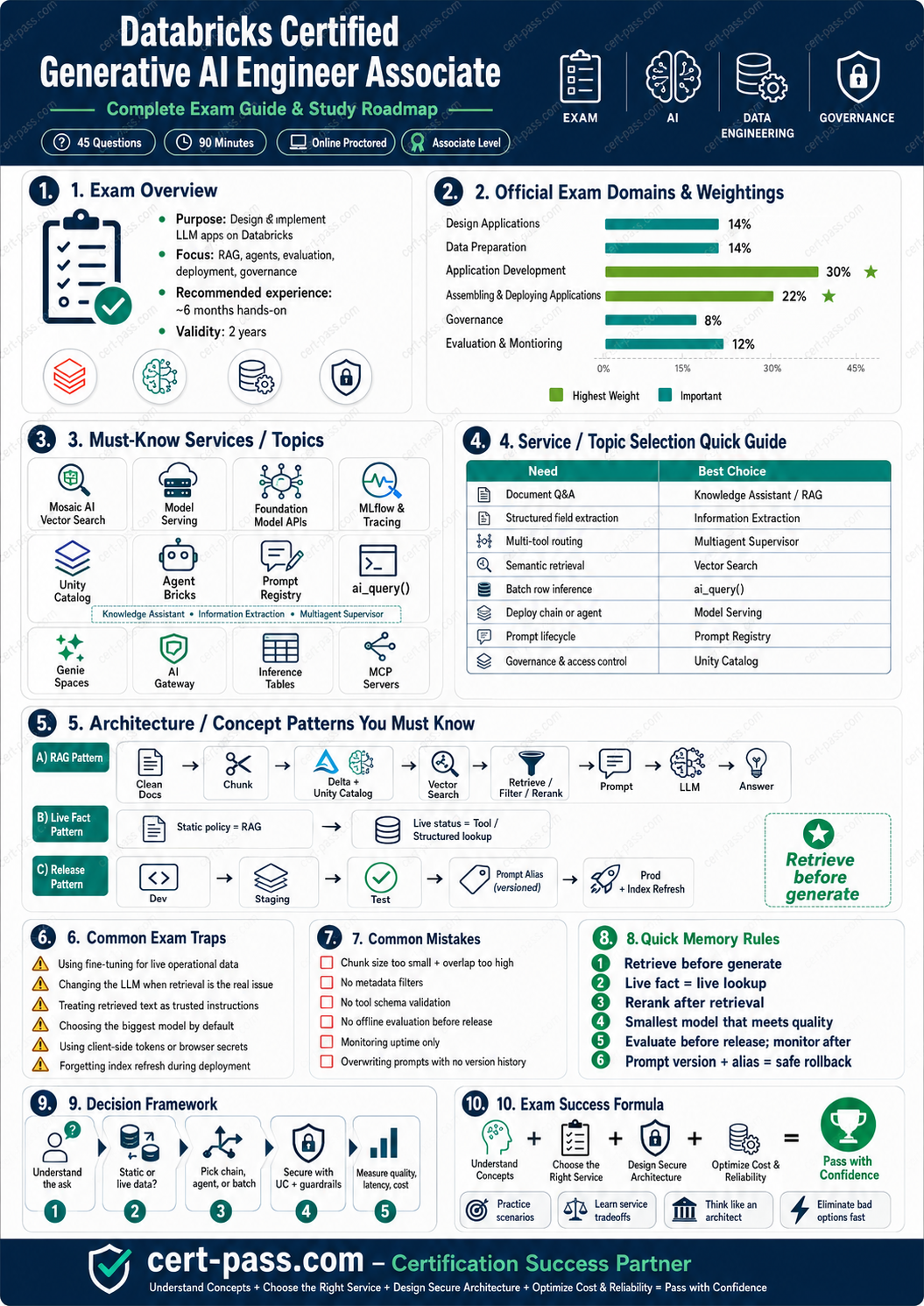
Databricks Certified Generative AI Engineer Associate study guide content should help you think like someone who can design, build, deploy, govern, and evaluate a production generative AI solution on the Databricks Platform. This is not a pure theory exam. It asks whether you can make the right engineering and governance choices across the full application lifecycle.
If you are preparing for Databricks Certified Generative AI Engineer Associate, the best starting point is the official certification page and exam guide. Then use this study guide to organize the domains into a practical plan. The exam expects hands-on familiarity with the tasks outlined in the guide, so the strongest candidates are the ones who connect concepts to workflows instead of memorizing isolated facts.
Official exam facts at a glance
| Detail | Information |
|---|---|
| Certification | Databricks Certified Generative AI Engineer Associate |
| Vendor | Databricks |
| Exam level | Associate |
| Type | Proctored certification |
| Scored questions | 45 |
| Time limit | 90 minutes |
| Registration fee | 200 USD |
| Question type | Multiple choice |
| Delivery method | Online or test center |
| Languages | English, Japanese, Portuguese BR, Korean |
| Prerequisites | None required, but related training is highly recommended |
| Recommended experience | 6+ months of hands-on experience with the tasks in the exam guide |
| Validity period | 2 years |
| Official page | https://www.databricks.com/learn/certification/genai-engineer-associate |
| Last verified | 2026-06-03 |
The official Databricks page is especially important because it lists the scored questions, time limit, fee, languages, delivery method, recommended experience, and recertification cycle. The exam is a practical associate-level certification, not a beginner awareness test. You should expect scenario-driven questions that ask you to choose the best implementation or governance approach.
What the exam is actually testing
The Databricks Certified Generative AI Engineer Associate exam is about building usable generative AI solutions with Databricks and making the solution work in a governed environment. That means you need to understand more than prompt writing. You should be comfortable with the full lifecycle:
- design the application correctly
- prepare data for the workflow
- develop the application logic
- assemble and deploy the app
- apply governance controls
- evaluate and monitor the result
The best way to think about the exam is as a production workflow exam. It asks whether you can translate a business goal into inputs, outputs, tools, storage, retrieval, deployment, and evaluation. If you can reason through that flow, the questions become much easier.
The six domain areas you must master
| Domain | Weight | What to study |
|---|---|---|
| Application Development | 30% | Prompting, tool use, traces, routing, state, agent behavior |
| Assembling and Deploying Apps | 22% | App packaging, production rollout, durable state, deployment choices |
| Design Applications | 14% | Business requirements, input-output contracts, use-case scoping |
| Data Preparation | 14% | Source selection, cleaning, structuring, retrieval readiness |
| Evaluation and Monitoring | 12% | Scoring, custom rubrics, quality control, production monitoring |
| Governance | 8% | Access, tenant filtering, prompt injection defense, policy and control |
The heaviest domain is Application Development, but the most dangerous mistakes often come from governance and evaluation. A candidate can write a plausible app design and still lose points if the answer ignores access control or cannot be measured in a repeatable way.
A smart way to study this certification
The most efficient study process moves from design to deployment:
- define the use case and the input-output contract
- prepare the data and confirm it is usable
- design the application flow and state handling
- assemble and deploy the app in a governed way
- evaluate it with a repeatable rubric
- monitor it after release and iterate safely
That sequence mirrors how the exam thinks. It also helps you avoid the common trap of jumping straight to model choice before understanding the business and data requirements.
Design Applications
This domain asks you to turn business goals into application behavior. In practice, that means you should be able to define:
- what the user wants to achieve
- what data the app should use
- what the output should look like
- what state needs to persist
- what constraints the solution must respect
What to focus on
A strong answer in this domain typically starts with clear requirements. For example, if an app serves compliance reviewers, the solution should identify authoritative sources, expected freshness, output format, and acceptance criteria. If the app needs to support an enterprise workflow, the design should not rely on vague assumptions or an unbounded prompt.
Common traps
- choosing a model before defining the use case
- storing state only in process memory
- ignoring where the data comes from
- building the UI before the input-output contract is clear
- treating a broad document set as if all documents are equally reliable
What to remember
Design begins with the business need, not the biggest model. The exam often rewards the answer that creates a clear contract between inputs and outputs and then measures the result against that contract.
Data Preparation
Data preparation is often underappreciated, but the exam clearly expects it. You need to understand that gen AI applications work better when the source data is selected, cleaned, and prepared carefully.
What to focus on
- choosing authoritative source systems
- cleaning and normalizing data
- structuring documents for retrieval
- applying freshness expectations
- handling access and tenant boundaries
- making the data usable for the downstream app
Common traps
- embedding every record without considering scope or access
- treating raw data as ready-to-use input
- ignoring freshness or accuracy requirements
- failing to distinguish source data from processed output
- asking the model to compensate for poor data preparation
What to remember
If the question asks about collecting, cleaning, and transforming source data into usable form, the right answer is usually about data ingestion and preparation. If the requirement is about which records the app may see, then governance and filtering matter as much as the data itself.
Application Development
This is the largest section, so it deserves careful study. The exam wants to know whether you can build an app that behaves correctly in production.
What to focus on
- prompt structure and instruction hierarchy
- retrieval and context handling
- state management and durable storage
- tool use and function-style actions
- traces and debugging
- avoiding unnecessary token growth
- limiting prompt injection risk
Common traps
- putting retrieved context in the wrong place
- letting process memory act as the only state store
- hiding traces instead of inspecting them
- adding more tools when the real problem is unclear tool behavior
- using raw prompts to solve authorization problems
What to remember
If the question involves a tool selection failure, inspect traces and clarify tool descriptions before you change the whole app. If the question involves context from documents, keep trusted instructions separate from retrieved material. If the question involves ongoing state, store it in a governed datastore rather than transient memory.
Assembling and Deploying Apps
This domain is about the move from prototype to production. You need to know how to package the application, keep the state durable, and support controlled rollout.
What to focus on
- deployment choices that preserve maintainability
- durable state in a governed datastore
- how app components fit together in production
- minimizing operational risk during release
- supporting rollback and controlled changes
Common traps
- relying on browser local storage as the system of record
- keeping all state in one process
- building around an ungoverned prototype
- assuming the app is production-ready just because the demo worked
- ignoring rollback and change management
What to remember
Production assembly is about reliability and operational control. If the app must continue after restart or scale cleanly, state should live somewhere durable and governed. If the question asks for a production design, think beyond the demo.
Governance
Governance has a smaller weight than application development, but it is one of the easiest sections to underestimate. The exam expects you to know how to keep the solution safe and controlled.
What to focus on
- least privilege access
- tenant filtering
- authorization boundaries
- prompt injection awareness
- policy controls
- secure and auditable handling of data
Common traps
- removing tenant filters because similarity search seems sufficient
- relying on the prompt alone to enforce access restrictions
- giving unrestricted credentials to simplify the app
- ignoring prompt injection in retrieved documents
- assuming a model warning is a substitute for authorization
What to remember
Governance is not optional decoration. It is part of how the app stays safe and maintainable. Prompt instructions help, but they do not replace access control. If a question mentions unauthorized data or tenant separation, keep the answer anchored in enforcement, not wishful prompting.
Evaluation and Monitoring
This domain is critical because the exam expects repeatable quality control, not informal guesswork.
What to focus on
- custom scorers and rubric-based evaluation
- reference-free evaluation when ground truth is unavailable
- measuring the right quality dimensions
- monitoring production behavior over time
- identifying regression after release
- checking the app against representative cases
Common traps
- inventing a gold answer after seeing the output
- using a single anecdotal example as the evaluation set
- relying on confidence alone as a quality measure
- skipping evaluation and trusting the demo
- confusing UI changes with evaluation changes
What to remember
If ground truth is unavailable, use a suitable reference-free judge or rubric-based scorer. If the requirement asks for a domain-specific quality rule, a custom scorer may be the right answer. The central idea is reproducibility: the same app should be judged in the same way each time.
A practical review table
| Scenario | Likely domain | Best answer style |
|---|---|---|
| The app needs durable state across restarts | Assembling and Deploying Apps | Store state in a governed datastore |
| The app must avoid unauthorized tenant data | Governance | Filter by tenant and minimize prompt fields |
| The app has poor tool routing | Application Development | Inspect traces and refine tool descriptions |
| Ground truth is unavailable | Evaluation and Monitoring | Use a rubric-based scorer or reference-free judge |
| Raw data needs transformation before use | Data Preparation | Clean, structure, and prepare the data pipeline |
| Business goals need translation into inputs and outputs | Design Applications | Define fields, sources, freshness, and acceptance criteria |
What strong candidates do differently
Strong candidates read the question as a workflow problem. They ask:
- What is the app supposed to do?
- What data is allowed into the workflow?
- Where should state live?
- How will the solution be evaluated?
- What controls are needed before production?
They do not treat every question as a prompt question. That is the biggest mistake to avoid. The exam is broader than prompting. It is about building a controlled, useful, and measurable Databricks gen AI application.
Common mistakes to avoid
1. Choosing the model before the design
The exam often expects you to define inputs, outputs, and constraints before picking the model or agent approach.
2. Relying on runtime memory for durable state
If the app needs continuity, use a governed datastore. Process memory is not enough.
3. Treating prompt instructions as security controls
Access restrictions should be enforced with proper governance, not just wording.
4. Skipping evaluation
If you cannot measure the app, you cannot improve it reliably.
5. Ignoring prompt injection risk
Retrieved documents and external content can contain instructions that should not be followed blindly.
A one-week study plan
Day 1
Read the official Databricks certification page and exam guide. Note the six domains and the recommended experience.
Day 2
Study design applications and data preparation. Write down the input-output contract for sample use cases.
Day 3
Study application development, especially state, traces, routing, and tool use.
Day 4
Study assembling and deploying apps, with a focus on durable state and production fit.
Day 5
Study governance, access control, tenant filtering, and prompt injection awareness.
Day 6
Study evaluation and monitoring, including custom scorers and rubric-based review.
Day 7
Take practice questions, review every miss, and revisit the domain that caused the most mistakes.
How this certification fits Databricks career paths
This certification is strongest for people who are already working with Databricks or who plan to work in environments where data, governance, and generative AI intersect. It is not just an AI badge. It signals that you can build a solution inside the Databricks ecosystem with the right controls and quality checks in place.
That makes it a good fit for data engineers, analytics engineers, platform teams, and AI-adjacent practitioners who want a certification tied to implementation rather than abstract theory.
Internal links and next steps
This study guide works best as part of a cluster:
- Databricks Certified Generative AI Engineer exam page
- Try 35 free Databricks Generative AI Engineer practice questions
- Databricks Generative AI Engineer common mistakes and exam traps
- Browse Databricks certification options
FAQ
Is the Databricks Generative AI Engineer Associate exam hands-on?
It is not a lab exam, but it does expect practical understanding of building and deploying generative AI applications on Databricks.
How hard is it?
It is an associate-level exam, but it is still technical enough that you should study the official guide and practice the domain workflows.
Do I need prior Databricks experience?
Prior experience helps a lot. The official page recommends 6+ months of hands-on experience with the tasks in the guide.
What should I focus on first?
Start with application development, data preparation, and the input-output design of the app. Those areas affect almost everything else.
What is the best way to prepare?
Use the official page, the exam guide, a structured study guide, and practice questions. Then review any weak areas in governance or evaluation before the exam.
Official source and verification
Official Databricks certification page: https://www.databricks.com/learn/certification/genai-engineer-associate