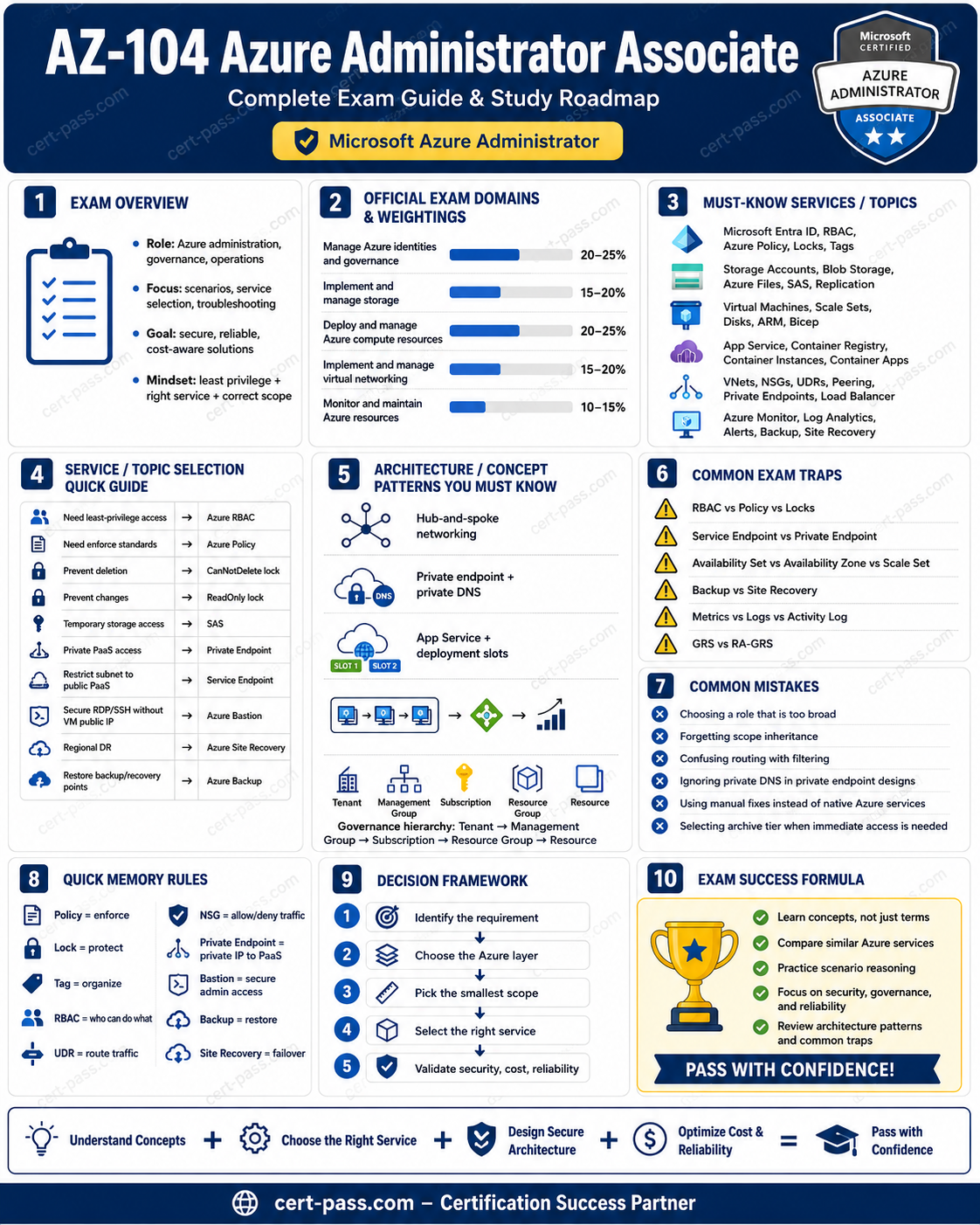
AZ-104 Azure Administrator Associate Practice Questions 2026: Try a Free Test
AZ-104 Azure Administrator Associate practice questions are the best way to check whether you can solve real administration tasks instead of just recognizing service names. The exam is practical. It focuses on storage, networking, identity, monitoring, governance, and everyday operational decisions that Azure administrators make in production.
If you are preparing for AZ-104, start with the official Microsoft Learn page, then use this free test to measure how well you can apply the concepts under time pressure. These exam-style practice questions are designed to mirror the kinds of supportable, requirement-driven scenarios that appear on the certification.
Official exam facts at a glance
| Detail | Information |
|---|---|
| Certification | AZ-104 Azure Administrator Associate |
| Vendor | Microsoft |
| Role | Administrator |
| Level | Intermediate |
| Product focus | Azure |
| Exam duration | 100 minutes |
| Exam policy | Proctored exam |
| Interactive components | May be included |
| Renewal frequency | 12 months |
| Last updated | 2026-04-17 |
| Official page | https://learn.microsoft.com/en-us/credentials/certifications/azure-administrator/ |
| Last verified | 2026-06-03 |
The official page is the source of truth for exam duration, policy, and renewal details. Use it before scheduling, and use this practice test to see whether you can make the right admin choice in a realistic scenario.
What this practice test is designed to measure
This article focuses on the skills the exam keeps returning to:
- choosing the right storage control
- solving networking and routing problems
- applying least-privilege access
- configuring monitoring and diagnostics
- selecting the right Azure service for the requirement
- distinguishing policy from access and access from routing
- understanding when private connectivity is required
A strong candidate does not just know what Azure services exist. A strong candidate knows which one solves the requirement with the smallest supportable scope.
How to use these questions
Use the questions in three passes:
- answer without looking at the explanation
- review the correct answer and the trap
- write down the topic you missed and revisit the official Microsoft Learn materials
That process helps you separate knowledge gaps from reading mistakes. On AZ-104, both matter.
Practice questions
Question 1
A team manages a production storage account and needs to revoke several service SAS tokens centrally before their individual expiration times. What should they use?
A. Blob versioning B. A ReadOnly lock C. A stored access policy D. A VM password rotation
Correct answer: C
Why this is correct: A stored access policy lets you manage and revoke service SAS tokens centrally. That is the right control when the requirement is centralized revocation.
Common trap: Blob versioning protects blob content history, but it does not revoke delegated access.
Question 2
A support team needs to move blobs from Hot to Cool after 30 days and delete them after 365 days. Which configuration best meets the requirement?
A. A storage firewall rule B. A Recovery Services vault C. A blob lifecycle management rule D. A VM scale-set autoscale rule
Correct answer: C
Why this is correct: Blob lifecycle management automates tier changes and deletion based on blob age and other conditions.
Common trap: A firewall controls network access, not retention or tiering.
Question 3
A VM cannot reach an on-premises destination, and the team suspects a user-defined route is overriding a system route. Which view should they inspect?
A. Effective routes on the VM network interface B. Blob inventory C. App Service deployment slots D. Microsoft Entra sign-in logs only
Correct answer: A
Why this is correct: Effective routes show the route table entries applied to the NIC and help identify the selected next hop.
Common trap: NSG views show filtering rules, not the final routing decision.
Question 4
Users need to recover files deleted from an Azure file share during a retention window. What should be configured?
A. Blob versioning B. Soft delete for Azure file shares C. A public endpoint D. A virtual machine snapshot
Correct answer: B
Why this is correct: Azure Files soft delete protects file shares from accidental deletion during a configured retention period.
Common trap: Blob versioning applies to blobs, not file shares.
Question 5
Clients in a virtual network must access an Azure PaaS service through a private IP address, and public network access should be disabled. What is the best configuration?
A. A service endpoint only B. A private endpoint and appropriate private DNS resolution C. A public load balancer D. A VM availability set
Correct answer: B
Why this is correct: Private endpoints expose supported PaaS resources through private IP addresses inside a virtual network. Private DNS resolution is usually part of the solution.
Common trap: A service endpoint still uses the service's public endpoint.
Question 6
A team needs SMB access to an Azure file share using identities rather than a shared storage key. What should they configure?
A. A service SAS with full permissions for all users B. Identity-based authentication for Azure Files and share-level permissions C. Anonymous blob access D. A VM public IP
Correct answer: B
Why this is correct: Azure Files supports identity-based authentication and share-level authorization for SMB access.
Common trap: A shared SAS is not the same as per-user identity-based access.
Question 7
An operations team needs to collect guest OS performance counters from an Azure VM and query them in Log Analytics. What should be applied?
A. A DNS CNAME record B. A blob lifecycle policy C. Azure Monitor Agent and an appropriate data collection rule D. A resource lock
Correct answer: C
Why this is correct: Azure Monitor Agent combined with data collection rules is the standard way to collect supported guest telemetry and send it to destinations such as Log Analytics.
Common trap: Platform metrics alone do not always provide every guest OS counter.
Question 8
A service must be reachable only from inside a virtual network and is hosted on multiple backend VMs. Which change best meets the requirement?
A. A public load balancer with a public frontend B. An internal load balancer with a private frontend IP C. A user-assigned managed identity D. A blob container
Correct answer: B
Why this is correct: An internal load balancer uses a private frontend IP and keeps the service reachable only within private network boundaries.
Common trap: A public frontend would expose the service more broadly than required.
Answer pattern summary
| Scenario | Best fit |
|---|---|
| Centrally revoke SAS access | Stored access policy |
| Tier and delete blobs by age | Blob lifecycle management |
| Check route selection on a NIC | Effective routes |
| Recover deleted Azure file shares | Soft delete for Azure file shares |
| Private access to PaaS | Private endpoint plus private DNS |
| Identity-based SMB access | Azure Files identity auth |
| Guest OS counters in Log Analytics | Azure Monitor Agent plus DCR |
| Private VNet-only backend service | Internal load balancer |
The exam often rewards the answer that solves the requirement without adding unnecessary scope. If two options sound plausible, ask which one directly satisfies the stated operational need.
Common mistakes to avoid
1. Confusing storage retention with network security
A lifecycle policy does not control access, and a firewall rule does not control blob retention.
2. Mixing routing with filtering
When the question is about where traffic actually goes, effective routes are usually more relevant than NSG rules.
3. Reaching for public endpoints first
If the question says public access must be disabled, think private endpoint and private DNS.
4. Using shared keys when identity-based access is required
If the requirement says identities, the answer should reflect identity and permissions, not a shared secret.
5. Forgetting the scope of the service
Blob features apply to blobs. Azure Files features apply to file shares. Load balancer choices affect reachability. Match the service to the requirement.
A quick readiness check
You are in better shape for AZ-104 if you can answer these without hesitation:
- which Azure feature can centrally revoke SAS tokens
- how to automate blob tiering and deletion
- how to inspect the effective routes on a NIC
- how to protect deleted Azure file shares
- when to choose a private endpoint
- how to enable identity-based access for Azure Files
- how to collect guest OS counters into Log Analytics
- how to keep a backend service private inside a virtual network
If those still feel shaky, keep studying before you take a timed practice set.
Study plan after the free test
If you missed several questions, review AZ-104 in this order:
- storage
- virtual networking
- identity and access
- monitoring and maintenance
- governance and operational controls
That sequence works well because storage and networking show up constantly in administrative scenarios, and they often drive the answer before identity or monitoring do.
Internal links and next steps
- AZ-104 Azure Administrator Associate exam page
- Try 35 free AZ-104 practice questions
- AZ-104 Azure Administrator Associate study guide 2026
- Browse Microsoft Azure certifications
FAQ
Is AZ-104 a hands-on exam?
It is a certification exam, not a lab, but it is operationally focused and often includes practical decision-making with Azure services.
Are these the real exam questions?
No. They are exam-style practice questions designed to reflect the format and the kind of administrative reasoning the exam expects.
What should I focus on first?
Start with storage and networking, then move to identity, monitoring, and governance.
How should I study the explanations?
Do not just memorize the answer. Identify why the other options fail, because that is often how the exam eliminates distractors.
Does the certification renew?
Yes. The official page shows a 12-month renewal frequency.
Official source and verification
Official Microsoft Learn certification page: https://learn.microsoft.com/en-us/credentials/certifications/azure-administrator/