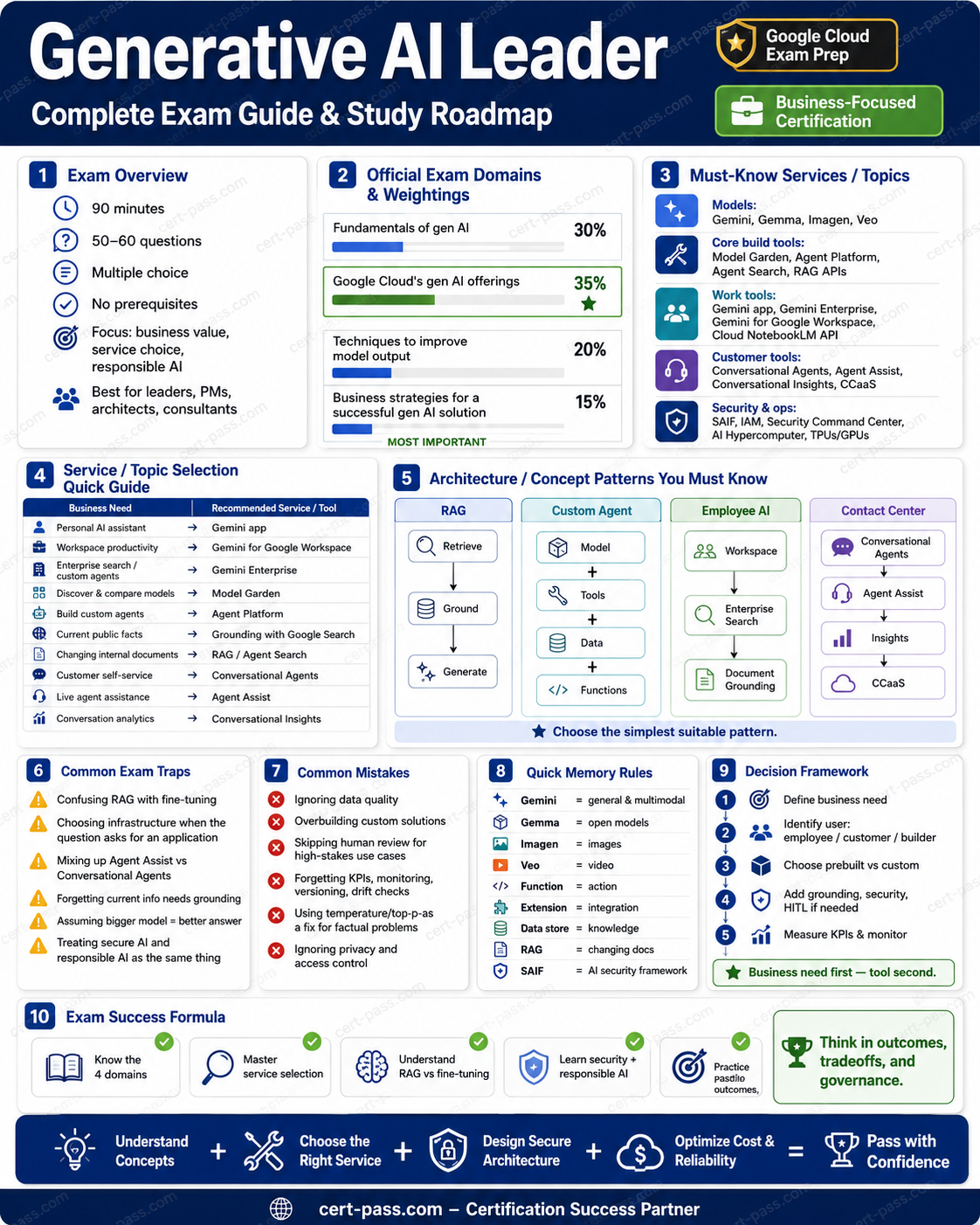

Google Generative AI Leader Practice Questions 2026: Try a Free Test
Google Generative AI Leader practice questions are one of the fastest ways to turn the official exam outline into something practical. This certification is not about memorizing product names in isolation. It is about understanding where generative AI fits, how to choose the right approach, and how to talk about governance, measurement, and business value in a realistic enterprise setting.
If you are preparing for the Google Generative AI Leader exam, start with the official certification page, then use this free test to check how well you can apply the ideas under pressure. The questions below are exam-style practice questions designed to reflect the style, difficulty, and decision-making you are likely to face.
Official exam facts at a glance
| Detail | Information |
|---|---|
| Certification | Google Generative AI Leader |
| Vendor | Google Cloud |
| Exam length | 90 minutes |
| Registration fee | $99 plus tax where applicable |
| Question format | 50 to 60 multiple-choice questions |
| Delivery method | Online-proctored or onsite-proctored |
| Languages | English, Japanese, Spanish, Portuguese |
| Prerequisites | None |
| Validity period | 3 years |
| Renewal | Certification renewal is available |
| Official page | https://cloud.google.com/learn/certification/generative-ai-leader |
| Last verified | 2026-06-03 |
The official page is the source of truth for timing, format, delivery, language options, and renewal. Use it before scheduling, and use this practice test to see whether you can apply the concepts to business scenarios rather than reciting definitions.
What this practice test is designed to measure
This article focuses on the kinds of decisions the exam rewards:
- identifying suitable gen AI use cases
- choosing the right approach for the problem
- understanding prompt engineering basics
- recognizing governance and security concerns
- connecting business strategy to AI adoption
- knowing when a model is not the right first answer
- distinguishing experimentation from production readiness
A strong candidate does not just know what generative AI is. A strong candidate can explain when to use it, how to limit risk, how to measure value, and how to avoid common implementation mistakes.
How to use these questions
Use the questions in three passes:
- answer without looking at the explanation
- review the correct answer and the trap
- write down the topic you missed and revisit the official guide
If you miss a question because you read too quickly, that is a timing issue. If you miss it because you did not know the core idea, that is a study gap. Treat those differently.
Practice questions
Question 1
A retail company is exploring a customer support assistant. The team wants the system to discover patterns in unlabeled customer conversation data before it decides what to automate next. Which learning approach is the best fit?
A. Supervised learning B. Unsupervised learning C. Reinforcement learning D. Prompt chaining
Correct answer: B
Why this is correct: Unsupervised learning is used to find structure or groupings in data when there is no target label. In this scenario, the company is not trying to predict a known outcome yet. It wants to discover patterns first.
Common trap: Supervised learning sounds familiar, but it requires labeled examples. If the question says there is no target label, that option is usually wrong.
Question 2
A marketing agency wants to improve model responses by changing instructions, examples, context, and output constraints without retraining the model. What should it focus on?
A. Prompt engineering B. Building custom silicon C. Data warehouse partitioning D. Model distillation
Correct answer: A
Why this is correct: Prompt engineering improves outputs by shaping the request to the model. It is the right answer when the problem is about improving behavior through instructions and examples.
Common trap: Retraining sounds powerful, but it is usually unnecessary when the issue is prompt quality or instruction design.
Question 3
A healthcare provider wants a contact-center assistant that can reason over context, call tools, and complete organization-specific tasks. What is the most direct recommendation?
A. Create only a static FAQ document B. Build a custom agent with an agent platform C. Increase GPU count without defining tools D. Use a longer policy document as the only control
Correct answer: B
Why this is correct: A custom agent can combine reasoning, tools, and organizational context to carry out tasks. A static FAQ is useful for reference, but it does not execute work or use tools.
Common trap: More compute is not a substitute for a clear agent design.
Question 4
A financial-services team is reviewing a gen AI pilot that must improve visibility into security posture and monitor workloads while preserving data governance. What is the best recommendation?
A. Use only a larger context window B. Use Security Command Center and workload monitoring tools C. Use only the Gemini app D. Use only few-shot prompting
Correct answer: B
Why this is correct: Security monitoring and workload visibility are governance and operations concerns. The correct recommendation adds the right controls rather than just changing the prompt or model size.
Common trap: A larger context window may help with input size, but it does not create security visibility.
Question 5
A pharmaceutical company wants to keep control over proprietary data used in a gen AI solution without adding unnecessary complexity. What is the best approach?
A. Publish the data to the open internet B. Disable governance to simplify adoption C. Use Google Cloud security, privacy, and governance controls with appropriate model selection D. Put the full data set into every prompt
Correct answer: C
Why this is correct: The requirement is control, not exposure. Enterprise governance controls are the right answer when data ownership and privacy matter.
Common trap: More data is not always better. Sending everything to the model can weaken privacy and increase risk.
Question 6
A product team wants the assistant response to stay concise for a better user experience. Which control is most relevant?
A. Set an appropriate token count or output-length limit B. Add more labels to the training set C. Raise top-p and remove all constraints D. Switch to a different IAM role
Correct answer: A
Why this is correct: Output-length controls directly shape how long the response can be. That is the right tool when the requirement is brevity.
Common trap: Sampling settings like top-p affect diversity, not response length in the same direct way.
Question 7
A business leader wants to make the case for a gen AI project to the executive team. The solution should summarize long source material into concise briefing notes and still be validated against realistic scenarios. What should the team recommend?
A. Generate synthetic data and skip validation B. Provision GPUs and skip measurement C. Summarize information and validate the result against representative scenarios D. Train a model from scratch as the first step
Correct answer: C
Why this is correct: Summarization is the right use case when the goal is condensed briefing notes. Validation matters because a successful demo is not the same as a reliable business workflow.
Common trap: The model may look impressive in a demo, but the exam cares about whether the solution works in practice.
Question 8
A team is discussing the area of AI most directly concerned with understanding and working with human language. Which option is most appropriate?
A. Reinforcement learning B. Natural language processing C. Cloud orchestration D. Diffusion modeling
Correct answer: B
Why this is correct: Natural language processing focuses on language understanding and generation. It is the right foundational term when the question is about text-based systems.
Common trap: Reinforcement learning is a training method based on reward and feedback, not the core discipline for language work.
Answer pattern summary
| Question type | What the exam wants |
|---|---|
| Unlabeled data | Unsupervised learning |
| Improve output without retraining | Prompt engineering |
| Tool-using assistant | Custom agent or agent platform |
| Governance and visibility | Security and monitoring controls |
| Data control | Security, privacy, and governance |
| Concise response | Output-length or token limit |
| Executive summary use case | Summarization plus validation |
| Language understanding | NLP |
Use that pattern to eliminate distractors. The exam often looks straightforward until two answers sound plausible. The safe move is to match the requirement to the capability, not to the buzzword.
Common mistakes to avoid
1. Treating every problem as a model-training problem
A lot of candidates jump straight to training, but many gen AI problems are solved by better prompting, better context, or better governance.
2. Ignoring business strategy
The exam is not only technical. It expects you to connect a use case to risk, adoption, and value.
3. Mixing up language and model terms
Natural language processing, prompt engineering, and generative AI are related but not identical. Read the wording carefully.
4. Overlooking governance
If a scenario mentions proprietary data, control, or security posture, governance is probably part of the answer.
5. Choosing a tool before defining the use case
Start with the business need. Then choose the method, controls, and deployment style.
A quick readiness check
You are in good shape for the Google Generative AI Leader exam if you can do all of the following:
- explain the difference between prompt engineering and model training
- identify when unsupervised learning is the right fit
- recommend governance controls for proprietary data
- recognize when a custom agent is better than a static FAQ
- describe why validation matters after a pilot
- match output-length limits to concise UX requirements
- explain the role of NLP in gen AI conversations
If several of those points still feel fuzzy, go back to the official page and the study guide before attempting more questions.
Study plan after the free test
If your score was lower than expected, do not just retake the questions. Rebuild the knowledge in this order:
- gen AI fundamentals
- prompt engineering basics
- model and use-case selection
- governance and security
- business value and adoption
- practice questions with explanations
That sequence helps because it moves from foundational language to enterprise decision-making.
Internal links and next steps
- Google Generative AI Leader exam page
- Try 35 free Generative AI Leader practice questions
- Google Generative AI Leader study guide 2026
- Browse Google Cloud certifications
FAQ
Is the Google Generative AI Leader exam technical?
It is technical enough to require real understanding, but it is also a leadership-oriented certification. Expect questions about use cases, governance, and business decisions, not only deep engineering details.
Are these questions the same as the live exam?
No. They are exam-style practice questions designed to reflect the format and topic mix of the certification.
What should I study first?
Start with fundamentals, then prompt engineering, then governance and business strategy.
How many practice questions should I do?
Use enough questions to spot patterns, not just memorize answers. Review explanations carefully and revisit weak topics.
Is the certification renewable?
Yes. The official page states that renewal is available, and the credential is valid for 3 years.
Official source and verification
Official Google Cloud certification page: https://cloud.google.com/learn/certification/generative-ai-leader