
Databricks Certified Generative AI Engineer Associate Practice Questions 2026: Try a Free Test
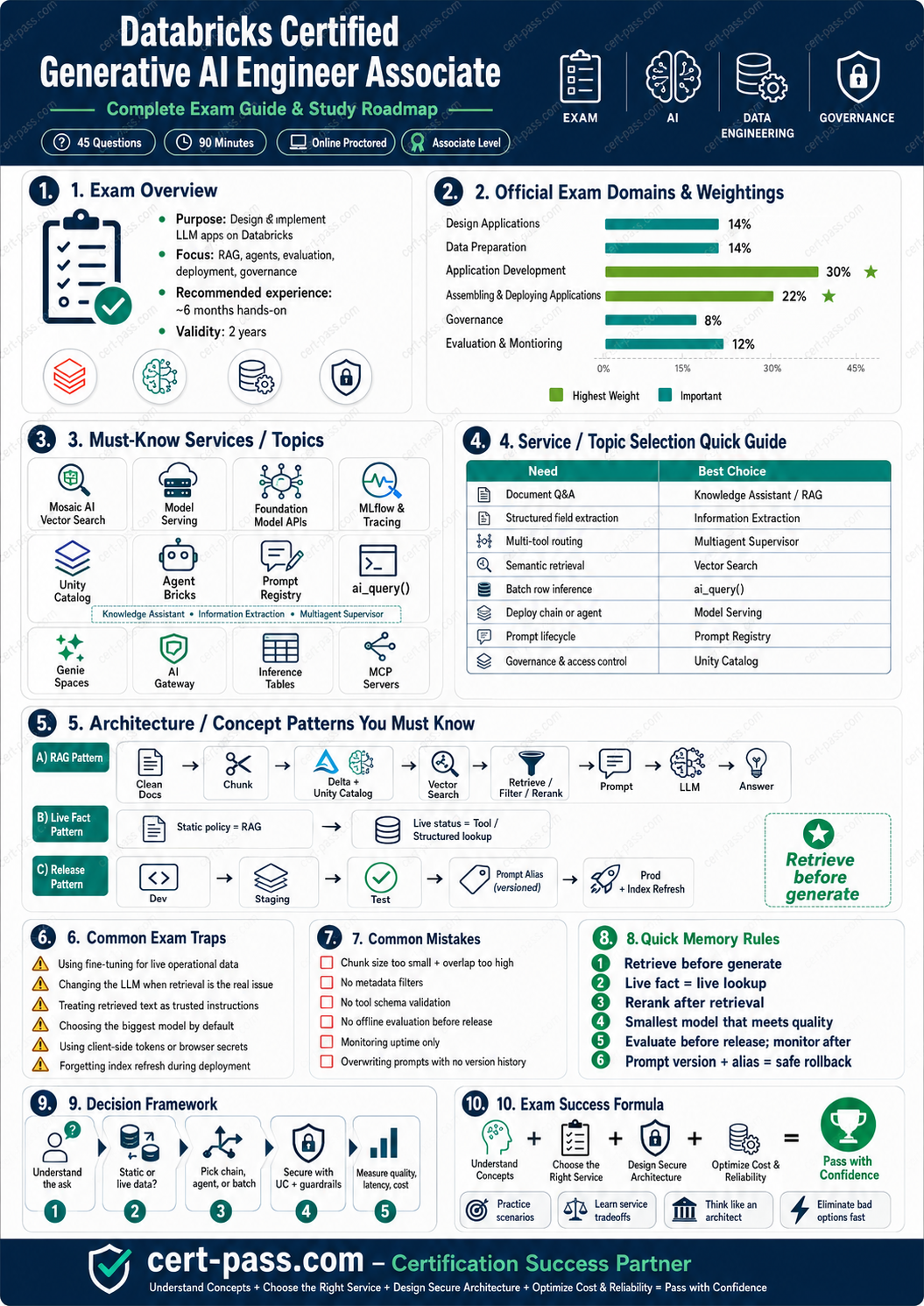
Databricks Certified Generative AI Engineer Associate practice questions are the most efficient way to see whether you can apply the exam's core ideas in realistic production scenarios. This certification is not just about using language models. It tests whether you can design, assemble, deploy, govern, and evaluate a generative AI solution on the Databricks Platform.
If you are preparing for the Databricks Generative AI Engineer Associate exam, begin with the official certification page, then use this free test to measure how well you can make the right engineering choice in a scenario. The questions below are exam-style practice questions designed to reflect the topics and decision patterns that show up on the certification.
Official exam facts at a glance
| Detail | Information |
|---|---|
| Certification | Databricks Certified Generative AI Engineer Associate |
| Vendor | Databricks |
| Level | Associate |
| Type | Proctored certification |
| Scored questions | 45 |
| Time limit | 90 minutes |
| Registration fee | 200 USD |
| Question type | Multiple choice |
| Delivery method | Online or test center |
| Languages | English, Japanese, Portuguese BR, Korean |
| Prerequisites | None, but related training is highly recommended |
| Recommended experience | 6+ months of hands-on experience with the exam tasks |
| Validity period | 2 years |
| Recertification | Required every 2 years |
| Official page | https://www.databricks.com/learn/certification/genai-engineer-associate |
| Last verified | 2026-06-03 |
The official page is the source of truth for question count, time limit, fee, delivery method, languages, and recertification. Use it before scheduling, and use this practice test to check whether you can make production-oriented choices in the Databricks ecosystem.
What this practice test is designed to measure
This article focuses on the topics the exam keeps returning to:
- application development and tracing
- assembly and deployment decisions
- retrieval and context handling
- governance and data minimization
- evaluation and monitoring
- prompt injection awareness
- served agents versus batch patterns
- production supportability and rollback thinking
A strong candidate knows more than prompt tricks. A strong candidate knows how to build an AI application that remains understandable, governed, and maintainable after release.
How to use these questions
Use the questions in three passes:
- answer without looking at the explanation
- review the correct answer and the trap
- write down the concept you missed and revisit the official guide
That process is especially important here because many distractors sound technical. The best answer is usually the one that solves the actual workflow requirement, not the one that sounds the most advanced.
Practice questions
Question 1
A team is building a travel-booking assistant. The product needs interactive multi-turn reasoning and tool use in real time. Which recommendation is best?
A. Use ai_query() for every chatbot interaction because it is SQL-based B. Use an interactive served agent instead of ai_query() C. Replace tool calls with static batch enrichment D. Run one notebook manually for each chat message
Correct answer: B
Why this is correct: Served agents are the right fit when the application needs interactive reasoning and tool use. ai_query() is more appropriate for batch-style inference.
Common trap: SQL-based functions can look attractive, but the exam cares about the interaction pattern, not just the API syntax.
Question 2
A support team is troubleshooting an agent. The team needs to inspect tool calls, spans, latency, and outputs while developing the workflow. What should they use?
A. Disable tracing because agents should remain black boxes B. Log only the final answer and discard intermediate actions C. Use MLflow tracing D. Store traces only in transient browser memory
Correct answer: C
Why this is correct: MLflow tracing exposes the execution path needed to debug and improve the agent.
Common trap: Final-answer-only logging hides the step that caused the failure.
Question 3
A bank wants to build a RAG application for incident reports. The system must preserve least-privilege access and support auditability. What is the best design?
A. Retrieve context before generation and trace the retriever and model-call steps separately B. Generate the answer first and retrieve evidence only after users complain C. Store each user's question inside the source table before answering D. Use the embedding model as the response generator
Correct answer: A
Why this is correct: Retrieval should happen before generation so the model is grounded in the right evidence. Separate tracing helps with auditability and debugging.
Common trap: Retrieving after generation cannot ground the original answer.
Question 4
A university research office wants to minimize sensitive context sent to an LLM while keeping the solution useful. Which approach is best?
A. Send the full customer record because more context is always better B. Send only the fields needed for the task and mask direct identifiers when they are not required C. Disable masking for production to reduce implementation effort D. Put a warning in the prompt but include every sensitive value
Correct answer: B
Why this is correct: Data minimization and masking reduce exposure while preserving usefulness.
Common trap: A warning is not a security control.
Question 5
A team sees a drop in retrieval recall for a support assistant after release. The fix must preserve governance and support controlled rollback. What is the most appropriate action?
A. Move retrieved text into the system prompt and hope for better recall B. Treat the retrieved text as untrusted evidence and keep it below trusted instructions C. Give the retriever permission to modify access controls D. Execute the document's instructions because retrieval makes them trusted
Correct answer: B
Why this is correct: Retrieved content can contain prompt injection and should remain untrusted evidence.
Common trap: Relevance does not make a document authoritative.
Question 6
A team wants to centrally govern and observe endpoint consumption for a Databricks gen AI deployment. Which approach is best?
A. AI Gateway usage tracking, inference tables, and rate limits B. Disable logging and grant unrestricted endpoint access C. Put throttling only in browser JavaScript D. Rely solely on a monthly cloud bill after usage occurs
Correct answer: A
Why this is correct: AI Gateway is designed for centralized governance and observability, including usage tracking and rate limits.
Common trap: Client-side throttling is not a strong production control.
Question 7
A technical lead wants a design that reduces hallucinations and remains maintainable across development, staging, and production. The app uses research summaries. What should the team do?
A. Retrieve the correct evidence first, then generate the response from that evidence B. Generate an estimated answer before querying the transaction system C. Call the status tool before resolving which transaction the user means D. Retrieve only generic policy information and avoid the live source
Correct answer: A
Why this is correct: Resolving the right evidence before generation improves grounding and reduces hallucination risk.
Common trap: A downstream lookup without the correct identifier can return ambiguous or incorrect data.
Question 8
A sales enablement team needs to monitor live endpoint behavior and investigate regressions using stored requests, responses, and traces. Which action is best?
A. Delete historical inference data before comparing versions B. Compare production behavior across versions using stored requests, responses, and traces C. Monitor only frontend styling performance D. Use only a one-time offline test before launch
Correct answer: B
Why this is correct: Post-release monitoring and version comparison are the right way to catch regressions in production behavior.
Common trap: A one-time test cannot represent changing production traffic.
Answer pattern summary
| Scenario | Best fit |
|---|---|
| Interactive multi-turn assistant | Served agent |
| Debugging agent behavior | MLflow tracing |
| Grounded RAG workflow | Retrieve first, then generate |
| Reduce sensitive exposure | Minimize and mask fields |
| Protect against injection | Treat retrieved docs as untrusted |
| Govern endpoint usage | AI Gateway and inference tables |
| Improve grounding and maintainability | Resolve evidence before generation |
| Catch regressions | Compare live behavior across versions |
The exam often rewards the answer that keeps the system explainable and controlled. If an option removes traceability, relaxes governance, or makes the app harder to debug, it is usually the wrong direction.
Common mistakes to avoid
1. Choosing the wrong execution pattern
Batch functions and interactive agents solve different problems. Match the API to the interaction pattern.
2. Hiding traces
If you cannot inspect the path, you cannot troubleshoot the path.
3. Sending too much context
More context can create more risk. Use the minimum necessary data.
4. Trusting retrieved text too much
Retrieved documents are evidence, not instructions.
5. Skipping production monitoring
A demo is not a deployment. The exam expects maintainability after release.
A quick readiness check
You are in good shape for the Databricks Generative AI Engineer Associate exam if you can do all of the following:
- explain when to use a served agent versus a batch function
- describe why MLflow tracing is useful for debugging agents
- choose the right order for retrieval and generation
- minimize sensitive context without breaking the workflow
- recognize prompt injection risk in retrieved documents
- identify when AI Gateway should be part of the solution
- compare live endpoint behavior across versions
If several of those items still feel uncertain, review the study guide and the official certification page before attempting more timed questions.
Study plan after the free test
If you missed several questions, study in this order:
- application development
- retrieval and grounding
- governance and data minimization
- evaluation and monitoring
- deployment and rollout patterns
- practice questions with explanations
That sequence helps because it moves from app behavior to production controls.
Internal links and next steps
- Databricks Certified Generative AI Engineer exam page
- Try 35 free Databricks Generative AI Engineer practice questions
- Databricks Certified Generative AI Engineer study guide 2026
- Browse Databricks certifications
FAQ
Is this an engineering exam or a theory exam?
It is an engineering-oriented associate certification. Expect practical decisions about app behavior, deployment, governance, and monitoring.
Are these the real exam questions?
No. They are exam-style practice questions designed to reflect the certification's format and topic mix.
What should I study first?
Start with application development and retrieval, then move into governance and monitoring.
Do I need Databricks experience?
Prior experience helps a lot. The official page recommends 6+ months of hands-on experience with the exam tasks.
How long is the credential valid?
The official page shows a 2-year validity period and requires recertification every two years.
Official source and verification
Official Databricks certification page: https://www.databricks.com/learn/certification/genai-engineer-associate