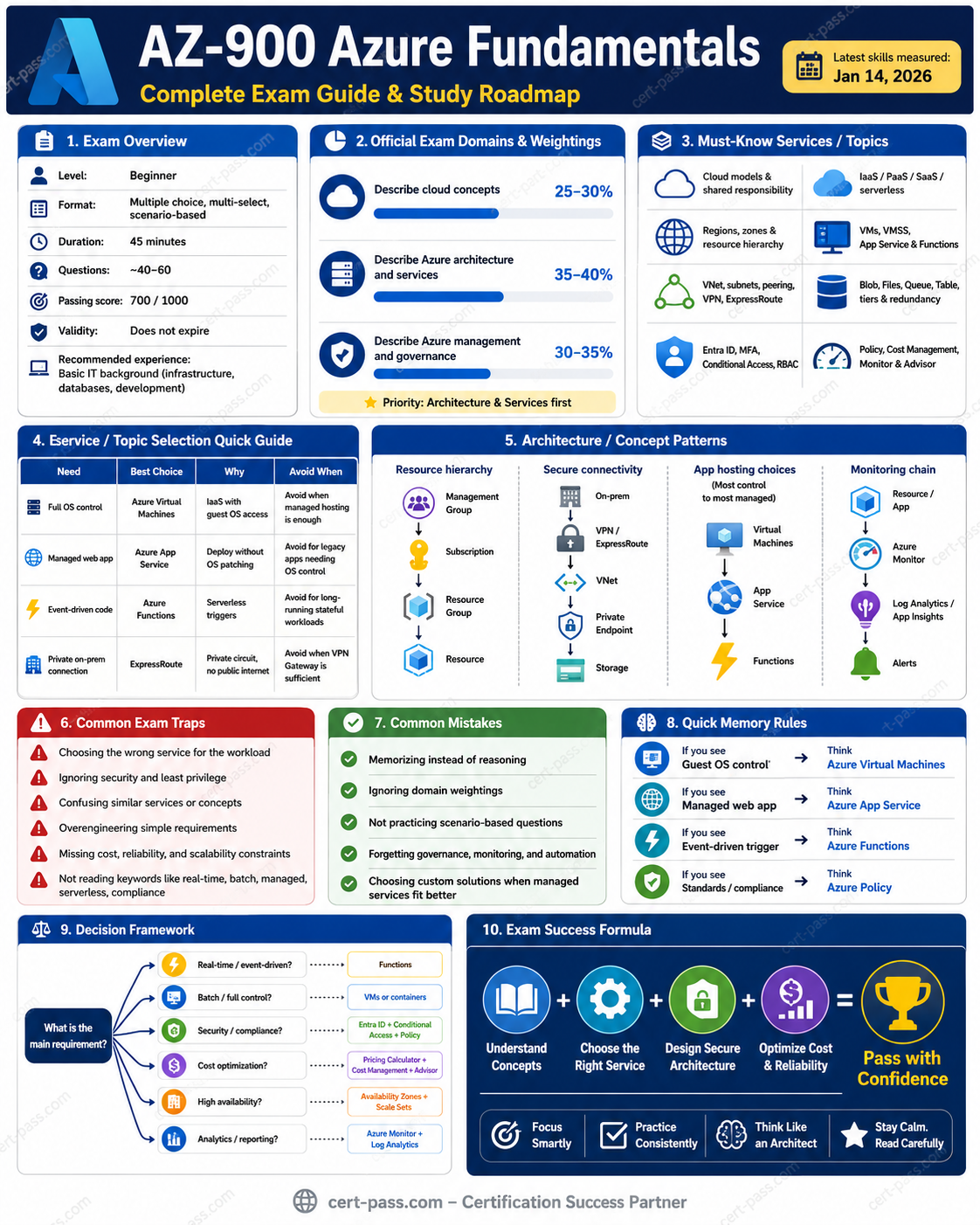
AZ-900 Study Plan 2026: 2-Day, 5-Day, and 7-Day Options
AZ-900 study plan options should do one thing well: turn the Azure Fundamentals blueprint into a sequence that feels manageable, not vague. The AZ-900 exam is broad, but it is not deep in the same way as role based Azure exams. That makes planning more important than memorizing random facts. A strong AZ-900 study plan focuses on the three exam domains, spends extra time on the topics that usually confuse new candidates, and leaves enough room for review and practice. This guide lays out three practical plans so a candidate can choose the one that matches the time available, the starting level, and the amount of review needed before exam day.
The fastest path is not to read everything equally. It is to learn the high yield concepts first, check understanding with exam style practice, and then revisit weak spots with purpose. That is why the plans below are organized around cloud concepts, Azure architecture and services, and Azure management and governance. If the goal is to pass AZ-900 with less stress, the plan should be simple, repeatable, and linked to the official exam page at AZ-900 Azure Fundamentals and the live question set at try free AZ-900 practice questions.
Official AZ-900 exam facts
| Detail | Info |
|---|---|
| Exam code | AZ-900 |
| Certification | Azure Fundamentals |
| Vendor | Microsoft |
| Questions | 50 |
| Time limit | 45 minutes |
| Passing score | 70 |
| Exam fee | 29 EUR for exam style practice, 39 EUR for full prep package |
| Retirement date | Not announced |
| Main domains | Cloud concepts, Azure architecture and services, Azure management and governance |
| Official source | Microsoft Learn Azure Fundamentals |
The right study plan starts with what the exam actually tests. AZ-900 is not a trivia quiz about obscure Azure SKUs. It is a fundamentals exam that checks whether a candidate can identify cloud concepts, choose the right Azure service for a basic scenario, and understand core management features like policies, locks, and governance scopes. That means the exam rewards recognition, comparison, and practical judgment more than deep implementation knowledge.
How the exam is usually experienced
Most AZ-900 candidates find the hardest part is not the vocabulary itself. The hard part is separating similar sounding services. For example, a candidate may confuse:
- Azure Policy with Azure Monitor
- Resource groups with management groups
- Private endpoints with public endpoints
- Hot storage with archive storage
- IaaS, PaaS, and SaaS use cases
- CapEx with OpEx
A good AZ-900 study plan puts these contrasts near the top of the schedule rather than leaving them for the final review night. If the candidate can classify a scenario quickly, the rest of the exam becomes much easier.
Which AZ-900 study plan should you use?
The best plan depends on the time available and the starting point. The table below gives a simple decision framework.
| Available time | Best plan | Best for | Main risk |
|---|---|---|---|
| 2 days | Crash plan | Candidates who already know basic cloud terminology | Too much passive reading |
| 5 days | Balanced plan | Candidates who can study each day and need a structured review | Skipping practice until the end |
| 7 days | Full review plan | Beginners or candidates who want a calmer pace | Spending too long on low value details |
Use the 2 day plan only if the candidate already knows basic cloud ideas and simply needs to organize what is known. Use the 5 day plan for most learners. Use the 7 day plan when the goal is more confidence, not speed. No matter which plan is chosen, keep one rule: every session should end with a short recall check or question set. Reading alone rarely produces enough retention for AZ-900.
The topic order that works best
A lot of candidates start with Azure services because the names feel concrete. That can work, but the strongest order is usually:
- Cloud concepts
- Azure core services and architecture
- Azure management and governance
- Review of differences and common traps
- Practice questions and final recall
Why start with cloud concepts? Because the exam often uses those ideas as the foundation for other questions. If a candidate does not clearly understand CapEx versus OpEx, shared responsibility, elasticity, scalability, or high availability, the service questions become harder than they need to be. Once cloud concepts are stable, Azure service choices become more intuitive.
AZ-900 domain priority table
| Priority | Domain | What to know | Why it matters |
|---|---|---|---|
| 1 | Cloud concepts | CapEx vs OpEx, IaaS, PaaS, SaaS, public, private, hybrid cloud, elasticity, scalability | These ideas appear across the exam and help decode scenario questions |
| 2 | Azure architecture and services | Regions, availability zones, resource groups, containers, storage tiers, VMs, App Service, VNets, private endpoints | This is where most service selection questions live |
| 3 | Azure management and governance | Azure Policy, resource locks, RBAC, management groups, subscriptions, monitor, service health | These are common confusion points and easy points if learned cleanly |
This table should shape the study schedule. If the time is limited, spend more time on the first two rows. If the candidate already works in cloud or IT, they may move faster through cloud concepts and spend more time on management and governance because those features are often described in exam style wording that sounds similar but means different things.
2 day AZ-900 study plan
The 2 day plan is not ideal for a complete beginner, but it can work for someone with prior exposure to cloud ideas. The key is to study with intent and avoid passive reading. A compact AZ-900 study plan should feel like an exam rehearsal, not a textbook marathon.
Day 1 morning: cloud concepts
Start with the essentials:
- IaaS, PaaS, SaaS
- CapEx and OpEx
- public, private, and hybrid cloud
- elasticity and scalability
- shared responsibility model
- resilience, availability, and fault tolerance
Use short definitions and one example for each. The goal is not to memorize prose. The goal is to recognize the right label when a scenario is described.
A useful self test is to ask:
- Is the organization buying and managing the hardware itself, or consuming a service?
- Is the scenario asking for managed hosting, software access, or infrastructure control?
- Is the benefit about scaling resources up and down quickly, or about handling increased workload over time?
Day 1 afternoon: core Azure architecture
Move into the most visible Azure concepts:
- regions and region pairs
- availability zones
- resource groups
- subscriptions
- management groups
- virtual networks
- private endpoints
- storage tiers
- compute choices such as VMs, containers, and App Service
The best way to study this block is by comparison. For example:
- resource groups organize resources for a solution
- subscriptions separate billing and access boundaries
- management groups organize multiple subscriptions
- availability zones protect against datacenter failure within a region
- region pairs help with recovery and redundancy planning
Do not let the words blur together. Write a one line difference for each pair.
Day 1 evening: practice questions and recall
End day 1 with exam style questions. Do not only check the correct answer. Read the explanation and note why the wrong answers are wrong. That step matters because AZ-900 questions are often built around near misses. A wrong option may describe a real Azure feature, but not the one the question asks for.
If available, take the live set at AZ-900 practice questions and then review the study guide at AZ-900 Azure Fundamentals study guide.
Day 2 morning: governance and monitoring
Focus on the features that are often confused:
- Azure Policy
- RBAC
- resource locks
- Azure Monitor
- Azure Service Health
- cost management basics
- security center concepts if included in your prep notes
A simple comparison helps:
- Azure Policy enforces rules
- RBAC controls who can do what
- resource locks prevent accidental changes
- Azure Monitor collects and analyzes telemetry
- Service Health reports service issues and outages
The exam may ask which service best matches a governance requirement, so this section deserves careful attention.
Day 2 afternoon: full review and timed practice
Spend the last session doing two things only:
- Review the key comparisons
- Answer a timed set of mixed questions
Do not introduce new topics unless a gap appears in the practice set. A short final review should include:
- cloud concepts flash review
- service selection by scenario
- governance and monitoring distinctions
- storage tier differences
- one pass through your missed questions
The 2 day plan works when the candidate already has some intuition. It fails when the candidate treats the plan like a reading checklist. If time is that short, the plan must be active.
5 day AZ-900 study plan
This is the most practical option for many candidates. It gives enough space to learn, revisit, and practice without creating unnecessary complexity.
Day 1: cloud concepts and exam map
Learn the full exam structure first. Read the official page at Microsoft Learn Azure Fundamentals and then map the three domains to a simple notebook outline.
Your notes should answer:
- What is cloud computing?
- What are the business advantages?
- What are the deployment models?
- What is the difference between CapEx and OpEx?
- What is the shared responsibility model?
End the day with a ten minute recall exercise. If the candidate cannot explain these ideas without reading, the plan needs more repetition.
Day 2: Azure compute and storage basics
Study the core service families:
- virtual machines
- containers
- App Service
- storage accounts
- blob storage and access tiers
- file storage
- disks
- backup and recovery concepts
This is the day to learn which service is best for which scenario. The exam likes straightforward prompts such as a web app, a containerized workload, a storage requirement, or a need for a private connection. The candidate should be able to map the need to the service quickly.
Use examples from the question bank. For instance:
- frequent access data often points to hot tier storage
- infrequently accessed data often points to cool or archive, depending on the need
- a portable app package points to containers
- a managed web hosting platform points to App Service
Day 3: networking and architecture choices
The exam does not require deep network engineering, but it does expect basic architecture understanding.
Study:
- virtual networks
- subnets at a conceptual level
- private endpoints
- public endpoints
- DNS basics if present in prep notes
- availability zones
- region pairs
- resource groups and subscriptions
The goal here is to answer simple architecture questions without overthinking. If a question asks for a private IP connection to a supported service, private endpoint is the kind of answer candidates should identify immediately. If a question asks about grouping resources for a single solution, resource group is the right idea.
Day 4: management and governance
Now focus on the operational layer.
Study:
- Azure Policy
- RBAC
- management groups
- locks
- Azure Monitor
- Service Health
- cost management concepts
A useful memory aid is to separate intent:
- policy sets standards
- RBAC grants access
- locks protect resources from deletion or modification
- monitor watches runtime behavior
- service health reports platform issues
A 5 day plan should include at least one dedicated block for these items because they are frequently tested in ways that sound deceptively similar.
Day 5: practice, review, and weak spots
Use the final day to simulate the exam environment.
Recommended flow:
- 20 to 30 minutes of rapid review
- one timed practice set
- review every incorrect answer
- create a short list of the top five weak spots
- reread the specific sections related to those weak spots
- finish with a final recall pass
If the candidate is scoring comfortably on scenario questions by the end of day 5, that is a strong sign they are ready. If not, the candidate should extend the review by one day rather than booking the exam too quickly.
7 day AZ-900 study plan
The 7 day plan is the safest choice for beginners or for candidates who want to reduce stress. The extra time is valuable only if it is used wisely. Do not stretch the schedule by reading slowly. Stretch it by revisiting the highest value concepts in different forms.
Day 1: cloud concepts
Learn the base definitions and write them in your own words.
Day 2: core Azure service families
Cover compute, storage, networking, and application hosting at a basic level.
Day 3: architecture and resource organization
Study regions, availability zones, subscriptions, management groups, and resource groups.
Day 4: governance and security basics
Cover Azure Policy, RBAC, locks, and identity related concepts.
Day 5: monitoring and cost management
Study monitor, service health, and basic financial responsibility in the cloud.
Day 6: practice question review
Use a mixed question set and sort each missed question into a theme. The themes usually become obvious after a few rounds:
- concept confusion
- service selection
- governance mix ups
- storage tier confusion
- deployment model misunderstanding
Day 7: final exam rehearsal
Do a shorter practice set, review notes, and stop learning new material late in the day. The last day should create confidence, not overload.
The 7 day plan is especially useful for candidates who are new to Microsoft terminology. More time allows the candidate to hear the same idea in multiple forms and still keep the pace manageable.
Topic checklist for the final review
If there is only one sheet of paper for last minute revision, it should contain these items.
| Topic | Must know | Common trap |
|---|---|---|
| IaaS, PaaS, SaaS | Match the service model to the use case | Confusing managed hosting with infrastructure management |
| CapEx vs OpEx | Upfront purchases versus ongoing spending | Treating cloud usage like a hardware purchase |
| Resource group vs subscription | Grouping resources versus billing and access boundary | Using the wrong organizational level |
| Management group | Organizing multiple subscriptions | Confusing with resource groups |
| Azure Policy | Enforce standards | Thinking it is monitoring only |
| RBAC | Control access | Thinking it blocks configuration drift |
| Resource lock | Prevent accidental changes | Using ReadOnly when CanNotDelete is enough |
| Azure Monitor | Telemetry and alerts | Confusing with service incidents |
| Service Health | Azure platform issues | Confusing with application monitoring |
| Hot, cool, archive | Access frequency | Picking archive for frequently used data |
This checklist is short on purpose. The final review is not the time for a new chapter. It is the time to make the important differences automatic.
A practical revision method that actually helps
A lot of candidates ask for a schedule, but the schedule works only if the revision method is strong. The simplest effective method for AZ-900 is this:
- Read one concept
- Write a one line explanation in plain language
- Add one example
- Compare it with one similar Azure feature
- Test yourself with a scenario question
This turns passive reading into active memory. For example:
- Azure Policy: used to enforce organizational rules
- RBAC: used to assign permissions to users and groups
- Resource locks: used to reduce accidental changes
- Monitor: used to observe telemetry and trigger alerts
- Service Health: used to see Azure service incidents
The same pattern works for storage tiers, compute services, and deployment models. If the candidate can explain the difference in one line, the idea is probably learned well enough for AZ-900.
What to do when the plan starts slipping
Even a good AZ-900 study plan can slip if life gets busy. When that happens, do not try to make up for lost time by reading everything quickly. Instead:
- identify the highest priority domain
- skip low value repetition
- do a short mixed quiz
- review only the missed questions
- return to the topic that caused confusion
If the candidate loses a full day, compress the next day into a review plus practice session. If the candidate loses two days, switch from the 7 day plan to the 5 day plan structure and focus on the highest yield topics. The key is to maintain momentum instead of waiting for the perfect schedule to resume.
A simple daily rhythm
A study plan works better when each day follows the same rhythm. The rhythm does not need to be complicated. It just needs to repeat often enough that the learner knows what comes next.
A practical rhythm is:
- 15 minutes of review from yesterday
- 45 to 60 minutes of new learning
- 20 minutes of active recall
- 20 to 30 minutes of practice questions
- 10 minutes of note cleanup
This rhythm helps because it mixes input and output. The review from yesterday strengthens memory. The new learning adds progress. The active recall step forces the candidate to explain ideas in plain language. The practice questions show whether the explanation holds up under scenario wording. The note cleanup creates a short list of weak spots for the next day.
If the candidate only has one hour in a day, keep the same logic but compress it. Use a short review, one focused topic block, and a small question set. Consistency is more important than duration.
The 24 hours before the exam
The final day should not be used for heavy new study. The goal is to enter the exam with calm recall, not with a full notebook of new facts.
A good final day looks like this:
- Morning: quick review of core definitions and common traps
- Midday: one mixed practice set
- Afternoon: review only the missed questions
- Evening: stop early and rest
On the final day, avoid trying to master every edge case. It is better to remember the big distinctions clearly than to chase obscure details and exhaust your focus. For AZ-900, the most valuable items to review on the final day are the service comparisons, the governance distinctions, and the cloud model basics.
The final 24 hours should also include practical preparation. Make sure the exam login, ID requirements, test environment, and timing plan are ready. Small logistics problems can steal attention from the actual questions, so handle them before exam day if possible.
Why practice questions belong in the middle, not the end
Many candidates save practice questions for the last day. That is less effective than using them during the plan. Practice questions should appear after the first major learning block and then again near the end.
Why? Because the explanations reveal which distinctions are still unclear. A candidate may think they understand PaaS until a scenario question asks about managed hosting versus infrastructure control. A candidate may think they understand governance until a question contrasts Azure Policy with RBAC.
That is why the best AZ-900 study plan uses the question set as a learning tool, not just a scoreboard. Start with the exam page at AZ-900 Azure Fundamentals, then use the practice questions to reveal weak spots, then return to the study guide to close the gap.
Readiness checklist
Before booking the exam, a candidate should be able to do the following without hesitation:
- explain cloud concepts in plain language
- choose between IaaS, PaaS, and SaaS in simple scenarios
- identify when CapEx or OpEx applies
- distinguish resource groups from subscriptions and management groups
- choose the correct storage tier for access frequency
- recognize what Azure Policy does and does not do
- identify the difference between Azure Monitor and Service Health
- recognize the function of resource locks
- answer mixed scenario questions without relying on guesswork
If any two of those items are weak, spend another review cycle before scheduling the exam. For AZ-900, the goal is not to know everything about Azure. The goal is to know the fundamentals well enough to make the right choice in common scenarios.
Common mistakes that ruin an otherwise good schedule
A strong AZ-900 study plan can still fail if the candidate makes avoidable mistakes.
Mistake 1: reading too much and testing too little
Reading feels productive, but recognition improves only when the candidate applies the concepts. Use practice questions early.
Mistake 2: ignoring the governance section
Some candidates think governance is secondary. It is not. Azure Policy, RBAC, and locks appear often enough to matter.
Mistake 3: learning services without learning comparisons
Knowing what App Service is helps, but knowing when App Service is the correct answer matters more.
Mistake 4: confusing similar terms
Hot and cool, policy and monitor, subscription and management group, private endpoint and public endpoint are classic traps.
Mistake 5: cramming at the end
Cramming may help with recall for a few hours, but it usually does not create stable recognition. Spread the review across the plan.
Useful internal links
- AZ-900 Azure Fundamentals
- Try free AZ-900 practice questions
- AZ-900 Azure Fundamentals study guide
- AZ-900 Practice Questions and Answers for 2026
- AZ-900 Common Mistakes and Exam Traps for 2026
- Microsoft Learn Azure Fundamentals
These links support the plan from multiple angles. The exam page gives the destination. The study guide gives the structured review. The practice questions give application. The mistakes article gives a final check on the most common failure points.
FAQ
How many days are enough for AZ-900?
For a candidate who already knows basic cloud terminology, 2 to 5 days can be enough if the study is focused. Beginners usually do better with 7 days so the material can be reviewed without rushing.
What is the best order to study AZ-900?
Start with cloud concepts, then move to Azure services and architecture, and then finish with management and governance. That order helps because many service and governance questions depend on understanding the basic cloud model first.
Should practice questions come before or after the study guide?
Both. A short practice set should come after the first learning block so weak spots become visible, and another set should come near the end so the candidate can confirm readiness.
What is the biggest mistake candidates make on AZ-900?
The biggest mistake is treating the exam like a vocabulary test instead of a scenario exam. Many questions ask for the best service or concept in a specific situation, so comparison matters more than memorization.
Is the AZ-900 exam hard?
It is usually manageable for candidates who study the core concepts and practice scenario style questions. It becomes much harder when the candidate does not understand the differences between similar Azure features.
Final recommendation
If the candidate wants the shortest workable route, use the 2 day plan and focus on cloud concepts, service selection, and governance. If the candidate wants the most balanced approach, use the 5 day plan. If the candidate wants the least stressful route, use the 7 day plan and leave enough room for review and recall.
The best AZ-900 study plan is the one that fits the calendar and still protects enough time for practice. Read the exam page, build the notes around the domains, test with realistic questions, and finish with comparison based review. That sequence turns AZ-900 from a broad fundamentals exam into a clear checklist with manageable parts.
For the official exam overview, visit AZ-900 Azure Fundamentals and review Microsoft Learn at Azure Fundamentals.
If the exam date moves up
If the candidate has less time than expected, keep the same order and compress the depth rather than changing the whole plan. Focus first on the services and ideas that appear most often in the official blueprint: identity, governance, compute, storage, networking, and cost.
Fast adjustment rule
- Cut any low-value rereading.
- Keep one short practice set after each topic block.
- Spend the final review on confusion points only.
- Use the same official Azure terminology in every note.
Final check before the exam
- Can the candidate explain each core service in one sentence?
- Can the candidate spot the difference between a control plane action and a workload action?
- Can the candidate eliminate obviously wrong answers quickly?
- Can the candidate answer a short set of mixed questions without overthinking?
That is usually enough to keep a compressed plan useful even when the calendar changes.
How to adapt the plan if time gets cut short
The best study plan is the one the candidate can actually finish. If the schedule changes, keep the sequence and compress the depth rather than changing the order of the topics.
The priority order usually stays the same:
- Cloud concepts and service models.
- Identity and governance.
- Storage and networking.
- Monitoring and cost.
- A final pass through mixed practice questions.
A short emergency version
If the candidate only has a little time, focus on the topics that appear most often in fundamentals style questions and skip low-value rereading. The goal is not to collect more notes. The goal is to keep the main comparisons fresh enough to answer quickly.
Final self check
- Can the candidate explain each core service family in plain language?
- Can the candidate tell which service solves the actual problem?
- Can the candidate eliminate wrong answers without second guessing every line?
If those feel manageable, the plan is doing its job.
Suggested next article: Azure AZ-900 Changes in 2026 or AZ-900 Worth It in 2026