dbt Analytics Engineering Certification Worth It 2026: Salary, ROI, and Job Market
Quick answer
dbt Analytics Engineering certification is worth it when the candidate needs a clearer market signal, a structured way to prove platform fluency, or a practical reason to sharpen the core analytics engineering workflow. It is less about collecting another badge and more about turning dbt knowledge into something easier for hiring managers, teammates, and clients to understand.
That value is strongest when the candidate is early in the analytics engineering path, moving from general analytics into transformation work, or trying to show that dbt skills are current rather than informal. It is weaker when the candidate already has strong production experience and can demonstrate dbt decision making through real projects, because the work itself may already carry more weight than the certificate.
The best way to judge the return is to compare three things: the time required to study, the credibility gained in the job market, and the practical usefulness of the exam topics in day to day work. If the candidate wants a low risk starting point, begin with the exam hub: dbt Analytics Engineering. For a no signup test drive, use Try 35 free dbt Analytics Engineering practice questions - no signup required. For a tighter review after the value question is settled, Preview the compressed dbt Analytics Engineering course.
Official exam facts
| Detail | Current info |
|---|---|
| Exam name | dbt Analytics Engineering |
| Vendor | dbt |
| Exam slug | dbt-dbt-analytics-engineering |
| Questions | 50 |
| Time limit | 90 minutes |
| Passing score | 70 percent |
| Practice access | Cert-Pass practice options start at EUR 29 |
| Full access | Cert-Pass complete access starts at EUR 39 |
| Official vendor page | dbt certification overview |
| Cert Pass exam page | dbt Analytics Engineering |
| Last verified | 2026-06-01 |
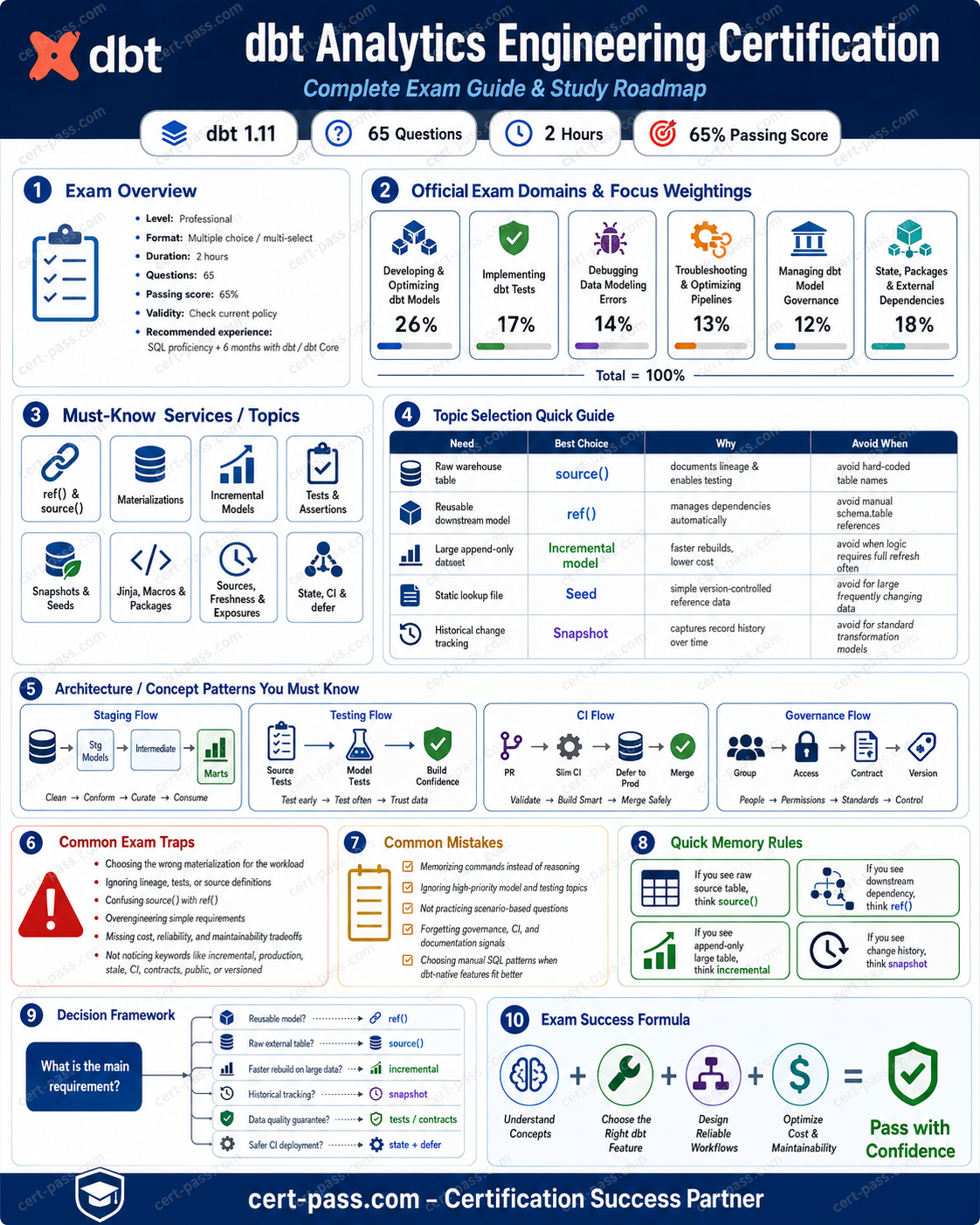
Those facts matter for ROI because the investment is not only money. It is also time, focus, and opportunity cost. A certification is worth more when the exam topics map closely to real work, and dbt is one of the clearer examples of that because the exam centers on model development, tests, governance, debugging, pipelines, state, documentation, and external dependencies.
What ROI means for this certification
ROI in certification terms is not just salary. It is the combined return from multiple benefits:
- better interview credibility;
- clearer signal to hiring managers;
- more confidence in actual dbt work;
- better structure for learning the platform;
- more fluent conversations with data teams;
- easier internal mobility or promotion discussions;
- a stronger case for consulting or client facing work.
That broader view matters because salary is only one part of the value story. Many candidates assume a certificate is worth it only if it immediately changes compensation. That is too narrow. A certification can still be useful if it shortens the time needed to get hired, helps a candidate stand out for a role, or makes the candidate more effective once on the job.
The central question: is it worth it for the right person?
The answer depends on the candidate's starting point.
It is usually worth it if the candidate:
- is new to analytics engineering and needs a focused structure;
- has used dbt casually but wants a formal signal;
- is moving from BI, analytics, or SQL work into transformation ownership;
- wants to show current dbt fluency to an employer or client;
- is preparing for roles where dbt appears in the job description;
- benefits from guided study more than from learning only through trial and error.
It is less useful if the candidate:
- already has strong production dbt experience and can show real project impact;
- is not applying for roles where dbt matters;
- only wants a credential for its own sake without building practical skills;
- has very limited time and would benefit more from shipping a portfolio project first;
- is looking for a shortcut that replaces actual hands on work.
That does not mean the certification has no value for experienced practitioners. It means the relative value changes. The more real project evidence a candidate has, the more the certification becomes a supporting signal rather than the main signal.
Why employers care about dbt certification
Hiring managers do not usually care about a badge by itself. They care about what the badge suggests.
A dbt certification can imply that the candidate:
- understands modeling discipline;
- can work with transformation logic in a structured way;
- knows how to test changes and reduce breakage;
- understands documentation and lineage concepts;
- can think about state and pipeline behavior instead of just writing one off SQL;
- has enough command of the platform to learn faster on the job.
That is the real market value. The credential is a shorthand for platform fluency. In a crowded job market, shorthand matters, especially when many candidates list dbt on a resume but fewer can show a coherent understanding of how it is used in production.
What the certification does not prove
It does not prove that the candidate has solved every real world data problem. It does not prove leadership, system design maturity, or cross team influence. It does not replace project evidence.
A strong resume still needs examples of outcomes:
- improved pipeline reliability;
- cleaner modeling structure;
- better testing coverage;
- easier documentation and handoff;
- safer production releases;
- reduced debugging time.
The certification works best when it supports those outcomes, not when it tries to stand in for them.
Salary: how to think about it without fake numbers
Salary questions are often the least reliable part of the certification conversation because pay depends on many variables:
- region;
- role level;
- company size;
- remote versus local market;
- industry;
- whether the job is analytics, data engineering, BI, or platform oriented;
- actual project experience;
- interview performance;
- the candidate's ability to explain business impact.
That means there is no honest single salary number that can be attached to this certification and treated as universal. A better question is whether the certification makes the candidate more competitive for roles that tend to pay better because they require stronger transformation, governance, and production discipline.
Salary value factors that matter more than a headline number
| Factor | Why it affects salary potential |
|---|---|
| Relevant job title | Roles that already center dbt or modern transformation work usually value the credential more |
| Hands on practice | Strong actual skill matters more than the badge alone |
| Portfolio quality | Real project evidence can increase interview success |
| Role complexity | More ownership and production responsibility usually correspond to better compensation |
| Industry demand | dbt adoption inside the target market affects usefulness |
| Communication ability | Candidates who can explain tradeoffs often do better in hiring conversations |
The right way to think about salary is therefore not "What salary does the certificate guarantee?" but "Does the certificate help the candidate get into roles where stronger compensation is more likely?" That is a much more honest ROI question.
Job market value: where the certification helps most
The certification is most useful in job markets where dbt appears frequently in job descriptions or where analytics engineering is a distinct hiring category.
High value situations
| Situation | Why the certification helps |
|---|---|
| Early career candidate | Provides structure and a clear signal of serious study |
| Career switcher | Helps translate previous SQL or analytics experience into a dbt aligned profile |
| Generalist analyst moving into modeling | Shows intent to work on transformation and data quality |
| Consultant or freelancer | Makes it easier to discuss dbt capability with clients |
| Team adopting dbt | Helps prove baseline fluency while the team builds standard practices |
Lower value situations
| Situation | Why the certification may matter less |
|---|---|
| Senior engineer with strong dbt portfolio | Real work samples may already be more convincing |
| Candidate targeting non dbt roles | The market signal is weaker if the role does not use the tool |
| Candidate with no project practice | The badge may not survive technical interviews without hands on understanding |
The certification is therefore not universally high value in every market. Its value depends on job alignment.
What the exam topics tell us about value
The domain breakdown is one of the best clues about practical worth.
| Topic area | What it suggests about real work |
|---|---|
| Developing dbt models | The core day to day transformation work |
| Implementing dbt tests | Data trust and pipeline quality |
| Debugging data modeling errors | Production problem solving |
| Understanding dbt model governance | Ownership and safe data use |
| Managing data pipelines | Repeatability and release discipline |
| Leveraging dbt state | Efficient change management |
| Creating and maintaining dbt documentation | Collaboration and discoverability |
| Implementing and maintaining external dependencies | Integration with real data sources and downstream systems |
This is the strongest argument for the certification's value. The topics are not random trivia. They line up with the work analytics engineers actually do. That is why the credential is more than a theoretical badge.
Useful asset: dbt certification ROI decision matrix
Use this matrix to decide whether the certification is a good investment right now.
| Candidate situation | Likely ROI | Why |
|---|---|---|
| New to dbt and looking for structure | High | The exam topics teach a practical workflow |
| Using dbt at work but without formal proof | High | The certification turns informal skill into a visible signal |
| Switching into analytics engineering | High | It helps bridge the gap between past work and target role |
| Already experienced and well documented | Medium | Useful as a supporting signal, but not the main proof |
| No dbt access and no practice time | Low | The study cost may exceed the immediate benefit |
| Targeting a role that does not use dbt | Low | The market relevance is weaker |
This matrix is useful because it avoids the common mistake of asking only whether the certification is good in the abstract. The better question is whether it is good for the candidate's current situation.
What the candidate actually gets by studying for it
Even before taking the exam, the study process itself creates value.
Skills reinforced during study
- better SQL discipline;
- more structured modeling habits;
- a clearer sense of testing and trust;
- stronger understanding of documentation and lineage;
- better awareness of dependency management;
- more confidence discussing analytics engineering tradeoffs.
That matters because some of the benefit comes from the preparation, not only from the credential. If the candidate studies seriously, the learning itself may improve job performance.
When salary impact is realistic
Salary impact is most realistic when the certification helps the candidate do one or more of these things:
- get interviews for better aligned roles;
- pass screening filters when dbt is listed in the job description;
- negotiate from a stronger position because the candidate can explain the platform clearly;
- move from a general analytics role into a more specialized analytics engineering role;
- gain trust faster in a new team or client setting.
That is a practical view of compensation. The certification is not magic. It influences the path into opportunity, and opportunity affects salary.
When the certification is not enough
A certification alone rarely changes everything. It should not be treated as a substitute for:
- project experience;
- SQL fluency;
- communication;
- data modeling judgment;
- debugging ability;
- version control and collaboration habits;
- understanding how data teams work in production.
Candidates who expect the badge to carry them without practice are likely to be disappointed. Candidates who treat the badge as proof of disciplined study and pair it with real examples usually get much more out of it.
A practical return on investment framework
The best ROI calculation is simple.
Costs
- study time;
- practice question time;
- possible exam fee;
- opportunity cost of not studying another skill;
- energy spent preparing.
Benefits
- better interview signal;
- more confident self presentation;
- stronger dbt knowledge;
- better workflow discipline;
- possible role alignment benefits;
- more credible conversation with teams or clients.
If the benefits clearly outweigh the costs for the candidate's target role, the certification is worth it. If the role does not care about dbt, the ROI is lower.
How long it can take to pay off
The payoff timing depends on the candidate's market position.
| Scenario | Likely payoff pattern |
|---|---|
| Active job search | Faster, because the credential can support applications and interviews |
| Internal promotion path | Medium term, because it may help with visibility and trust |
| Freelance or consulting work | Variable, depending on whether clients ask for dbt proof |
| Learning only | Immediate learning payoff, slower market payoff |
The fastest payoff usually comes when the certification is aligned with active hiring demand.
Useful asset: study versus value timeline
| Stage | What the candidate gains |
|---|---|
| Before studying | Unclear signal and uneven confidence |
| During study | Better understanding of the platform and workflow |
| After passing | A clearer resume signal and stronger interview talking points |
| After job application use | Better odds of passing filters and explaining dbt work |
| After hands on use | The credential becomes part of a broader skill story |
This timeline helps candidates avoid a common mistake: expecting the certificate to do all the work instantly. The real value compounds when the study process is combined with practice and job usage.
How employers typically read the certification
Employers usually do not think, "This candidate has a badge, therefore hire immediately." They think, "This candidate likely understands dbt fundamentals and can probably ramp faster."
That difference matters. The credential is a signal of:
- seriousness;
- familiarity;
- learning discipline;
- a desire to work in analytics engineering;
- enough platform focus to study the core topics.
When the credential is paired with a strong resume and real examples, the signal is better. When it is alone, the signal is weaker.
What makes this certification different from generic courses
A course can teach the topic. A certification adds external validation.
That validation matters in three ways:
- it gives the candidate a defined target;
- it creates a shared standard for assessment;
- it makes the skill easier to recognize quickly in a crowded candidate pool.
This is especially useful when dbt knowledge is present but not obvious from the rest of the resume.
How to maximize value before taking the exam
A candidate gets more ROI if preparation is practical rather than passive.
Better preparation habits
- study the official exam facts first;
- use scenario based practice questions;
- review wrong answers carefully;
- learn the why behind each answer, not just the answer itself;
- connect topics to real transformations or project stories;
- write short notes on model development, testing, governance, and debugging;
- revisit the weakest domains before scheduling the exam.
Poor preparation habits
- memorizing feature names without context;
- ignoring tests and governance;
- studying only from summaries and never practicing;
- treating the exam like a trivia quiz;
- skipping dbt state and external dependencies because they seem minor.
Value by candidate type
Beginner
Usually high value. The certification can provide direction, structure, and a concrete milestone.
Career switcher
Usually high value if the target role uses dbt. The exam can help translate existing SQL or analytics experience into a relevant signal.
Working analyst
Often medium to high value. It depends on whether the current role is moving toward transformation ownership.
Experienced analytics engineer
Usually medium value. The certification may support credibility, but real project work still carries more weight.
Consultant or freelancer
Often high value if clients care about tool knowledge and clear signaling.
Where the certification is strongest in the market
The certification is strongest in environments where:
- dbt is already in use;
- analytics engineering is treated as a real discipline;
- teams care about testing and governance;
- the hiring process values structured platform knowledge;
- the candidate needs to show that they can work in modern transformation workflows.
If those conditions are present, the certification can be genuinely useful.
Useful asset: worth it checklist
Use this checklist before investing time in the exam.
| Question | Yes or no |
|---|---|
| Is dbt part of the target job market? | |
| Does the candidate need a structured learning path? | |
| Will the credential help in interviews or client conversations? | |
| Can the candidate study enough to understand the core workflow? | |
| Is there a real plan to use the skill after passing? | |
| Would the candidate benefit from external validation? |
If most answers are yes, the certification is probably worth it. If most answers are no, the candidate may get more value from building a project first.
How to combine certification with portfolio value
The best outcome is not certification alone. It is certification plus proof of work.
A candidate can improve the return by doing things like:
- building a small dbt project;
- documenting model decisions;
- writing tests and explaining why they matter;
- describing a transformation problem and the chosen design;
- showing how dbt was used to improve reliability or maintainability.
That combination is much stronger in the job market than either component alone.
How to decide if the fee is worth paying
A practical way to think about the fee:
- if the certification opens at least one better interview opportunity, the fee may be quickly justified;
- if the certification helps the candidate negotiate a better role or move into a more relevant one, the fee is small relative to the possible benefit;
- if the candidate has no use for dbt in the next year, the fee may not be the main issue because the bigger cost is study time.
The fee is therefore only one part of the decision. The more important question is whether the credential supports the candidate's next step.
What the candidate loses by skipping it
Skipping the certification is not automatically a mistake. In some cases it is the right call. But it helps to be honest about what gets lost when the candidate never creates a formal dbt milestone.
Possible downsides of skipping the certification
- less structure in the learning path;
- weaker shorthand in interviews;
- fewer easy ways to show current dbt fluency;
- more difficulty proving that the candidate understands testing, governance, and state based workflows;
- less incentive to review the platform methodically.
That does not mean the certification is mandatory. It means the candidate should understand the tradeoff clearly.
When the badge matters less than the story
Some candidates worry too much about whether a certification is enough. In reality, the strongest job market story usually combines three pieces:
- a clear title or target role;
- a dbt certification or similar proof of study;
- a concrete example of using dbt in real work.
The badge matters least when the candidate has no story behind it. It matters more when it supports a specific transition, such as moving from analyst to analytics engineer or from ad hoc SQL work to structured transformation ownership.
A simple self assessment
Use this quick self assessment to judge whether the exam belongs on the roadmap now or later.
| Question | If yes, the certification helps more |
|---|---|
| Do target jobs mention dbt? | The market signal is relevant |
| Is the candidate moving toward transformation work? | The topics align with the next role |
| Does the candidate need a structured study path? | The exam provides one |
| Would a formal credential help with confidence or credibility? | The external validation matters |
| Is there time to pair study with practice? | The learning sticks better |
If several answers are yes, the certificate is likely worth it now. If not, the candidate may still benefit from the knowledge, but the timing may not be ideal.
Why the study process itself has value
The certification can be worth it even before the exam is taken because the study process teaches the candidate to think like an analytics engineer.
That means learning to ask better questions:
- how is this model built?
- what should be tested?
- how will this change be governed?
- what depends on this model downstream?
- what happens if the source data changes?
Those are useful questions in any dbt project, with or without a certificate. So part of the ROI is the improvement in thinking, not just the credential itself.
One sentence summary for decision making
If dbt is part of the candidate's current or near future job path, the certification is often worth it; if dbt is not relevant to the target role, the value drops quickly.
Related reading in the Cert-Pass library
The most useful adjacent pages are:
- dbt Analytics Engineering Study Guide 2026
- dbt Analytics Engineering Practice Questions 2026
- dbt Analytics Engineering Certification Study Guide 2026
- dbt Analytics Engineering Practice Questions 2026: 20 Realistic Examples
- Databricks Data Engineer Associate Worth It 2026: Salary, ROI, and Job Market
For the official route and free practice, keep these links close:
- dbt Analytics Engineering
- Try 35 free dbt Analytics Engineering practice questions - no signup required
- Preview the compressed dbt Analytics Engineering course
FAQ
Is the dbt certification worth it for beginners?
Often yes, especially when the candidate needs a clear study path and wants to build a stronger analytics engineering profile.
Does the certification guarantee a higher salary?
No. Salary depends on role, market, experience, and interview performance. The certification can help create opportunities, but it does not guarantee compensation.
Is the credential useful if dbt is already used at work?
Yes. It can make the candidate easier to trust and may support internal mobility or more confident project ownership.
Is real project experience more important than the certificate?
Usually yes. The strongest outcome is a combination of both.
How should ROI be measured?
By comparing study time and exam cost against the likely benefits in interviews, job search, role fit, and practical skill improvement.
Can an experienced analytics engineer still benefit?
Yes, but the benefit is often more about external signaling and structured refresh than about raw learning.
Final answer
dbt Analytics Engineering certification is worth it when the candidate needs a stronger market signal and a better structured path into analytics engineering work. Its value is highest for learners who are early in the journey, switching into the field, or trying to prove current dbt fluency in a job market that cares about modern transformation skills.
The certification is not a magic salary lever, and it is not a replacement for real project work. Its real value comes from a combination of learning, signaling, and practical alignment with the kind of work analytics engineers actually do. When those three pieces line up, the return can be very good. When they do not, the certification becomes less important.
For the official exam path, use dbt Analytics Engineering. For immediate practice, use Try 35 free dbt Analytics Engineering practice questions - no signup required. For a tighter review after deciding that the credential is worth pursuing, use Preview the compressed dbt Analytics Engineering course.
The shortest summary is this: the certification is most worth it when it helps the candidate get into the right role, speak the right language, and prove the right kind of skill at the right time.
A practical decision framework for the certification
The decision to pursue dbt certification is easier when it is based on role fit instead of a vague salary expectation. A candidate should ask three questions:
- Will this certification help with the current role?
- Will it support the next role the candidate wants?
- Does the candidate already use dbt often enough for the study to feel practical?
If the answer to those questions is mostly yes, the certification can be a strong signal of analytics engineering focus. If the candidate works in a broader data role and rarely touches transformation modeling, the value is usually more about learning structure and terminology than about immediate career change.
When the certification tends to fit best
- Analytics engineers who want a clearer foundation.
- Data professionals who already use dbt and want to formalize the skill.
- Candidates moving from general data work into transformation and governance.
- Teams that want a shared vocabulary around tests, models, and documentation.
When it may be less urgent
- Candidates who are still early in data and need broader fundamentals first.
- People who are not using dbt in real work and only want a generic credential.
- Candidates who need hands-on project experience more than another certificate.
That framing keeps the article focused on actual value rather than hype. It also helps the reader decide whether to spend the time now or postpone the exam until the role is a better fit.