
Quick answer
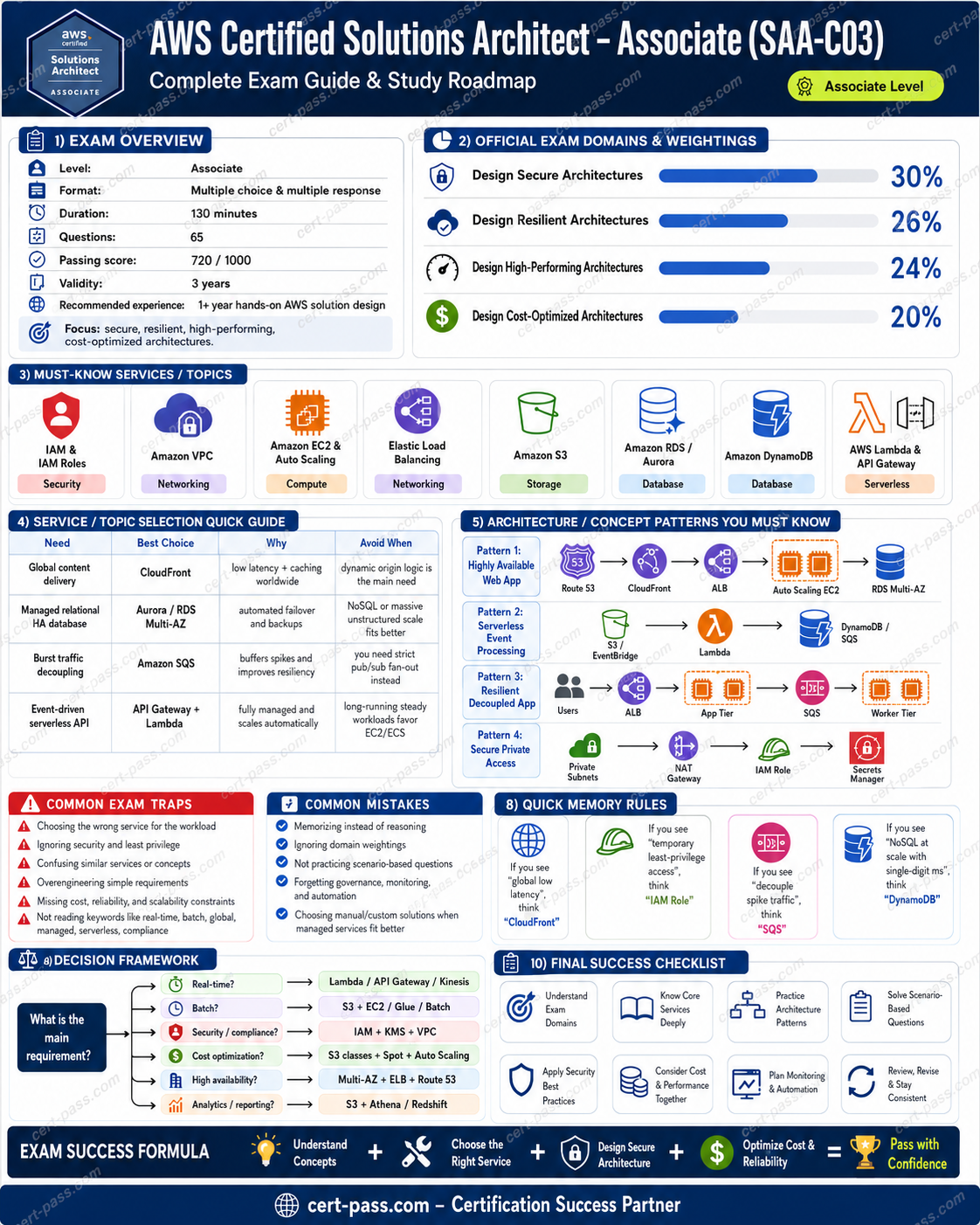
The AWS Solutions Architect Associate SAA-C03 exam is easiest to fail when a candidate treats it like a memorization test instead of a decision test. The exam is built around scenario judgment. It rewards people who can read a prompt, identify the real constraint, and choose the most suitable AWS service, not the most advanced one, the most familiar one, or the one that sounds impressive in isolation.
That is why a guide about common mistakes is useful. Most wrong answers come from the same patterns: overengineering, confusing similar services, missing the actual requirement, or picking a service that solves only part of the problem. A candidate who learns to avoid those mistakes usually does better than a candidate who tries to memorize hundreds of unrelated facts.
If the goal is to pass SAA-C03 with less stress, the best strategy is simple:
- learn the AWS service families
- learn the exam's common scenario patterns
- practice choosing the simplest service that still meets the requirement
- pay attention to security, reliability, and cost together
- avoid reading the question too fast
This article focuses on the mistakes that cost points and the habits that prevent them.
Official exam facts
| Detail | Information |
|---|---|
| Exam | AWS Solutions Architect Associate SAA-C03 |
| Vendor | AWS |
| Focus | Design cost optimized, resilient, secure, and operationally effective solutions |
| Question style | Scenario based multiple choice and multiple response |
| Primary skill | Choosing the right AWS service for the right constraint |
| Best fit | Candidates who can reason about architecture tradeoffs |
The official exam page should always be the final source of truth before scheduling:
- AWS Solutions Architect Associate
- AWS official certification page: https://aws.amazon.com/certification/certified-solutions-architect-associate/
What this exam is really testing
SAA-C03 is not mainly testing whether a candidate can define AWS terms. It is testing whether the candidate can make good architecture choices under constraints. That sounds obvious, but many candidates still study it the wrong way. They spend too much time on isolated facts and too little time on tradeoff thinking.
The exam asks questions like this in spirit, even when the wording is different:
- Which option is simplest while still meeting the requirement?
- Which service gives the best balance of cost and reliability?
- Which design supports scale without adding unnecessary complexity?
- Which answer actually satisfies the prompt's security requirement?
- Which choice fits the workload pattern described in the question?
That means the candidate is not expected to choose the fanciest architecture. The candidate is expected to choose the most appropriate architecture. That distinction is the difference between passing and missing easy points.
A lot of mistakes happen because candidates assume the exam wants advanced solutions. In reality, the exam usually prefers the clean solution that solves the stated problem with the fewest moving parts. If two answers both work, the simpler and more AWS native one is often the better choice.
Mistake 1: choosing the most complex solution
The most common mistake is assuming that a more complex design must be more correct. That is not how this exam works.
Candidates often pick extra components because they look enterprise ready. They add unnecessary queues, functions, orchestration layers, custom code, or multi service combinations when the prompt does not ask for them. That usually creates a worse answer, not a better one.
The exam often rewards the design that meets the requirement directly. If the prompt only needs storage and retrieval, the answer does not need a pipeline with five stages. If the prompt needs high availability, the answer does not need a completely rearchitected multi region platform unless the question says so.
The habit to build is this: start with the simplest answer that satisfies the requirement, then add complexity only if the prompt forces it.
A practical way to train this habit is to ask after every practice question: what did this answer add that the question actually required? If the answer adds a feature the question never asked for, that answer is probably too complex.
Mistake 2: confusing similar services
AWS has many services that sound similar or overlap in function. SAA-C03 questions often use that overlap to test whether the candidate knows the distinction.
Common confusion pairs include:
- S3 versus EBS versus EFS
- CloudFront versus Route 53
- RDS versus DynamoDB
- Auto Scaling versus Elastic Load Balancing
- IAM versus KMS
- CloudWatch versus CloudTrail
- SQS versus SNS
- Lambda versus EC2
- Multi AZ versus multi region
The mistake is not only failing to know the difference. The deeper mistake is not recognizing the use case that points to the right family.
For example, if the question is about shared file access across multiple instances, the candidate should think about EFS rather than S3 or EBS. If the question is about DNS, Route 53 is the obvious family. If the question is about centralized event notifications, SNS may fit better than SQS. If the question is about decoupled message processing, SQS is usually the better match.
The candidate should not try to memorize each service in isolation. The better approach is to map each service to a workload pattern.
Mistake 3: ignoring the real constraint in the prompt
Many questions contain more than one piece of information, but only one or two of those pieces are the real constraint. A candidate who skips too quickly may answer the wrong requirement.
Common constraints include:
- lowest cost
- high availability
- fault tolerance
- fastest deployment
- minimal operational overhead
- no downtime
- encryption at rest
- encryption in transit
- least privilege access
- global distribution
- write heavy workload
- read heavy workload
- burst traffic
The exam expects the candidate to identify which constraint drives the answer. If the prompt says the solution must be highly available and cost effective, both matter. If the prompt says the workload must be accessible from multiple Availability Zones, that changes the architecture. If the prompt mentions low operational burden, that usually favors managed services.
A candidate who reads only the first line of the question will miss the real constraint. The fix is to slow down enough to underline the exact requirement words in the prompt mentally. That habit alone can save a large number of points.
Mistake 4: treating every problem as a compute problem
A lot of candidates are comfortable with EC2, so they reach for compute first. That is a bad habit on SAA-C03.
Not every workload needs servers. Not every architecture problem is solved by launching EC2 instances. Sometimes the right answer is storage, database, cache, managed queue, serverless function, content delivery, or identity control.
The exam often rewards candidates who know when compute is unnecessary. If the question describes a simple event driven task, Lambda may be better than EC2. If the question is about static content delivery, S3 with CloudFront may solve it cleanly. If the question is about managed failover and storage durability, the answer may be a managed database or storage service instead of a custom server stack.
A good practice question habit is to ask: does this problem really need a server, or does it need a managed AWS service that removes server management? That question helps avoid the instinct to overuse EC2.
Mistake 5: mixing up availability and backup
Availability and backup are not the same thing, but candidates often treat them as if they are.
Availability is about keeping a system up and usable. Backup is about recovering data or state after a loss. The architecture for one is not automatically the architecture for the other.
A candidate may see a question about resilience and choose a backup solution when the prompt actually needs continuous availability. Or the candidate may choose a multi AZ design when the real problem is data recovery after deletion or corruption.
The exam likes precise thinking here:
- High availability usually points toward redundancy and failover.
- Backup usually points toward recovery copies and restoration plans.
- Disaster recovery may involve a mix of both, depending on the recovery objective.
If the prompt asks how to avoid service interruption, think availability. If it asks how to recover from accidental deletion or corruption, think backup and restore. The mistake is assuming one covers the other.
Mistake 6: forgetting security is part of architecture, not a separate topic
Some candidates treat security as a final add on. They design the core system first and then try to bolt on security later. That approach fails on SAA-C03.
Security is part of the architecture choice from the beginning. The prompt may mention encryption, least privilege, private access, role based controls, secure storage, or network isolation. In those cases, security is not optional. It is part of the design requirement.
The candidate should constantly ask:
- Does the answer control access correctly?
- Does the answer encrypt data where required?
- Does the answer keep traffic private if needed?
- Does the answer minimize permissions?
- Does the answer use the right AWS security service for the use case?
Some questions are designed to reward the candidate who remembers that security and architecture are connected. A technically correct but insecure answer is often wrong.
Mistake 7: not separating monitoring from auditing
CloudWatch, CloudTrail, and related services are easy to mix up if the candidate studies them only as definitions.
Monitoring tells you about operational behavior. Auditing tells you about actions and events, especially who did what and when.
If a prompt is about tracking API activity or recording account events for investigation, CloudTrail may be the right family. If a prompt is about metrics, alarms, or system health, CloudWatch is usually more relevant.
The mistake is choosing a monitoring tool for an audit problem or an audit tool for a monitoring problem.
The exam often turns this into a subtle scenario. The candidate must identify whether the question wants visibility into system performance or a historical record of actions. Once that distinction is clear, the service choice becomes much easier.
Mistake 8: using a cost answer without checking the usage pattern
SAA-C03 loves cost questions, but cost is rarely just about the cheapest price tag. It is about the cheapest solution that still fits the workload pattern.
A candidate may see "reduce cost" and immediately choose the least expensive service in the abstract. That is risky. The right answer depends on usage volume, access frequency, latency needs, durability, and operational burden.
For example:
- infrequent access may point toward archival storage
- steady transactional workloads may need a managed database
- bursty serverless workloads may favor pay per use models
- high traffic web delivery may benefit from caching and content delivery
The candidate should never treat cost as a standalone decision. Cost only matters when matched to the workload pattern and the architectural constraint. Cheap but wrong is still wrong.
Mistake 9: not using a domain first approach
A better way to study SAA-C03 is to group services by domain, not by random flashcard order. Candidates who do this usually retain more and make fewer mistakes.
Useful service families include:
- compute
- storage
- database
- networking and content delivery
- security and identity
- monitoring and governance
- messaging and integration
- migration and deployment
- analytics and search
When a question appears, the candidate should first decide which domain it belongs to. That narrows the service set quickly.
For example, if a prompt talks about DNS routing and latency based traffic steering, the candidate should look in networking and content delivery. If it talks about queues and asynchronous processing, the candidate should look in messaging. If it talks about permissions and role based access, the candidate should look in security and identity.
A domain first habit reduces the chance of wandering through the full AWS catalog.
Mistake 10: not knowing the service family map
A lot of candidates know individual services but not the map that connects them.
The service family map is the mental picture that tells you which services belong together and how they differ. That is what lets you move from prompt to answer quickly.
A few examples:
- S3 is object storage
- EBS is block storage
- EFS is shared file storage
- RDS is managed relational database
- DynamoDB is managed NoSQL database
- EC2 is compute on virtual machines
- Lambda is serverless compute
- SNS is pub sub notification
- SQS is queue based messaging
- CloudFront is CDN delivery
- Route 53 is DNS and routing
Without this map, candidates see individual names but not architecture choices. With the map, a prompt becomes a pattern recognition exercise.
The exam rewards the candidate who can quickly recognize the family and then choose the right member of that family.
Mistake 11: reading for keywords instead of meaning
Some candidates search for keywords and jump to a service based on a single word. That is dangerous.
The exam likes to hide the real answer behind similar sounding language. A prompt may mention "scaling" but the actual issue is not scaling at all. It may mention "secure" but the actual issue is identity permissions. It may mention "high performance" but the real constraint is storage access pattern.
The candidate should read for meaning, not just for buzzwords.
A useful habit is to paraphrase the question in one sentence before looking at the answers. If the candidate can say, "this is a low cost static website delivery problem," the answer choices become easier. If the candidate can say, "this is a message buffering problem between services," the right family becomes obvious.
Keyword hunting is too shallow for scenario questions. Meaning hunting is better.
Mistake 12: not ruling out impossible options first
Good exam strategy is not just choosing the best answer. It is also eliminating the clearly wrong ones quickly.
Sometimes one option is wrong because it violates the prompt directly. Another may be wrong because it adds unnecessary complexity. Another may be wrong because it solves a different problem entirely.
Candidates who skip elimination often waste time trying to prove the best answer from scratch. That is slower and more error prone.
Instead, ask:
- Which option fails the requirement immediately?
- Which option is overengineered?
- Which option solves the wrong problem?
- Which option leaves out the key constraint?
Elimination is especially useful when two answers look similar. Removing the obviously wrong choices often reveals the correct one faster than trying to analyze all options equally.
Useful asset: mistake ranking table
| Mistake | How often it hurts | How to prevent it |
|---|---|---|
| Choosing the most complex solution | Very often | Start with the simplest valid design |
| Confusing similar services | Very often | Study by service family and workload pattern |
| Missing the real constraint | Very often | Paraphrase the prompt before choosing |
| Overusing EC2 | Often | Ask whether a managed service can solve it |
| Mixing up backup and availability | Often | Separate recovery needs from uptime needs |
| Treating security as an add on | Often | Read security as part of the architecture |
| Confusing monitoring and auditing | Often | Know CloudWatch versus CloudTrail use cases |
| Ignoring usage pattern in cost questions | Often | Match cost to traffic and access behavior |
| Not using a domain first approach | Often | Classify the question before scanning services |
| Keyword chasing | Sometimes but costly | Read for meaning, not just buzzwords |
This table is useful because it turns vague advice into a review list. A candidate can scan it before practice sessions and before the real exam.
What passing candidates do differently
Candidates who pass SAA-C03 usually do a few things better than candidates who struggle.
They keep their study organized by domain. They do not just bounce between random questions. They build a map.
They learn the difference between similar services instead of memorizing one sentence definitions.
They practice reading prompts carefully and identifying the actual constraint.
They get comfortable with choosing the simplest AWS native answer that fits the requirement.
They review mistakes after practice tests and look for patterns instead of only checking the score.
They do not assume that being "close" to the right answer is enough. On the exam, close is not enough. The best answer must match the prompt exactly.
How to study for fewer mistakes
The fastest way to improve is not to read more notes. It is to remove recurring errors.
A good study loop looks like this:
- Take a practice set.
- Mark every missed question by mistake type.
- Group the misses into patterns.
- Review the AWS service family involved.
- Rework the same pattern with a new set of questions.
This is more effective than repeatedly reading the same summary page. The exam is about judgment, so the study plan should build judgment.
Candidates should spend extra time on:
- storage patterns
- database selection
- network delivery and routing
- security and identity choices
- monitoring versus auditing
- backup versus availability
- serverless versus server based decisions
- cost optimization tradeoffs
That list covers many of the recurring question types.
14 day pass strategy based on common mistakes
A short sprint can work if the candidate already has some AWS background.
Days 1 to 3
Build the service family map. Focus on compute, storage, database, networking, security, and monitoring.
Days 4 to 6
Study the difference between similar services. Do not memorize just names. Learn use cases.
Days 7 to 9
Work practice questions and tag each miss by mistake type.
Days 10 to 11
Review the patterns that showed up most often. Read the questions again and explain the correct choice in plain language.
Days 12 to 13
Take another practice set and focus on the lowest accuracy domains.
Day 14
Review the mistake ranking table, the service family map, and the final exam day checklist.
This kind of sprint is not magic. It works only when the candidate already understands that SAA-C03 is about decision quality. If the candidate is still trying to learn AWS from zero, the timeline should be longer.
Common wrong answer shapes
Wrong answers on this exam often fall into predictable shapes.
Too complex
The answer adds more services than needed.
Wrong domain
The answer solves a different problem from the one in the prompt.
Missing one constraint
The answer is good on one requirement but fails another.
Too manual
The answer requires unnecessary administration when a managed service would fit better.
Too expensive
The answer works but ignores the workload pattern and cost target.
Security gap
The answer does not satisfy access, encryption, or isolation requirements.
Learning these shapes helps candidates eliminate options faster.
How to think when stuck
If the candidate gets stuck between two answers, use a simple checklist:
- Which answer solves every requirement in the prompt?
- Which one is simpler?
- Which one is more AWS native for this use case?
- Which one matches the workload pattern?
- Which one avoids unnecessary moving parts?
That checklist often breaks the tie.
If both answers still seem plausible, go back to the prompt and identify which word controls the decision. The prompt usually contains the clue that separates the two choices.
What to do in the final 48 hours
The last two days before the exam should not be used for cramming random facts.
Focus on:
- the service family map
- the top confusion pairs
- the mistake ranking table
- a few timed practice sets
- the official exam page
In the final 48 hours, the goal is confidence, not quantity. The candidate should walk into the exam with a stable mental model and a clear elimination strategy.
A three sentence exam habit
A useful habit is to turn every question into three sentences:
- What is the actual problem?
- Which AWS family fits the problem?
- Which option solves the requirement with the least unnecessary complexity?
That habit slows the candidate down just enough to avoid impulsive mistakes.
Quick self check before submitting an answer
Before selecting an answer, the candidate should ask:
- Did I read the whole prompt?
- Did I identify the real constraint?
- Did I confuse a similar service?
- Did I overengineer the answer?
- Did I assume compute when a managed service would be better?
- Did I mix up backup, monitoring, and availability?
If any answer feels uncertain, the candidate should re read the prompt before locking it in.
Why this guide is useful beyond the exam
The habits in SAA-C03 are not only exam skills. They are architecture skills.
A person who learns to avoid these mistakes will usually write better designs, ask better questions in meetings, and make cleaner cloud choices at work. The exam is useful because it trains the candidate to think in tradeoffs.
That is why this guide matters. It is not just about passing a test. It is about learning how to avoid the kinds of architecture mistakes that hurt real systems.
A simple way to stop overthinking answers
A common reason candidates miss SAA-C03 questions is that they keep searching for a hidden trick even when the prompt is straightforward. The exam does contain traps, but not every question is a puzzle. Sometimes the obvious service family is the right family, and the question only becomes difficult when the candidate starts inventing extra conditions.
To stop overthinking, the candidate should force a three step pattern:
- Identify the workload type.
- Identify the service family.
- Check the prompt for the one constraint that changes the default answer.
That pattern keeps the candidate from wandering into unnecessary options. It also prevents the common problem of changing a good answer into a worse one during review.
How to review missed questions properly
A lot of candidates check the answer key and move on. That is not enough. The real value comes from classifying the miss.
Ask whether the error came from:
- not knowing the service family
- confusing two similar services
- missing a constraint word
- overengineering
- misunderstanding the workload pattern
- rushing the prompt
Once the mistake type is known, the candidate should review just that topic, not the whole exam again. This keeps the study cycle efficient and prevents burnout.
If the candidate repeatedly misses the same type of question, that is a sign the issue is not general knowledge. It is pattern recognition. The fix is targeted practice, not more broad reading.
Why simple answers often win
Simple does not mean incomplete. Simple means the answer solves the actual problem with the fewest moving parts.
On SAA-C03, simple often wins because AWS provides managed services that absorb complexity. When a managed service can meet the requirement, the exam often prefers that over a custom build. The candidate should remember that the test is about using AWS well, not about designing the most impressive possible system.
This is a subtle but important mindset shift. If the candidate keeps asking, "What would I build from scratch?" the answers can drift away from the exam. If the candidate asks, "What is the cleanest AWS service based solution that matches the prompt?" the answers get much better.
Related Cert Pass reading
If the candidate wants a full study path after this mistakes guide, these pages are a good next step:
- AWS SAA C03 Practice Questions
- AWS Solutions Architect Associate Study Guide
- Cloud Certification Study Plan While Working Full Time
For the certification page and free practice access, use:
FAQ
Is SAA-C03 harder than the old AWS Solutions Architect exam?
It is still a scenario based architecture exam, so the main challenge remains judgment rather than memorization. Candidates who study service patterns and tradeoffs usually do better than candidates who only study definitions.
What is the biggest mistake people make on SAA-C03?
Picking the most complex answer instead of the simplest valid one is one of the biggest mistakes. Confusing similar services is another major issue.
Should candidates memorize every AWS service?
No. Candidates should learn the major service families, the common use cases, and the differences between the services that appear most often in scenario questions.
Is EC2 always the wrong answer when other managed services exist?
No, but candidates often overuse EC2. The right answer depends on the workload and the prompt, not on a blanket rule.
How should candidates study for the exam?
Study by domain, practice scenario questions, review mistakes by pattern, and learn the service family map.
What should candidates review the night before the exam?
The service family map, the top confusion pairs, the mistake ranking table, and a few timed practice sets.
Official sources and verification
Use the official AWS certification page for the final exam check: