AWS SAA C03 Study Guide and Exam Strategy
Quick answer
AWS Solutions Architect Associate SAA C03 is the exam that moves a candidate from basic cloud vocabulary into practical architecture judgment. It is still an associate level certification, but it expects more than surface familiarity. The exam asks whether a candidate can choose the right AWS services for a scenario, balance security and resilience with cost, and avoid overengineering when a simpler AWS native option would do the job.
The best way to prepare is not to memorize a giant service catalog. The better approach is to learn how the exam groups problems: security, resilience, performance, cost, storage, compute, networking, and operational tradeoffs. Once those layers are clear, many questions become easier because the wrong answers are obviously solving the wrong problem.
For the official exam path, start here: AWS Solutions Architect Associate SAA C03. For low friction practice, use Try 35 free AWS Solutions Architect Associate practice questions - no signup required. For a tighter review after this guide, Preview the compressed AWS Solutions Architect Associate course.
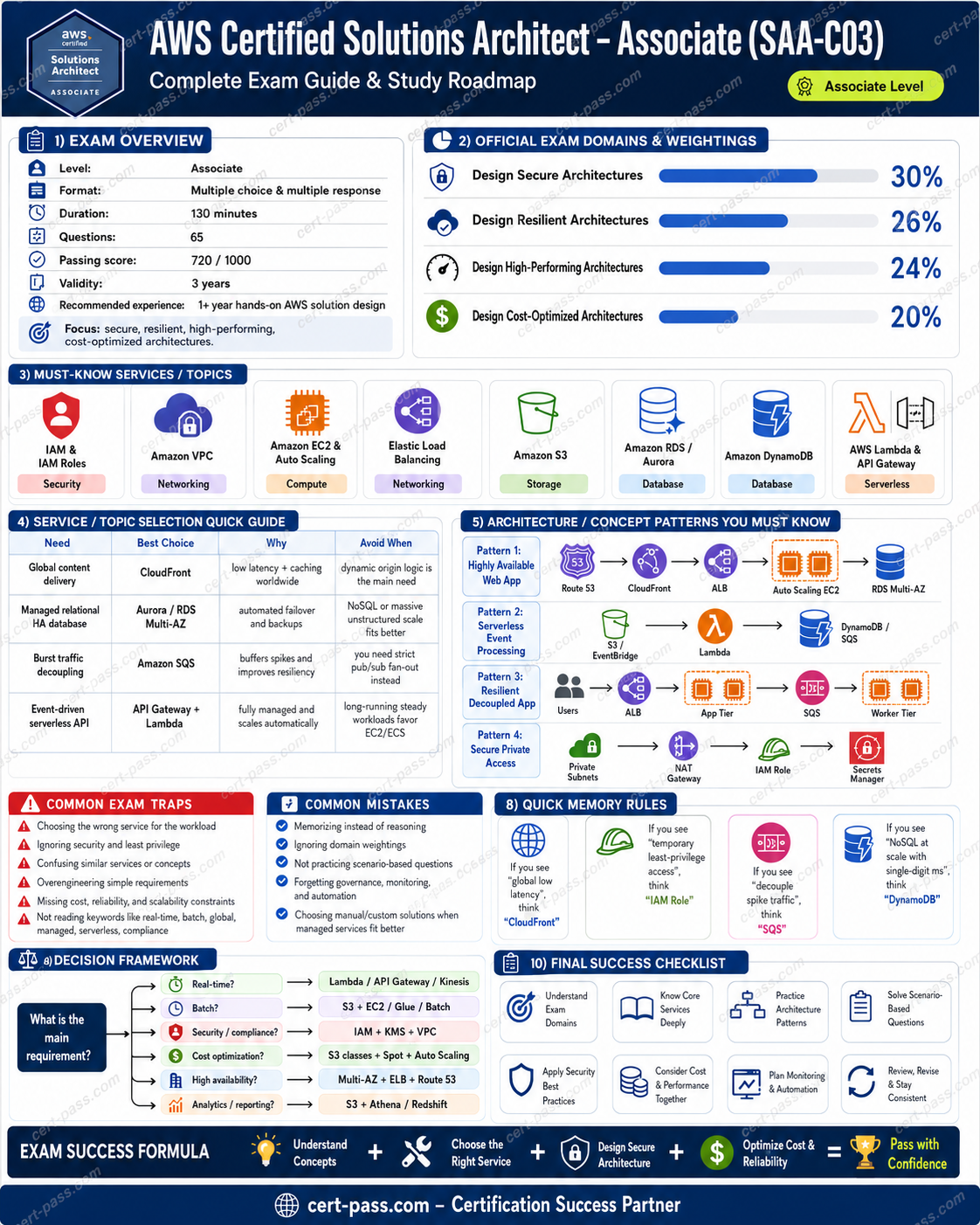
Official exam facts
| Detail | Current info |
|---|---|
| Exam name | AWS Certified Solutions Architect - Associate |
| Exam code | SAA-C03 |
| Vendor | AWS |
| Exam slug | aws-aws-solutions-architect-associate-saa-c03 |
| Questions | 65 questions |
| Question types | Multiple choice and multiple response |
| Duration | 130 minutes |
| Cost | 150 USD |
| Validity | 3 years |
| Exam page | AWS Solutions Architect Associate SAA C03 |
| Official vendor page | AWS Certified Solutions Architect - Associate |
| Cert-Pass pricing start | EUR 29 |
| Full access pricing start | EUR 39 |
| Last verified | 2026-06-01 |
The official AWS page confirms the core logistics: 65 questions, 130 minutes, multiple choice and multiple response format, a 150 USD exam price, and a three year validity period. Those details matter because they shape pacing and study effort. SAA C03 is not a speed quiz, but it is broad enough that time management and question recognition both matter.
What this exam is really testing
The exam is not asking whether a candidate can name every AWS service. It is asking whether the candidate can design a sensible solution using the right AWS building blocks for a realistic scenario. That means the exam is testing architectural judgment, not just memorization.
A good answer often does four things at once:
- meets the technical requirement;
- keeps the design secure;
- keeps the design resilient enough for the scenario;
- avoids unnecessary cost or complexity.
That combination is important. Many candidates know one of those goals but not all four. For example, a solution can be secure but too expensive, cheap but not resilient, or technically correct but much more complex than the question needs. The exam often rewards the option that balances the tradeoffs best, not the option with the longest list of features.
This is why a focused study guide matters. The candidate needs a repeatable decision framework, not a pile of random AWS facts.
How to study this exam
The most effective study path follows this sequence:
- learn the service families;
- learn the architecture tradeoffs;
- learn the common question patterns;
- drill the exam traps;
- finish with mixed scenario practice.
The candidate should not start by trying to memorize every edge case. The first goal is to build a clean mental map of AWS.
If the candidate wants to keep the study path in one place, use the main exam hub again here: AWS Solutions Architect Associate SAA C03. If the candidate wants a broader beginner friendly explanation before diving deeper, compare this guide with AWS Cloud Practitioner CLF C02 Study Guide 2026.
Domain priority map
| Priority | Domain | Approximate weight | What to master |
|---|---|---|---|
| 1 | Design secure architectures | 30% | IAM, KMS, encryption, network controls, logging, least privilege |
| 2 | Design resilient architectures | 26% | Multi AZ design, backups, fault tolerance, scaling, failover |
| 3 | Design high performing architectures | 24% | Compute, storage, networking, caching, database selection |
| 4 | Design cost optimized architectures | 20% | Pricing models, storage tiers, right sizing, elasticity, architecture tradeoffs |
This is the study order that makes the most sense. Security is the largest single domain and should be treated as a major skill, not a side topic. Resilience comes next because AWS loves scenario questions about high availability and fault tolerance. Performance and cost then round out the decision making layer.
The most important mental model
SAA C03 is mostly a tradeoff exam.
The same workload can often be built in several technically valid ways. The candidate wins by choosing the option that best balances the scenario requirements. That usually means asking four questions:
- Does this answer meet the requirement?
- Is it secure enough for the described environment?
- Is it resilient enough for the failure scenario?
- Is it simpler or cheaper than the alternatives?
If an answer is too complex, it is often wrong. If it ignores security, it is often wrong. If it fails to meet a resilience requirement, it is wrong even if it sounds modern. The best answer usually looks boring because it matches the need directly.
Core AWS service families to know
The exam is service heavy. The candidate should be able to recognize the main family first and then the exact service second.
| Service family | What it solves | Common services |
|---|---|---|
| Compute | Running applications, code, and workloads | EC2, Lambda, ECS, EKS, Elastic Beanstalk |
| Storage | Object, block, file, and archive storage | S3, EBS, EFS, Glacier |
| Database | Managed relational and non relational data | RDS, Aurora, DynamoDB, Redshift |
| Networking | Routing, DNS, delivery, isolation, and load balancing | VPC, Route 53, CloudFront, ELB, API Gateway |
| Security | Identity, access control, encryption, edge protection | IAM, KMS, WAF, Shield, Cognito |
| Observability | Metrics, logs, traces, and account activity | CloudWatch, CloudTrail, Config |
| Resilience and DR | Backup, recovery, failover, and multi region planning | AWS Backup, Route 53 failover, Multi AZ architectures |
| Migration and hybrid | Import, connect, and move workloads | Direct Connect, Snowball, Migration Hub |
The exam often gives clues in business language instead of technical language. The candidate should translate the business need into the service family before selecting the exact service.
Service selection guide
| Scenario in the question | Most likely direction |
|---|---|
| Run code without managing servers | Lambda |
| Need full operating system control | EC2 |
| Need a container platform | ECS or EKS |
| Need static object storage | S3 |
| Need block storage for an instance | EBS |
| Need shared file storage | EFS |
| Need low maintenance relational database | RDS or Aurora |
| Need key value style scale | DynamoDB |
| Need DNS routing | Route 53 |
| Need CDN delivery | CloudFront |
| Need traffic distribution across targets | Elastic Load Balancing |
| Need isolated network design | VPC |
| Need least privilege permissions | IAM |
| Need encryption key control | KMS |
| Need monitoring and alarms | CloudWatch |
| Need audit trail of API calls | CloudTrail |
| Need config change history | Config |
This is one of the most useful assets in the article because it converts vague exam language into a stable decision map.
Security architecture: what to know first
Security is the most important theme for many SAA C03 questions because AWS expects the candidate to design with security in mind by default.
Shared responsibility model
AWS secures the cloud infrastructure. The customer secures what they deploy in the cloud and how they configure it. The exact split depends on the service model, but the core idea is always the same: AWS is not responsible for every configuration choice.
A candidate should be able to explain:
- what AWS is responsible for;
- what the customer is responsible for;
- how managed services still leave some customer responsibility;
- why security must be designed into the architecture rather than added later.
Common security topics
| Topic | What the candidate should know |
|---|---|
| IAM | Users, groups, roles, policies, and least privilege |
| MFA | Additional authentication factor for account protection |
| KMS | Key management for encryption |
| Encryption | Protecting data at rest and in transit |
| Security groups | Instance level traffic control |
| Network ACLs | Subnet level traffic control |
| CloudTrail | API and account activity audit log |
| CloudWatch | Metrics, logs, alarms, dashboards |
| AWS Organizations | Multi account structure and governance |
| WAF | Protection against common web attacks |
| Shield | DDoS protection service family |
Security trap patterns
| Trap | Why it is wrong |
|---|---|
| Assume AWS handles all security automatically | Shared responsibility still applies |
| Use a public bucket when the prompt wants private access | Security requirement is violated |
| Use IAM when the question asks about network filtering | IAM controls identity, not network traffic |
| Use security groups and NACLs interchangeably | They work at different levels |
| Treat logging as the same thing as monitoring | CloudTrail and CloudWatch are different |
The best security answers are usually the ones that enforce least privilege, protect data, and keep access visible.
Resilient architectures: how AWS asks about failure
Resilience questions usually ask how to survive an outage, keep a workload available, or reduce the impact of failure. The exam likes to test whether the candidate can choose a resilient pattern without overbuilding.
Core resilience ideas
- design for failure, not perfection;
- use multiple Availability Zones for high availability;
- use backups and recovery planning;
- remove single points of failure;
- use managed services where they reduce operational burden;
- choose the simplest failover pattern that meets the requirement.
Common resilience patterns
| Scenario | Likely answer direction |
|---|---|
| Need high availability for an application | Multi AZ design |
| Need to protect data from deletion or corruption | Versioning, backups, recovery options |
| Need to survive instance failure | Auto scaling, load balancing, redundant instances |
| Need to keep DNS failover working | Route 53 health checks or failover routing |
| Need business continuity across zones | Multi AZ or managed service with HA design |
| Need recovery after region wide disruption | Multi region pattern depending on requirement |
Resilience trap patterns
| Trap | Why it fails |
|---|---|
| Rely on a single instance for a critical workload | Single point of failure |
| Use one Availability Zone for everything | No zone level resilience |
| Choose a backup only solution when the question wants high availability | Backup helps recovery, not uptime |
| Choose multi region when the prompt only needs multi AZ | Overengineering |
| Use manual failover when the prompt wants automated recovery | Too fragile for the requirement |
The exam often rewards the answer that meets the stated recovery goal and nothing more. If the question only needs fault tolerance in one region, a multi AZ design may be the right choice. Multi region is stronger, but not always necessary.
Performance architecture: what to know
Performance questions usually involve choosing the right compute, storage, database, or delivery option for the workload.
High yield performance themes
| Theme | What it usually means |
|---|---|
| Compute choice | Which AWS service should run the workload |
| Storage choice | Which storage type fits the data and access pattern |
| Database choice | Which database model fits the query and scale pattern |
| Caching | Reduce repeated reads and improve speed |
| CDN | Deliver content closer to users |
| Load balancing | Spread incoming traffic effectively |
| Auto scaling | Match capacity to demand |
Common service decisions
| Question clue | Strong candidate answer direction |
|---|---|
| Need a managed relational database | RDS or Aurora |
| Need massive scale with simple access pattern | DynamoDB |
| Need static assets delivered globally | S3 plus CloudFront |
| Need user traffic spread across multiple instances | Elastic Load Balancing |
| Need compute that runs only on demand | Lambda |
| Need containerized orchestration | ECS or EKS depending on requirement |
Performance trap patterns
| Trap | Why it is wrong |
|---|---|
| Choose the most powerful service instead of the simplest one | The prompt may not need it |
| Use a database when object storage is enough | Wrong data model |
| Ignore CDN options when the question is about global content delivery | Misses latency improvement |
| Use EC2 for something event driven and short lived | Lambda may fit better |
| Treat scaling as the same as resilience | They overlap but are not identical |
The exam usually wants the cleanest service fit, not the most famous service in the family.
Cost optimized architecture: where candidates lose easy points
The cost domain is smaller, but it often contains easy wins if the candidate knows the basic pricing and design logic.
Cost concepts to know
| Concept | Meaning |
|---|---|
| On demand | Pay for what is used without long term commitment |
| Reserved pricing | Lower cost in exchange for commitment |
| Savings Plans | Flexible commitment based discount model |
| Right sizing | Match resource capacity to actual need |
| Storage tiering | Move colder data to lower cost storage |
| Auto scaling | Pay for what is needed when needed |
| Free tier | Limited free usage for new or eligible accounts |
| TCO | Total cost of ownership |
Cost trap patterns
| Trap | Why it fails |
|---|---|
| Choose reserved pricing for a workload with highly unpredictable usage | Commitment may not fit |
| Keep hot data in expensive storage without a reason | Wastes money |
| Use oversized instances for small workloads | Poor right sizing |
| Ignore CDN or caching when the workload repeats the same reads | Unnecessary spend |
| Assume the cheapest service is always correct | It may fail security or resilience needs |
Cost questions often test whether the candidate can remove waste without harming the architecture. The correct answer usually improves efficiency in a way that still meets the requirement.
A useful architecture decision matrix
This table helps the candidate think like the exam.
| If the question emphasizes... | Think first about... | Then check... |
|---|---|---|
| Identity and permissions | IAM | MFA, roles, policies, least privilege |
| Data protection | KMS and encryption | Storage location and access path |
| Audit and visibility | CloudTrail and CloudWatch | What event or metric is being tracked |
| High availability | Multi AZ design | Whether the workload needs region level protection |
| Performance | Compute, caching, CDN, or database | Whether the problem is latency, throughput, or global delivery |
| Cost | Right sizing, storage tiering, on demand, or reserved pricing | Whether the usage is steady or variable |
| Network access | VPC, security groups, NACLs, ELB, Route 53 | Whether the issue is traffic routing or access control |
The exam often gives enough context to identify one row of this matrix. The candidate then only needs to select the right AWS control within that row.
How to break down a question quickly
Use this five step method:
- Identify the main requirement.
- Identify the domain: security, resilience, performance, or cost.
- Identify the service family.
- Eliminate answers that solve the wrong layer.
- Choose the simplest AWS native option that still satisfies the prompt.
Example:
If the question asks for a way to deliver static website content quickly to users across multiple regions, the domain is performance. The service family is storage and delivery. The likely answer is S3 plus CloudFront, not EC2 and not a database.
If the question asks for protecting an application from unauthorized access, the domain is security. The service family is identity and edge protection. The likely answer is IAM, KMS, WAF, or a network control depending on the exact prompt.
If the question asks how to reduce downtime after an instance fails, the domain is resilience. The service family is compute plus load balancing and multi AZ design. The likely answer is to remove the single point of failure, not to buy a bigger server.
What this exam is not
The exam is not asking for deep implementation details of every service. It is not a coding exam. It is not a deep networking exam. It is not a deep database tuning exam.
That matters because candidates often overstudy the wrong layer. The right target is a practical architecture baseline, not advanced specialization.
What the candidate should avoid:
- memorizing obscure service names before learning the major ones;
- focusing on edge cases before learning the core decision patterns;
- treating every question like a trick question;
- assuming the most complex architecture is the best answer.
The exam is broad, but the underlying logic is stable.
Useful asset: a 21 day study plan
| Day | Focus | Goal |
|---|---|---|
| 1 | Exam facts and domains | Know the logistics and structure |
| 2 | Cloud concepts | Understand regions, AZs, elasticity, and availability |
| 3 | Compute and storage | Learn EC2, Lambda, S3, EBS, and EFS |
| 4 | Database and networking | Learn RDS, Aurora, DynamoDB, VPC, Route 53, ELB, CloudFront |
| 5 | IAM and access control | Master least privilege, roles, MFA, and policies |
| 6 | Encryption and logging | Learn KMS, CloudTrail, and CloudWatch |
| 7 | Resilience basics | Review multi AZ, backups, and failover |
| 8 | Cost basics | Review pricing models, tiering, and right sizing |
| 9 | Security scenario questions | Practice security tradeoffs |
| 10 | Performance scenario questions | Practice service selection under latency and scale pressure |
| 11 | Resilience scenario questions | Practice failover and availability prompts |
| 12 | Cost scenario questions | Practice pricing and spend control prompts |
| 13 | Mixed practice set | Switch between domains quickly |
| 14 | Wrong answer review | Turn mistakes into rules |
| 15 | Service family drill | Map common prompts to service families |
| 16 | Security controls drill | Distinguish IAM, KMS, NACLs, security groups, CloudTrail |
| 17 | Resilience drill | Review HA, backups, and multi AZ patterns |
| 18 | Cost drill | Review savings plans, on demand, and storage efficiency |
| 19 | Full timed practice | Simulate exam pacing |
| 20 | Weak area cleanup | Fix the lowest scoring domain |
| 21 | Final review | Revisit matrices and elimination rules |
This plan is intentionally practical. It gives the candidate a repeatable order instead of a vague “study everything” instruction.
Common mistakes candidates make
Mistake 1: learning services without learning tradeoffs
A candidate may know the names of the services but still miss the question because the tradeoff is wrong. The exam cares about why one service is better than another.
Mistake 2: treating security as an add on
Security is not optional. Many answers fail because they ignore access control, encryption, or logging.
Mistake 3: choosing multi region too early
Multi region sounds impressive, but many questions only need multi AZ or a simpler resilience pattern.
Mistake 4: ignoring cost context
A technically valid architecture can still be the wrong answer if it is wasteful and the question is clearly cost sensitive.
Mistake 5: overusing EC2
EC2 is powerful, but not every problem needs a server. Sometimes Lambda, a managed service, or a storage based pattern is cleaner.
Mistake 6: confusing monitoring with audit logging
CloudWatch and CloudTrail solve different problems. The exam likes to test that distinction.
Mistake 7: ignoring the simplest service family fit
If the prompt is about storage, the answer should probably live in storage first. If the prompt is about identity, the answer should probably live in IAM first.
Readiness checklist
A candidate is probably ready when these statements feel automatic:
- identify the domain before reading the answer choices;
- explain shared responsibility in plain language;
- distinguish security groups from NACLs;
- distinguish CloudWatch from CloudTrail;
- choose S3, EBS, or EFS based on the scenario;
- choose EC2, Lambda, or container services based on the workload;
- explain why multi AZ is different from multi region;
- explain why cost optimized does not mean cheapest at all costs;
- recognize when a prompt is really asking for IAM or KMS;
- eliminate answers that are technically real but solve the wrong problem.
If the candidate cannot do those things yet, more service family practice is needed before the final timed practice set.
Related reading in the Cert-Pass library
To keep this cluster aligned, the most useful adjacent pages are:
- AWS Cloud Practitioner CLF C02 Study Guide 2026
- AWS Cloud Practitioner CLF C02 for Beginners: What to Learn First
- AWS Cloud Practitioner CLF C02 FAQ: 20 Common Questions Answered
- AWS Cloud Practitioner CLF C02 Practice Questions: 25 Exam Style Examples
- AWS Cloud Practitioner CLF C02 Salary 2026: Career Value and Compensation Factors
For the official route and free practice, return to the exam hub:
- AWS Solutions Architect Associate SAA C03
- Try 35 free AWS Solutions Architect Associate practice questions - no signup required
- Preview the compressed AWS Solutions Architect Associate course
FAQ
Is SAA C03 harder than Cloud Practitioner?
Yes. SAA C03 expects deeper architecture judgment and more nuanced service selection.
What should be studied first for SAA C03?
Start with the major service families, then security, then resilience, then performance and cost tradeoffs.
Is the exam mostly memorization?
No. It is mostly scenario based. The candidate needs to choose the best architecture, not just remember names.
Do the questions require advanced coding?
No. The exam is focused on architecture and service selection rather than programming.
How long should the candidate spend on each question?
The candidate should move efficiently, but should not rush. The exam is long enough that pacing matters, especially on multi response questions.
How long is the certification valid?
The official AWS page lists a validity period of 3 years.
The last week review loop
The last week before SAA C03 should be used to speed up classification, not to learn a brand new set of services. By that point the candidate should already know the major families. The final job is to make the exam language feel familiar.
| Topic | What the candidate should be able to say quickly |
|---|---|
| Security | This answer protects identity, data, or network access without adding unnecessary complexity |
| Resilience | This answer removes a single point of failure or improves recovery without overbuilding |
| Performance | This answer improves latency, throughput, or delivery speed for the described workload |
| Cost | This answer reduces waste while still meeting the requirement |
| Service fit | This is the AWS native service that solves the exact problem in the prompt |
A strong final review habit is to read the last line of the question first, name the domain, and then compare only the answer choices that solve that domain. If two answers still look close, the safer choice is usually the one that is simpler, more direct, and more consistent with the wording of the scenario. That small habit prevents many avoidable misses on associate level architecture questions.
Common question words that change the answer
SAA C03 often hides the right answer inside one or two key words. A candidate can know the services well and still miss a question if those words are overlooked. The goal is to train the eye to notice the difference between similar prompts.
| Key word or phrase | What it usually changes |
|---|---|
| highly available | Favor multi AZ or managed resilience patterns |
| fault tolerant | Remove single points of failure |
| lowest cost | Prefer the simpler valid design |
| encrypted | Look for KMS, SSL/TLS, or an encrypted transport path |
| private access | Avoid public exposure and use private networking patterns |
| audit | Think CloudTrail, logs, or traceability |
| performance | Consider latency, caching, delivery, or scaling |
Reading these words carefully saves time because it tells the candidate which domain is really being tested. Once the domain is known, the candidate can discard the answers that solve a different layer of the problem.
One last exam-day habit
On the exam itself, the candidate should keep one simple habit: if a question feels long, slow down just enough to name the domain before reading the answers. That small pause usually prevents the most expensive mistake, which is choosing an answer that sounds right but solves the wrong problem.
Final answer
AWS Solutions Architect Associate SAA C03 is worth studying carefully because it teaches a practical architecture mindset that is useful well beyond the exam itself. The candidate who learns the domain map, service families, and tradeoff logic is much more likely to choose the right answer under pressure. The candidate who tries to memorize isolated services without context is much more likely to get trapped by plausible distractors.
Use the exam hub as the anchor: AWS Solutions Architect Associate SAA C03. Use free practice to pressure test the basics: Try 35 free AWS Solutions Architect Associate practice questions - no signup required. Use the compressed course when the goal is to tighten the final review: Preview the compressed AWS Solutions Architect Associate course.
The most useful study habit is simple: identify the domain first, identify the service family second, and choose the answer that meets the requirement without overbuilding.