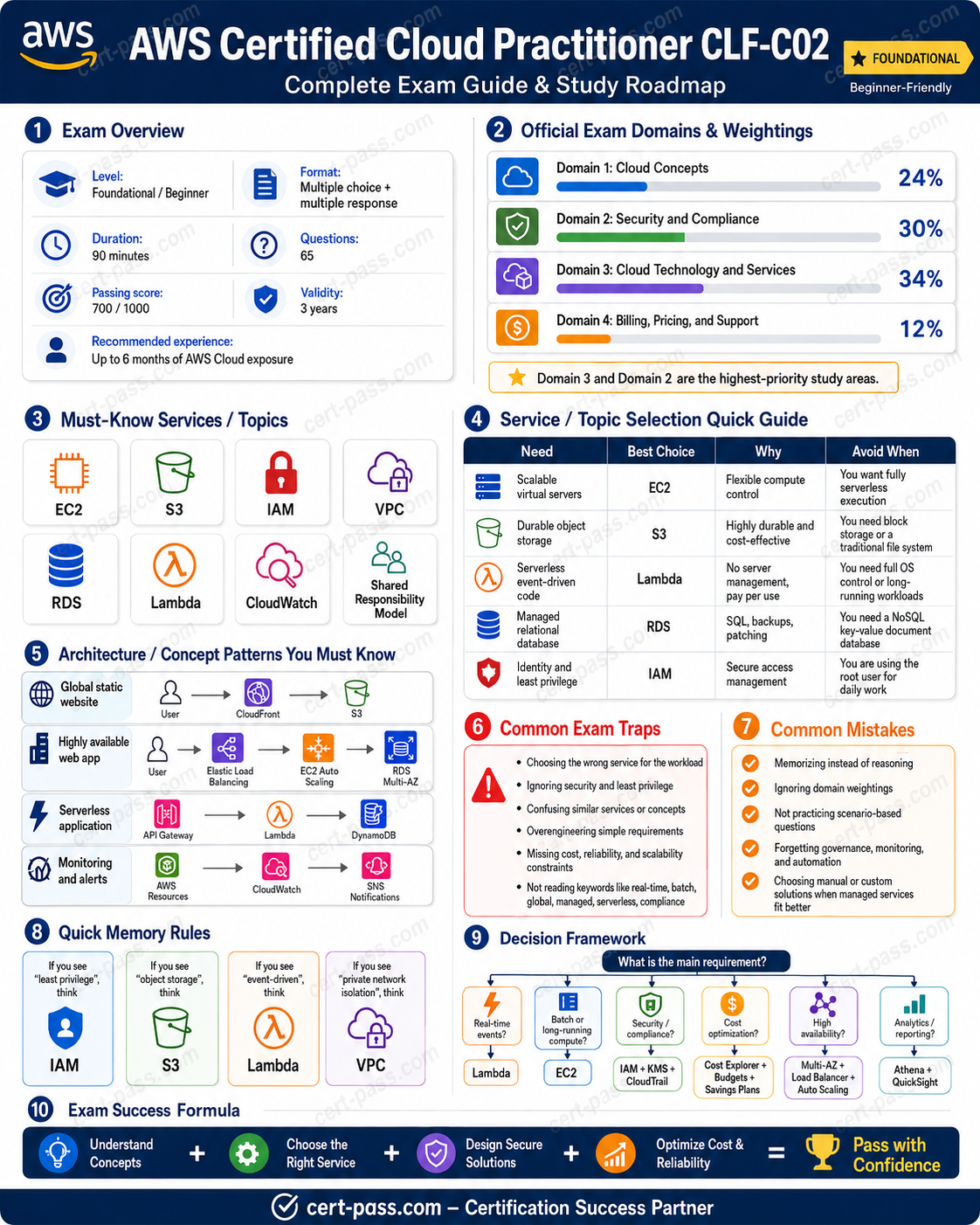
The goal of this page is simple: answer the questions candidates ask most often, keep the explanation grounded in the official exam scope, and point the reader toward the right next step without turning the page into a second full study guide. For the main exam hub, use AWS Cloud Practitioner CLF C02 practice exam. For free practice, use Try 35 free AWS Cloud Practitioner CLF C02 practice questions - no signup required. For a compressed study path, use Preview the compressed AWS Cloud Practitioner CLF C02 course.
Official exam facts
| Detail | Current info |
|---|---|
| Exam name | AWS Cloud Practitioner CLF-C02 |
| Exam slug | aws-aws-cloud-practitioner-clf-c02 |
| Vendor | AWS |
| Questions | 65 |
| Time limit | 90 minutes |
| Passing score | 70 out of 100 on the scaled score model |
| Prerequisites | None required |
| Domain 1 | Cloud Concepts, 24 percent |
| Domain 2 | Security and Compliance, 30 percent |
| Domain 3 | Cloud Technology and Services, 34 percent |
| Domain 4 | Billing, Pricing, and Support, 12 percent |
| Official certification page | AWS Certified Cloud Practitioner |
| Main study hub | AWS Cloud Practitioner CLF C02 practice exam |
| Free practice | Try 35 free AWS Cloud Practitioner CLF C02 practice questions - no signup required |
| Compressed course | Preview the compressed AWS Cloud Practitioner CLF C02 course |
| Last verified | 2026-06-01 |
AWS describes this certification as a foundational cloud credential. That matters because the exam is designed to check cloud literacy, service recognition, and basic scenario reading rather than deep architecture design. A candidate does not need to know every AWS service. A candidate does need to know the common service families, the shared responsibility model, the main cost tools, and the basic support structure. That is the real center of the exam, and this FAQ is built around that center.
Why an FAQ page helps more than another long guide
A beginner often does not need another generic overview of AWS. What the candidate needs is quick clarification on the exact things that still feel fuzzy after a first read. That is where an FAQ page works well. It gives direct answers to the most common sticking points:
- What is this exam actually testing?
- How hard is it?
- What should be studied first?
- Which services matter most?
- How long should preparation take?
- How do the look alike services differ?
- What is the best next step after reading the FAQ?
The page stays focused on those questions so the reader can make a decision quickly. If the answer is to keep studying, the next step should be obvious. If the answer is to start practice, the route should be obvious. If the answer is to review the official exam facts again, that should also be obvious.
FAQ at a glance
| Question type | Short answer |
|---|---|
| What is the exam? | A foundational AWS cloud certification |
| Is it beginner friendly? | Yes |
| How many questions? | 65 |
| How long is it? | 90 minutes |
| Is there a prerequisite? | No |
| What matters most? | Common AWS services, cloud concepts, security, billing tools |
| What is the main study strategy? | Learn service families and compare look alike services |
| What is the best first step? | Open the exam hub and start with the study guide |
1. What is AWS Cloud Practitioner CLF C02?
AWS Cloud Practitioner CLF C02 is AWS's foundational certification for broad cloud understanding. It is aimed at candidates who need to understand AWS at a high level, not at the level of building or troubleshooting complex architectures. The exam checks whether the candidate can recognize cloud benefits, understand the shared responsibility model, and choose the correct AWS service or tool for a basic scenario.
The important idea is that this exam is wide rather than deep. It covers many service names, but the questions usually stay at the level of purpose and fit. That makes it a practical exam for people entering cloud work, moving into a cloud adjacent role, or building a baseline before a more advanced AWS path.
2. Is AWS Cloud Practitioner CLF C02 good for beginners?
Yes. It is one of the most approachable AWS certifications because it does not require prior cloud experience. A beginner can start from the basics and still make real progress. The exam rewards clear thinking more than technical memorization. A candidate who learns the common service families and the meaning of the main security and cost tools can answer a surprising number of questions correctly.
A beginner should not treat the exam as a trivia quiz. The better mindset is to treat it as a vocabulary and scenario exam. Once the vocabulary is learned, the questions stop feeling random.
3. How hard is the exam?
The exam is usually manageable for candidates who study consistently, but it is not automatic. The hard part is not deep engineering detail. The hard part is distinguishing similar services and reading the scenario carefully.
For example, CloudTrail and CloudWatch sound related, but they do different jobs. S3 and EBS are both storage services, but they solve different problems. Pricing Calculator and Cost Explorer both deal with cost, but one estimates future spend while the other analyzes current or historical spend. The exam becomes much easier once those pairs are learned cleanly.
4. How many questions are on the exam?
The exam has 65 questions. That number is useful because it reminds the candidate to pace the exam sensibly. There is enough room to spend a little extra time on tricky questions, but not so much room that careless pacing can be ignored. A candidate should aim to move steadily, mark uncertain items when allowed, and return to them with a clearer head.
5. How long is the exam?
The exam time limit is 90 minutes. That means the candidate has a little more than a minute per question on average. The practical lesson is not to rush every item, but to avoid getting stuck too long on a single confusing service choice.
A good test habit is to classify the question first. Ask whether the item is about security, storage, compute, networking, billing, or cloud concepts. Once the category is clear, the answer choices usually narrow quickly.
6. Is there a prerequisite?
No. AWS Cloud Practitioner CLF C02 does not require a prior certification or formal technical background. That does not mean the exam is effortless. It means the entry point is open. A candidate can begin with core AWS ideas, then move into the service families and cost tools.
That open entry is one reason the certification is popular with career switchers, non technical team members who work with cloud teams, and candidates who want to build a clean starting point before a more advanced AWS exam.
7. What should a beginner study first?
The best starting order is:
- cloud concepts
- shared responsibility
- IAM and security basics
- S3, EBS, EFS, Glacier
- EC2, Lambda, containers, Elastic Beanstalk
- RDS, DynamoDB, Redshift, ElastiCache
- CloudTrail, CloudWatch, Config, Artifact
- Route 53, CloudFront, VPC, Direct Connect, VPN
- Pricing Calculator, Cost Explorer, Budgets
- support plans and organizations
That order works because it begins with the ideas that explain the rest of AWS. A beginner who starts with the shared responsibility model and the major service families usually learns faster than a beginner who starts by memorizing obscure product names.
8. Which AWS services matter most?
The exam does not require deep knowledge of every AWS product. It does require a stable understanding of the most common ones. The most important services for a beginner are usually:
| Category | Services to know well |
|---|---|
| Identity and access | IAM, roles, policies, MFA |
| Audit and monitoring | CloudTrail, CloudWatch, Config |
| Storage | S3, EBS, EFS, Glacier |
| Compute | EC2, Lambda, ECS, EKS, Fargate, Elastic Beanstalk |
| Databases | RDS, DynamoDB, Redshift, ElastiCache |
| Networking | VPC, Route 53, CloudFront, Direct Connect, VPN |
| Security | KMS, Secrets Manager, WAF, Shield, GuardDuty, Inspector, Macie |
| Billing | Pricing Calculator, Cost Explorer, Budgets |
| Support | Basic, Developer, Business, Enterprise |
The candidate does not need to become an expert in every one of those services. The goal is service recognition. If the candidate can explain what each service is for, the exam becomes much more approachable.
9. What is the difference between CloudTrail and CloudWatch?
This is one of the most common FAQ questions because the names sound similar.
- CloudTrail records API activity and account events.
- CloudWatch monitors metrics, logs, dashboards, and alarms.
A simple way to remember the difference is to ask what the question is trying to reveal. If the scenario asks who did something or what API action occurred, CloudTrail is usually the right choice. If the scenario asks what is happening to the system right now, CloudWatch is usually the right choice.
10. What is the difference between CloudWatch and Config?
CloudWatch and Config both help with visibility, but they are not interchangeable.
- CloudWatch is operational visibility: metrics, logs, and alarms.
- Config is change and compliance visibility: what changed, when it changed, and whether a resource still matches the expected configuration.
If the question is about an alarm on CPU usage, CloudWatch fits. If the question is about whether a resource drifted away from a compliance rule, Config fits.
11. What is the difference between S3, EBS, EFS, and Glacier?
This storage comparison appears constantly because each service solves a different problem.
| Service | Main purpose |
|---|---|
| S3 | Object storage for files, images, backups, static assets, and data lakes |
| EBS | Block storage for EC2 volumes |
| EFS | Shared file storage across multiple instances |
| Glacier | Long term archive storage |
The simplest memory rule is:
- S3 stores objects.
- EBS stores blocks.
- EFS stores shared files.
- Glacier stores archives.
A candidate who keeps that rule in mind can answer many storage questions quickly.
12. What is the difference between RDS, DynamoDB, and Redshift?
This is another question that shows up often because database selection is a common exam pattern.
- RDS is a managed relational database service.
- DynamoDB is a NoSQL key value and document database with low latency access.
- Redshift is a data warehouse for analytics.
The exam usually gives a clue in the workload description. If the workload is transactional and relational, RDS is likely. If the workload needs highly scalable NoSQL access, DynamoDB is likely. If the workload is about analysis across large data sets, Redshift is likely.
13. What is the difference between Route 53 and CloudFront?
These are both network and edge services, but they do different jobs.
- Route 53 is DNS and domain routing.
- CloudFront is a content delivery network that caches content closer to users.
If a question is about resolving a domain name, routing traffic by DNS policy, or managing a hosted zone, Route 53 is the better fit. If a question is about delivering content quickly from edge locations, CloudFront is the better fit.
14. What is the difference between Direct Connect and VPN?
Both help with private connectivity, but they are not the same.
- Direct Connect provides a dedicated private connection to AWS.
- VPN provides an encrypted connection over the internet.
If the scenario explicitly asks for a dedicated link, Direct Connect is the better answer. If the scenario asks for encrypted connectivity over the public internet with less setup complexity, VPN is usually the better answer.
15. What is the difference between Pricing Calculator, Cost Explorer, and Budgets?
These tools are easy to confuse, but the exam tests them separately.
| Tool | Main job |
|---|---|
| Pricing Calculator | Estimate future cost before deployment |
| Cost Explorer | Analyze historical or current spend |
| Budgets | Alert when spending or usage crosses a threshold |
A candidate should think of them as a planning sequence:
- estimate first with Pricing Calculator
- analyze spend with Cost Explorer
- get alerts with Budgets
That sequence is one of the easiest billing concepts to learn well.
16. What is the difference between IAM, Organizations, and SCPs?
These three concepts all relate to access and governance, but at different levels.
- IAM controls identity and permissions inside an account.
- AWS Organizations manages multiple accounts together.
- Service Control Policies set permission boundaries across accounts in an organization.
If the question is about an individual user or role, IAM is usually the answer. If the question is about many accounts, Organizations is probably involved. If the question is about restricting what can happen across the organization, SCPs are often the key clue.
17. What is the best way to study the exam domains?
A good study method is to use the domain weights as a priority guide rather than as a strict rule.
| Domain | Weight | Study focus |
|---|---|---|
| Cloud Technology and Services | 34 percent | service families and scenario matching |
| Security and Compliance | 30 percent | IAM, audit, monitoring, encryption, threat detection |
| Cloud Concepts | 24 percent | cloud value, elasticity, scalability, resilience |
| Billing, Pricing, and Support | 12 percent | cost tools and support plans |
The largest domain deserves the most attention, but the smaller domain should not be ignored. The best exam prep is balanced, not lopsided.
18. What should a candidate do if the service names feel overwhelming?
The best response is to stop trying to memorize the entire AWS catalog as a flat list. Instead, group the services by job.
- Identity and access
- Audit and monitoring
- Storage
- Compute
- Database
- Networking
- Security
- Billing
- Support
Once the candidate sees the service as part of a family, the names become easier to retain. The question changes from “What is this random product?” to “Which family does this belong to, and what does it solve?”
19. How should practice questions be used?
Practice questions should be used to improve recognition, not to replace study. The value of practice is that it shows how AWS wording appears in actual scenarios. The learner can then compare the wrong answers and learn why the distractors are tempting.
A useful method is to review each wrong answer and identify the clue that was missed:
- Did the question describe audit history?
- Did it describe operational monitoring?
- Did it describe a storage type?
- Did it describe a cost estimate or cost alert?
- Did it describe web protection or DDoS defense?
That style of review is more effective than simply scoring the practice set and moving on.
20. What is the best next step after reading this FAQ?
The best next step is to move from questions into structured practice. The main exam page should stay open as the anchor, and the candidate should use it to connect the FAQ answers to the study guide and the free practice path.
Recommended sequence:
- review the exam hub
- read the study guide
- take free practice questions
- return to the FAQ for any unclear service pair
- use the compressed course preview for final review
The most useful internal route is still AWS Cloud Practitioner CLF C02 practice exam.
Common beginner traps in FAQ form
| Trap | Better interpretation |
|---|---|
| CloudTrail vs CloudWatch | Audit history versus operational monitoring |
| CloudWatch vs Config | Metrics and alarms versus configuration compliance |
| S3 vs EBS | Object storage versus block storage |
| EBS vs EFS | Single volume versus shared file system |
| RDS vs DynamoDB | Relational versus NoSQL |
| Route 53 vs CloudFront | DNS versus content delivery |
| Direct Connect vs VPN | Dedicated link versus encrypted internet tunnel |
| Pricing Calculator vs Cost Explorer | Estimate future spend versus analyze past spend |
| Budgets vs Cost Explorer | Alerts versus analysis |
| WAF vs Shield | Web request filtering versus DDoS protection |
A candidate who can explain those pairs in plain language is usually in much better shape than a candidate who knows only service names.
Study strategy by question type
AWS Cloud Practitioner CLF C02 questions usually fall into a few broad patterns.
Definition questions
These ask what a service or concept means. The best answer comes from clean vocabulary. For example, a question may ask what IAM or CloudTrail does.
Comparison questions
These ask the candidate to choose between similar tools. For example, S3 versus EBS or CloudWatch versus CloudTrail. The best answer comes from understanding the job of each service.
Scenario questions
These ask what to use for a business requirement. The best answer comes from translating the business need into the service family.
Cost questions
These ask about cost planning, analysis, or alerts. The best answer usually comes from knowing the difference between Pricing Calculator, Cost Explorer, and Budgets.
Responsibility questions
These ask what AWS manages and what the customer manages. The best answer comes from the shared responsibility model.
A compact answer map for the most common questions
| If the question asks about... | Think of... |
|---|---|
| API activity | CloudTrail |
| metrics or alarms | CloudWatch |
| configuration compliance | Config |
| compliance reports | Artifact |
| object storage | S3 |
| block storage | EBS |
| shared file storage | EFS |
| archive storage | Glacier |
| relational database | RDS |
| NoSQL database | DynamoDB |
| data warehouse | Redshift |
| DNS | Route 53 |
| content delivery | CloudFront |
| dedicated private connection | Direct Connect |
| encrypted internet connection | VPN |
| cost estimate | Pricing Calculator |
| cost analysis | Cost Explorer |
| cost alert | Budgets |
| web filtering | WAF |
| DDoS protection | Shield |
This map is useful because it turns broad exam prep into a quick recall tool. The candidate can use it as a self check during study.
Related reading in the Cert Pass library
If this FAQ made the exam feel more manageable, the next useful pages are:
- AWS Cloud Practitioner CLF C02 Study Guide 2026
- AWS Cloud Practitioner CLF C02 for Beginners: What to Learn First
- AWS Cloud Practitioner CLF C02 Practice Questions: 25 Exam Style Examples
- AWS Cloud Practitioner CLF C02 Salary 2026: Career Value and Compensation Factors
- AWS Cloud Practitioner CLF C02 practice exam
The exam hub should remain the central starting point: AWS Cloud Practitioner CLF C02 practice exam.
FAQ summary
AWS Cloud Practitioner CLF C02 is a foundational exam with 65 questions and a 90 minute time limit. It does not require prerequisites, and it is designed to test cloud literacy, not advanced engineering. The most important study strategy is to learn the common AWS service families, compare look alike services, and understand the shared responsibility model. The most important support tools are the exam hub, the free practice questions, and the compressed course preview.
Official source
The official AWS certification page for AWS Certified Cloud Practitioner should remain the external reference point for exam facts.
21. How should a candidate study in the first week?
The first week should be about structure, not volume. A candidate who tries to memorize everything on day one usually ends up with a pile of unrelated terms. A better first week is short and ordered.
A strong first week looks like this:
- Day 1: read the exam facts and the cloud concepts summary
- Day 2: study shared responsibility and IAM
- Day 3: learn S3, EBS, EFS, and Glacier
- Day 4: learn EC2 and Lambda
- Day 5: learn CloudTrail, CloudWatch, and Config
- Day 6: review the most confusing service pairs
- Day 7: take a small practice set and review every wrong answer
That rhythm keeps the candidate moving without overwhelming them. The goal is not to master the whole blueprint in seven days. The goal is to build a stable base so the rest of the study plan has something to connect to.
22. What is the most efficient way to review wrong answers?
Wrong answers are valuable only if the candidate learns the reason they were wrong. A good review process is simple:
- identify the service or concept the question was really testing
- explain why the correct answer fits the scenario
- explain why the tempting wrong answer is wrong
- write one short memory note in plain language
For example, if a question asks about audit history and the candidate missed CloudTrail, the memory note should not be a giant paragraph. It can be something like: "CloudTrail records API activity, not metrics." That short line is more useful than copying the whole explanation.
23. What should a candidate do when two answers both look correct?
This happens often in Cloud Practitioner questions. The best response is to compare the answers against the wording of the scenario. One answer usually fits the exact need more closely.
A good elimination habit is to ask:
- Which answer matches the job of the service most directly?
- Which answer solves a different problem layer?
- Which answer is broader than the question needs?
- Which answer adds extra complexity?
The correct answer is often the simplest one that fully satisfies the requirement. The exam usually rewards precise fit, not the fanciest product name.
24. Is the exam more about memorization or understanding?
It is both, but understanding matters more. Memorization helps the candidate recognize the service names, yet understanding is what makes the right answer stand out in a scenario. A candidate who memorizes only definitions may still struggle when the answer choices are close together. A candidate who understands the purpose of each service can usually eliminate wrong answers faster.
The best balance is to memorize the core service names and then practice applying them to scenarios. That is why this FAQ keeps returning to the same idea: know the service family, know the difference between similar services, and know the clue in the question.
25. What should a candidate remember on exam day?
A candidate does not need a massive last minute cram sheet. The most useful last day review is a short list of high frequency comparisons:
- CloudTrail versus CloudWatch versus Config
- S3 versus EBS versus EFS versus Glacier
- RDS versus DynamoDB versus Redshift
- Route 53 versus CloudFront
- Direct Connect versus VPN
- Pricing Calculator versus Cost Explorer versus Budgets
- WAF versus Shield
- IAM versus Organizations versus SCPs
If those comparisons are clear, the exam usually feels much less chaotic.
26. What does a candidate not need to overfocus on?
A candidate does not need to overfocus on obscure service details, advanced configuration steps, or long lists of feature names that rarely appear in foundational questions. The exam usually rewards purpose and fit. That means the candidate is better off knowing what a service does than memorizing every product variant or optional subfeature.
It also helps to avoid going too deep into specialist architecture topics before the basics are stable. A beginner who knows the common services well usually gains more than a beginner who spends too much time on niche services that are unlikely to appear in a foundational scenario.
27. What is the simplest way to know the candidate is ready?
A candidate is usually ready when the common comparisons feel automatic and comfortable. If CloudTrail and CloudWatch are easy to separate, if S3, EBS, EFS, and Glacier are easy to separate, if RDS, DynamoDB, and Redshift are easy to separate, and if Pricing Calculator, Cost Explorer, and Budgets are easy to separate, the foundation is probably strong enough for the exam.
Readiness is not perfect confidence. It is stable recognition and retention. When the service families start to feel familiar and the scenario clues feel obvious, the exam becomes far more manageable.
28. Should a candidate take Cloud Practitioner before an associate exam?
It depends on the starting point. If the candidate still feels weak on cloud vocabulary, shared responsibility, or the AWS service families, Cloud Practitioner is a useful first step because it creates a stable foundation. If the candidate already has those basics and is aiming directly at an associate level role, the foundation exam is helpful but not strictly required. The real decision is whether the candidate needs a vocabulary step before the deeper exam.
Final CTA
If the next step should be simple and practical, open AWS Cloud Practitioner CLF C02 practice exam, then move to Try 35 free AWS Cloud Practitioner CLF C02 practice questions - no signup required, and finish by reviewing Preview the compressed AWS Cloud Practitioner CLF C02 course.