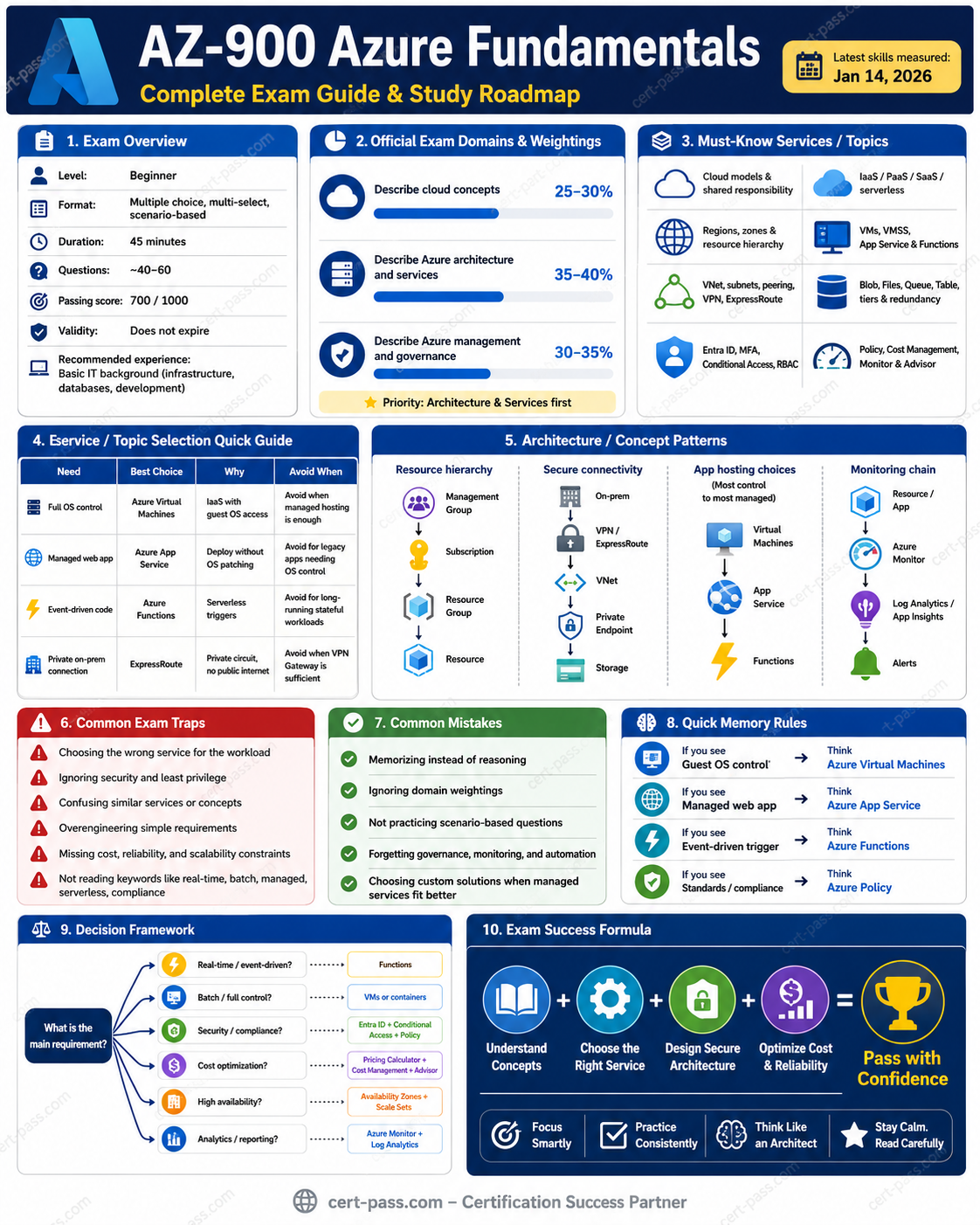
AZ-900 Changes in 2026: What Has Actually Changed
AZ-900 changes in 2026 should be understood carefully. The exam is a fundamentals certification, so the biggest risk is not a dramatic rewrite of every topic. The bigger risk is assuming that nothing has changed at all. In practice, the way candidates prepare for AZ-900 can change because Microsoft naming evolves, the Azure product catalog evolves, and the wording around identity, governance, and cloud operations becomes more current over time. This guide explains what should be reviewed in 2026, what has stayed stable, and how to adjust a study plan without chasing rumors or outdated notes.
The best place to anchor the preparation is the official exam page at AZ-900 Azure Fundamentals. For a full topic review, keep the current study guide nearby: AZ-900 Azure Fundamentals Study Guide for 2026. For answer practice, use the live question set: AZ-900 Practice Questions and Answers for 2026. For the most common mistakes and traps, review: AZ-900 Common Mistakes and Exam Traps for 2026. For a structured calendar approach, use: AZ-900 Study Plan 2026: 2-Day, 5-Day, and 7-Day Options.
Official exam facts
| Detail | Info |
|---|---|
| Exam code | AZ-900 |
| Certification | Azure Fundamentals |
| Vendor | Microsoft |
| Best use of this page | Track what has changed and what has stayed the same |
| Official source | Microsoft Learn Azure Fundamentals |
| Cert Pass hub | AZ-900 Azure Fundamentals |
| Retirement date | Not announced |
The key idea for 2026 is simple: study the current vocabulary and current service names, but do not overreact to small phrasing changes. AZ-900 still tests cloud concepts, Azure architecture, compute, networking, storage, identity, governance, monitoring, and cost basics. What changes most often is the surface layer: product names, UI wording, and the way Microsoft frames certain services. That means a strong candidate should spend time aligning older notes with current terms rather than trying to relearn the whole exam from zero.
What actually changes in a fundamentals exam
Fundamentals exams change in a different way than role based technical exams. A service engineer exam may shift more rapidly because the platform depth changes quickly. AZ-900 is broader and more stable. That means the most important updates usually fall into one of three groups:
- Naming updates
- Terminology updates
- Question framing updates
These updates can affect how a candidate reads a question even when the underlying concept is unchanged. For example, Microsoft may rename a service, update a portal label, or modernize identity language. The exam then expects the candidate to recognize the current term, not just the older one.
The exam is still fundamentally about understanding the same ideas:
- What is cloud computing?
- What is the difference between IaaS, PaaS, SaaS, and serverless?
- How do regions, subscriptions, and resource groups fit together?
- Which service is used for a specific compute, storage, networking, identity, governance, or monitoring need?
So when people ask what is new in 2026, the best answer is not “everything.” The best answer is that candidates should align their vocabulary and examples to the current Azure ecosystem while keeping the same core concepts.
What has stayed stable
A lot of AZ-900 remains stable year to year. That stability is useful because it means candidates can prepare with confidence instead of waiting for a massive overhaul that is unlikely to arrive.
Stable concept 1: cloud models
The major cloud models are still the same:
- public cloud
- private cloud
- hybrid cloud
The exam may describe these differently, but the underlying classification still matters. A candidate should still be able to identify whether a scenario describes shared cloud resources, a dedicated environment, or a mixture of both.
Stable concept 2: service models
IaaS, PaaS, SaaS, and serverless remain central to AZ-900. They may appear in different wording, but the distinction has not changed:
- IaaS gives the customer more OS and infrastructure control
- PaaS removes more management work
- SaaS gives access to the full application
- serverless shifts infrastructure management to the provider and focuses the customer on code
Stable concept 3: core Azure hierarchy
The hierarchy still matters:
- management group
- subscription
- resource group
- resource
This structure helps candidates understand where policies apply, where billing boundaries exist, and how Azure resources are organized.
Stable concept 4: governance and monitoring
The same Azure tools still matter:
- Azure Policy
- RBAC
- resource locks
- Azure Monitor
- Azure Service Health
- Azure Advisor
- Cost Management
- pricing calculator
The names may evolve slightly in portal displays or documentation phrasing, but the functional distinctions remain important for AZ-900.
Stable concept 5: service selection by scenario
The exam still rewards one thing above all else: matching the requirement to the right Azure service. A candidate should still be able to choose between a virtual machine, App Service, Functions, containers, Blob Storage, Azure Files, VPN Gateway, ExpressRoute, private endpoint, or a governance control depending on the wording of the prompt.
What is worth reviewing carefully in 2026
If a candidate is using old notes, there are some areas that deserve extra attention. These are not necessarily brand new exam topics. They are the topics where the wording is most likely to feel current in 2026.
1. Microsoft identity naming
Microsoft identity terminology continues to matter. The ecosystem uses Microsoft Entra ID as the cloud identity platform. Candidates who only remember older naming habits can get distracted, especially if they studied older notes that still use different terminology. The concept is not new, but the wording needs to be current.
A candidate should still know the difference between:
- identity and access management
- authentication and authorization
- MFA and passwordless sign in
- Conditional Access and RBAC
If a note set uses older wording, update it to the current term while keeping the meaning the same.
2. Monitoring versus application observability
The line between Azure Monitor, Service Health, Log Analytics, and Application Insights remains important. This is not a new exam area, but the exact wording in 2026 style materials may use more current observability language. Candidates should know what is platform health, what is environment telemetry, and what is application telemetry.
3. Storage access patterns
Storage questions remain common because the wrong answers are so believable. In 2026, candidates should still be able to tell the difference between:
- Blob Storage for object data
- Azure Files for SMB style shared file access
- Queue Storage for messages
- Table Storage for simple NoSQL entities
- Managed disks for VM disks
4. Networking distinctions
Networking questions remain one of the most testable areas because the wording is easy to twist. The candidate should still distinguish:
- VNet versus subnet
- peering versus VPN Gateway
- VPN Gateway versus ExpressRoute
- public endpoint versus private endpoint
The concepts are stable, but the questions may be framed with slightly more current Azure service language.
5. Governance and compliance language
Azure Policy, tags, RBAC, and resource locks are all stable topics, but they are often discussed in more business oriented language now. The candidate should be able to map business requirements to the technical control:
- enforce standards -> Azure Policy
- grant permissions -> RBAC
- protect from deletion -> resource lock
- classify resources -> tags
What may feel different to candidates in 2026
Candidates often interpret a new question style as a content change. Sometimes it is. Sometimes it is just a wording change. It helps to know the difference.
A. More scenario driven wording
AZ-900 has long been scenario based, but candidates in 2026 may notice that questions are framed around practical business situations more often than around pure definitions. This does not mean the exam is harder in a new way. It means the candidate must read for the actual requirement instead of reacting to a familiar keyword.
Example patterns include:
- A company needs to reduce operational overhead.
- A team wants to avoid managing the operating system.
- A business needs to enforce standards across subscriptions.
- A group wants to review Azure platform incidents.
- A workload must connect privately without using the public internet.
Those are still concept questions, but the wording looks more practical.
B. More emphasis on the simplest valid answer
The exam often rewards the least complex service that satisfies the requirement. In 2026, that habit matters even more because many candidates have seen enough Azure content to overcomplicate answers. If a question asks for a managed web app platform, App Service is often better than a virtual machine. If a question asks for encrypted internet connectivity, VPN Gateway may be better than ExpressRoute. If a question asks for a private IP path to a supported service, private endpoint is often the clean answer.
C. More current Microsoft branding
Microsoft branding and naming can change over time. Candidates may see newer names in official pages and need to recognize them quickly. This is especially true in identity and AI related areas, but it can also affect general Azure materials. A good review process should scan old notes for outdated names and update them into the current vocabulary.
How to refresh older notes for 2026
If a candidate already has AZ-900 notes from a previous year, the best approach is not to throw everything away. The better approach is to refresh the notes carefully.
Step 1: check the official exam page
Start with the current exam hub and Microsoft Learn page. Confirm the exam still has the same general scope and that there is no retirement announcement. For AZ-900, the official source remains the safest reference point.
Step 2: update terminology
Replace old or inconsistent wording with the current Azure names. This keeps the notes aligned with the current platform vocabulary. For example, if the notes use an older identity label, switch it to the current Microsoft name while preserving the explanation.
Step 3: fix near duplicate examples
Older notes often repeat the same example in slightly different forms. This is not harmful, but it can create noise. In a 2026 refresh, try to keep one strong example per concept instead of three nearly identical ones.
Step 4: rebuild the comparison tables
AZ-900 is a comparison exam. Old notes should be checked for missing pairs:
- Policy versus RBAC
- Monitor versus Service Health versus Application Insights
- VPN Gateway versus ExpressRoute
- Blob Storage versus Azure Files
- pricing calculator versus Cost Management
Step 5: add current internal links
Make sure the study guide, practice questions, trap article, and study plan are linked together. A complete cluster is stronger than isolated pages.
Current AZ-900 cluster structure
This exam is now best supported by a small, connected cluster rather than a single page.
| Article type | Purpose |
|---|---|
| Study guide | Learn the full exam scope and core concepts |
| Practice questions | Apply the concepts in scenario form |
| Common mistakes and exam traps | Avoid the most likely wrong answers |
| Study plan | Follow a realistic 2 day, 5 day, or 7 day schedule |
| Changes in 2026 | Refresh wording and keep the notes current |
| Worth it in 2026 | Decide whether the certification is a good investment |
A cluster works because each page reinforces a different part of the decision process. The study guide teaches the broad map. The practice questions test it. The trap article shows where mistakes happen. The study plan tells the candidate how to move through the material. The changes article keeps the wording current. The worth it article helps candidates decide whether to invest the time.
What should be linked from every AZ-900 article
A cluster article should never stand alone. Every page should link to the same core set of resources when relevant:
- AZ-900 Azure Fundamentals
- AZ-900 Azure Fundamentals Study Guide for 2026
- AZ-900 Practice Questions and Answers for 2026
- AZ-900 Common Mistakes and Exam Traps for 2026
- AZ-900 Study Plan 2026: 2-Day, 5-Day, and 7-Day Options
- Microsoft Learn Azure Fundamentals
The goal is to make the cluster feel like a connected path, not a pile of unrelated posts.
What has not changed enough to panic about
Some candidates worry that the exam changes every year. For AZ-900, that is usually not the right way to think about it. The exam may evolve, but the core requirements do not usually change enough to require a completely new strategy.
These topics still matter in essentially the same way:
- cloud deployment models
- service models
- architecture hierarchy
- compute and storage selection
- identity and access basics
- governance and monitoring basics
- cost planning and tracking
That means old learning remains valuable if it is updated with the current names and checked against the official page.
What is most likely to confuse candidates using old notes
Old notes can be useful, but they often create the same three kinds of confusion.
Confusion 1: old brand names
The candidate remembers the concept but not the current product label. This is a naming problem, not a knowledge problem.
Confusion 2: outdated examples
The note uses an old example that no longer feels current. This can make the concept seem harder than it is.
Confusion 3: too much detail in one place
Old notes sometimes grow into a wall of text. That makes the exam harder to study from. For AZ-900, comparison tables and short rules are more useful than long paragraphs alone.
How to study AZ-900 in 2026 if starting from zero
A new candidate does not need a huge amount of technical depth to start. The best path is simple.
Day 1
- Cloud concepts
- Deployment models
- Service models
- Azure hierarchy
Day 2
- Compute services
- Storage services
- Networking basics
Day 3
- Identity and security
- Governance and policy
Day 4
- Monitoring, cost, and management tools
- Review of weak areas
Day 5
- Practice questions
- Mistake review
- Final exam page review
That structure works because it moves from broad concepts to more concrete services and then to review. Candidates who skip this sequence often find themselves memorizing service names without understanding the underlying pattern.
How to study if the candidate already knows Azure basics
An experienced candidate should not use the same slow path. Instead, focus on the changes and the traps.
- Recheck the official Microsoft Learn page
- Scan the service names for current wording
- Review monitoring and identity terminology
- Use practice questions immediately
- Focus on the most common mistake pairs
- Refresh the study guide instead of rereading everything
For someone already comfortable with Azure, the best use of time is usually in practice and elimination, not in relearning what a virtual machine is.
A 2026 review checklist
Use this checklist to see whether the notes are current enough.
| Question | If yes, the notes are in good shape |
|---|---|
| Do the notes use current Microsoft naming? | Identity and service references feel current |
| Do the notes separate Policy, RBAC, locks, and tags clearly? | Governance is likely well covered |
| Do the notes distinguish Monitor, Service Health, Advisor, and Application Insights? | Monitoring coverage is strong |
| Do the notes include current links to the exam hub and practice pages? | The cluster is well connected |
| Do the notes still explain the service model and cloud model basics? | The fundamentals are intact |
| Do the notes focus on scenario reading and elimination? | The exam strategy is correct |
Comparison table for current revision
| Concept | Stay with the old note if it still works | Update it if... |
|---|---|---|
| Cloud concepts | The definitions still match | The examples feel outdated |
| Service models | The explanation is still correct | The note confuses OS control versus managed platform |
| Identity | The current Microsoft name is missing | The terminology feels old or inconsistent |
| Networking | The core distinctions are correct | The notes do not separate VPN and ExpressRoute cleanly |
| Governance | The note clearly separates Policy and RBAC | The note treats Policy and RBAC as interchangeable |
| Monitoring | The note separates Monitor, Service Health, and App Insights | The note combines them into one vague concept |
| Cost | The note separates planning from analysis | The note mixes up calculator and cost management |
When the exam page itself should be checked again
The exam page should be rechecked when any of the following happen:
- Microsoft updates the certification page
- the vendor changes product names or terms
- the pricing model is adjusted
- the candidate sees conflicting wording in older materials
- a major documentation refresh appears on Microsoft Learn
For AZ-900, the safest habit is to revisit the official page before final review rather than relying on memory alone.
The role of practice questions in a refreshed 2026 plan
Practice is where the newer wording becomes visible. If the candidate studies only notes, wording changes can feel surprising. If the candidate uses practice questions after each topic block, the current phrasing becomes familiar. That is why the practice questions page matters so much in a 2026 plan.
Use practice questions to answer:
- Can the candidate spot the category immediately?
- Can the candidate ignore a familiar but wrong service name?
- Can the candidate distinguish platform health from application health?
- Can the candidate distinguish policy from permissions?
- Can the candidate distinguish planning from analysis in cost questions?
Those are the exact skills the exam rewards.
Refresh order for the cluster
If the AZ-900 cluster is being improved one page at a time, the best order is usually:
- Study guide
- Practice questions
- Common mistakes and exam traps
- Study plan
- Changes in 2026
- Worth it in 2026
This order works because it builds from foundational understanding into application and then into planning and update management. The changes article belongs after the main guide and the traps article because it makes the cluster more current without replacing the core learning pages.
A simple way to keep terms current
When a candidate sees a term that feels old, use this rule:
- Check the Microsoft Learn source.
- Match the current label.
- Keep the concept the same.
- Update the note in place.
- Add a short example if needed.
This avoids unnecessary rewrites and keeps the notes useful.
What to watch for next
Candidates often ask what they should monitor between now and exam day. For AZ-900, the most useful habit is not constant speculation about future blueprint changes. The useful habit is checking a few reliable signals and ignoring the rest.
Watch for these types of updates:
- Microsoft Learn wording changes on the official exam page
- service name changes in identity or management tools
- updated portal labels or navigation changes that affect study notes
- pricing or packaging changes for study resources on the Cert Pass site
- new guidance that clarifies common confusion points such as identity, governance, and monitoring
If one of those changes appears, the right reaction is usually to refresh the note rather than rewrite the whole strategy. AZ-900 is still a fundamentals exam, so a major overhaul is less likely than a wording refresh or a terminology update. That is why a good 2026 study routine includes a quick source check before the final review session.
Why the changes page belongs in the cluster
A changes page is useful because it prevents older study material from drifting out of date. It also gives the candidate a place to confirm whether a new word means a new concept or just a renamed version of an old one. This matters in certification study because a lot of false uncertainty comes from terminology drift, not from actual changes in exam scope.
For that reason, the changes page should not sit alone. It works best when linked to the study guide, the practice questions, the mistakes article, and the study plan. Together, those pages let a candidate learn the exam, apply the exam, avoid traps, and then refresh the wording as needed.
Quick decision rule for 2026
If a question or note looks unfamiliar in 2026, use this rule:
- If the concept is the same, update the wording.
- If the wording is the same, keep the concept.
- If the source page changed, verify the current Microsoft wording.
- If the change is only a label, do not overcomplicate the concept.
- If the question still maps to the same service family, the core answer is probably unchanged.
That rule prevents unnecessary resets and keeps study time focused on real gaps.
FAQ
Has AZ-900 been retired in 2026?
No retirement has been announced in the current official source. Candidates should still verify the Microsoft Learn page before scheduling the exam, but at the moment the certification remains active.
Did the exam become harder in 2026?
Not necessarily harder in a dramatic sense. The more realistic change is that candidates need to stay current with Microsoft wording and keep practicing scenario style questions instead of memorizing outdated notes.
What should be updated first in older notes?
Update names, definitions, and comparison tables first. Those are the areas where outdated language usually causes the most confusion.
Is the study guide still useful if there are changes?
Yes. The study guide remains the core page because the main concepts are stable. The changes page is there to refresh wording, not to replace the whole guide.
Should old practice questions be thrown away?
Not if the concepts are still valid. However, the candidate should prefer the most current set of practice questions and explanations when possible.
What is the most important 2026 habit?
The most important habit is to check current terminology against the official Microsoft source and then practice scenario reading until the category recognition becomes automatic.
Final recommendations for 2026
If a candidate is preparing for AZ-900 in 2026, the best strategy is to treat the exam as a stable fundamentals exam with a current vocabulary layer on top. Focus on the core model concepts, update the Microsoft terms, and use the cluster pages together instead of reading them separately.
The practical workflow is:
- start with the exam page
- read the study guide
- practice with answer explanations
- use the common mistakes page to reduce errors
- follow the study plan that fits the time available
- revisit the current Microsoft Learn page before the exam
That workflow keeps the candidate grounded in the actual exam scope and prevents old notes from drifting too far from current wording.
Related links
- AZ-900 Azure Fundamentals
- AZ-900 Azure Fundamentals Study Guide for 2026
- AZ-900 Practice Questions and Answers for 2026
- AZ-900 Common Mistakes and Exam Traps for 2026
- AZ-900 Study Plan 2026: 2-Day, 5-Day, and 7-Day Options
- Microsoft Learn Azure Fundamentals
Final note
The most helpful way to think about AZ-900 changes in 2026 is this: the exam is not being rebuilt from scratch, but the surrounding language and emphasis can still shift enough to matter. Candidates who keep their notes current, keep their comparisons clean, and keep their practice aligned to the official source will usually feel much more prepared than candidates who rely on older, unrefreshed material.
That is why the best answer to what changed in 2026 is not panic. It is refresh, align, and keep practicing with the current wording.
How to update older notes for 2026
The safest way to refresh old AZ-900 notes is to compare them against the current wording of the exam topics and official Microsoft materials. The candidate does not need to rebuild every note from scratch. Usually it is enough to update service names, re-check the emphasis, and remove anything that feels too old or too generic.
Refresh checklist
- Check whether the topic still appears in the current official outline.
- Replace outdated wording with the current Azure terminology.
- Make sure examples still match the current service families.
- Remove anything that sounds like a guess from an earlier version of the exam.
- Keep the note set short enough to review quickly.
Why this matters
Older notes often look correct on the surface but feel slightly off when a candidate sees a real question. A small mismatch in wording can slow the answer down. A quick refresh keeps the notes aligned with the exam language and makes the last review session more effective.